
 Dorothy Brown
 In a firm and unambiguous statement issued today, the New Zealand Indian Central Association (NZICA) has called for full cooperation with Immigration New Zealand following reports that members of a cultural delegation entering the country for Holi celebrations have allegedly breached their visa conditions. The press release, signed by President Veer Khar, represents a decisive stance from one of the nation’s oldest and most respected ethnic community organisations.
The statement arrives at a delicate moment for Aotearoa New Zealand’s Indian community, which has spent more than a century building a reputation for hard work, integrity, and contribution to national life. With an estimated 320,000 people of Indian origin now calling New Zealand home , the community stands as the country’s third-largest ethnic group and a vital pillar of the social and economic landscape.
A Century of Contribution, A Moment of Accountability
The New Zealand Indian Central Association was formed in 1926, emerging from a period when Indians in New Zealand faced what official records describe as “oppressive legislation and discriminatory immigration policy” . For nearly 100 years, the organisation has fought for the rights of Indian New Zealanders while simultaneously promoting harmony between Indian, Māori, and European communities.
Today, with 20 affiliated branches nationwide, NZICA represents more than 240,000 Indian New Zealanders . Its mission has always been twofold: to advocate for the community’s interests and to ensure that community members uphold the laws and values of their adopted home. President Veer Khar’s statement reinforces that dual commitment with unmistakable clarity.
“New Zealand has long been a country built on trust, integrity, and respect for the rule of law,” Khar said. “The Indian community in Aotearoa New Zealand has contributed positively for over a century and continues to uphold these values with pride.”
The association’s message to any individuals currently in New Zealand in breach of their visa conditions could not be more direct: come forward and cooperate fully with Immigration New Zealand. Khar urged those affected to “take immediate steps to regularise their situation or make arrangements to depart New Zealand voluntarily,” warning that doing so promptly would “help avoid further legal consequences.”
The Scale of Visa Non-Compliance
Immigration New Zealand estimates that approximately 20,980 people are currently unlawfully in the country . While this figure represents a small fraction of the millions of annual arrivals, it underscores the ongoing challenge of visa compliance. Visitor visas make up the majority of overstays, with key nationalities including Tonga, China, the United States, Samoa and India .
The human reality behind these statistics is often complex. Many individuals who become unlawful began with valid visas but found themselves caught in difficult circumstances. Some receive bad advice from unqualified consultants. Others are misled by offshore agents promising pathways to residence that simply do not exist. A significant number have lived in New Zealand for years, built lives and families, and now face the distressing prospect of being forced to return to countries they no longer call home .
Yet the legal consequences of overstaying are severe. In the 2024–25 financial year, 1,259 people were deported, self-deported or voluntarily departed New Zealand — an increase of more than 350 on the previous year . Deportation often carries lengthy re-entry bans, effectively severing ties with the country individuals may have come to regard as home.
The Shadow of Exploitation
NZICA’s statement expresses particular concern about reports suggesting that some individuals may have been misled by offshore agents or intermediaries. This concern is well-founded. The promise of migration pathways to New Zealand has become a lucrative business for unethical operators, both overseas and domestically.
In October 2025, 59-year-old Umesh Patel, an Indian-origin Auckland man, was sentenced to nine months’ home detention for orchestrating an elaborate immigration fraud scheme that ran for years . Patel created fake jobs and submitted fraudulent documents to Immigration New Zealand, charging applicants between NZD $10,000 and $30,000. Some of his businesses were initially legitimate, but Patel used them to fabricate employment and submit fraudulent documents to the government. Applicants were instructed to deposit money into company accounts under the guise of business income, which Patel then returned to them as wages — less PAYE deductions — to create the illusion of genuine employment .
“This was a calculated and exploitative scheme that undermined the integrity of New Zealand’s immigration system,” said Steve Watson, General Manager of Immigration Compliance and Investigations at the time .
The following month, a man and woman were sentenced in Auckland District Court for a prolonged scheme to obtain visas and residence using false identities and forged documents . The 50-year-old man received three years’ imprisonment, while the 44-year-old woman was sentenced to 11 months of home detention after pleading guilty to 16 charges of immigration and identity fraud. The pair had arrived in New Zealand in 2011 using the identities of Hungarian nationals known to them, then spent five years submitting fraudulent visa applications using forged documents and false declarations .
Jason Perry, National Manager Investigations at the Ministry of Business, Innovation and Employment, said at the time: “This was not a one-off lapse in judgement. It was a sustained and calculated deception over many years. The defendants exploited the goodwill of New Zealand’s immigration system and undermined its integrity.”
The Offshore Agent Problem
The issue extends beyond New Zealand’s shores. In June 2025, an Ahmedabad trader filed a complaint alleging he was cheated of Rs 14.5 lakh (approximately NZD $28,000) by a Gujarat-based immigration consultancy that promised to send him to New Zealand on a work permit . The complainant discovered a Facebook advertisement in February 2024, contacted the firm, and was told the total cost for a New Zealand work permit would be Rs 18.5 lakh — of which only Rs 2.5 lakh would be accepted through official channels, the remainder required in cash .
After submitting documents and making multiple payments through angadia services and Google Pay, the complainant received what appeared to be a visa approval letter on WhatsApp. He was instructed to travel to Dubai, where he waited for a week before being told his New Zealand ticket could not be confirmed and he should return to India. He was later sent fake air tickets from Mumbai to Auckland and Ahmedabad to Wellington .
Such cases are not isolated. They represent a pattern of exploitation that preys on legitimate aspirations for a better life in New Zealand. As NZICA noted in its statement, “Exploiting individuals through false promises of migration pathways is unacceptable and undermines the credibility of genuine cultural and community exchanges.”
The Living Bridge
The irony of these exploitative practices is that they target a community whose contributions to New Zealand are overwhelmingly positive and increasingly recognised at the highest levels.
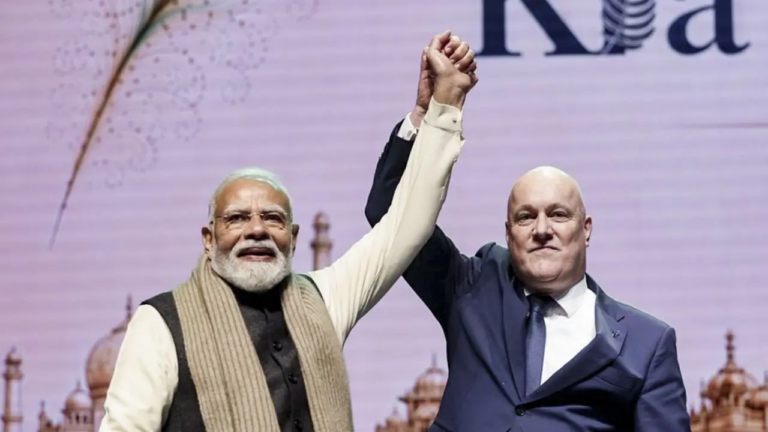
During his visit to India in March 2025, Prime Minister Christopher Luxon spoke warmly of the Indian diaspora, describing it as a “living bridge” between the two nations — a phrase originally used by Prime Minister Narendra Modi . Luxon noted that Kiwi-Indians are, on average, younger, better educated, and earn more than the general New Zealand population . India is now the largest source of skilled migrants to New Zealand and the second-largest source of international students .
“In short, Indian-Kiwis are making a massive contribution to New Zealand,” Luxon said at an India New Zealand Business Council event in Auckland .
That contribution extends across every sector of national life. In June 2025, Indian-origin technologists Sunit Prakash and Lalita Kasanji were named Members of the New Zealand Order of Merit for their contributions to the digital technology sector and for strengthening ties between India and New Zealand . Their research revealed that Indian IT professionals contribute approximately NZD $350 million to the New Zealand economy each year .
Their work, including founding the New Zealand Centre for Digital Connections with India, has brought attention to what Lalita Kasanji described as an “invisible” community. “Till I met Sunit, like the rest of New Zealand, Digital India and new Indians had been invisible to New Zealand,” she said .
Cultural Preservation and Community Leadership
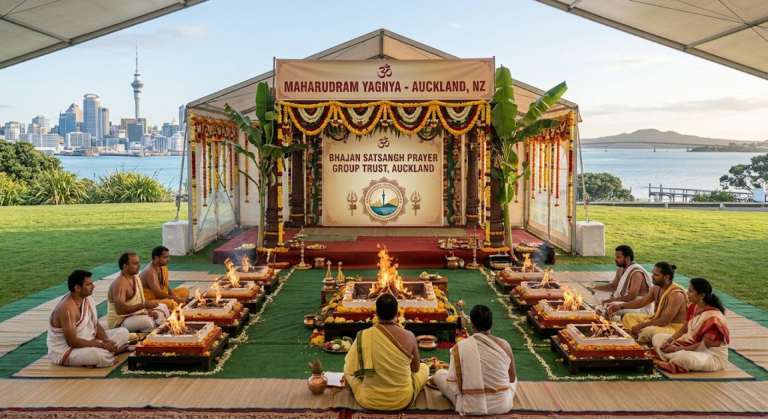
NZICA itself has been at the forefront of celebrating and preserving Indian culture in New Zealand. The organisation has won the Kiwi Indian Community Organisation of the Year Award, recognising its role in organising major cultural events including Diwali in Parliament and Holi festivals that showcase India’s rich heritage to all New Zealanders . Venues like the Mahatma Gandhi Centre in Auckland serve as hubs for cultural and community engagement, while educational initiatives such as the Gandhi Gruh Gujarati School ensure future generations stay connected to their heritage .
As NZICA approaches its 100th anniversary in 2026, the organisation’s leadership is acutely aware of the importance of protecting this legacy. The current situation involving the cultural delegation represents not just a compliance issue, but a test of the community’s commitment to the values that have sustained it for a century.
“The strength of our community lies in our commitment to doing what is right,” Khar said in today’s statement.
A Call to Action
NZICA’s press release is notable not only for its firmness but for its comprehensive call to action. The association has urged:
- Event organisers and sponsors to cooperate transparently with authorities
- Community leaders and members to encourage compliance and lawful conduct
- Agents and facilitators to act ethically and responsibly
This multi-pronged approach recognises that maintaining the integrity of the immigration system is a shared responsibility. It also acknowledges the reality that unethical behaviour by a small number of individuals can have consequences for an entire community.
For those currently unlawfully in New Zealand, immigration experts emphasise the importance of seeking confidential, professional advice. People who overstay their visas often live with constant fear of detection, avoid essential services such as healthcare, and may end up in cash-in-hand jobs that leave them open to exploitation . Taking action early can help identify legal pathways to remain in New Zealand, prevent deportation, and reduce the risk of long-term re-entry bans .
Immigration New Zealand continues to prioritise enforcement against those posing the highest risks, but anyone unlawfully in the country can be made liable for deportation. The message from both authorities and community leaders is consistent: engagement is better than avoidance, and voluntary compliance is better than enforced removal.
The Stakes for New Zealand
The broader stakes extend beyond the individuals directly involved. New Zealand’s immigration system depends on trust. Each year, millions of people enter the country lawfully, contributing to the economy, enriching communities, and building lives. That system functions because the overwhelming majority of people respect the rules.
When breaches occur, they undermine confidence in the system as a whole. They provide ammunition to those who would argue for tighter restrictions and more stringent enforcement. They risk damaging the reputation of entire communities who have done nothing wrong.
As NZICA noted in its statement, the organisation remains committed to working constructively with government agencies to ensure that cultural exchanges continue in good faith, that visa processes are respected and protected, and that “the reputation of the Indian community in New Zealand remains strong and respected.”
A Defining Moment
The situation unfolding now is, in many ways, a defining moment. How it is resolved will send messages far beyond the individuals involved. It will speak to the strength of community leadership, the effectiveness of regulatory systems, and the shared commitment to the rule of law that underpins New Zealand’s social cohesion.
For nearly a century, NZICA has stood as a voice for Indian New Zealanders — advocating for their rights, celebrating their culture, and calling them to account when necessary. Today’s statement continues that tradition. It acknowledges that genuine cultural exchange depends on mutual respect and compliance with the law. It recognises that the actions of a few can affect the reputation of many. And it makes clear that the Indian community in New Zealand stands ready to do its part in upholding the integrity of the immigration system.
“This is a moment for responsibility, cooperation, and integrity,” Khar said.
The question now is whether those who find themselves in breach of their visa conditions will heed the call.
If you or someone you know is unlawfully in New Zealand, immigration experts advise seeking confidential professional advice to explore available options. Immigration New Zealand can also be contacted directly for assistance with regularising immigration status.