Lara Zijl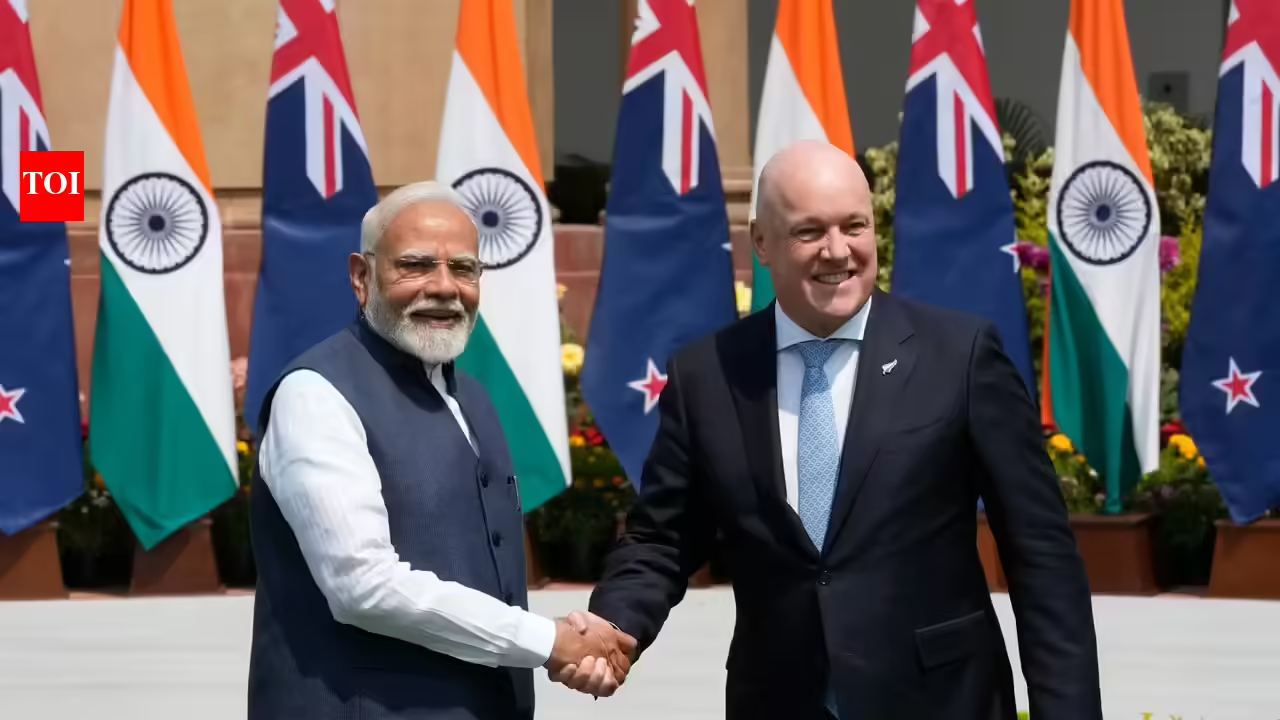
A Deal Sixteen Years
in the Making:
Bharat–New Zealand FTA Signed
From a joint feasibility study in 2007 to a landmark signing in New Delhi, the story of how two Pacific nations forged a once-in-a-generation economic compact — and the community voices that championed it every step of the way.
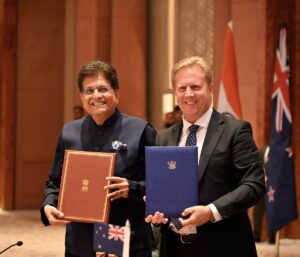
On the afternoon of Monday, 27 April 2026, in the presence of a large gathering of business leaders, diplomats, and community representatives, New Zealand Trade and Investment Minister Todd McClay and India’s Commerce and Industry Minister Piyush Goyal set pen to paper in New Delhi, completing a journey that had spanned the tenures of four New Zealand Prime Ministers, multiple rounds of stalled negotiations, and the patient advocacy of hundreds of thousands of Kiwis of Indian origin. The Bharat–New Zealand Free Trade Agreement is, by any measure, a defining moment in the bilateral relationship between Aotearoa and the world’s most populous nation.
The agreement eliminates or reduces tariffs on 95 per cent of New Zealand’s exports to India, with 57 per cent of those goods receiving duty-free access from the very first day the deal enters into force. It commits New Zealand to invest NZ$20 billion in India over fifteen years, opens pathways for up to 5,000 skilled Indian professionals to work in New Zealand, and introduces world-first provisions on manuka honey and kiwifruit access. For a bilateral trading relationship currently valued at NZ$3.68 billion annually, the potential is transformational.
Context: Why This Agreement Matters Now
The FTA arrives at a moment of acute global trade disruption. New Delhi has been seeking to diversify export markets in the wake of steep tariffs imposed by the United States, while Wellington is actively reducing its trading dependence on China. Both nations, as Minister McClay observed, chose each other deliberately — and in doing so, positioned themselves for deeper integration as India’s economy accelerates towards becoming the world’s third-largest by 2030.
A Long Road: The Full History of Negotiations
The story of the Bharat–New Zealand FTA is, in equal measure, a story of ambition, bureaucratic patience, geopolitical timing, and — ultimately — political will. Its roots stretch back nearly two decades, through joint studies, formal rounds, an extended hiatus, a prime ministerial handshake, and a remarkable nine-month sprint to the finish line.
New Zealand Prime Minister Helen Clark visits India and meets with senior Indian officials, laying the groundwork for closer economic engagement. The Indian diaspora in New Zealand, growing steadily through skilled migration, begins to emerge as a meaningful bridge between the two nations.
New Zealand and India jointly commission a formal feasibility study to assess the viability of a Free Trade Agreement or Comprehensive Economic Cooperation Agreement (CECA). The study, concluded in 2008, recommends that both governments proceed to formal negotiations. New Zealand’s Cabinet approves the recommendation in March 2009. Public submissions are invited, with widespread interest from sectors including dairy, horticulture, and professional services.
The New Zealand Cabinet formally approves commencing FTA negotiations with India. A further round of public submissions is invited. Stakeholders from agriculture, manufacturing, and services sectors are consulted, and the Ministry of Foreign Affairs and Trade begins assembling its negotiating team.
India’s government formally approves the commencement of FTA negotiations in early 2010, and the first negotiating round takes place. Both sides acknowledge the considerable ambition required — India’s complex tariff structure, agricultural sensitivities, and services market present significant challenges, while New Zealand pushes hard for dairy access and investment protections.
Nine formal rounds of bilateral FTA negotiations take place over four years, covering goods, services, investment, intellectual property, customs procedures, and rules of origin. Progress is made on many technical chapters, but deeply sensitive areas — particularly India’s dairy sector and New Zealand’s concerns about investment access — prove difficult to bridge. Both teams acknowledge that political-level direction is needed to unlock the final phase.
The ninth and final formal round takes place in New Delhi. With no agreement reachable on key issues, formal negotiations are suspended. Informal meetings between lead negotiators continue sporadically throughout 2015 and 2016, but no breakthrough materialises. The hiatus will last nearly a decade.
During Prime Minister John Key’s official visit to India, he and Prime Minister Narendra Modi issue a joint statement committing to work towards “a high-quality, comprehensive and balanced bilateral Free Trade Agreement delivering meaningful commercial outcomes to both sides.” The pledge keeps the aspiration alive but progress remains dependent on India’s readiness to make substantive offers.
With bilateral FTA talks dormant, both countries engage through multilateral settings including the Regional Comprehensive Economic Partnership (RCEP) negotiations. India ultimately withdraws from RCEP in 2019. The COVID-19 pandemic further disrupts trade diplomacy. Meanwhile, the Indian diaspora in New Zealand grows significantly, exceeding 300,000 people — becoming a politically significant demographic and an increasingly vocal advocate for closer trade ties. New Zealand’s reliance on China as its dominant trading partner becomes a growing strategic concern.
During the televised New Zealand election debate, National Party leader Christopher Luxon publicly commits to securing a free trade agreement with India. The pledge resonates with the Indian community and business sector. Following National’s election victory, Trade Minister Todd McClay is tasked with turning the commitment into reality.
Formal FTA negotiations between New Zealand and India restart in earnest on 21 March 2025. Minister McClay and his Indian counterpart Minister Piyush Goyal personally drive the talks with high-level political engagement. McClay visits India seven times over the course of negotiations — an indication of the extraordinary effort invested. Both governments operate under a shared understanding that the geopolitical moment demands urgency.
In the lead-up to the formal signing, community consultations take place across New Zealand. On 28 March 2026, the Consulate General of India Auckland holds a landmark interactive session in Waikato, Hamilton — bringing together community leaders, entrepreneurs, and professionals to discuss trade, investment, and bilateral opportunities. The session is led by Consul General Dr Madan Mohan Sethi, with engagement extending across Wellington, Auckland, and Christchurch in the weeks that follow.
Negotiations conclude on 22 December 2025 — just nine months after their formal reopening, and described by commentators as one of the fastest FTAs ever finalised by India. The speed reflects exceptional political will on both sides, with Prime Ministers Luxon and Modi providing direct direction to their respective negotiating teams. Both governments work through the holiday period to finalise the legal text.
The FTA is formally signed in New Delhi in front of a delegation of New Zealand MPs and more than 30 business representatives — the first time India has signed a trade agreement before such a large business gathering. The ceremony marks the culmination of sixteen years of attempted negotiations and is described by Prime Minister Luxon as a “once-in-a-generation” deal. The Indian community across Aotearoa watches with pride and emotion.
“This once-in-a-generation Agreement creates opportunities New Zealand exporters have never had in India. This deal is in New Zealand’s best interest and will deliver thousands of jobs and billions in additional exports.”— Todd McClay, New Zealand Minister for Trade and Investment
“India today works with the rest of the world from a position of strength, full of confidence to engage, expand the relationship. India and New Zealand have chosen each other at a time when the world economy is being recast.”— Piyush Goyal, India’s Minister for Commerce and Industry
What the Agreement Delivers
The NZ–India FTA is a comprehensive agreement covering goods, services, investment, labour mobility, intellectual property, customs procedures, and sustainable development. Its scope reflects the ambition both governments brought to the table when formal talks reopened in March 2025.
Tariff elimination or reduction across 95% of New Zealand’s export lines; 57% duty-free from day one, rising to 82% when fully implemented, with sharp cuts on the remaining 13%.
Duty-free kiwifruit quota nearly four times current exports; apple tariffs halved within a quota nearly double recent average exports; manuka honey tariffs cut by 75% over five years — the first preferential honey access in any Indian FTA.
Bulk infant formula and dairy preparations: 33% tariff phased out over seven years. Fast-track mechanism for NZ dairy ingredients to enter India duty-free for export manufacturing — a first in any Indian FTA. Automatic consultation rights if India offers better dairy access to comparable nations.
Wine tariffs slashed from a prohibitive 150% by 66–83% over ten years, with any better deal India strikes with future FTA partners automatically extended to New Zealand.
Up to 5,000 temporary three-year work visas annually for skilled Indian professionals in IT, healthcare, education, engineering, and skilled trades; no cap on Indian students in New Zealand; extended post-study work rights in STEM fields.
New Zealand commits to NZ$20 billion in private-sector investment in India over fifteen years, with both governments committing to reduce investment barriers and establish transparent regulatory frameworks.
Indian exporters stand to benefit substantially as well. With New Zealand removing tariffs on 100% of Indian goods from day one, sectors including textiles and apparel, engineering goods, leather and footwear, marine products, pharmaceuticals, and processed foods will gain significantly improved market access into what is an affluent, high-income Pacific economy.
Immediate Tariff Eliminations — New Zealand’s Day-One Concessions
Immediate tariff elimination on sheep meat, wool, coal, and over 95% of forestry and wood exports; duty-free access for most seafood including mussels and salmon over seven years; duty-free access for most industrial products over five to ten years. For Indian exporters, 100% of goods entering New Zealand will be tariff-free from the date the agreement enters into force.
The agreement also contains modern provisions on geographical indications — protecting iconic New Zealand product names such as manuka, marlborough, and others in Indian markets — as well as comprehensive chapters on e-commerce, customs facilitation (with India committing to 48-hour clearance for all goods), financial services, environmental services, and FinTech. A dedicated Māori economic development chapter, included as in all New Zealand FTAs since 2001, preserves the Treaty of Waitangi protections and facilitates cultural and traditional knowledge exchange between indigenous communities of both nations.
Strategic Context: Why April 2026
The timing of the NZ–India FTA signing is not incidental. It arrives in the midst of a profound restructuring of global trade patterns that few could have anticipated even a year ago. The imposition of sweeping tariffs by the United States has disrupted supply chains that underpinned the global trading order established in the post-war era, and both India and New Zealand find themselves in the unusual position of actively seeking new partnerships in a world where the old certainties no longer hold.
For New Zealand, the imperative is diversification. China currently accounts for an outsized share of New Zealand’s exports — a dependency that successive governments have recognised as a strategic vulnerability. India, by contrast, offers a high-growth market with a rapidly expanding middle class projected to reach 715 million by 2030 and over one billion by 2047. The Indian economy is forecast to reach NZ$12 trillion by the same year, making it one of the world’s largest consumer markets.
For India, the FTA with New Zealand extends its network of trade partnerships in the Pacific and Oceania, and provides a platform for greater economic engagement with a country that shares values around democracy, rule of law, and multilateralism. Minister Goyal’s reference to the two nations having “chosen each other” is deliberate: in a world of fragmenting alliances, the depth of partnership matters as much as its economic content.
The “Living Bridge” Factor
New Zealand’s Indian diaspora — now exceeding 300,000 people, or approximately six per cent of the population — has been repeatedly described in government briefings as a vital “living bridge” between the two nations. Their professional and entrepreneurial networks, their cultural institutions, and their deep ties with family and business partners in Bharat have provided both an economic rationale and a political constituency for the FTA that no previous generation of New Zealand governments could count on. The diaspora’s presence has transformed the domestic politics of the India relationship in Aotearoa.
NZICA: A Century of Advocacy, Recognised
For the New Zealand Indian Central Association — the oldest and most storied apex body for Indians in Aotearoa, founded in 1926 and celebrating its centenary in 2026 — the signing of the FTA carries a significance that transcends the economic. It represents a century of patient advocacy, quiet diplomacy, and community building finally converging with a moment of national consequence.
NZICA, incorporated as the sole national umbrella body for Indian community groups throughout New Zealand, has since its founding championed the rights and interests of Indians in a country that did not always receive them warmly. From fighting discriminatory immigration policies in the early twentieth century to engaging constructively with governments on multicultural policy, trade advocacy, and community wellbeing in recent decades, the Association has grown into a mature civic organisation with a track record of earned trust on both sides of the Tasman and the Indian Ocean.
At the April 2026 signing ceremony in New Delhi, Trade Minister Todd McClay took a moment to acknowledge NZICA’s centenary year — a recognition that moved the Association’s current President, Veer Khar, deeply.
“Tears in my eyes as Todd recognises our 100 years at the signing ceremony. It is very special. Hats off to NZICA family and wider partnering organisations. Together we make the two nations proud.”
Veer Khar — President, New Zealand Indian Central Association (NZICA)
Following the FTA signing ceremony, New Delhi, 27 April 2026
Khar, who assumed the NZICA presidency at the Association’s Annual General Meeting in Wellington in April 2025, has led the organisation through an extraordinary convergence of milestones: the centenary year, the FTA signing, and a broader national conversation about the role of the Indian community in shaping New Zealand’s future. His tenure as former General Secretary (2007–2010) and his long service as President of the Indian Association Manukau have prepared him well for this historic season.
That Minister McClay would choose to recognise NZICA’s hundred years at so prominent an occasion as the FTA signing ceremony is itself a measure of how far the community’s standing has advanced. The Association’s centenary, formally launched at the Curtain Raiser event on 28 February 2026 at the Cordis Auckland, has been accompanied by a Memorandum of Understanding between New Zealand and India on sporting ties — acknowledged by Prime Ministers Luxon and Modi during their bilateral engagements — with the convergence of sporting and civic centenaries reinforcing just how deeply Indian roots now run in the fabric of Aotearoa.
Groundwork in Grassroots: Dr Sethi’s Community Consultations
Transformative trade agreements do not spring from diplomatic tables alone. The months preceding the New Delhi signing saw an intensive and deliberate effort by the Consulate General of India in Auckland to engage the Indian diaspora across New Zealand — listening, informing, and connecting community voices with the bilateral process.
Central to these efforts was Dr Madan Mohan Sethi, Consul General of India for Auckland, who embarked on a series of interactive community consultations with leaders, entrepreneurs, and professionals across the country. These sessions were not ceremonial gatherings — they were substantive working meetings convened to discuss ideas, best practices, and concrete pathways for investment, trade, and professional cooperation between New Zealand and India.
On Saturday, 28 March 2026, Dr Sethi convened a landmark interactive session at the Good News Community Centre in Nawton, Hamilton — the heart of Waikato’s Indian and broader South Asian community. The session, held from 3.00 pm to 5.00 pm, brought together community leaders, business professionals, and diaspora representatives for structured dialogue on three themes: innovative ideas in participants’ fields of expertise; area-specific best practices operating in New Zealand and India; and opportunities to connect with Indian stakeholders for projects, investment, trade, and professional planning.
The invitation, issued through Vice Consul (Diaspora Engagement) Divya, described the event as an “immersive mode interactive session” — a format that placed genuine community expertise at the centre rather than positioning the Consulate as a broadcaster of information. The Waikato consultation was one of several such engagements Dr Sethi conducted nationwide in the lead-up to the FTA signing, with similar sessions held in Auckland, Wellington, and Christchurch.
These consultations served a dual purpose: enriching the Indian government’s understanding of the practical needs of its diaspora in Aotearoa, and signalling to the community that their expertise, networks, and business experience were valued in shaping the bilateral agenda. They were, in a meaningful sense, the human infrastructure upon which the FTA’s community benefits will be built.
Hindu Council, Women’s Forum, & HOTA:
Turning Policy Into Community Action
Whilst diplomats negotiated and ministers deliberated, some of Aotearoa’s most energetic community mobilisation around the FTA has been led by the Hindu community organisations — organisations that have long understood that trade is not an abstraction but a lived reality, most acutely felt by entrepreneurs, small business owners, and professionals navigating two countries and their respective regulatory worlds.
The NZ Hindu Women Forum (HWF), a service division of the Hindu Council of New Zealand, has moved swiftly and purposefully to translate the FTA’s promise into practical opportunity for Hindu women entrepreneurs and businesswomen across Aotearoa. HCNZ President Dr Guna Magesan has announced an ambitious series of free public seminars on the proposed Bharat–New Zealand FTA, to be held across Wellington, Auckland, and Christchurch in the coming weeks and months.
These seminars are organised in direct association with the Indian High Commission and are proudly supported by the HOTA (Hindu Organisations, Temples and Associations) Forum New Zealand — a powerful network that, in Bharat, works with the heads of some of the world’s most prominent Hindu organisations including Art of Living Foundation, Chinmaya Mission, Mata Amritanandamayi Math, ISKCON, BAPS Swaminarayan Sanstha, Ramakrishna Mission, and All World Gayatri Pariwar.
The seminars will serve as a formal prelude to the 2nd New Zealand Hindu Women Conference, themed “Women Entrepreneurs — Leading Progress, Powering Prosperity,” scheduled for Sunday, 30 August 2026, in Auckland — a conference that positions the FTA’s opportunities explicitly within the context of women’s economic leadership. Those wishing to register interest in attending the seminars may do so at tinyurl.com/HWFSeminarFTA.
Venue and date to be confirmed in partnership with the Indian High Commission.
Coordinators:Amita Fotedar
Varsha Jagdish Bhai
Shyama Kumar
Venue and date to be confirmed in partnership with the Indian High Commission.
Coordinators:Shivani Arora
Neelu Taore
Madhavi Vora
Venue and date to be confirmed in partnership with the Indian High Commission.
Coordinators:Archana Tandon
Prachee Gokhale
Geetha Kopparapu
The HWF’s initiative reflects a broader understanding within the Hindu community that free trade agreements, whilst negotiated at the governmental level, deliver their greatest value when communities are equipped to engage with them directly. For women entrepreneurs in particular, the FTA opens pathways in textiles, food processing, technology services, education, and creative industries that have not previously existed at preferential terms.
HCNZ President Dr Guna Magesan has also announced her intention to organise a special meeting for women entrepreneurs and business leaders with Swami Vigyananand ji — former IIT Kharagpur alumnus, Founder of the World Hindu Economic Forum, and founder of the HOTA Forum. Swami Vigyananand’s work in building global Hindu economic networks makes him a uniquely placed figure to connect New Zealand’s Hindu entrepreneurial community with Bharat’s broad base of faith-affiliated institutions and their affiliated economic development programmes.
About the HOTA Forum
The HOTA (Hindu Organisations, Temples and Associations) Forum New Zealand is the local expression of a global network that in Bharat works in collaboration with the heads of India’s most prominent Hindu organisations. The Forum’s New Zealand chapter provides a platform for temples, cultural associations, and faith organisations across Aotearoa to coordinate on matters of social, economic, and cultural significance — making it a natural partner for community-level FTA awareness work.
The Road Ahead: Ratification and Implementation
Signing is a milestone, not a conclusion. Before the NZ–India FTA enters into force, it must be ratified by the New Zealand Parliament. The National–ACT government has the numbers to pass the legislation, and Labour has offered its qualified support, though New Zealand First remains opposed. The ratification process will place the FTA before parliamentary scrutiny and public examination over the coming months.
There are genuine debates to be had. The Council of Trade Unions has raised concerns about labour conditions and the adequacy of consultation. Environmental organisations have sought greater clarity on sustainability provisions. And dairy farmers — long the most vocal constituency in New Zealand trade politics — will watch closely to see how the fast-track mechanism and the future-proofing clause operate in practice.
But for the hundreds of thousands of New Zealanders with roots in Bharat — the engineers and nurses, the small business owners and IT professionals, the temple trustees and women entrepreneurs — the agreement represents something more immediate and personal than a parliamentary vote. It represents the formalisation of a relationship that has been built, generation by generation, through their own labour, sacrifice, and community investment.
“The Indian community has always been a living bridge between our two nations. Today that bridge has been strengthened with the steel of commerce, the warmth of shared values, and the promise of a shared future.”— Zealandia News Editorial
As the ink dries on the NZ–India FTA — and as the seminar rooms fill with Hindu women entrepreneurs discussing what it means for their businesses, and as NZICA’s centenary celebrations continue under the presidency of Veer Khar, and as the echoes of Dr Sethi’s community consultations in Hamilton and beyond shape the next phase of engagement — it is worth pausing to appreciate the full arc of what has been achieved.
Sixteen years of negotiation. Decades of community advocacy. Hundreds of thousands of individual migrants who built a living relationship between Aotearoa and Bharat long before any government formalised it. The FTA is their achievement as much as it is any minister’s.
Key Reference: How to Engage With the FTA
Full text and chapter summaries: www.mfat.govt.nz/nz-india-fta
NZ Hindu Women Forum FTA Seminar Registration: tinyurl.com/HWFSeminarFTA
Consulate General of India, Auckland: www.cgiauckland.gov.in
NZICA: www.nzica.org.nz | HCNZ: hcnz.org
HOTA Forum NZ: hotaforumnz.orgThis article was prepared by Zealandia News with reference to official government statements, MFAT documentation, community communications, and press reports. NZ English spellings throughout.