 Dorothy Brown
 Introduction
In most nations, geography is defined by topography—mountains, rivers, plains, and borders. In Bharat, geography has always been something more: sacred. From its icy northern peaks to its southern ocean shores, Bharat is not just a landmass—it is a living landscape of divine energy, storied myth, and spiritual resonance.
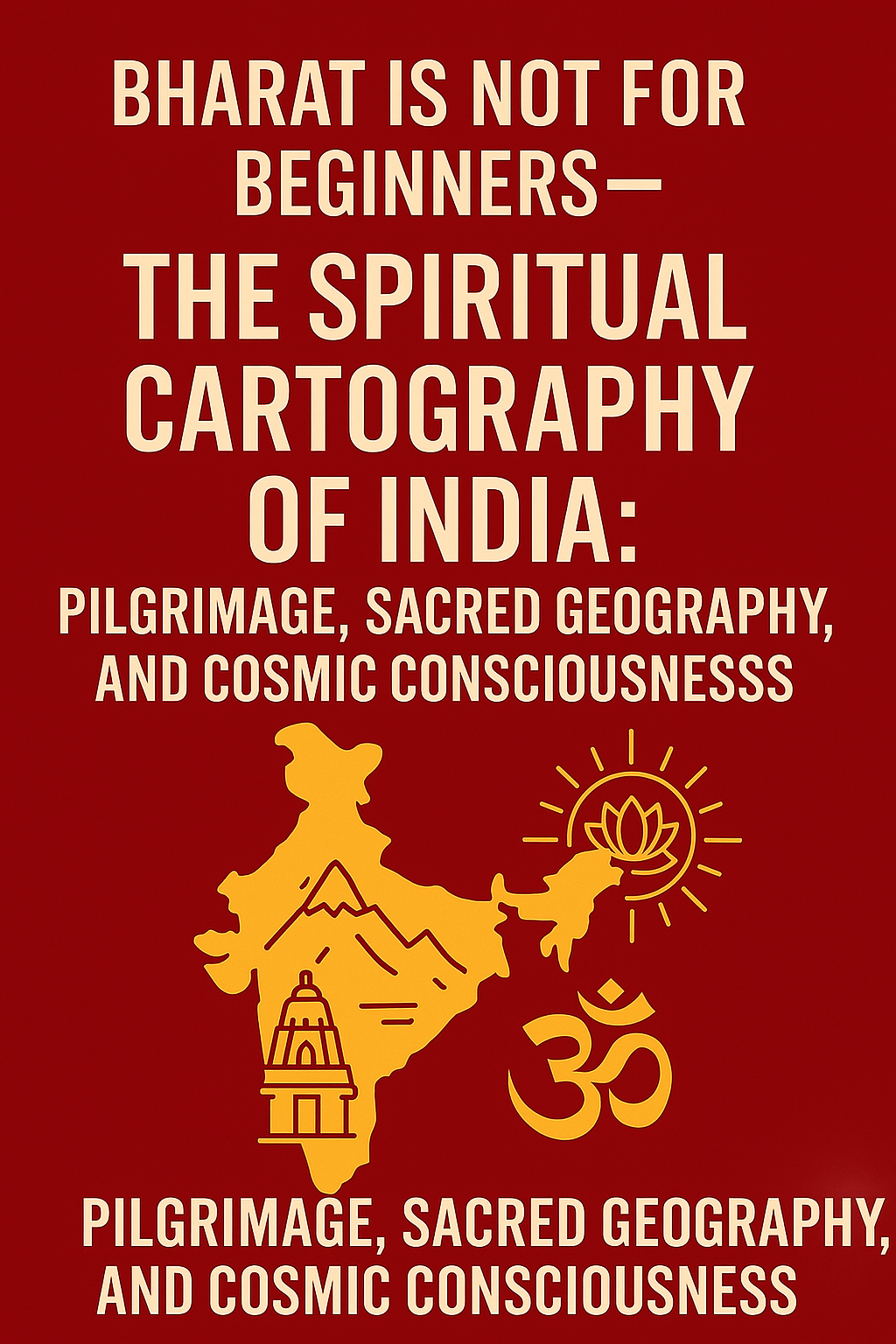
This 70th article in the Bharat Is Not for Beginners series explores the idea of Bharatvarsha as a sacred terrain—where every hill, river, forest, and temple is not only a site of devotion but also a node in a civilisational network of cosmic consciousness. Pilgrimage in India is not a journey of distance alone; it is a journey of inner transformation, where the physical movement across land mirrors the metaphysical unfolding of the self.
Let us chart this ancient map—not drawn with borders and highways, but with shrines, holy rivers, energy centres, and sacred circuits. This is the story of Bharat as the tirtha—a crossing point between the human and the divine.
I. The Concept of Sacred Geography
In the Indian tradition, space is not neutral. It is alive, charged with memory, myth, and meaning.
Tirtha: Crossing Over
The Sanskrit word tirtha means “a ford” or “crossing point.” In the spiritual sense, it refers to a place where one can cross over from the mundane to the sacred, from ignorance to enlightenment. A tirtha could be a river confluence, a mountaintop, a cave, or even a person—a realised being.
The Mahabharata notes that visiting a tirtha is not merely about travel, but about inner purification. “The earth is full of holy spots, O Bharata, and abounds with places that confer merit.” Pilgrimage, therefore, is both physical movement and psychic activation.
Bharatvarsha as Mandala
In cosmological terms, Bharat is seen as a mandala—a sacred geometric pattern where:
- Mount Meru is the axis mundi.
- The land is divided into regions corresponding to deities.
- The movement through space reflects the journey through chakras and koshas (subtle layers of consciousness).
II. Sacred Rivers: Flowing Lifelines of Devotion
Water is not just a resource in India; it is liquid divinity. The rivers of Bharat are mothers, goddesses, and healers.
Ganga: The Celestial Descent
Ganga is believed to descend from the heavens, split into three streams by Shiva’s hair. She is both Moksha Dayini (the giver of liberation) and a river that nurtures millions.
Cities like Haridwar, Varanasi, and Prayagraj are not merely urban centres—they are living tirthas along her course. Bathing in the Ganga is seen as washing away karmic burden.
Yamuna, Godavari, Narmada, and Kaveri
- Yamuna: Krishna’s childhood leela took place on her banks; she symbolises devotion and sweetness.
- Godavari: The ‘Ganga of the South’, associated with the Ramayana and revered in Nashik and Trimbakeshwar.
- Narmada: Worshipped not just for her waters but for her very stones, known as Shiva lingams.
- Kaveri: Central to Tamil and Kannada spiritual life, with temples, rituals, and songs invoking her grace.
Pilgrims often undertake parikramas—ritual circumambulations—of these rivers, moving clockwise along their banks to absorb their spiritual energies.
III. Pilgrimage Circuits: Mapping the Inner and Outer Realms
Indian pilgrimages are often organised into circuits—not unlike spiritual circuits on a divine motherboard.
Char Dham
Propounded by Adi Shankaracharya, the Char Dham (four abodes) are:
- Badrinath (North): Abode of Vishnu in the Himalayas.
- Dwarka (West): Krishna’s coastal kingdom.
- Rameswaram (South): Where Rama worshipped Shiva.
- Puri (East): Home to Jagannatha, the lord of the universe.
The Char Dham represents a full cosmic journey across Bharat’s sacred compass.
Jyotirlingas
There are 12 Jyotirlingas—shrines where Shiva is said to have manifested as a column of light. These range from:
- Somnath in Gujarat (symbol of resilience),
- to Kedarnath in Uttarakhand (in the Himalayas),
- and Rameswaram in Tamil Nadu (where Rama worshipped Shiva).
Together, they symbolise the geographical embodiment of Shiva consciousness.
Shakti Peethas
According to legend, the body parts of Sati fell across the subcontinent, forming 51 Shakti Peethas. Each is a portal to the Divine Feminine—from Kamakhya in Assam to Kanyakumari in the south.
Visiting these sites is not just worship—it is an act of remembering that the divine is present in the body, in the earth, in the feminine.
IV. Pilgrimage Towns: Living Mandalas
India’s spiritual map is dotted with cities whose very layout reflects sacred principles.
Varanasi (Kashi)
Perhaps the world’s oldest living city, Kashi is said to rest atop Shiva’s trident. Its 108 shrines, 84 ghats, and unique pancha-krosha yatra (circumambulation path) represent the microcosm of the universe.
To die in Kashi is believed to offer instant liberation.
Prayagraj
Here, the Ganga, Yamuna, and mythical Saraswati converge. The Kumbh Mela, held here every 12 years, is the world’s largest spiritual gathering—a cosmic reset.
Tirupati, Sabarimala, Amritsar, Madurai, Ujjain, Puri, Pandharpur
Each city holds specific spiritual significance tied to regional traditions—Vaishnavism, Shaivism, Sikhism, Bhakti movements—and is often aligned with cosmic calendars, star positions, and ritual cycles.
V. The Inner Pilgrimage: Spiritual Topography of the Body
Indian philosophy often maps geographical pilgrimage onto the human body.
The Body as Temple
Yoga and Tantra describe the human body as a microcosm of the cosmos:
- The chakras are spiritual centres aligned along the spine—just as sacred cities are aligned along riverbanks.
- The journey from Muladhara (base) to Sahasrara (crown) mirrors the pilgrimage from mundane to divine.
- Sacred geometry (Sri Yantra, mandalas) is used in both temple design and visualisation practices.
This correspondence makes pilgrimage both an outer journey and an inner awakening.
VI. Science of Sacred Space: Vastu and Astronomy
Ancient Indian temple architecture is not random—it is based on vastu shastra, nakshatras, and geomagnetic principles.
Temples as Energy Centres
- Temples are often built at high electromagnetic points, where ley lines or underground water currents intersect.
- The garbha griha (sanctum) is constructed to amplify pranic vibrations through use of specific materials, geometries, and orientation.
- Idol installations follow astrological calculations, aligning deities with cosmic events.
Thus, the pilgrim walking into a temple is not merely visiting a building—they are stepping into an engineered spiritual field.
VII. The Modern Yatra: Continuity and Challenge
Even today, millions of Indians undertake yatras every year—not out of superstition, but out of ancestral memory and soulful longing.
Kailash Mansarovar, Amarnath, Vaishno Devi, Chardham Yatra
Despite the difficulty of terrain and age, devotees continue to journey—often barefoot, fasting, singing, and serving one another along the way.
Yet, modern challenges arise:
- Over-tourism, environmental degradation, and loss of sanctity.
- Commercialisation of pilgrimage infrastructure.
- Political interference and erasure of traditional custodianship.
Reviving sacred geography in the 21st century will require preservation, education, and a return to eco-spiritual sensibility.
VIII. Sacred Bharat: A Vision Beyond Nationhood
Bharat’s spiritual cartography reminds us that:
- The land itself is alive (Bhoomi Devi).
- Civilisational unity exists beyond politics, language, or economy—it lies in shared pilgrimage and sacred memory.
- The yatra is not a retreat from life but a return to what truly matters.
Even today, whether through the Ramayana Circuit, the Buddhist Trail, or tribal sacred groves in the Northeast, India’s sacred geography holds the key to its civilisational resilience.
Conclusion: Walking the Land, Awakening the Soul
To walk Bharat is to walk through myth, meditation, and meaning. Every step is a mantra, every river a hymn, every mountain a teacher.
In a world that often defines progress by how fast we move, Bharat’s pilgrimages invite us to slow down, walk, chant, bow, and remember. Not just where we came from—but who we really are.
Sacred geography is not a relic of the past. It is a call to reorient ourselves to the sacredness of space, time, and life itself.
What’s Next?
In Article 71: Bharat Is Not for Beginners – The Architecture of the Infinite: Temples, Mandalas, and the Science of Sacred Design, we’ll examine how Indian temples are not just places of worship, but precise instruments of energy, geometry, and consciousness. We’ll explore how their layouts encode cosmological truths and serve as portals between worlds.