



 Dorothy Brown
 This is the 77th article in the Bharat Is Not for Beginners series. After exploring the temple as a cosmological and astronomical machine in Article 76, we now turn our gaze downward—not towards the heavens, but into the very earth that sustains us. What we uncover is another marvel of ancient Bharat: a water civilisation unparalleled in ingenuity, aesthetics, and sacred integration.
Before the rise of industrial pumps, pipes, and tanks, Bharat had mastered the art of hydraulic architecture—from elaborate stepwells in the parched landscapes of Gujarat and Rajasthan to sacred temple tanks in the lush regions of Tamil Nadu, from rainwater harvesting systems in the Western Ghats to riverine rituals in the Gangetic plains.
This was not merely a question of quenching thirst. In Bharat, water was sacred, scientifically managed, and aestheticised. The civilisational ethos surrounding water combined utility, spirituality, and ecological foresight. This article explores how the civilisation of Bharat turned water into worship, storage into sacred space, and infrastructure into civilisational art.
I. The Civilisational Philosophy of Water
Water in Bharat is not just an element. It is a deity, a purifier, and a carrier of memory.
- Jala (water) is revered in the Rig Veda as a living entity with healing powers.
- Rivers are personified as goddesses: Ganga, Yamuna, Sarasvati.
- Rituals from birth to death involve water—be it the sprinkling of Ganga water on a newborn or the immersion of ashes after cremation.
This reverence had practical implications. Water was managed not just as a resource but as a sacred trust. The outcome? A vast and regionally adapted network of water systems that were:
- Environmentally appropriate
- Architecturally sophisticated
- Culturally integrated
II. Stepwells: Descent into Coolness and Time
1. What is a Stepwell?
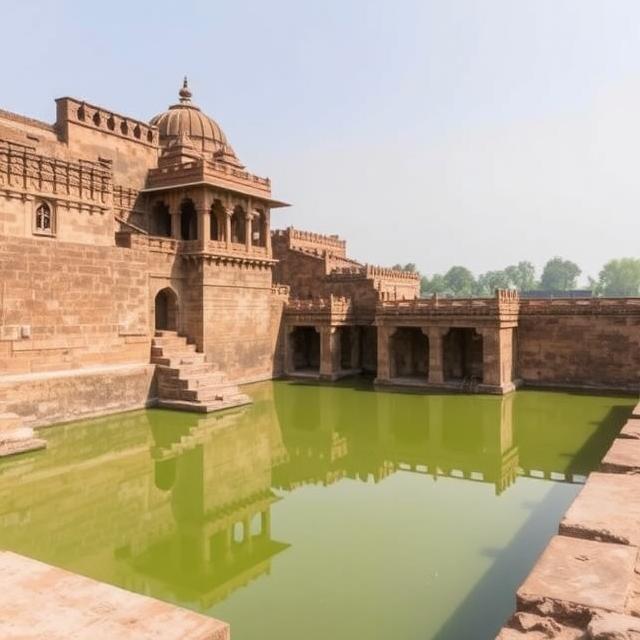
Known variously as vav (Gujarati), baoli or bawdi (Hindi), pushkarani (Kannada), or kalyani (Telugu), stepwells are subterranean structures built to access groundwater. But they were much more than functional reservoirs:
- Architectural wonders with intricate carvings and corridors
- Cool sanctuaries in arid regions, often 5–7°C cooler than above ground
- Social and ritual spaces for women, pilgrims, and travellers
2. Engineering Mastery
Stepwells reflect a deep understanding of:
- Hydrogeology: Sited with precision over aquifers
- Structural engineering: Balancing downward thrust with lateral support
- Seasonality: Designed to store monsoon water and offer access in dry months
3. Notable Examples
- Rani ki Vav (Patan, Gujarat): A UNESCO World Heritage Site, commissioned by Queen Udayamati in the 11th century. It is an underground palace, filled with 1,500 sculptures of gods, goddesses, and apsaras.
- Adalaj ni Vav (Ahmedabad): Built in 1499, combining Indo-Islamic architecture, it reflects an intermingling of cultures and a timeless dedication to water preservation.
- Chand Baori (Abhaneri, Rajasthan): One of the deepest and most visually arresting baoris with 3,500 narrow steps, descending over 13 stories.
Stepwells, in essence, are inverted temples—sacred geometry carved downward.
III. Temple Tanks and Sacred Hydrology
1. Functional Sanctity
Temple tanks, or kalyanis, served multiple purposes:
- Hydrological: Harvested and retained rainwater
- Ritualistic: Provided sanctified water for ablutions and ceremonies
- Cooling mechanisms: Reduced ambient temperature around temple complexes
They were essential for daily rituals, festivals, and even astronomical alignments—some were constructed to reflect celestial events in their waters.
2. Architectural Beauty
Unlike plain water tanks, temple tanks are often:
- Symmetrical and geometrical, reflecting Vastu principles
- Surrounded by mandapas, steps, and shrines
- Built with granite or laterite for durability
Examples:
- Golden Temple Sarovar (Amritsar): A central element of Sikh worship.
- Kapaleeswarar Temple Tank (Chennai): Plays a central role during float festivals.
- Pushkar Lake (Rajasthan): Surrounded by 52 ghats, said to be created by Lord Brahma.
In every case, the waterbody is not a backdrop but a core spiritual feature.
IV. Rainwater Harvesting: Decentralised and Decolonised
1. Indigenous Techniques
Bharat had diverse and region-specific rainwater harvesting systems:
- Johads (Rajasthan): Crescent-shaped earthen check dams.
- Zing systems (Ladakh): Small channels that melt glacial water for irrigation.
- Eri systems (Tamil Nadu): Large tanks that interconnect via canals and check flooding.
- Kunds (Gujarat): Underground tanks used to harvest rain in saline areas.
2. Community-Based Water Management
These were not state-owned or centrally controlled. They were managed by local panchayats, temple trusts, and community guilds. Water was treated as a commons, not a commodity.
Contrast this with post-colonial water governance that centralised control and severed community accountability.
V. Urban Water Planning in Ancient Bharat
1. Harappan Hydraulic Brilliance
- Mohenjo-daro and Dholavira featured covered drains, individual wells, and stormwater systems.
- Dholavira, in particular, had interconnected tanks and stone-lined reservoirs that could store millions of litres.
2. Medieval Cities
- Jaipur, designed by Vidyadhar Bhattacharya, integrated water flow into its Vastu-based layout.
- Tanjore, under the Cholas, had a network of canals bringing Cauvery water to all corners of the kingdom.
This integration of urban design with hydrology is a lesson for today’s city planners.
VI. The Ritual Ecology of Water
Water in Bharat was not merely “used” but ritually honoured.
- Tirthas: Sacred crossings of river and consciousness.
- Snan: Holy baths during festivals like Kumbh Mela signify spiritual cleansing.
- Pujas and Yajnas: Always begin with water offerings (ācamana).
This ritual ecology generated respect, not extraction. You did not pollute a river you saw as your mother.
VII. Colonial Disruption and Post-Colonial Amnesia
British colonialism disrupted this civilisational water logic by:
- Abandoning decentralised systems for centralised supply
- Neglecting indigenous structures as “primitive”
- Taxing traditional water use and dismantling community rights
Post-independence, India’s planners copied Western models—concrete dams, chlorinated water, centralised pipes—without integrating the cultural and ecological wisdom of the past.
The result: water scarcity, urban floods, dried rivers, toxic lakes.
VIII. Revival, Resilience, and Modern Relevance
The good news is that Bharat’s ancient water systems are experiencing a quiet renaissance.
1. Civil Society and Community Efforts
- Rajasthan’s Alwar district saw revival of johads by Rajendra Singh, reversing desertification.
- In Tamil Nadu, temples have begun restoring their ancient tanks.
- Auroville and Hampi have integrated traditional recharge techniques with modern needs.
2. Smart Water Heritage
Today, India can lead a global movement by integrating:
- Traditional wisdom with modern innovation
- Community stewardship with scientific monitoring
- Ritual reverence with ecological resilience
A temple tank may not just be a relic—it can be a model for urban water sustainability.
Conclusion: Water as Wisdom
Ancient Bharat did not view water as just a utility. It was:
- A medium of spiritual transformation
- A core of community bonding
- A canvas for civilisational creativity
To understand Bharat’s water systems is to understand how ecology, spirituality, and technology once walked hand in hand.
It’s not that Bharat lacked “modern” water management. It’s that modernity forgot how to listen.
The stepwell is not just a stair to water. It is a descent into memory. The temple tank is not just a reservoir. It is a mirror of the heavens.
This is why Bharat is not for beginners. Because here, even water is sacred architecture.
What’s Next?
In Article 78: Bharat Is Not for Beginners – Beyond the Binary: Ancient Indian Perspectives on Gender, Fluidity, and the Sacred Feminine, we’ll explore how Indian civilisation has engaged with gender beyond Western binaries, offering space for transcendence, multiplicity, and sacred androgyny through mythology, ritual, temple iconography, and philosophical insight.