

 Vinay Karanam
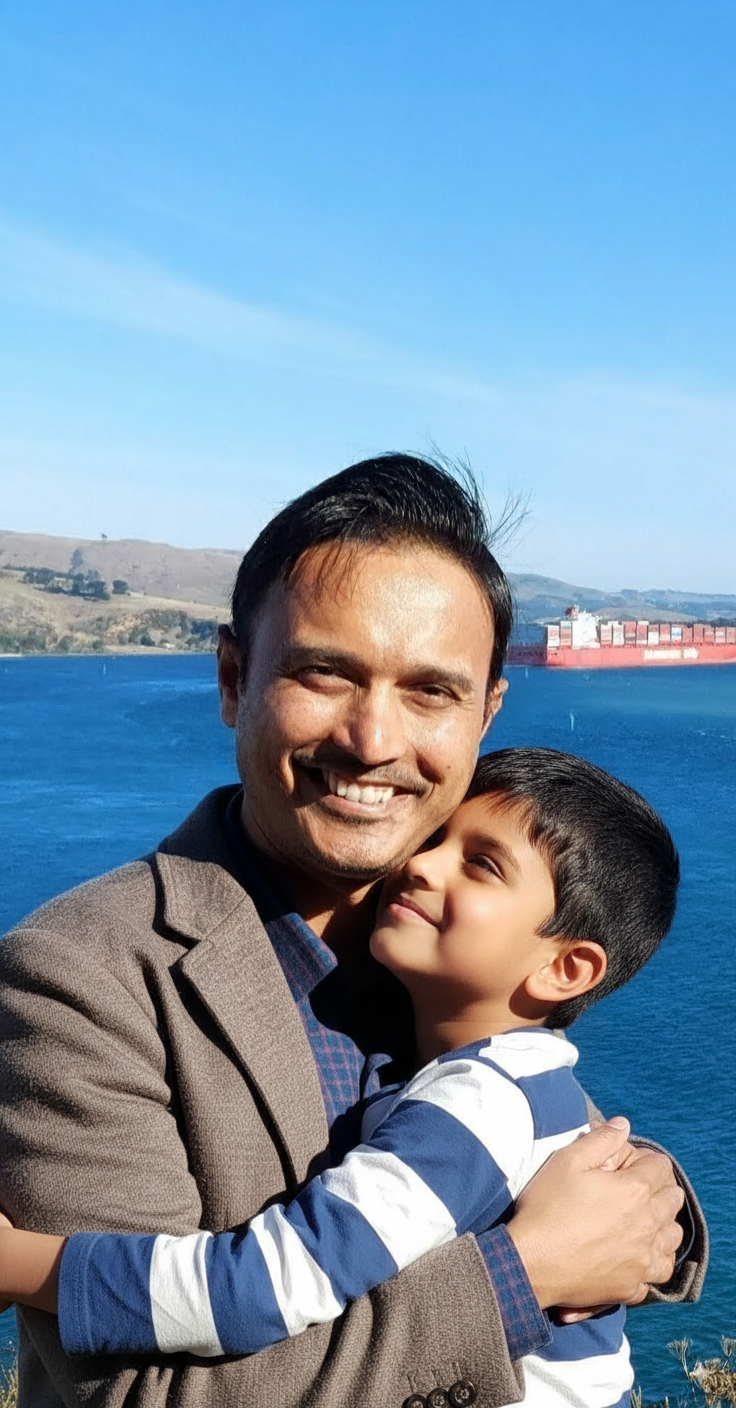
 The synthesis of a “hug my younger self” image—where a current portrait is emotionally and physically combined with a childhood photograph—exemplifies the frontier of AI-driven personal photo creation. Google’s Nano Banana (Gemini 2.5 Flash Image) has set new standards, with its unprecedented fidelity in blending faces across different ages and contexts, maintaining identity, expression, and photorealism. This article explores the deep technical roots behind such composite photos, tracing historical breakthroughs, recent architectural leaps, and the operational pipeline with engineering-level detail.



Historical Timeline: From Early Synthesis to Modern Masterpieces
1. Early Image Synthesis (1970s-2010s)
- Procedural Technologies: Fundamental image operations, such as morphing and blending, used pixel or feature-based interpolations, typically for artistic or cinematic effects.
- Neural Networks’ Rise: The development of perceptrons, followed by feedforward neural networks and the creation of backpropagation in the 1980s, enabled digital tools to “learn” mappings from input images to outputs, albeit at low resolution and with limited realism.
- Autoencoders & VAEs (2013): Variational Autoencoders could compress and reconstruct images, enabling rudimentary generative capability.
2. The Generative Adversarial Network (GAN) Breakthrough (2014)
- GANs: Introduced adversarial learning, pitting a generator against a discriminator to force increasingly realistic outputs. Immediate applications included face generation, editing, and eventually, controllable transformation (e.g., age, style).
- Progressive GANs, StyleGAN (2018): Allowed for high resolution and style/attribute editing, impacting everything from portrait tools to synthetic dataset creation.
3. The Diffusion Model and Multimodal Leap (2020–2025)
- Diffusion Models: Used iterative denoising (from noise to clarity), proving superior in photorealism and controllability compared to GANs.
- Text-to-Image Synthesis (2021+): DALL-E, Imagen, and Stable Diffusion scaled the use of prompts, introducing cross-attention to link text and pixels.
- Conditioned and Multi-Input Synthesis (2022–2024): AI began merging multiple photos, allowing new compositions (such as placing yourself with a historic figure or a different-aged version of yourself).
4. The Gemini 2.5 Flash Image (Nano Banana) Era (2025)
- Faster On-Device Synthesis: The Multimodal Diffusion Transformer (MMDiT) backbone enabled rapid, locally processed, and privacy-aware image generation and editing.
- Photo Identity Consistency: New attention modules allowed for reliable face, posture, and gesture blending between vastly different source images.
- 3D Reasoning & Contextual Awareness: Algorithms learned not just “what” but “how”—how a hug should look in space, how clothing or lighting changes with age, and how to preserve mood or relationship cues.
How Nano Banana Works: Technical Pipeline
Architectural Innovations
Multimodal Diffusion Transformer (MMDiT)
- Separate encoder tracks for image and text/prompt (image, language, metadata).
- Visual autoregressive modeling: Instead of only adding noise (diffusion), starts synthesis using a learned “sketch” then iteratively refines.
- 15 to 38 transformer blocks, up to billions of parameters for enterprise applications, ensuring sharp output at high resolutions.
Hierarchical Visual Encoding
- Semantic grouping of image regions allows the model to “understand” where faces begin/end, or how an arm wraps around a torso.
- Maintains local and global consistency (lighting, color, facial proportions).
Cross-Attention Fusion
- Accepts multiple reference images (current portrait, childhood photo).
- Attention layers blend embeddings at semantic points: aligns facial geometry, preserves skin texture, maintains clothing cues, and ensures real-world physics (e.g., correct direction of the “hug”).
Prompt and Instruction Conditioning
- Can receive not just “hug my younger self,” but nuanced, multi-stage commands (background, pose, artistic style).
Identity-Consistency Loss and Regularization
- Contrastive and identity loss terms ensure output faces remain matched to provided images across pose, age, and context.
Technical Process in the “Hug My Younger Self” Use Case
- Input Preparation
- One present-day and one childhood image are provided.
- Optional textual prompt: e.g., “hug my younger self on a sunny day.”
- Encoding
- Encode each image into a vector space (face, posture, clothing, and context).
- Text is tokenized and encoded via transformer layers.
- Semantic Alignment
- Leveraging facial landmarks and body keypoints, align “hug” positions for natural overlap.
- Backgrounds may be harmonized, or replaced entirely if instructed.
- Fusion
- Multi-head cross-attention fuses image and text features.
- Visual autoregression generates a first-draft composition.
- Diffusion Decoding
- Start with a low-res, noise-enhanced blend.
- Iteratively “denoise” with each step guided by embeddings, restoring details and adjusting features for coherence.
- Identity and Emotion Control
- Fine-grain modules maintain facial and emotional realism—expressions are preserved and naturally blended.
- Discrepancies in lighting, color, or age progression resolved via learned mapping functions.
- Postprocessing
- Quality checks: Remove artifacts, upscale, remap color space.
- Optional stylization or background augmentation.
Pseudocode for Core Pipeline
pythondef nano_banana_hug_generation(present_img, child_img, prompt):
    # Step 1: Encode images and prompt
    v_present = encode_image(present_img)
    v_child = encode_image(child_img)
    v_prompt = encode_text(prompt)

    # Step 2: Detect and align keypoints
    present_points = detect_body_face_keypoints(present_img)
    child_points = detect_body_face_keypoints(child_img)
    hug_alignment = align_for_hug(present_points, child_points)

    # Step 3: Cross-Attention fusion
    fused_vector = cross_attention([v_present, v_child], v_prompt, hug_alignment)

    # Step 4: Autoregressive sketch and diffusion decode
    initial_draft = autoregressive_sketch(fused_vector)
    out_img = diffusion_refine(initial_draft, guidance=fused_vector)

    # Step 5: Identity-consistency loss enforcement
    final_img = apply_identity_loss(out_img, [v_present, v_child])

    # Step 6: Final postprocessing
    return postprocess(final_img)
Strengths and Milestones of Nano Banana
1. Photorealism and Identity Preservation
No longer limited to “close enough,” Nano Banana treats details like eye shape, micro-expressions, skin tone, and even subtle aging with mathematical fidelity, ensuring outputs remain recognisable and emotionally resonant.
2. Speed, Scalability, Privacy
Thanks to GPU-optimized transformers and lightweight diffusion, images can be created and edited rapidly, often on-device, addressing privacy and scalability for consumer and enterprise users alike.
3. Flexible, Multimodal Workflow
Allows:
- Textual instructions for edits (“change shirt color to blue”)
- Multi-image compositing (“hug my family at the beach”)
- Iterative creativity—generated outputs can be re-input and further refined
4. 3D Awareness and Context
Nano Banana infers depth, pose, and spatial relationships, key for generating complex social interactions (e.g., “hug” poses, group photos, or placing people in lifelike environments).
Historical Progress in AI Image Synthesis
Key Algorithmic Steps
- 1958: Perceptron, first neural net for pattern recognition
- 1982: Recurrent Neural Networks (RNNs) for sequence and context
- 2013: Variational Autoencoders and early deep generative models
- 2014: GANs (and their evolution: DCGAN, StyleGAN, BigGAN)
- 2017: Attention and Transformer architectures applied to vision (ViT)
- 2021: DALL-E, Imagen, GLIDE, and Stable Diffusion for text-to-image
- 2022–2025: Gemini, Flash Image, and real-time multimodal prompt-based compositing
Quality Assurance: Testing and Trust in AI Imaging
Human-Like Perception
Modern models undergo extensive evaluation for consistency, bias, and photorealism, often using human-in-the-loop feedback to tune model responses.
Robustness
Vision transformers and edge-optimized diffusion engines provide resilience to background noise, compression, and low-quality source materials.
Customization and Open Editions
Nano Banana supports “private cloud” deployment for organisations, and has enabled an ecosystem of creative plug-ins, extensions, and secure API access.
Real-World Adoption and Impact
- Personal Memories: Family portraits, ancestor recreations, heritage-based visualisation
- Professional Design: Creative agencies use batch-processing to rapidly test and visualise product campaigns with “realistic” human actors
- Media and Entertainment: Virtual film and music covers, sports fan art, historic reconstructions
- Therapeutic Applications: Counseling, bereavement support, and life-story therapy
Future Directions in AI Image Generation
- More Accurate 3D Synthesis: Integration with LiDAR, AR apps, and VR avatars
- Advanced Contextual Reasoning: Multi-turn dialog with AI about edits (“smile more,” “hold tighter”)
- Generative Video: Synthesize moving scenes from static images and prompts, potentially enabling interactive storytelling.
- Direct Hardware Integration: In-camera AI generation on mobile and wearable devices
- Federated Learning: Continuous improvement using anonymized, on-device training data
Summary
Google’s Nano Banana model, epitomised through the seamless, emotionally resonant generation of images like “hug my younger self,” represents the pinnacle of AI’s marriage with human memory. Through the evolution from classic GANs and VAEs to vision transformers and multimodal diffusion, the engineering journey has shifted generative AI from static pixels to living, deeply personal storytelling. Data engineers, computer vision scientists, and creatives now wield tools giving anyone the ability to turn separate eras, faces, and feelings into unified visual memories—remaking both what we see in our albums and what we imagine for the future.