




 Eleanor Thompson
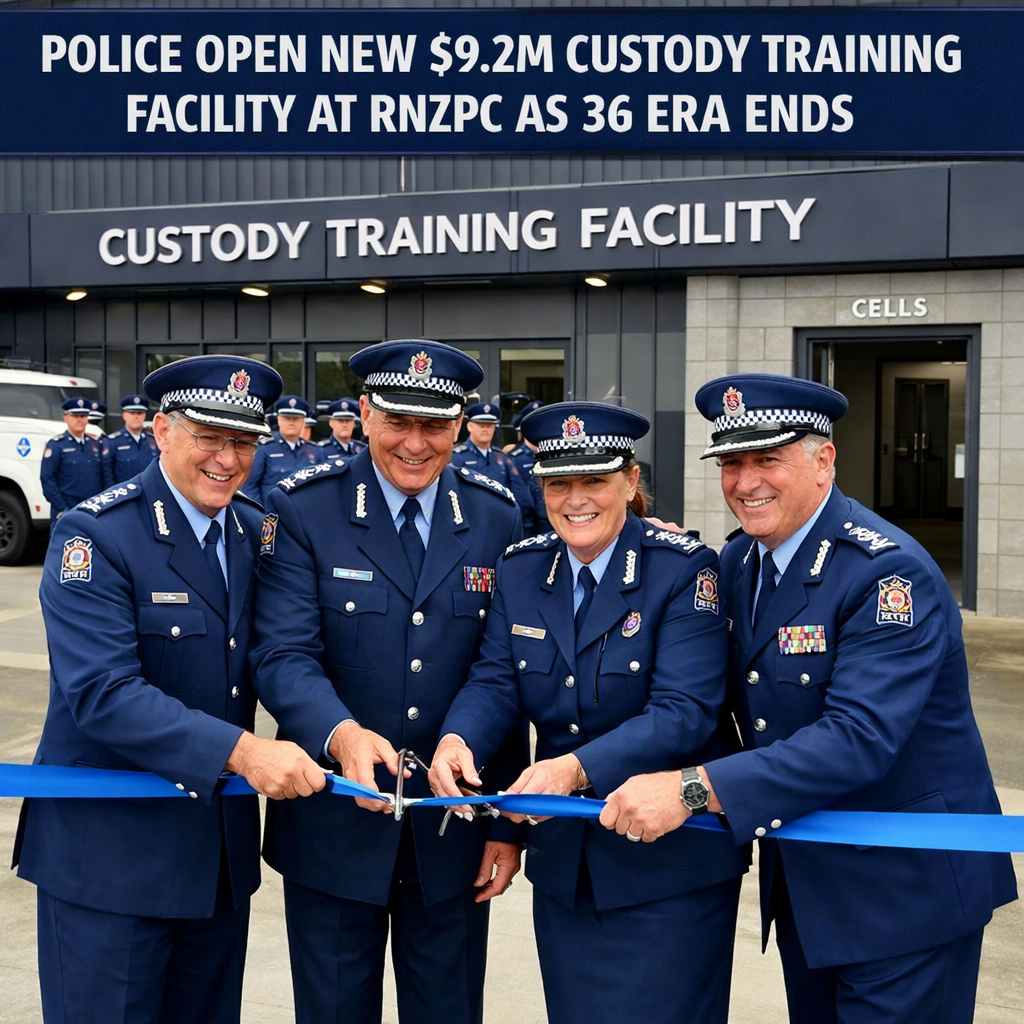
 The Royal New Zealand Police College’s state-of-the-art centre features cells, CCTV monitors, and a custody van to simulate real-world arrest-to-custody scenarios for recruits.
By Eleanor Thompson
Managing Editor
Zealandia News
March 31, 2026 — WELLINGTON
Police Minister Mark Mitchell joined senior officers at the Royal New Zealand Police College this morning for the official opening of a new $9.2 million custody training facility, designed to give recruits hands-on experience in the full arrest-to-custody process.
The facility, opened on the same day Spark New Zealand switched off its remaining 3G infrastructure, is equipped with all the features of a real custody unit including cells, CCTV cameras, monitors, and a custody van. The setup allows trainee officers to run through full scenarios from arrest, to transport, to the custodial environment in a controlled setting.
Assistant Commissioner Capability and Infrastructure Sam Hoyle and Assistant Commissioner Deployment Jeanette Park joined Mitchell for the opening ceremony, which included a scenario demonstration. The facility is expected to significantly enhance training outcomes for new recruits entering the police force.
The timing of the opening coincides with the final phase of New Zealand’s 3G network shutdown, which concluded today after Spark completed its switch-off following One New Zealand’s earlier closure of both 2G and 3G services. The parallel developments highlight the dual nature of infrastructure transitions underway across the country — one focused on public safety training, the other on telecommunications modernisation.
3G Shutdown Finalised After Months of Preparation
With today’s date marking the hard deadline for the nationwide 3G shutdown, Spark confirmed any remaining 3G-only phones will no longer be able to make emergency 111 calls. The company had previously announced plans to block some devices that cannot support emergency calling over 4G, a measure designed to prevent users from mistakenly believing their phones remain functional for critical communications.
One New Zealand completed its shutdown earlier in March. Telecommunications Forum chief executive Paul Brislen said the industry had prepared extensively for the transition, with millions of customer emails and SMS messages sent in the months leading up to the deadline. Pre-recorded voice messages also alerted affected customers that they might soon be unable to make standard voice calls and, more importantly, emergency calls.
“Once network operators have switched off 3G services, any devices that rely on 3G for voice calls, texts or data will no longer be able to connect, including for emergency 111 calls,” Brislen said earlier this month.
The industry estimates that only a small share of users remain on 3G, likely thousands in a market of millions. However, the impact falls disproportionately on harder-to-reach and more vulnerable population groups, including older New Zealanders and those in lower-income households.
Device Fragmentation Exposes Regulatory Gap
The 3G shutdown has exposed an unexpected problem that telecommunications analysts say warrants closer regulatory attention: device fragmentation. Industry estimates suggest as many as 30,000 handset variants are active on local networks, many of which advertise 4G capability but cannot support voice calls — including to 111 — over the newer networks.
Most affected phones arrived through parallel imports or non-telco retailers, placing them beyond carrier control. Spark identified around 300 devices, predominantly from the ASUS range, that would be permanently blocked from its network if users did not install available software updates. Devices without available updates, including the ASUS ROG Phone 5S, ROG Phone 6 series, ZenFone 7, ZenFone 8, and ZenFone 9, are now unable to connect to Spark’s network at all.
Digital Equity Coalition Aotearoa’s Marie Silberstein warned earlier this year that many people would not understand what was required to keep connected after the shutdown. She noted that even phones labelled as 4G capable may not work on New Zealand networks because the bands used here differ from those overseas.
“It’s really imported, refurbished [phones]. You won’t know unless you text 3G to 550, especially if you bought it overseas,” Silberstein said. “4G here is not on the same band as 4G overseas.”
The experience has prompted discussion about whether New Zealand’s regulatory approach to device imports should be reconsidered. The country once operated the Telepermit system, a compatibility gatekeeping mechanism that ensured all connected devices met local network standards. While Telepermit was criticised for reducing consumer choice, the 3G shutdown suggests some form of modern device certification could prevent costly and potentially dangerous compatibility gaps.
Infrastructure Investment Continues Amid Transition
Despite the consumer challenges, telecommunications infrastructure development continues across the country. One New Zealand has installed a rooftop solar system at its Christchurch data centre, the telco’s first major onsite renewable energy project. The installation comprises 142 panels capable of generating up to 90 kilowatts at peak output — on sunny days, nearly enough to meet the combined demand of the data centre and an adjacent mobile site serving the nearby One New Zealand Stadium.
One NZ chief technology officer Kieran Byrne said switching off the old networks was necessary to meet growing demand for mobile data. “By switching off the old technology and re-using the radio spectrum on 4G and 5G, we can boost speeds, increase capacity and make sure our network is ready to support New Zealanders with what’s next.”
The company has invested more than $100 million in mobile network improvements over the past year.
Spark, meanwhile, has teased the forthcoming launch of its satellite-to-mobile service. A web page in Spark’s online shop indicates customers will eventually be able to “send and receive texts and use data on selected satellite-ready apps,” though the service will require an eligible phone, SIM, and plan.
New Leadership at Commerce Commission
Suzanne Stew has been appointed chief executive of the Commerce Commission, beginning May 4. Stew brings telecommunications expertise to the role, having worked as an electronic product engineer for British Telecom in the United Kingdom before joining TelstraClear in New Zealand and later moving into the public service.
Her appointment comes at a significant time for the telecommunications sector, with network transitions ongoing and regulatory frameworks for fibre, mobile termination rates, and consumer protections under active review.
In Perspective
The opening of the Police College’s custody training facility and the completion of the 3G shutdown represent two very different kinds of infrastructure milestones, yet both speak to the broader theme of institutional adaptation. For Police, the investment in realistic scenario training reflects a commitment to preparing officers for the complexities of frontline work. For the telecommunications sector, the 3G transition marks the end of a network that enabled the first generation of mobile internet, while raising important questions about consumer protection in an era of increasingly fragmented device markets.
For the thousands of New Zealanders who did not upgrade their handsets in time, today’s shutdown brings an urgent reality: their phones are no longer capable of reaching emergency services. Consumer advocates are urging whānau and community members to check on older or vulnerable relatives who may now be without a functioning 111 connection. Those affected can recycle their old devices for free through New Zealand’s RE:MOBILE programme, with more than 400 drop-off locations nationwide.