 Dorothy Brown
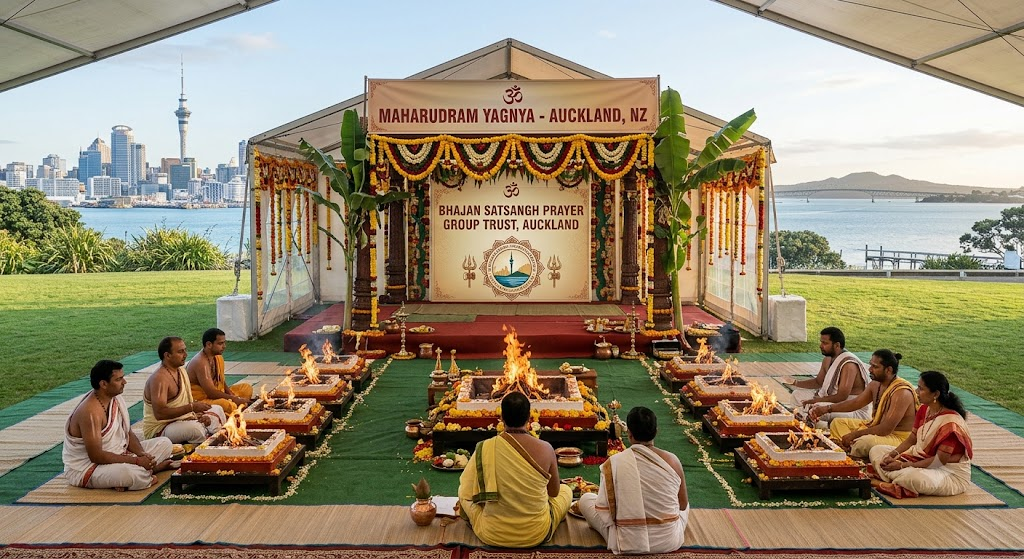
 In the heart of Aotearoa, where the waters of the Hauraki Gulf meet the skies of the South Pacific, a sacred Vedic vibration is set to rise. The ancient ritual of Sri Maha Rudra Yagnyam—one of the most powerful and spiritually profound ceremonies in Sanatan Dharma—is being organised in Auckland, bringing together the city’s growing Hindu community for a transformative journey of chanting, fire offerings, and universal prayer.
The Bhajan Satsangh Prayer Group Trust, Auckland, cordially invites all devotees to this auspicious occasion, which will be held on Friday, 10th July, and Saturday, 11th July 2026, at the Shri Shirdi Sai Mandir, 12-18 Princes Street, Onehunga, Auckland. This two-day spiritual extravaganza promises to be a landmark event for the Hindu community in New Zealand, offering devotees an unparalleled opportunity to participate in one of the most sacred rituals of the Vedic tradition.
The Essence of Maharudram: Invoking the Cosmic Force
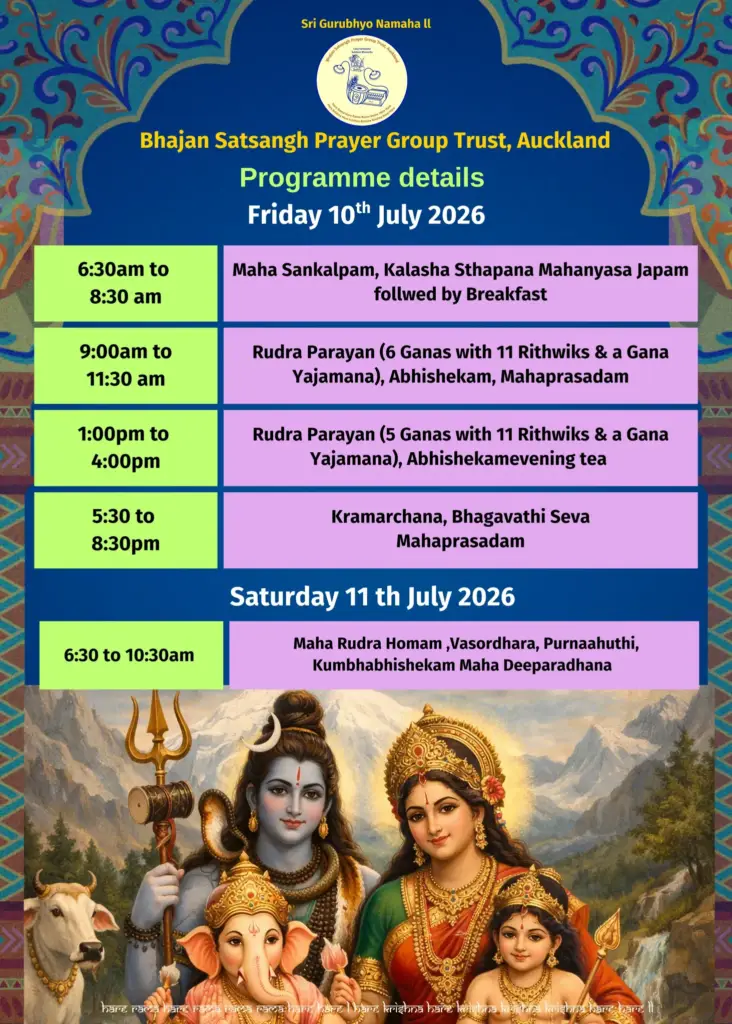
The Rigveda describes the Maharudram and the Rudra Homam as chants that invoke Lord Shiva as the universal supreme force that wipes out all troubles. Maharudram is not merely a ritual; it is a profound spiritual undertaking—a collective recitation of the Sri Rudram, the sacred Vedic hymn from the Krishna Yajur Veda, dedicated to Lord Shiva in his fierce and benevolent form as Rudra. The term “Rudra” itself means “the one who removes sorrows”, and the chanting of this hymn is believed to purify the environment of all negative energies and remove impurities.
The structure of Maharudram follows a precise and mathematically profound pattern. The Maharudram is the chanting of Rudra Japam 1,331 times, chanted by 121 Ritwiks (Vedic priests) 11 times each. A single recitation of the Rudram—comprising the Namakam (all eleven anuvākas or sections) followed by the Chamakam—is known as one Rudram. Eleven such recitations, where each chanting of the Rudram is followed by a successive anuvāka of the Chamakam, constitute a Rudra Ekadasini. Eleven Rudra Ekadasinis make one Laghu Rudram. And eleven Laghu Rudrams—amounting to the Sri Rudram being chanted 1,331 times and the Chamakam 121 times—make one Maharudram. This is the scale of devotion that defines the Maharudram: a symphony of 1,331 sacred vibrations, each one a prayer for peace, prosperity, and the welfare of all beings.
The Kaivalya Upanishad mentions that the Rudra Japam is able to wipe out all the sins of mankind and acts as a means of penance. Chanting or merely listening to the Sri Rudram is widely believed to confer holistic merits—both material and spiritual—and to alleviate sufferings of all kinds. The Maharudram, therefore, is performed for Loka Kalyana—the general prosperity and universal peace and harmony of all creation. It purifies us of all negative energies, relieves us from the burdens of karma, and protects from natural calamities.
Our Shastras say that participating in one Ekadasa Rudram and one Rudra Homam removes the Panchamaha Patakams—the five great sins. The effects are exponential when one person participates in Maharudram. The individual as well as the community at large—are blessed and benefit from this. The Sri Maha Rudra Yagnyam in Auckland is therefore a rare and precious opportunity for every devotee to earn immense spiritual merit and contribute to the welfare of all beings.
The Ritual Journey: Two Days of Divine Resonance
The Sri Maha Rudra Yagnyam is a carefully orchestrated sequence of Vedic rituals, each carrying its own spiritual significance. The event spans two full days, beginning before sunrise and continuing until the evening, with breaks for breakfast, lunch, and tea. The programme has been meticulously planned to ensure that every devotee can participate in the various rituals and receive the blessings of Lord Shiva.
Chief Priest: Chandru Kurukkal
The event will be led by Chandru Kurukkal as the Chief Priest, supported by a team of 121 Ritwiks (Vedic priests) who have dedicated their lives to the preservation and propagation of the Vedic tradition. These Ritwiks will chant the Rudram in unison, creating a powerful wave of positive energy that will sanctify the entire venue and bless all who attend.
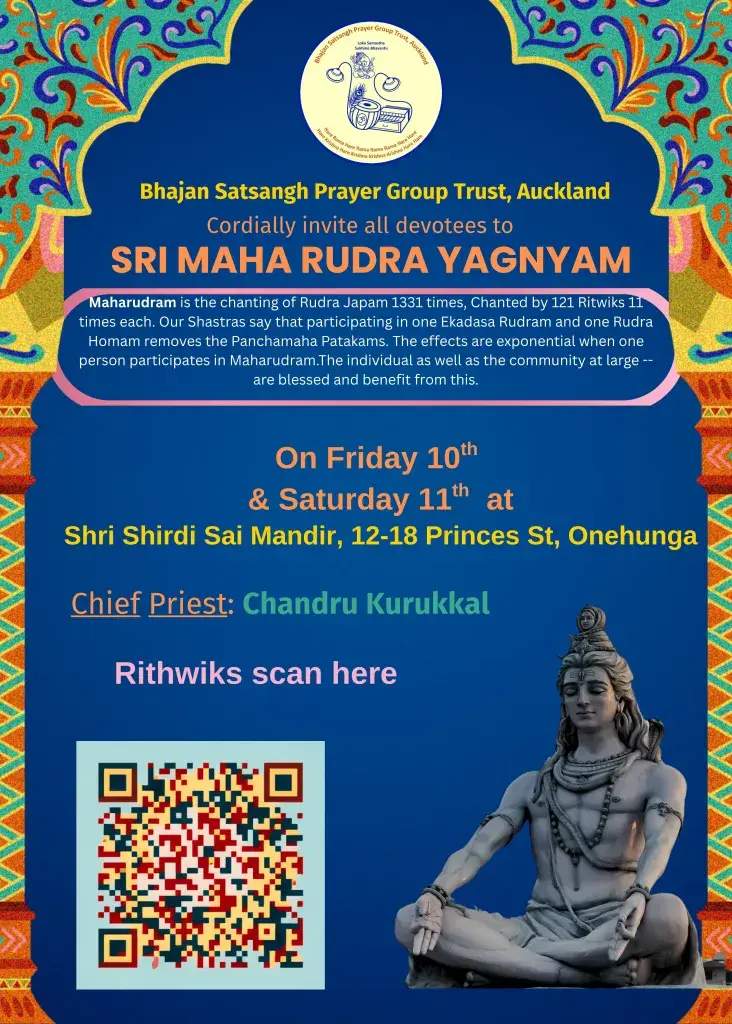
Friday, 10th July 2026: The Day of Chanting and Abhishekam
The first day of the Sri Maha Rudra Yagnyam is dedicated to the chanting of the Rudram, the Abhishekam (sacred bathing) of the Shiva Lingam, and the invocation of divine energies.
Morning Session (6:30 am to 8:30 am)
The day begins with the Maha Sankalpam—the divine mantra recited to signify the place, time, and purpose of the Maharudram ritual, creating a divine atmosphere for the proceedings. This is the formal declaration of intent—a sacred vow to perform the ritual for the welfare of all beings. This is followed by the Kalasha Sthapana, the ceremonial installation of the sacred water pots (kalashas) that will be used for the Abhishekam and later for the Kumbhabhishekam. The Mahanyasa Japam is then performed—the chanting of the sacred mantras that invoke the presence of the divine in the ritual space.
After this profound opening, breakfast will be served to all devotees, providing an opportunity for the community to come together and share in the spirit of satsang (spiritual fellowship).
Late Morning Session (9:00 am to 11:30 am)
The heart of the morning session is the Rudra Parayan—the collective chanting of the Rudram. The programme details indicate that 6 Ganas (groups) will chant, with 11 Rithwik and a Gana Yajamana (the sponsor or leader of each group) in each Gana. This means that 66 Ritwiks will be chanting simultaneously in the morning session, their voices rising in unison to create a powerful wave of devotion.
The Rudra Parayan is accompanied by the Abhishekam—the sacred bathing of the Shiva Lingam with eleven kinds of sacred offerings (dravyams) such as milk, curd, ghee, honey, sugar, water, and other sanctified substances. As the mantras are chanted, the Lingam is bathed in these offerings, symbolising the purification of the devotee’s soul and the removal of all obstacles.
The session concludes with the distribution of Mahaprasadam—sanctified food that has been offered to the deity. Sharing a meal together reinforces the values of equality, humility, and togetherness that remain central to Sanatan Dharma.
Afternoon Session (1:00 pm to 4:00 pm)
The afternoon session continues the sacred chanting with 5 Ganas chanting the Rudra Parayan, each with 11 Rithwik and a Gana Yajamana. This means that 55 Ritwiks will be chanting in the afternoon, adding to the cumulative power of the Maharudram.
The Rudra Parayan is again accompanied by the Abhishekam to the Shiva Lingam, ensuring that the divine energy continues to flow throughout the day.
After the afternoon session, evening tea will be served, providing a welcome break for devotees to refresh themselves before the evening programme.
Evening Session (5:30 pm to 8:30 pm)
The first day concludes with the Kramarchana—the step-by-step worship of the deity, following the traditional Vedic order. This is followed by the Bhagavathi Seva—the worship of the Divine Mother, invoking her blessings for protection, prosperity, and spiritual growth.
The evening session concludes with the distribution of Mahaprasadam to all devotees, marking the end of a spiritually charged first day.
Saturday, 11th July 2026: The Day of Fire and Fulfilment
The second day of the Sri Maha Rudra Yagnyam is dedicated to the Maha Rudra Homam—the grand fire ritual that forms the culmination of the Maharudram. This is the day when the chanting of the previous day is offered into the sacred fire, carrying the prayers of the devotees to the celestial realms.
Morning Session (6:30 am to 10:30 am)
The second day begins with the Maha Rudra Homam—the grand fire ritual where oblations are offered into a consecrated fire (agni) while the sacred mantras are recited. The fire acts as a divine messenger, carrying the prayers of the devotees to the celestial realms. The Homam is performed with great precision and devotion, with the Ritwiks chanting the Rudram and offering ghee, grains, and other sacred substances into the fire.
This is followed by the Vasordhara—the continuous pouring of ghee into the fire, symbolising the offering of one’s ego and desires to the divine. The Vasordhara is considered one of the most powerful aspects of the Homam, as it represents the complete surrender of the devotee to Lord Shiva.
The Purnaahuthi is then performed—the final and complete offering into the fire, marking the culmination of the Homam. This is the moment when all the chants, all the offerings, and all the prayers are symbolically offered to the divine, seeking blessings for universal peace and the welfare of all beings.
The session concludes with the Kumbhabhishekam—the ceremonial consecration of the sacred water pots (kalashas) that were installed on the first day. The consecrated water is then sprinkled on the devotees, blessing them with the divine energy of the Maharudram.
The grand finale is the Maha Deeparadhana—the offering of lamps to the deity, accompanied by the chanting of sacred mantras and the ringing of bells. The Deeparadhana is a visually stunning and spiritually uplifting experience, as the entire venue is illuminated by the light of hundreds of lamps, symbolising the dispelling of darkness and the ushering in of divine light.
The Sri Maha Rudra Yagnyam concludes with the distribution of Mahaprasadam to all devotees, marking the end of a spiritually transformative two-day event.
Sponsorship and Participation: Sankalpa Details
The Bhajan Satsangh Prayer Group Trust, Auckland, has thoughtfully designed multiple levels of participation and sponsorship, ensuring that every devotee—regardless of their financial capacity—can contribute to and benefit from this sacred Yagnyam. Each Sankalpa (sacred vow) carries its own unique blessings and privileges, allowing families to participate in a manner that resonates with their devotion and means.
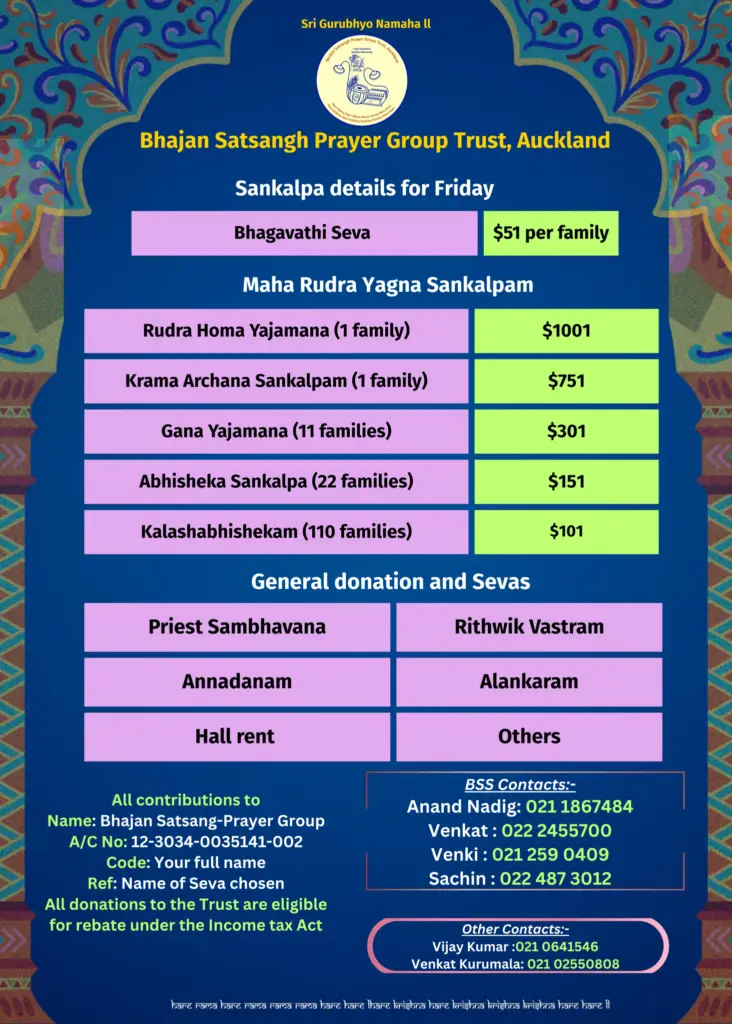
Friday Sankalpa Details
| Seva | Contribution |
|---|---|
| Bhagavathi Seva | $51 per family |
The Bhagavathi Seva on Friday evening is a beautiful opportunity for families to participate in the worship of the Divine Mother. This Seva invokes the blessings of Goddess Bhagavathi for protection, prosperity, and spiritual growth. Each family that takes this Sankalpa will be included in the sacred prayers offered during the Bhagavathi Seva.
Maha Rudra Yagna Sankalpam
| Sankalpa | Contribution | Details |
|---|---|---|
| Rudra Homa Yajamana | $1001 (1 family) | The highest level of participation, offering the family the privilege of being the primary sponsor of the Rudra Homa |
| Krama Archana Sankalpam | $751 (1 family) | Step-by-step worship of the deity, following the traditional Vedic order |
| Gana Yajamana | $301 (11 families) | Lead one of the eleven Ganas as a couple and participate closely in the sacred Rudra Parayanam |
| Abhisheka Sankalpa | $151 (22 families) | Witness and participate in the grand Abhishekam as 121 Ritwiks chant Rudram simultaneously |
| Kalashabhishekam | $101 (110 families) | A rare opportunity to personally carry a Kalasha sanctified through Ekadasha Rudra Japam |
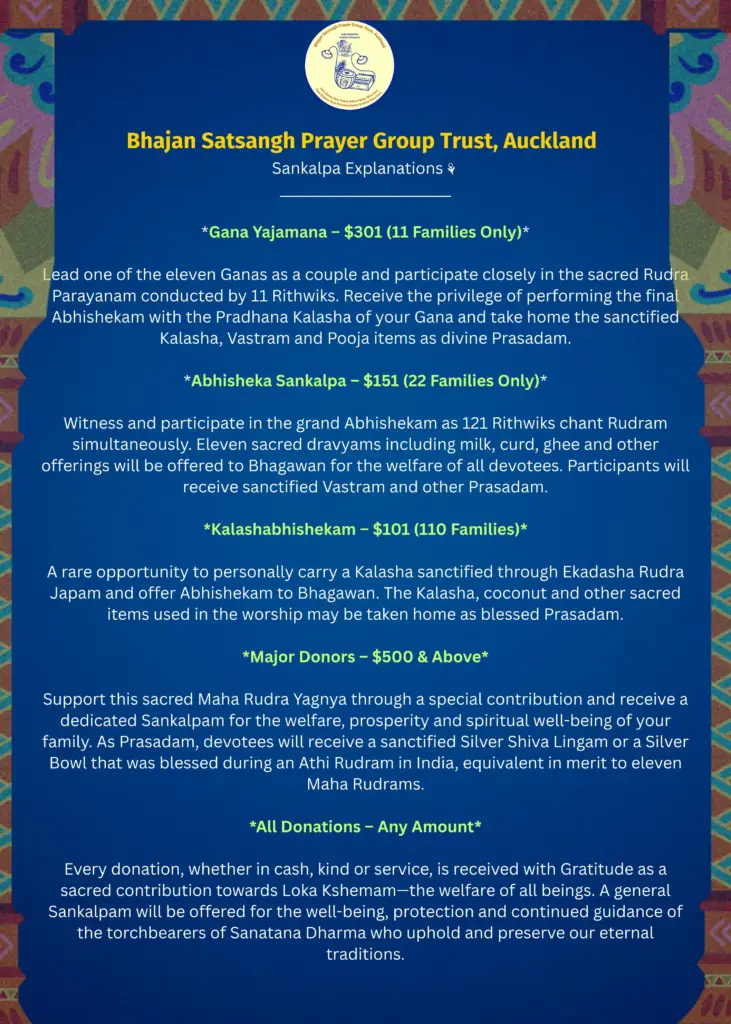
Gana Yajamana – $301 (11 Families Only)
This Sankalpa offers a truly unique and intimate experience of the Maharudram. As a Gana Yajamana, a couple leads one of the eleven Ganas and participates closely in the sacred Rudra Parayanam conducted by 11 Ritwiks. The Gana Yajamana receives the privilege of performing the final Abhishekam with the Pradhana Kalasha (the primary sacred pot) of their Gana. At the conclusion of the ritual, the couple may take home the sanctified Kalasha, Vastram (sacred cloth), and Pooja items as divine Prasadam—a tangible blessing that continues to grace their home long after the Yagnyam concludes.
Abhisheka Sankalpa – $151 (22 Families Only)
This Sankalpa allows families to witness and participate in the grand Abhishekam as 121 Ritwiks chant the Rudram simultaneously. Eleven sacred dravyams—including milk, curd, ghee, honey, sugar, water, and other sacred offerings—are offered to Bhagawan during this ritual. The Abhishekam is performed for the welfare of all devotees, and each participant receives sanctified Vastram and other Prasadam as a blessed reminder of their participation. This Sankalpa offers a profound connection to the heart of the ritual, as the devotee witnesses the sacred bathing of the Shiva Lingam amidst the collective chanting of 1,331 Rudrams.
Kalashabhishekam – $101 (110 Families)
This is a rare and deeply personal opportunity to carry a Kalasha that has been sanctified through the Ekadasha Rudra Japam and to offer Abhishekam to Bhagawan. The Kalasha, coconut, and other sacred items used in the worship may be taken home as blessed Prasadam. Each of the 110 families who take this Sankalpa will have the privilege of personally participating in the sacred Abhishekam, carrying the sanctified water pot and offering it to the deity. This is an experience that creates a lasting spiritual connection and brings the divine blessings of the Maharudram into the devotee’s home.
Krama Archana Sankalpam – $751 (1 Family)
This Sankalpa offers one family the privilege of performing the Kramarchana—the step-by-step worship of the deity, following the traditional Vedic order. The Kramarchana is a detailed and profound form of worship that follows the sequence prescribed in the Agamas and Vedic texts. The family that takes this Sankalpa will be at the centre of this sacred ritual, offering prayers and receiving the direct blessings of the deity.
Rudra Homa Yajamana – $1001 (1 Family)
This is the highest level of participation, offering one family the privilege of being the primary sponsor of the Rudra Homa—the grand fire ritual on Saturday morning. As the Rudra Homa Yajamana, the family assumes the role of the primary sponsor of the entire Yagnyam, receiving the most significant spiritual merit and blessings. This Sankalpa offers the family the opportunity to be the principal patrons of the sacred fire offering, ensuring that their prayers and intentions are carried directly to the divine through the sacred fire.
Major Donors – $500 & Above
For devotees who wish to support this sacred Maha Rudra Yagnya through a special contribution, the Trust offers a dedicated Sankalpam for the welfare, prosperity, and spiritual well-being of their family. This is an extraordinary opportunity to contribute at a significant level and receive blessings that extend far beyond the duration of the Yagnyam.
As Prasadam, major donors will receive a sanctified Silver Shiva Lingam or a Silver Bowl that was blessed during an Athi Rudram in India. The significance of this Prasadam cannot be overstated—an Athi Rudram is equivalent in spiritual merit to eleven Maha Rudrams. The offerings of one Athi Rudram (which has 14,641 times chanting the Rudram, 1,331 times the Chamakam, 121 Kumbhabhishekams and 11 Maha Rudrams, performed on special occasions) far exceeds one Maha Rudram. The sanctified Silver Shiva Lingam or Silver Bowl carries the blessings of this extraordinary ritual and serves as a powerful spiritual presence in the devotee’s home.
All Donations – Any Amount
The Trust emphasises that every donation, whether in cash, kind, or service, is received with gratitude as a sacred contribution towards Loka Kshemam—the welfare of all beings. No contribution is too small, and every devotee’s participation is valued equally in the eyes of the divine.
A general Sankalpam will be offered for the well-being, protection, and continued guidance of the torchbearers of Sanatana Dharma who uphold and preserve our eternal traditions. This includes all devotees who contribute their time, energy, or resources to the Yagnyam, ensuring that their spiritual efforts are recognised and blessed.
Additional Sponsorship Opportunities
Beyond the specific Sankalpas listed above, the Trust invites devotees to contribute towards the general expenses of the Yagnyam. These include:
| Category | Details |
|---|---|
| Priest Sambhavana | Honourarium for the Vedic priests who lead the chanting and rituals |
| Rithwik Vastram | Sacred clothing for the 121 Ritwiks |
| Annadanam | Provision of food for all devotees attending the Yagnyam |
| Alankaram | Decoration of the temple and ritual space |
| Hall Rent | Venue hire for the two-day event |
| Others | Miscellaneous expenses including flowers, ghee, and other ritual items |
These contributions ensure that the Yagnyam is conducted with the highest standards of Vedic precision and that all devotees are welcomed and cared for throughout the event.
A Global Phenomenon, A Local Reality
The Maharudram is a ritual that has been performed across the globe, from the temples of India to the diaspora communities of North America, Europe, and Australasia. In Toronto, Canada, the growing Sringeri community—comprising professionals from Bengaluru and other cities—celebrated its biggest event of the year with a two-day Maharudram that attracted followers from across Canada and the United States. Federal science minister Kirsty Duncan and the local MP joined in the celebrations as the temple turned into a “mini-South Indian enclave,” with mantra chants and rituals by 130 priests trained by the Shankaracharya.
In Pune, India, the Shree Hari Hara Bhajan Samajam has conducted the Maharudram on multiple occasions—first in 1991, then in 2006, and again in 2012—with 22 pandits chanting the Rudram 11 times for six days continuously. The event attracted 200-300 devotees on weekdays and over 500 on weekends.
Now, Auckland joins this global tradition. The city’s Hindu community, which has grown significantly over the past decades, is preparing to host its own Sri Maha Rudra Yagnyam. The event represents a milestone in the community’s journey—a transition from being a small, scattered diaspora to a mature, institution-building community. As Dr Lucky Lakshmanan, chairman of the Sringeri Vidya Bharati Foundation in Toronto, observed: “The temple and religious-cum-cultural activities here symbolize that our community is now in the stage of institution building”. The same sentiment now resonates in Auckland.
Preserving Heritage for Future Generations
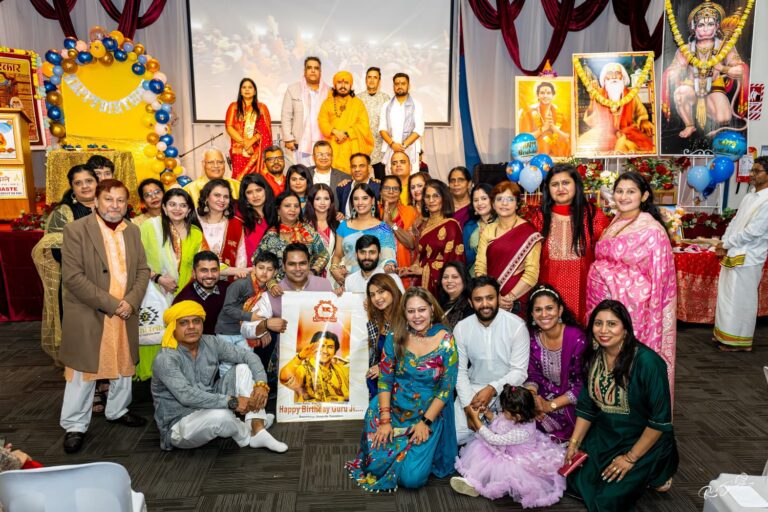
For the Indian diaspora in New Zealand, events like the Sri Maha Rudra Yagnyam hold a significance that extends far beyond the ritual itself. They provide a tangible connection to Sanatan Dharma for the younger generation—a chance for children born and raised in Aotearoa to witness the grandeur of their cultural heritage firsthand.
As Param Bhat, a nuclear engineer who has been part of the Canadian diaspora since 1978, remarked: “When I landed here in 1978, there were just a handful of Kannada families. Today, there are over a thousand families in the Greater Toronto Area alone. Seeing the ritwiks chanting rudram in praise of Lord Shiva more than 1,331 times was such a learning experience for us and our new generation”.
The same journey is unfolding in New Zealand. From the Bharatiya Mandir in Sandringham—the first purpose-built Hindu temple in New Zealand, officially opened in June 1993—to the ThiruMurugan Temple in Otahuhu, the Sri Venkateshwara Devasthanam taking shape in Ramarama, and the ISKCON temples across the city, Auckland’s Hindu community is growing, thriving, and building institutions that will serve generations to come.
The Sri Maha Rudra Yagnyam represents the culmination of this journey—a moment when the community comes together to participate in one of the most sacred and powerful rituals of the Vedic tradition. It is an opportunity for families to experience the chanting of the Vedas, to witness the fire offerings, to receive the blessings of Lord Shiva, and to pass on these traditions to their children.
The Spirit of Seva: Community and Devotion
Like all major Hindu events, the Sri Maha Rudra Yagnyam is made possible through the spirit of seva—selfless service. Volunteers, known as sewadars, dedicate their time and energy to preparing the venue, welcoming guests, coordinating registrations, managing the stage activities, organising audiovisual presentations, serving Mahaprasad, and ensuring that every family feels comfortable throughout the event.
The organisation of a Maharudram requires significant resources—both financial and human. As the secretary of the Shree Hari Hara Bhajan Samajam in Pune noted, organising a Maharudram on such a large scale takes “a lot of time, planning, resources and money”. The funds are typically obtained through donations from devotees, reflecting the collective commitment of the community to the preservation and propagation of their spiritual heritage.
The Bhajan Satsangh Prayer Group Trust, Auckland, has worked tirelessly to bring this sacred event to the community. Their dedication and vision have made it possible for devotees in New Zealand to participate in a Maharudram without having to travel to India. This is a testament to the growing strength and maturity of the Hindu community in Auckland.
Tax-Deductible Donations
All contributions to the Bhajan Satsangh Prayer Group Trust are eligible for a rebate under the Income Tax Act, providing an additional incentive for devotees to contribute generously to this sacred cause.
Bank Account Details:
- Account Name: Bhajan Satsang-Prayer Group
- Account Number: 12-3034-0035141-002
- Particulars: Your full name
- Code: Name of Seva chosen
Devotees are requested to use the above details when making their contributions, ensuring that the correct Sankalpa is recorded and the appropriate blessings are offered.
A Call to the Community
The Sri Maha Rudra Yagnyam is an invitation to all—devotees and non-devotees alike—to experience the power and beauty of the Vedic tradition. It is a chance to witness the chanting of the Sri Rudram, to participate in the Rudra Abhishekam, to offer prayers for universal peace, and to share in the Mahaprasad.
For those who have grown up in New Zealand, it is an opportunity to connect with their roots, to learn about their heritage, and to experience the richness of Sanatan Dharma in a vibrant community setting. For those who are new to the tradition, it is a chance to observe, to learn, and to be welcomed into a community that values inclusivity, compassion, and spiritual growth.
As the Kaivalya Upanishad reminds us, the Rudra Japam is able to wipe out all the sins of mankind and acts as a means of penance. In a world that often feels divided and troubled, the Sri Maha Rudra Yagnyam offers a powerful antidote—a collective prayer for peace, harmony, and the welfare of all beings.
Event Details at a Glance
| Event | Sri Maha Rudra Yagnyam |
|---|---|
| Organiser | Bhajan Satsangh Prayer Group Trust, Auckland |
| Date | Friday, 10th July & Saturday, 11th July 2026 |
| Venue | Shri Shirdi Sai Mandir, 12-18 Princes Street, Onehunga, Auckland |
| Chief Priest | Chandru Kurukkal |
| Ritwiks | 121 Vedic Priests |
| Chanting | Rudra Japam 1,331 times |
Programme Schedule:
Friday, 10th July 2026
- 6:30 am – 8:30 am: Maha Sankalpam, Kalasha Sthapana, Mahanyasa Japam (followed by Breakfast)
- 9:00 am – 11:30 am: Rudra Parayan (6 Ganas with 11 Rithwik and a Gana Yajamana), Abhishekam, Mahaprasadam
- 1:00 pm – 4:00 pm: Rudra Parayan (5 Ganas with 11 Rithwik and a Gana Yajamana), Abhishekam (followed by Evening Tea)
- 5:30 pm – 8:30 pm: Kramarchana, Bhagavathi Seva, Mahaprasadam
Saturday, 11th July 2026
- 6:30 am – 10:30 am: Maha Rudra Homam, Vasordhara, Purnaahuthi, Kumbhabhishekam, Maha Deeparadhana
Sankalpa Options Summary
| Sankalpa | Contribution | Availability |
|---|---|---|
| Rudra Homa Yajamana | $1001 | 1 family |
| Krama Archana Sankalpam | $751 | 1 family |
| Gana Yajamana | $301 | 11 families |
| Abhisheka Sankalpa | $151 | 22 families |
| Kalashabhishekam | $101 | 110 families |
| Bhagavathi Seva | $51 | Unlimited |
| Major Donors | $500+ | Unlimited |
| General Donations | Any amount | Unlimited |
Contacts
Bhajan Satsangh Prayer Group Trust (BSS) Contacts:
- Anand Nadig: 021 1867484
- Venkat: 022 2455700
- Venki: 021 259 0409
- Sachin: 022 487 3012
Other Contacts:
- Vijay Kumar: 021 0641546
- Venkat Kurumala: 021 02550808
Devotees are encouraged to reach out to any of the above contacts for further information, sponsorship enquiries, or to register their Sankalpa.
Sri Gurubhyo Namaha
ॐ नमः शिवाय
Om Namah Shivaya
Faith knows no borders. And in the sacred chants of the Sri Maha Rudra Yagnyam, the spirit of Sanatan Dharma continues to inspire hearts across Aotearoa New Zealand. The Bhajan Satsangh Prayer Group Trust, Auckland, invites every devotee to be part of this historic and spiritually transformative event—an opportunity to earn immense punya, to contribute to Loka Kshemam, and to strengthen the bonds of our community for generations to come.