 Seraphina Hughes
 By Seraphina Hughes
I’m from Cardiff and write articles about contemporary art, having earned a Master’s in Fine Arts
Published: February 26, 2025, NZB News
I’m from Cardiff and write articles about contemporary art, having earned a Master’s in Fine Arts
Published: February 26, 2025, NZB News
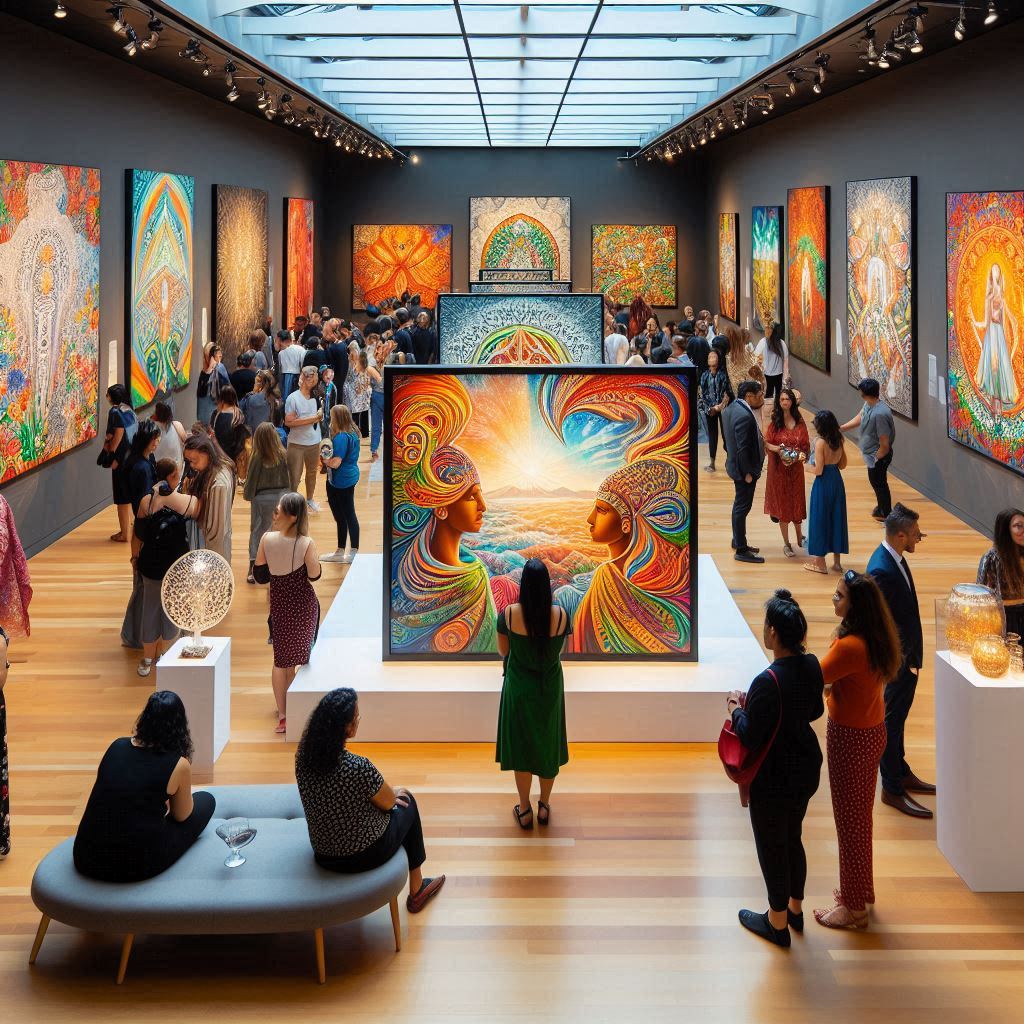
Christchurch, NZ – On February 23, 2025, the Christchurch Art Gallery Te Puna o Waiwhetū flung open its doors to Tā Moko, Tandava: Threads of Land and Spirit, a landmark contemporary art exhibition uniting Māori and Bharat (Indian) artists. Curated over two years, the show—featuring 40 works across sculpture, digital media, and performance—explores identity, ecology, and resilience in a world grappling with cultural erasure and climate crisis. With international buzz from London to Mumbai, it’s a bold statement: art in 2025 isn’t just decoration; it’s a call to rethink our shared future.
A Fusion of Visions
The exhibition’s seeds were planted in 2023, when Ngāi Tahu artist Ria Te Uira met Bharat’s Santosh Kumar Das at the Venice Biennale. Te Uira’s ink-on-wood carvings, tracing Māori whakapapa (genealogy), struck a chord with Das’s vivid Madhubani paintings, which map Bihar’s flood-ravaged landscapes. “We both saw land as alive,” Te Uira told me at the opening, her voice soft against the hum of the crowd. “That’s where it began.”
Funded by a $1.5 million grant from Creative New Zealand and Bharat’s Ministry of Culture, the project grew. Twelve Māori artists—think Lonnie Hutchinson’s laser-cut kowhaiwhai panels—and 10 from Bharat, like Subodh Gupta’s steel-and-neon installations, joined the fold. The result is visceral: a gallery transformed into a dialogue of color, texture, and sound, from taonga puoro (Māori instruments) echoing off walls to Bharatanatyam dancers weaving through crowds at the launch.
“This isn’t fusion for fusion’s sake,” said curator Dr. Priya Menon, a Christchurch-based art historian with roots in Kerala. “It’s about parallel struggles—colonization, displacement, environmental loss—finding voice together.”
Art Meets the Moment
The timing is uncanny. Globally, contemporary art is shedding old skins. The 2024 Art Basel report pegged social impact as the top driver for collectors, with sales hitting $22 billion—30% tied to works addressing identity or ecology. In New Zealand, Māori art’s renaissance is undeniable: Toi Māori Aotearoa reported a 25% rise in exhibitions since 2022, fueled by post-COVID cultural reckoning. Bharat’s scene mirrors this—its $2 billion art market grew 15% in 2024, per The Economic Times, with artists like Gupta and Atul Dodiya commanding six-figure sums.
Tā Moko, Tandava lands amid this shift. Te Uira’s centerpiece, Whenua Rising—a 3-meter wooden spiral etched with tā moko patterns—honors Māori land rights, a nod to the 2024 Waitangi Tribunal’s $1.2 billion settlement push. Das’s River Requiem, a canvas of muddied blues and reds, mourns Bharat’s 2024 monsoon toll—over 1,500 lives, per India’s National Disaster Management Authority. Together, they confront what Menon calls “the wounds we inherit and the healing we chase.”
Sustainability in Focus
The show’s eco-edge is no accident. Art’s carbon footprint—$1.7 billion annually, says the Global Art Sustainability Initiative—has sparked a green wave. Here, materials tell the story: Hutchinson’s panels use recycled rimu from cyclone-felled trees, while Gupta’s sculptures repurpose scrap from Mumbai’s shipyards. A digital wing, powered by solar panels installed at the gallery in 2023, streams performances globally, cutting travel emissions—a move mirroring Bharat’s 2024 Kochi Biennale, which slashed its footprint by 20%.
“We’re not just showing art,” Menon said, gesturing to a QR code linking to a carbon-offset fund. “We’re modeling responsibility.” Christchurch City Council, aiming for net-zero by 2030, chipped in $200,000, eyeing tourism—visitor numbers hit 800,000 in 2024, per Tourism NZ.
Voices of the Artists
At the opening, I caught Gupta mid-installation, welding a steel canoe studded with brass bells. “In India, we’ve lost rivers to greed,” he said, his hands blackened with soot. “This is my protest—and my hope.” Across the room, Hutchinson adjusted a video loop of Waitaha’s braided rivers, her voice fierce: “Māori have fought for this land since 1840. Art’s another battleground.”
Bharat’s Shilpa Gupta (no relation) brought Echoes Unheard, a soundscape of whispered protests from Delhi’s 2024 farmer marches—40,000 strong, per The Hindu—layered with Māori waiata. “Silence is complicity,” she told me. Māori performance artist Tāme Iti, a late addition, debuted a live haka, his tattooed face a canvas of defiance. “This is us saying, ‘We’re still here,’” he growled.
Global Echoes
The exhibition’s reach is already global. London’s Tate Modern, which hosted a Māori art survey in 2023, plans a 2026 sister show. Mumbai’s Chhatrapati Shivaji Maharaj Vastu Sangrahalaya offered a reciprocal exhibit for 2027, spotlighting Bharat’s tribal art. UNESCO, fresh off designating Kolkata a Creative City in 2024, praised the project as “a blueprint for cultural solidarity.”
It’s not alone. The 2024 Whitney Biennial in New York leaned hard into indigenous voices, drawing 600,000 visitors. South Africa’s Zeitz MOCAA saw 400,000 for its 2023 eco-art show. Tā Moko, Tandava—projected to hit 100,000 attendees by May—rides this wave, with livestreams pulling 50,000 views on opening night.
Challenges and Critiques
Not everyone’s cheering. Some Māori artists, like Kura Te Waru Rewiri, boycotted, arguing it “packages our taonga for Pākehā eyes.” Bharat’s critics, per ArtIndia, question if global shows dilute local roots—Gupta’s works fetch $500,000 abroad but rarely stay home. Logistics hiccupped too: a Das painting stalled at customs over biosecurity fears, resolved only last week.
Funding’s tight—Creative NZ’s $50 million 2025 budget is stretched thin, and Bharat’s contribution hinges on Delhi’s fiscal review. Menon shrugs it off: “Art’s never easy. That’s why it matters.”
A Wider Canvas
The show reflects 2025’s zeitgeist. New Zealand’s $1 billion creative sector, per NZIER, thrives on cultural exports—think The Piano at Cannes 2024. Bharat’s soft power—Bollywood, yoga, now art—hit $80 billion in 2024, says FICCI. Globally, art’s a $65 billion industry, per Artprice, but its real value is intangible: a mirror to our times.
For me, raised amid Cardiff’s industrial relics, this resonates. Tā Moko, Tandava isn’t just art—it’s a conversation across oceans, histories, and crises. As I left the gallery, Iti’s haka lingered in my ears, Das’s colors burned in my mind. Christchurch has lit a spark. Where it spreads—Delhi, London, beyond—is the next chapter.
What’s Next?
The exhibition runs through June 2025, with workshops—tā moko tattooing, Madhubani painting—booked solid. A documentary, co-funded by NZ On Air and Bharat’s NFDC, hits screens in 2026. If it tours, expect queues from Auckland to Ahmedabad. For now, it’s Christchurch’s gift to a world hungry for connection—and a challenge to look deeper.