


 Lara Zijl
 Rising temperatures linked to climate change are causing an unprecedented public health emergency across India, as a recent study finds that over 3,400 excess deaths occur each day during extreme heat events. Researchers contend that official data may drastically understate the true toll, with the oppressive heatwave straining hospitals, displacing tens of thousands, and disproportionately impacting vulnerable populations.
By Dr. Rukumangada Acharya
Medical and Public Health Correspondent
Zealandia News
12 June 2026 — NEW DELHI
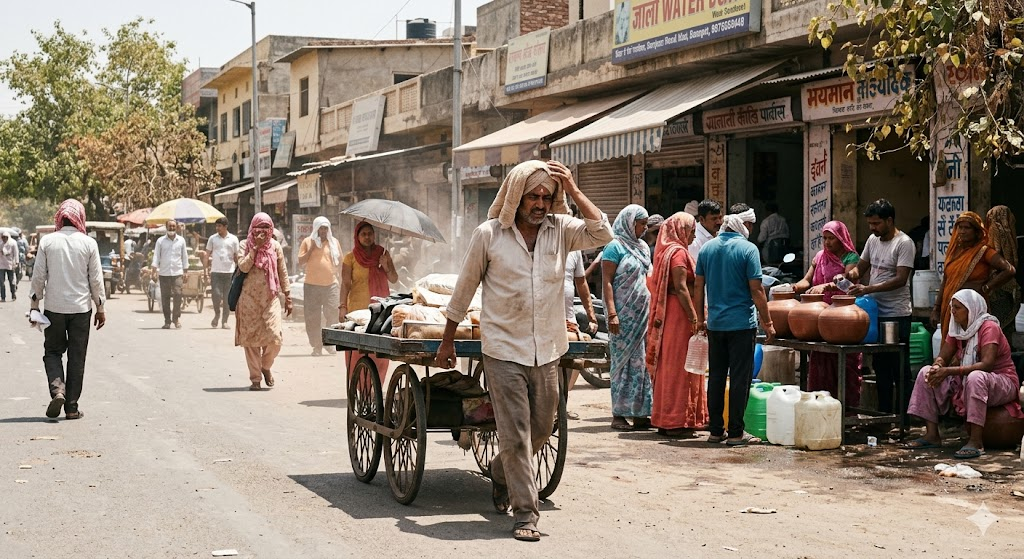
India is currently in the grip of one of the most severe heat crises in its recorded history. Temperatures across major cities including Delhi, Nagpur, and Jaipur have soared past 48 degrees Celsius on multiple days, with night-time lows failing to deliver respite. Power grids groan under relentless demand and water supplies are running critically low, as this latest series of heatwaves engulfs half the subcontinent’s population in states of emergency.
A new international analysis published this week estimates that at the current rate, India is facing around 3,400 excess or premature deaths daily attributable to extreme heat and its downstream impacts. The study, involving epidemiologists from the Indian Institute of Public Health and collaborators from Europe, used advanced modelling to compare mortality rates during periods of extreme heat with baseline averages. Their findings, described by public health professionals as “a wake-up call for the world,” indicate the health consequences may be vastly underestimated by existing official reporting.
“India’s heat crisis is not only a product of rising temperatures, but also of social vulnerability,” said Dr. Kavitha Srinivasan, specialist in environmental epidemiology at the All India Institute of Medical Sciences. “We are seeing alarming increases in admissions for heatstroke, dehydration, and complications in chronic cardiopulmonary diseases.”
Overwhelmed Hospitals and Frontline Response
Hospitals across the north and central regions of India are inundated with patients suffering from heat exhaustion and related secondary conditions. City clinics in Uttar Pradesh and Bihar report that inpatient wards have overflown, and emergency rooms are treating hundreds daily for serious electrolyte imbalances, fainting, and acute kidney injuries.
Dr. Pankaj Gupta, a physician at Safdarjung Hospital in Delhi, describes the current scene as “chaotic, with doctors working double shifts and supplies of IV fluids and oral rehydration solutions sporadically running out.” Makeshift cooling shelters have been opened in railway stations and schools, but these remain out of reach for many in the vast informal settlements and rural hinterlands.
Vulnerable at Greatest Risk
The worst affected are India’s urban and rural poor, whose homes offer scant insulation against the heat and for whom access to water, cooling devices, and reliable electricity remains inconsistent or unaffordable. Social workers warn that elderly residents, outdoor workers, children, and those with disabilities form the majority of new hospitalisations and deaths.
“There is an urgent need to address infrastructure and environmental resilience in heat-prone areas,” said Dr. Meenakshi Das, a public health advocate in Kolkata. “This is not a problem that can be solved by warning systems and ice-distribution alone. Structural change is required, including mass tree planting, climate-adapted public housing, and rapidly improving urban water supply systems.”
Underreporting and Official Acknowledgement
While Indian authorities have activated heat action plans in several states—issuing health advisories, restricting outdoor work hours, and distributing water—the study’s authors warn that government records may capture only a fraction of heat-related fatalities. Counting remains challenging due to fragmented healthcare reporting, and stigma around attributing deaths to climate rather than underlying conditions.
Official statements put confirmed deaths at several hundred, whereas the new figures suggest a staggering undercount. The World Health Organization has echoed calls for more rigorous surveillance and transparency, urging regional cooperation to enhance climate risk management.
Wider Implications and Global Context
India’s fate amid the heat is being closely observed by climate scientists and health policy leaders around the globe. With nearly one in five people alive today residing in India, the implications for public health, food security, and economic stability are immense.
Rising urbanisation has exacerbated the so-called “urban heat island” effect, while agricultural cycles are being disrupted with damaged crops and shortened growing seasons. Schools have closed early in Rajasthan and Haryana, and migrant labourers are returning to villages where the heat is marginally less punishing but where incomes dry up rapidly.
Looking Ahead
India faces a crossroads in adapting to a hotter world. Researchers point to the necessity of investing in resilient health infrastructure, developing targeted interventions for high-risk groups, and expanding community outreach to mitigate further loss of life. Policymakers are being urged to both acknowledge the true scale of the crisis and begin the long-term transformation required to protect the population from repeat disasters.
International support, both technical and financial, may play a critical role as India navigates this new climate reality. Without urgent action, the extreme heat of 2026 may become not an aberration, but the new normal.
In Summary
The accelerating impact of extreme heat across India is forcing an urgent reckoning with public health capacity, social vulnerability, and the realities of climate change. With thousands of lives lost each day, the imperative for national and global action could not be clearer.