


 Vinay Karanam
 Feel the thud of a bamboo staff against a Kerala sandpit, where a fighter spins with the grace of a dancer and the force of a storm. Or hear the clash of swords in a Punjab field, a Sikh warrior’s turban flashing as he parries a blow. This is the 29th strike in our 100-article battle through Bharat Is Not for Beginners, a saga that’s danced across cosmic charts, woven threads of eternity, and lit up silver screens. Now, we’re stepping into the ring of Bharat’s warrior’s way—its martial traditions and living legends—where sweat, skill, and spirit forge a legacy that’s as fierce as it is unbroken. This isn’t just combat; it’s Bharat swinging with a heart that never backs down.
Bharat doesn’t flinch—it fights, and it fights smart. Its martial arts aren’t museum pieces; they’re a living pulse, born in ancient arenas and thriving in modern dojos. From jungle duels to royal courts, Bharat’s warriors have honed moves that blend power with purpose, turning every strike into a story. This isn’t for the timid—it’s a clash with a civilization that’s been dodging blows and landing punches since time got counting.
Blood and Soil: The Roots of the Fight
Swing back to 1500 BCE—Vedic warriors weren’t just chanting; they were swinging. The Rigveda (Article 1) hails archers and charioteers, their bows taut with sinew, arrows tipped with Bharat’s early metal (Article 24). By 500 BCE, the Mahabharata rolls in—Arjuna’s bow, Bhima’s mace, a war manual wrapped in an epic. These weren’t fairy tales; they were playbooks—dhanurveda, the art of combat, broke it down: archery, wrestling, swordplay, all drilled with a science that’d make a general salute (Article 20).
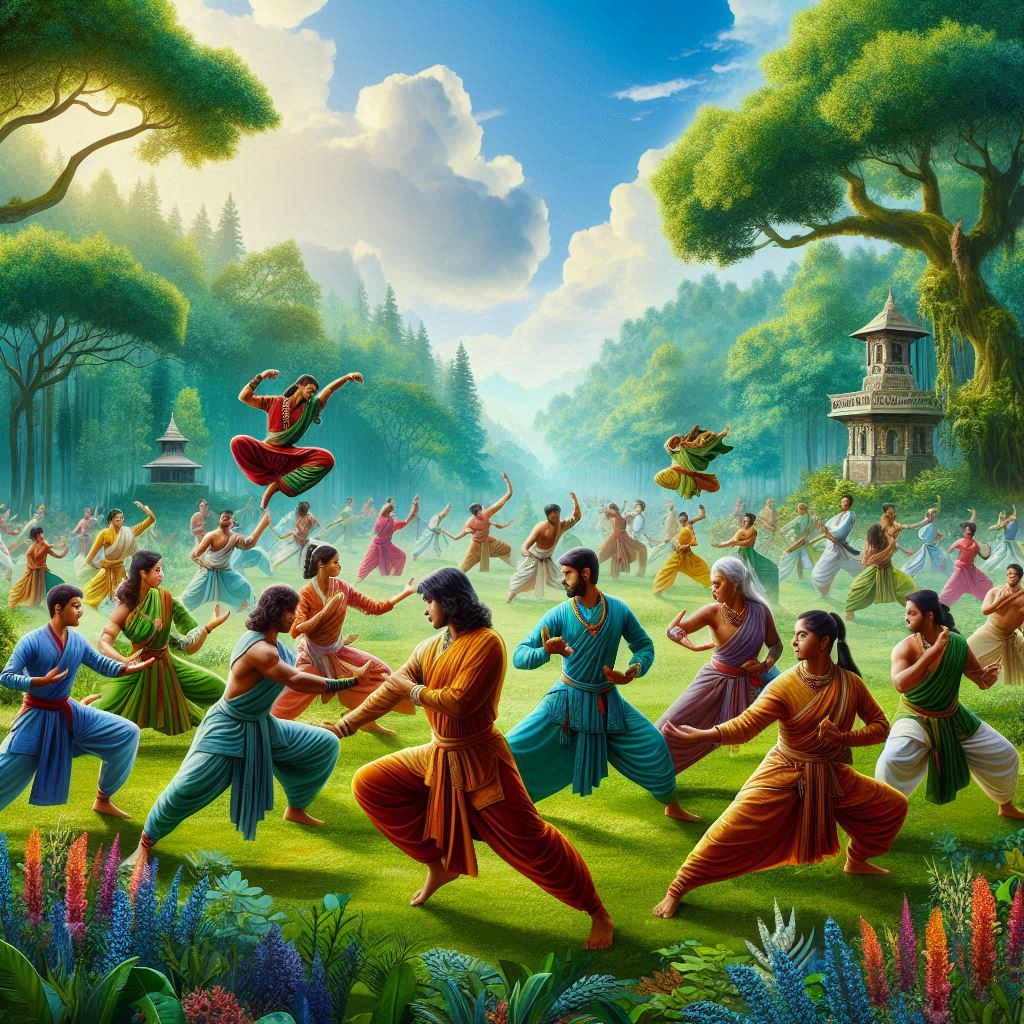
Kalaripayattu kicks in around then—Kerala’s gift to the fight game. Picture it: fighters leaping with curved blades—urumi—whipping like steel snakes, moves flowing from yoga’s bends (Article 17). Up north, Gatka took root—Sikh warriors twirling staffs and sabers, born from Guru Hargobind’s call to defend faith. This wasn’t chaos—it was Bharat’s brain and brawn in sync, crafting arts that turned survival into swagger.
Regional Rings: Warriors Across the Land
Bharat’s fight isn’t one-size-fits-all—it’s a brawl with a thousand faces. Kalaripayattu’s still king in Kerala—sandpits alive with angathari (weapon play), fighters dodging strikes like it’s choreography (Article 5). Strikes are sharp—marma points hit to stun, not just bruise—a healer’s know-how flipped for battle (Article 23). In Tamil Nadu, Silambam spins bamboo—staffs cracking air, a farmer’s tool turned warrior’s edge, fast as a monsoon gust.
Head to Punjab, and Gatka’s a blur—khanda swords flashing, a dance of defiance forged in Sikh grit. Rajasthan’s got Kshatriya blood—Marwari horsemen wielding talwars, their moves echoing desert raids. Up east, Manipur’s Thang-Ta cuts deep—sword and spear duets, paired with Huyen Langlon’s bare-hand fury. Every corner’s got a style—tribal axe fights in Chhattisgarh, stick duels in Gujarat—raw, real, and roaring with Bharat’s diversity (Article 19). These aren’t relics; they’re alive, passed down like a family blade.
Valor in Victory: Legends That Last
Bharat’s martial history isn’t theory—it’s etched in blood. Take Shivaji—17th-century Maratha king, a guerrilla genius who turned hills into forts and swords into freedom. His troops, light and lethal, used dandpatta—gauntlet-blades—to slash Mughal lines, a scrappy win for a scrappy land. Or Rani Lakshmibai—1857, Jhansi’s queen, sword in hand, charging British cannons like a storm no chain could hold. Her fight’s no myth—villagers still sing it.
Sikhs at Saragarhi, 1897—21 against 10,000, Gatka-honed hands holding a pass till the last breath. These weren’t just warriors; they were Bharat’s spine—unbending, unbreakable, fueled by arts that turned farmers into legends. Every clash was a masterclass—strategy, spirit, and a swing that said, “We’re here.”
The Modern Mat: Fighting On
Colonial fists tried to knock it out—British bans clipped swords, but not souls. Post-1947, the ring reopened—Kalaripayattu’s back in Kerala schools, Gatka’s a Sikh fest staple, Silambam’s spinning at demos. Bollywood’s hooked (Article 25)—Baahubali’s battles owe a nod to dhanurveda flair. Army drills borrow too—paratroopers train in marma strikes, a quiet salute to the old ways.
Globally, it’s flexing—Kalaripayattu troupes stun at martial arts fests, London to LA. MMA gyms eye Silambam’s stick tricks, while Gatka’s twirls pop up in diaspora parades—Toronto, Auckland, you name it. It’s not a comeback—it’s Bharat’s fight game stepping up, proving its moves still pack a punch.
Why the Fight Endures
How’s this warrior’s way hang on? It’s Bharat’s grit—gurus teach kids staff spins, villages host duels, elders recount Shivaji like it was yesterday. It’s baked in—festivals (Article 19) feature mock fights, schools drill it, and pride keeps it sharp. It’s not just muscle—it’s memory, a legacy of a land that fights for what’s right and keeps swinging.
Why It Packs a Punch
Why step into Bharat’s ring? Because it’s a thrill—a civilization that turned sticks into swords and spirit into strength. It’s fierce—leaps that defy gravity, strikes that echo history—and it’s alive, a pulse you can feel. For us in New Zealand or anywhere, it’s a jab—try a stance, swing a stick, catch Bharat’s fire. It’s not just combat; it’s courage, and Bharat’s got it in spades.
Excerpt
That’s 29 rounds in our 100-article slugfest through Bharat Is Not for Beginners, and Bharat’s still throwing haymakers—from starry skies to warrior ways, this land’s a champ. Stay in the ring as we dodge and weave through more of its glory. Join us tomorrow for Article 30: Bharat Is Not for Beginners – The River’s Song: Bharat’s Waterways and Lifelines of a Civilization, where we’ll flow with the currents that cradle a nation’s heart.