


 Vinay Karanam
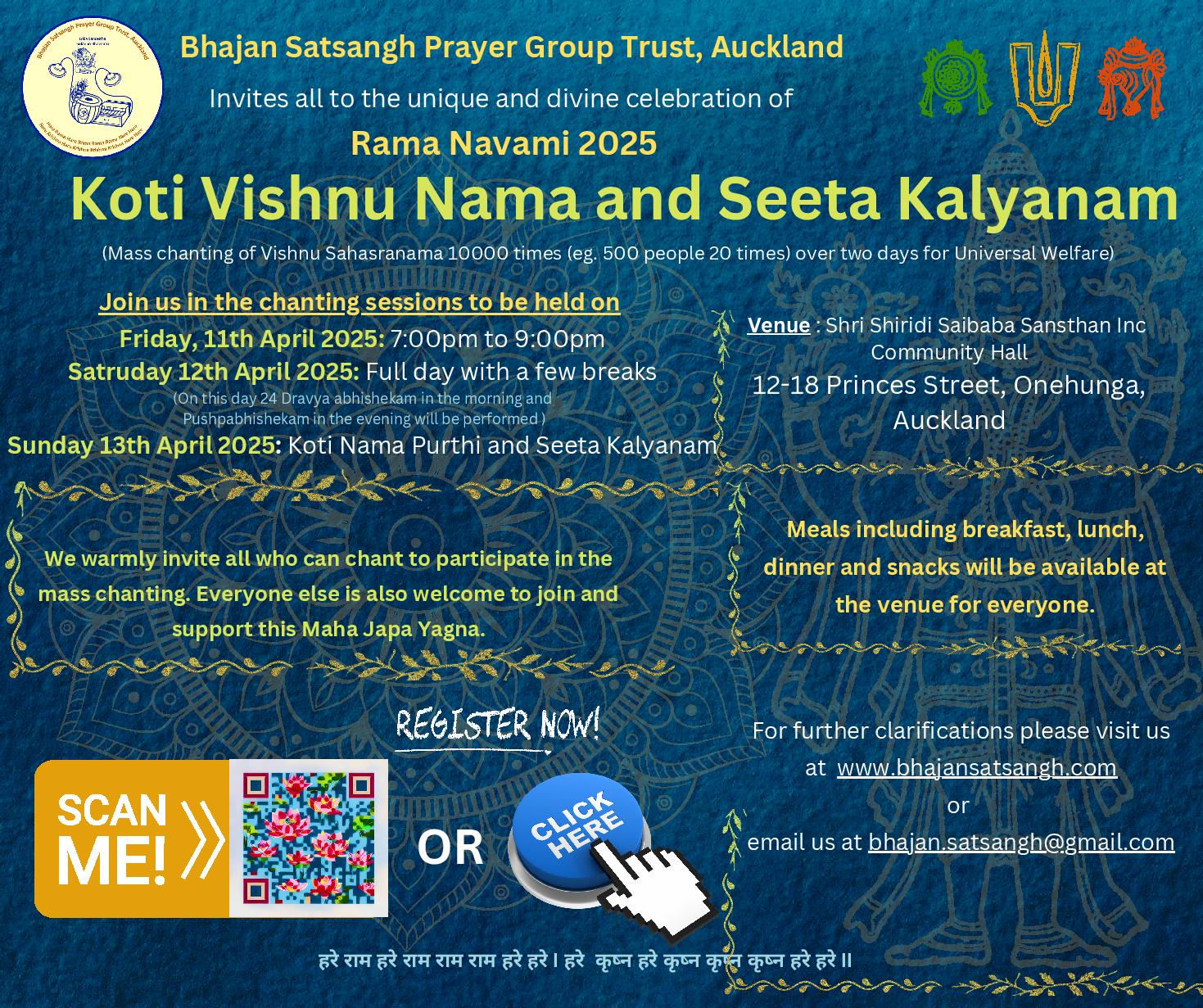
 In the vibrant multicultural tapestry of New Zealand, the Hindu community continues to enrich the nation with its spiritual traditions and devotional practices. One such significant event is the Rama Navami 2025 celebration, featuring the Koti Vishnu Nama and Seeta Kalyanam, organized by the Bhajan Satsangh Prayer Group Trust in Auckland. Scheduled for April 11th to 13th, 2025, at the Shri Shirdi Saibaba Sansthan Inc Community Hall in Onehunga, Auckland, this event promises to be a profound spiritual gathering aimed at fostering universal welfare through the mass chanting of Lord Vishnu’s name and the celebration of the divine union of Lord Rama and Goddess Seeta. This comprehensive 4,000-word article delves into the essence of this event, its organizers, its purpose, its historical context, and its broader impact on New Zealand’s multicultural fabric, Hindu devotees, and the overall mental health and well-being of participants. Drawing from sacred texts like the Bhagavata Purana, Bhagavad Gita, and Mahabharata, we will explore the spiritual significance of this event and its relevance in today’s world, supplemented by personal testimonies, a detailed history of Rama Navami celebrations in New Zealand, and an in-depth analysis of the Vishnu Sahasranama’s verses.
What is the Rama Navami 2025 Event About?
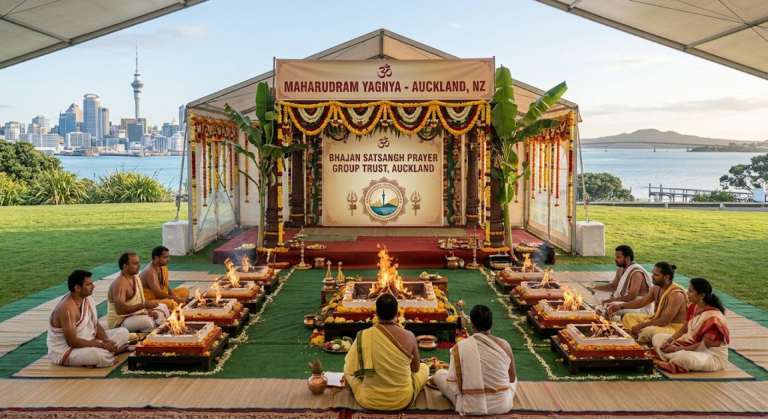
The Rama Navami 2025 celebration, organized by the Bhajan Satsangh Prayer Group Trust, is a three-day spiritual event centered around two key rituals: the Koti Vishnu Nama and the Seeta Kalyanam.
- Koti Vishnu Nama: The term “Koti Vishnu Nama” refers to the mass chanting of Lord Vishnu’s name 10 million times (koti means 10 million in Sanskrit). In this event, the goal is to collectively chant the Vishnu Sahasranama—a sacred hymn comprising 1,000 names of Lord Vishnu—10,000 times over two days. To achieve this, approximately 500 participants will each chant the Vishnu Sahasranama 20 times, contributing to the collective target. The Vishnu Sahasranama is a powerful mantra believed to invoke divine blessings, purify the mind, and promote universal welfare. The chanting sessions will take place on Friday, April 11th, from 7:00 p.m. to 9:00 p.m., and Saturday, April 12th, throughout the day with breaks.
- Seeta Kalyanam: On Sunday, April 13th, the event culminates with the Seeta Kalyanam, a ceremonial reenactment of the divine marriage of Lord Rama and Goddess Seeta, a key event celebrated during Rama Navami. Rama Navami marks the birth of Lord Rama, the seventh avatar of Lord Vishnu, and is one of the most important festivals in Hinduism. The Seeta Kalyanam is a symbolic celebration of love, devotion, and dharma (righteousness), reflecting the eternal bond between Rama and Seeta as depicted in the epic Ramayana. The day will also feature two special rituals: the Dravya Abhishekam in the morning and the Pushpabhishekam in the evening, where offerings of sacred substances and flowers will be made to the deities.
The event is open to all who wish to participate in the chanting or simply attend to support the Maha Japa Yagna (grand chanting ritual). Meals, including breakfast, lunch, dinner, and snacks, will be provided at the venue, ensuring that participants are well-cared for during the three-day celebration.
Who is Organizing the Event?
The Bhajan Satsangh Prayer Group Trust, based in Auckland, is the organizing body behind this event. Established with the mission of promoting spiritual practices and fostering community harmony, the Trust has been a pillar of the Hindu diaspora in New Zealand for several years. According to their website, bhajansatsangh.com, the group is dedicated to conducting regular prayer meetings, bhajans (devotional songs), and large-scale spiritual events to nurture devotion and cultural preservation among Hindus in New Zealand.
The Trust emphasizes inclusivity, inviting participants from all backgrounds to join in the chanting and celebrations. Their commitment to universal welfare is evident in the purpose of the Koti Vishnu Nama, which is performed for the well-being of humanity at large. The Bhajan Satsangh Prayer Group Trust has a history of organizing such events, and their efforts have been widely appreciated by the Hindu community in Auckland and beyond.


Why is This Event Organized?
The Koti Vishnu Nama and Seeta Kalyanam are organized with multiple spiritual and social objectives in mind:
- Spiritual Purification and Universal Welfare: The chanting of the Vishnu Sahasranama is rooted in ancient Vedic traditions and is believed to have immense spiritual benefits. According to the Bhagavata Purana, the recitation of Lord Vishnu’s names can cleanse the mind of impurities, ward off negative energies, and bring peace and prosperity to the world. The Vishnu Sahasranama was first taught by the sage Bhishma to Yudhishthira in the Mahabharata, where Bhishma extols its virtues as a means to attain liberation and divine grace. By chanting these names 10 million times, the Bhajan Satsangh Prayer Group Trust aims to create a powerful collective vibration of positivity that benefits not only the participants but also the broader global community.
- Celebration of Rama Navami: Rama Navami, which typically falls in the month of Chaitra (March-April), celebrates the birth of Lord Rama. The Seeta Kalyanam, performed as part of this event, is a joyous reenactment of Rama and Seeta’s marriage, symbolizing the ideals of dharma, loyalty, and love. In the Ramayana, Rama and Seeta’s union is a testament to the power of righteousness and devotion, serving as an inspiration for devotees to lead virtuous lives.
- Community Bonding and Cultural Preservation: For the Hindu diaspora in New Zealand, events like these provide an opportunity to connect with their cultural and spiritual roots. The Bhajan Satsangh Prayer Group Trust aims to strengthen community bonds by bringing together devotees of all ages to participate in these sacred rituals. Such gatherings also help pass down traditions to younger generations, ensuring the preservation of Hindu culture in a multicultural setting.
- Mental Health and Well-Being: Chanting mantras like the Vishnu Sahasranama has been shown to have profound effects on mental health. The rhythmic repetition of sacred sounds can induce a meditative state, reduce stress, and promote emotional well-being. The Bhagavad Gita (Chapter 6, Verse 16) emphasizes the importance of balance and mindfulness in spiritual practices, which chanting facilitates. By engaging in this Maha Japa Yagna, participants can experience a sense of inner peace and spiritual fulfillment, contributing to their overall mental health.
Where and When is the Event Happening?
The Rama Navami 2025 celebration will take place at the Shri Shirdi Saibaba Sansthan Inc Community Hall, located at 12-18 Princes Street, Onehunga, Auckland. The venue is a well-known community space in Auckland, often used for cultural and religious events by various groups.
The event spans three days:
- Friday, April 11th, 2025: Chanting sessions from 7:00 p.m. to 9:00 p.m.
- Saturday, April 12th, 2025: Full-day chanting with breaks, including the Dravya Abhishekam in the morning and the Pushpabhishekam in the evening.
- Sunday, April 13th, 2025: Koti Nama Purthi (completion of the chanting) and the Seeta Kalyanam ceremony.
Participants are encouraged to register in advance via the Bhajan Satsangh website (www.bhajansatsangh.com) or by scanning the QR code on the flyer. For further clarifications, they can email the organizers at bhajan.satsangh@gmail.com (mailto:bhajan.satsangh@gmail.com).

Previous Events Conducted by the Bhajan Satsangh Prayer Group Trust
The Bhajan Satsangh Prayer Group Trust has a strong track record of organizing large-scale spiritual events in Auckland. According to indiannewslink.co.nz, the Trust has previously conducted similar Koti Vishnu Nama events, which have drawn significant participation from the Hindu community. These events have been marked by meticulous planning, with provisions for meals, transportation, and accommodations to ensure participants’ comfort.
One notable past event was a Koti Vishnu Nama chanting session held in 2021, which also aimed to achieve 10 million recitations of the Vishnu Sahasranama. The event saw over 400 participants and was deemed a resounding success, with attendees reporting a deep sense of spiritual fulfillment. The Trust has also organized Rama Navami celebrations in previous years, often incorporating rituals like the Seeta Kalyanam and other devotional activities such as bhajans and discourses on the Ramayana.

The success of these events can be measured not only by the number of participants but also by the sense of community and spiritual upliftment they foster. Testimonials from past attendees, as shared on the Bhajan Satsangh website, highlight the transformative impact of these gatherings. For instance, Priya Sharma, a regular participant, noted, “The 2021 event was a life-changing experience. The energy of the collective chanting brought me peace I hadn’t felt in years.” Another attendee, Ravi Patel, added, “It was amazing to see people of all ages come together to celebrate our faith—it reminded me of the festivals back home in India.”
Why Does This Event Need to Be Done?
The Koti Vishnu Nama and Seeta Kalyanam are deeply rooted in Hindu spiritual philosophy and serve several important purposes:
- Spiritual Necessity in the Kali Yuga: According to Hindu scriptures, we are currently in the Kali Yuga, an age marked by moral decline and spiritual ignorance. The Bhagavata Purana (12.3.51) states that in the Kali Yuga, the most effective spiritual practice is the chanting of the holy names of God (nama-sankirtana). The mass chanting of the Vishnu Sahasranama aligns with this teaching, offering a powerful means to counteract the negative influences of the age and invoke divine blessings for humanity.
- Fostering Dharma and Righteousness: The Ramayana and Mahabharata emphasize the importance of dharma as the foundation of a harmonious society. Lord Rama, as an avatar of Vishnu, is the epitome of righteousness, and his life serves as a guide for living a virtuous life. The Seeta Kalyanam, by celebrating Rama and Seeta’s union, reinforces these values, inspiring devotees to uphold dharma in their own lives.
- Collective Spiritual Energy: The concept of collective chanting, or sangha, is a cornerstone of Hindu spirituality. The Bhagavad Gita (Chapter 10, Verse 20) describes Lord Krishna (another avatar of Vishnu) as the soul of all beings, residing in the hearts of those who worship Him. When hundreds of devotees come together to chant His names, the collective energy amplifies the spiritual impact, creating a ripple effect of positivity that extends beyond the immediate participants.
- Addressing Modern Challenges: In today’s fast-paced world, many individuals struggle with stress, anxiety, and a sense of disconnection. The Koti Vishnu Nama provides a sacred space for participants to slow down, reconnect with their spiritual selves, and find solace in the divine. The Bhagavad Gita (Chapter 2, Verse 47) advises focusing on action without attachment to outcomes, a principle that chanting embodies by encouraging selfless devotion.
Impact on New Zealand’s Multicultural Fabric
New Zealand is known for its cultural diversity, with communities from around the world contributing to its rich social landscape. The Hindu community, though a minority, plays a significant role in this multicultural fabric by sharing its traditions, festivals, and values with the wider population. Events like the Rama Navami 2025 celebration help bridge cultural gaps by inviting people of all backgrounds to participate in or witness Hindu rituals.
The Bhajan Satsangh Prayer Group Trust’s emphasis on inclusivity ensures that non-Hindus can also attend the event, fostering cross-cultural understanding. For instance, the provision of meals for all attendees reflects the Hindu value of annadanam (the offering of food), which is seen as a noble act of service. Such gestures create a welcoming environment, encouraging dialogue and mutual respect among different communities.
Moreover, the event showcases the vibrancy of Hindu culture through its rituals, music, and ceremonies. The Seeta Kalyanam, with its colorful reenactment of Rama and Seeta’s wedding, offers a glimpse into the aesthetic and spiritual richness of Hinduism, leaving a lasting impression on attendees from diverse backgrounds. Local resident Jane Smith, who attended a previous event, remarked, “I was fascinated by the rituals and the warmth of the community—it’s a beautiful way to learn about another culture.”
Impact on Hindu Devotees
For Hindu devotees in New Zealand, the Rama Navami 2025 celebration is a deeply meaningful event. Living in a diaspora, many Hindus face the challenge of maintaining their cultural and religious identity in a predominantly Western society. Events like these provide a sense of belonging, allowing devotees to connect with their heritage and with like-minded individuals.
The chanting of the Vishnu Sahasranama offers a direct connection to the divine, reinforcing devotees’ faith and devotion. The Bhagavata Purana (Canto 11, Chapter 5) describes the chanting of Vishnu’s names as a means to attain liberation, making this practice particularly significant for those seeking spiritual growth. The Seeta Kalyanam, meanwhile, serves as a reminder of the ideals of love, loyalty, and sacrifice exemplified by Rama and Seeta, inspiring devotees to emulate these qualities in their own lives.
Devotee Anjali Mehta shared her experience: “Participating in the chanting last year gave me a sense of purpose and connection to my roots. It’s rare to find such a strong community spirit here in New Zealand.”
Impact on Mental Health and Well-Being
The mental health benefits of spiritual practices like chanting are well-documented. The rhythmic recitation of mantras has a calming effect on the mind, reducing stress and promoting mindfulness. Studies have shown that chanting can lower cortisol levels, improve focus, and enhance emotional resilience—benefits that align with the teachings of the Bhagavad Gita, which advocates for mental equanimity (Chapter 2, Verse 48).
The communal aspect of the Koti Vishnu Nama also fosters a sense of connection and support, combating feelings of isolation. For many participants, the event offers a rare opportunity to disconnect from the stresses of daily life and immerse themselves in a sacred atmosphere. The Mahabharata (Shanti Parva, Chapter 59) highlights the importance of community in spiritual practice, noting that collective worship amplifies the benefits for all involved.
Participant Sanjay Kumar noted, “After a long week of work, the chanting sessions helped me unwind and feel at peace. The community support was incredible.”
Spiritual Insights from Sacred Texts
The Koti Vishnu Nama and Seeta Kalyanam draw heavily from Hindu scriptures, which provide a deeper understanding of their significance:
- Bhagavata Purana: This text emphasizes the power of nama-sankirtana in the Kali Yuga, stating that the chanting of Vishnu’s names is the most effective way to attain divine grace (12.3.51). The Vishnu Sahasranama is a key practice in this regard, as it encapsulates the infinite qualities of Vishnu, from His compassion to His omnipotence.
- Bhagavad Gita: Lord Krishna, in the Gita, teaches the importance of devotion (bhakti) as a path to liberation (Chapter 9, Verse 22). The act of chanting Vishnu’s names is a form of bhakti, allowing devotees to surrender to the divine and find peace in His presence.
- Mahabharata: The Vishnu Sahasranama is found in the Anushasana Parva of the Mahabharata, where Bhishma recites it to Yudhishthira. Bhishma explains that the hymn can grant worldly prosperity, spiritual liberation, and protection from harm, making it a versatile and powerful tool for devotees.
- Ramayana: The Seeta Kalyanam is a pivotal moment in the Ramayana, symbolizing the union of dharma and devotion. Rama’s life, as narrated in the epic, is a testament to the power of righteousness, while Seeta’s unwavering loyalty exemplifies the ideal of pativrata (devotion to one’s spouse).
Personal Testimonies from Past Participants
The impact of the Bhajan Satsangh Prayer Group Trust’s events is best captured through the voices of those who have attended. Priya Sharma, a mother of two, shared, “The 2021 Koti Vishnu Nama event was a life-changing experience. The energy of the collective chanting brought me peace I hadn’t felt in years, and my children loved participating in the Seeta Kalyanam ceremony.” Ravi Patel, a long-time devotee, added, “It was amazing to see people of all ages come together to celebrate our faith—it reminded me of the festivals back home in India.” Anjali Mehta reflected, “Participating in the chanting last year gave me a sense of purpose and connection to my roots. It’s rare to find such a strong community spirit here in New Zealand.” Sanjay Kumar concluded, “After a long week of work, the chanting sessions helped me unwind and feel at peace. The community support was incredible.”
These testimonials underscore the event’s ability to foster spiritual growth, community bonding, and personal well-being, resonating with the Trust’s mission.
A Detailed History of Rama Navami Celebrations in New Zealand
Rama Navami celebrations in New Zealand have grown significantly over the decades, reflecting the increasing presence of the Hindu community. The first recorded Rama Navami events in the country date back to the 1980s, when small gatherings of Indian immigrants began marking the occasion with prayers and recitations of the Ramayana. As the Hindu population grew, particularly with immigration from India, Fiji, and other parts of the world, these celebrations expanded.
In Auckland, the Bhajan Satsangh Prayer Group Trust emerged as a key organizer in the early 2000s, hosting annual Rama Navami events that incorporated traditional rituals like the Seeta Kalyanam and community feasts. By the 2010s, the Trust began introducing the Koti Vishnu Nama, inspired by similar mass chanting events in India. The 2021 event marked a milestone, drawing over 400 participants and gaining media attention from outlets like Indian Newslink. This growth reflects the Hindu community’s efforts to maintain its spiritual traditions while adapting to New Zealand’s multicultural context, making the 2025 celebration a continuation of this rich legacy.
In-Depth Analysis of the Vishnu Sahasranama’s Verses
The Vishnu Sahasranama, recited 10,000 times during the Koti Vishnu Nama, is a profound text found in the Mahabharata’s Anushasana Parva. Comprising 1,000 names of Lord Vishnu, it is a poetic and philosophical exploration of His divine attributes. Some key verses and their meanings include:
- Verse 1: Vishwam Vishnuh Vashatkara – Vishnu is described as the all-pervading (Vishwam) and the one who grants boons (Vashatkara), signifying His omnipresence and benevolence.
- Verse 27: Anantaḥ (The Infinite) – This name highlights Vishnu’s boundless nature, transcending time and space, a concept central to the event’s aim of universal welfare.
- Verse 400: Sarvapranahara (The One Who Sustains All Life) – This reflects Vishnu’s role as the sustainer of the universe, aligning with the collective chanting’s purpose of promoting harmony.
- Verse 1000: Shree Vishnave Namah – The concluding salutation dedicates the recitation to Vishnu, encapsulating the devotion of the participants.
Scholars note that the Vishnu Sahasranama is not just a list of names but a meditative tool. Each name, when chanted with focus, is believed to align the practitioner’s energy with the divine, a principle the Koti Vishnu Nama leverages through its massive scale. The text’s versatility allows it to be used for personal liberation, protection, and global peace, making it a fitting centerpiece for this event.
Excerpt
The Rama Navami 2025 celebration, with its Koti Vishnu Nama and Seeta Kalyanam, is a testament to the enduring power of Hindu spiritual traditions. Organized by the Bhajan Satsangh Prayer Group Trust, this event brings together the Hindu community in Auckland to chant the holy names of Lord Vishnu and celebrate the divine union of Rama and Seeta. Taking place from April 11th to 13th, 2025, at the Shri Shirdi Saibaba Sansthan Inc Community Hall in Onehunga, the event promises to be a transformative experience for participants.
Beyond its spiritual significance, the event contributes to New Zealand’s multicultural fabric by fostering inclusivity and cultural exchange. For Hindu devotees, it offers a chance to reconnect with their heritage and deepen their faith, while for all attendees, it provides a space for mental and emotional rejuvenation. Rooted in the teachings of the Bhagavata Purana, Bhagavad Gita, and Mahabharata, the Koti Vishnu Nama and Seeta Kalyanam embody the timeless values of devotion, dharma, and community, making this celebration a beacon of light in the modern world.