

 Lara Zijl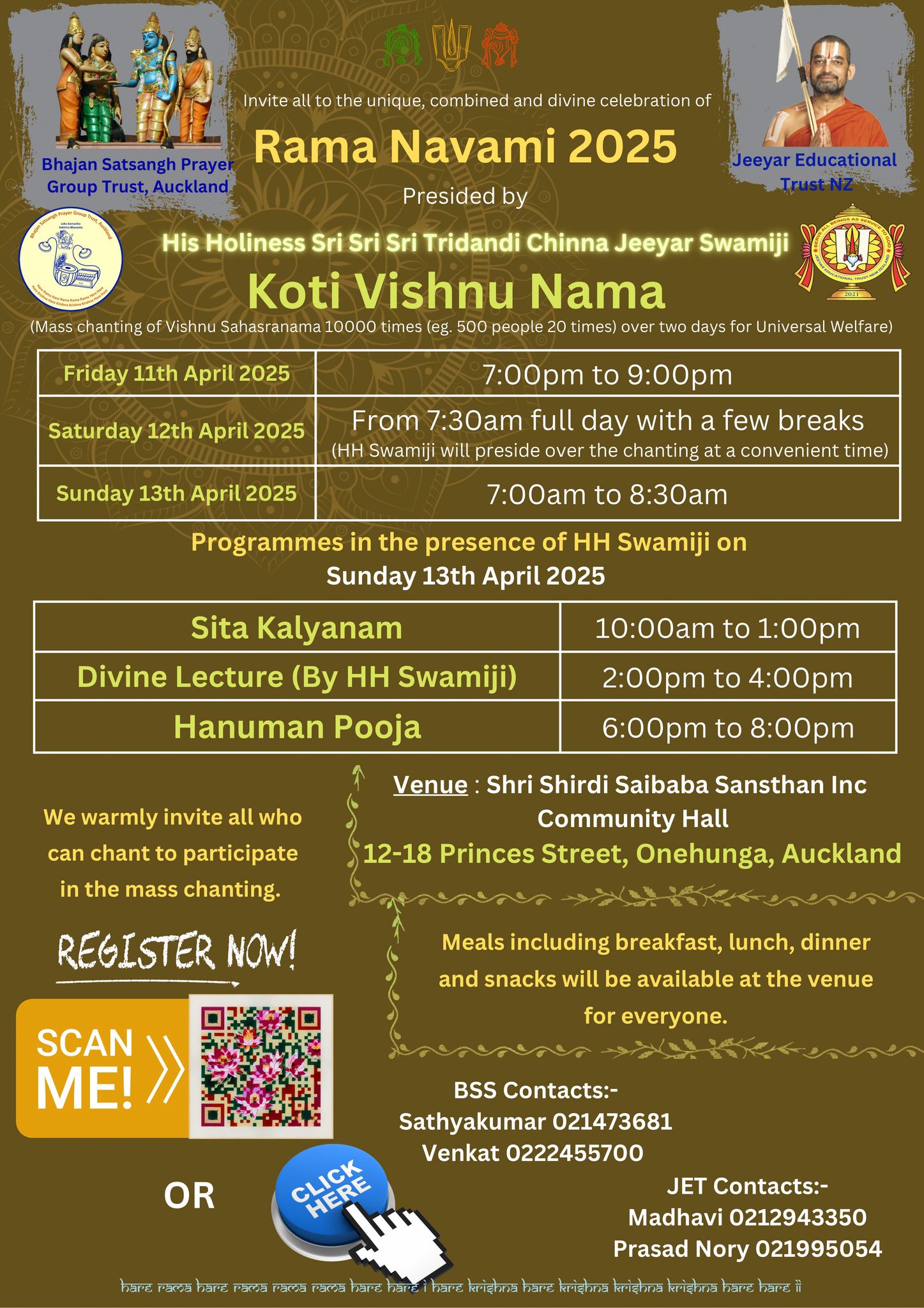
A Divine Invitation to Auckland’s Rama Navami 2025
In the vibrant, fast-paced tapestry of Auckland life—where the demands of work, family, and digital overload often leave us breathless—a sacred pause is on the horizon. The Bhajan Satsangh Trust is summoning the community to a transformative celebration of Rama Navami 2025, set for April 11-13 at the Shirdi Sai Sansthan Temple in Onehunga. This isn’t just another event; it’s a spiritual awakening wrapped in the Koti Vishnu Nama Parayanam—a collective chant of Lord Vishnu’s thousand names, the Vishnu Sahasranamam, ten million times—crowned by the Seeta Kalyanam, the divine wedding of Lord Rama and Sita, on April 13, 2025.
Here at New Zealand Bharat News (NZB News), we’re launching a 20-day odyssey today, March 23, 2025, to explore this sacred hymn, unveiling 50 names daily with insights from Adi Shankaracharya, the luminary of Advaita Vedanta. Our series, Chanting Divinity Down Under, isn’t just a countdown to the event—it’s a lifeline for a stressed world. Amid rising mental strain and fractured relationships, these names offer peace, purpose, and a call to action: register for this divine opportunity and let Vishnu’s grace reshape your life.
The Call of Vishnu Sahasranamam – Why It Matters Today
The Vishnu Sahasranamam, gifted to humanity by Sage Vyasa in the Mahabharata, is a celestial symphony of Lord Vishnu’s thousand attributes. Recited by Bhishma to Yudhishthira amidst the battlefield’s aftermath, it’s a testament to resilience, devotion, and the eternal. In Auckland, the Bhajan Satsangh Trust is channeling this power into a communal chant of ten million recitations—a monumental act of unity and upliftment.
But why does this resonate in 2025? Life in New Zealand, like elsewhere, is a pressure cooker. A 2024 report from the New Zealand Mental Health Foundation revealed that 62% of Kiwis battle chronic stress, with relationship tensions and workplace burnout as leading culprits. Enter the Vishnu Sahasranamam: a practice that scripture hails as a path to liberation and science confirms as a stress-buster. Adi Shankaracharya saw these names as portals to the divine; today, they’re tools to quiet the mind, mend bonds, and reclaim balance. Over 20 days, we’ll bridge their ancient wisdom with our modern woes, urging you to join the Auckland event.
Day 1 – The First 50 Names of Vishnu Sahasranamam
Let’s embark on this journey with the first 50 names. Each carries a direct meaning, a profound interpretation from Shankaracharya, and a practical anchor for today’s challenges—stress, disconnection, and the search for meaning.
- Vishvam – The Universe
Direct Meaning: He who is the entire cosmos.
Shankaracharya’s Insight: Vishnu is the all-pervading reality, the foundation of existence beyond form.
Relevance Today: Overwhelmed by deadlines or family spats? Chanting Vishvam dissolves isolation, reminding us we’re threads in a cosmic fabric—reducing stress through unity. - Vishnuh – The Pervader
Direct Meaning: He who permeates everything.
Shankaracharya’s Insight: His omnipresence sustains every particle, animate and inanimate.
Relevance Today: When trust wanes in relationships, this name restores faith in a protective divine force, calming anxious hearts. - Vashatkara – He Who is Invoked
Direct Meaning: The one called upon in Vedic rituals.
Shankaracharya’s Insight: Vishnu responds to heartfelt devotion, ever accessible.
Relevance Today: Feeling unheard? Invoke Him at the Auckland chant—your voice will join a chorus of healing. - Bhuta-bhavya-bhavat-prabhuh – Lord of Past, Present, and Future
Direct Meaning: Master of all time.
Shankaracharya’s Insight: Beyond temporal limits, He offers eternal refuge.
Relevance Today: Worried about tomorrow’s uncertainties? This name roots us in the present, easing overthinking. - Bhutakrit – Creator of Beings
Direct Meaning: He who births all life.
Shankaracharya’s Insight: Creation is His divine play, willed into being.
Relevance Today: Gratitude for existence counters despair—a mood-lifter for tough days. - Bhutabhrit – Sustainer of Beings
Direct Meaning: He who nourishes all.
Shankaracharya’s Insight: His sustenance is boundless and unconditional.
Relevance Today: Lean on Him during financial or emotional strain—relief is near. - Bhavah – The Existence
Direct Meaning: Pure being itself.
Shankaracharya’s Insight: Vishnu is Sat, the unchanging truth beneath all.
Relevance Today: Meditation on this steadies a restless mind amid chaos. - Bhutatma – Soul of All Beings
Direct Meaning: The indweller of all.
Shankaracharya’s Insight: He unites all souls in non-dual oneness.
Relevance Today: Sparks empathy, softening relationship friction. - Bhuta-bhavanah – Nurturer of Beings
Direct Meaning: He who fosters growth.
Shankaracharya’s Insight: His grace propels spiritual and worldly evolution.
Relevance Today: Stuck in a rut? This name inspires progress and hope. - Putatma – Pure Soul
Direct Meaning: He of untainted essence.
Shankaracharya’s Insight: Purity defines His being, untouched by flaws.
Relevance Today: Cleanses negativity, refreshing a cluttered mind. - Paramatma – Supreme Soul
Direct Meaning: The ultimate consciousness.
Shankaracharya’s Insight: Beyond individual souls, He is the all-encompassing Self.
Relevance Today: Rises above petty disputes, offering perspective. - Muktanam Parama Gatih – Goal of the Liberated
Direct Meaning: The destination of free souls.
Shankaracharya’s Insight: Liberation is union with Him.
Relevance Today: A beacon of hope beyond daily struggles. - Avyayah – Imperishable
Direct Meaning: He who never decays.
Shankaracharya’s Insight: Eternal amidst flux, He endures.
Relevance Today: Comforts us in a world of constant change. - Purushah – The Cosmic Person
Direct Meaning: The universal being.
Shankaracharya’s Insight: He embodies all existence, the cosmic blueprint.
Relevance Today: Unites us in shared humanity, easing division. - Sakshi – Witness
Direct Meaning: The observer of all.
Shankaracharya’s Insight: Detached yet aware, He sees without judgment.
Relevance Today: Teaches mindfulness—respond, don’t react. - Kshetrajnah – Knower of the Field
Direct Meaning: He who knows the body and world.
Shankaracharya’s Insight: Master of both matter and consciousness.
Relevance Today: Balances physical and mental health awareness. - Aksharah – Indestructible
Direct Meaning: He who is beyond destruction.
Shankaracharya’s Insight: The imperishable essence of reality.
Relevance Today: Offers stability in life’s upheavals. - Yogah – The Path of Yoga
Direct Meaning: He who is yoga itself.
Shankaracharya’s Insight: Union with Him is the goal of all yogic paths.
Relevance Today: Guides us to inner peace through practice. - Yoga-vidam Neta – Leader of Yogis
Direct Meaning: The guide of those who know yoga.
Shankaracharya’s Insight: He leads seekers to liberation.
Relevance Today: A mentor for those seeking purpose. - Pradhana-purusha-ishvarah – Lord of Matter and Spirit
Direct Meaning: Ruler of Prakriti (nature) and Purusha (soul).
Shankaracharya’s Insight: He harmonizes the dualities of existence.
Relevance Today: Balances work-life stress with spiritual calm. - Narasimha-vapuh – Man-Lion Form
Direct Meaning: He of the Narasimha incarnation.
Shankaracharya’s Insight: Ferocity to protect, tenderness to bless.
Relevance Today: Courage to face fears, protection in vulnerability. - Shriman – Abode of Lakshmi
Direct Meaning: He with Goddess Lakshmi.
Shankaracharya’s Insight: Prosperity and grace reside in Him.
Relevance Today: Attracts abundance, easing financial worry. - Keshava – Radiant-haired / Slayer of Keshi
Direct Meaning: He with beautiful hair or demon-slayer.
Shankaracharya’s Insight: Beauty and power in one.
Relevance Today: Inner strength to conquer personal demons. - Purushottamah – Supreme Person
Direct Meaning: The highest being.
Shankaracharya’s Insight: The pinnacle of perfection.
Relevance Today: Aspiration to rise above mediocrity. - Sarvah – All
Direct Meaning: He who is everything.
Shankaracharya’s Insight: Nothing exists apart from Him.
Relevance Today: Embraces all, dissolving exclusion. - Sharvah – Destroyer of Evil
Direct Meaning: He who eliminates negativity.
Shankaracharya’s Insight: Purifier of the cosmos.
Relevance Today: Clears mental clutter and toxic patterns. - Shivah – Auspicious
Direct Meaning: He who is ever-blessed.
Shankaracharya’s Insight: Source of all goodness.
Relevance Today: Infuses positivity into a gloomy day. - Sthanuh – Immutable
Direct Meaning: He who is steadfast.
Shankaracharya’s Insight: Unshaken by change.
Relevance Today: A rock amid life’s storms. - Bhutadih – Origin of Elements
Direct Meaning: Source of all creation.
Shankaracharya’s Insight: The primal cause.
Relevance Today: Connects us to nature’s roots, grounding us. - Nidhih Avyayah – Imperishable Treasure
Direct Meaning: The eternal wealth.
Shankaracharya’s Insight: Infinite riches of the spirit.
Relevance Today: True wealth beyond material loss. - Sambhavah – Self-existent
Direct Meaning: He who arises from Himself.
Shankaracharya’s Insight: Independent of all causes.
Relevance Today: Self-reliance in a dependent world. - Bhavanah – Bestower of Existence
Direct Meaning: He who grants being.
Shankaracharya’s Insight: Life flows from His will.
Relevance Today: Appreciation for every breath. - Bhartah – Supporter
Direct Meaning: He who upholds all.
Shankaracharya’s Insight: The cosmic pillar.
Relevance Today: Support when we feel alone. - Prabhavah – Source of Creation
Direct Meaning: The origin of all.
Shankaracharya’s Insight: The first cause of manifestation.
Relevance Today: Creativity sparked anew. - Prabhuh – Lord
Direct Meaning: The supreme ruler.
Shankaracharya’s Insight: Sovereign of all realms.
Relevance Today: Surrender control, find peace. - Ishvarah – Controller
Direct Meaning: He who governs.
Shankaracharya’s Insight: Master of destiny.
Relevance Today: Trust in a higher plan. - Svayambhuh – Self-born
Direct Meaning: He who is uncaused.
Shankaracharya’s Insight: The unoriginated origin.
Relevance Today: Freedom from external validation. - Shambhuh – Giver of Happiness
Direct Meaning: He who bestows joy.
Shankaracharya’s Insight: Bliss is His gift.
Relevance Today: A smile amid sorrow. - Adityah – Son of Aditi
Direct Meaning: Born of the infinite mother.
Shankaracharya’s Insight: Radiance of divinity.
Relevance Today: Light in dark times. - Pushkarakshah – Lotus-eyed
Direct Meaning: He with eyes like lotuses.
Shankaracharya’s Insight: Beauty and compassion in His gaze.
Relevance Today: Seeing love in others’ eyes. - Mahasvanah – Great Sound
Direct Meaning: He of mighty voice.
Shankaracharya’s Insight: The cosmic Om.
Relevance Today: Chanting heals through vibration. - Anadi-nidhanah – Without Beginning or End
Direct Meaning: Eternal in essence.
Shankaracharya’s Insight: Timeless reality.
Relevance Today: Eternity calms fleeting fears. - Dhata – Creator
Direct Meaning: He who creates.
Shankaracharya’s Insight: The artisan of existence.
Relevance Today: Inspiration for new beginnings. - Vidhata – Dispenser of Destiny
Direct Meaning: He who assigns fates.
Shankaracharya’s Insight: Architect of life’s script.
Relevance Today: Acceptance of life’s flow. - Dhatur-uttamah – Supreme Creator
Direct Meaning: The highest maker.
Shankaracharya’s Insight: Pinnacle of creative power.
Relevance Today: Excellence in all we do. - Aprameyah – Immeasurable
Direct Meaning: Beyond comprehension.
Shankaracharya’s Insight: Infinite and unknowable.
Relevance Today: Humility before the vast. - Hrishikeshah – Lord of Senses
Direct Meaning: Master of perception.
Shankaracharya’s Insight: Controller of mind and body.
Relevance Today: Calm amidst sensory overload. - Padmanabhah – Lotus-naveled
Direct Meaning: He from whose navel springs creation.
Shankaracharya’s Insight: The womb of the universe.
Relevance Today: Nurturing life’s potential. - Amaraprabhuh – Lord of Immortals
Direct Meaning: Ruler of the deathless.
Shankaracharya’s Insight: Sovereign of eternal beings.
Relevance Today: Aspiration for lasting peace. - Vishvakarma – Architect of the Universe
Direct Meaning: The cosmic designer.
Shankaracharya’s Insight: Crafter of all that is.
Relevance Today: Order in a chaotic world.
Spiritual Significance – A Pathway to Inner Peace
The Vishnu Sahasranamam is a spiritual alchemy. Shankaracharya’s Advaita lens reveals Vishnu as the non-dual truth—chanting His names dismantles the illusion of separateness, merging us with the infinite. Each name, from Vishvam to Vishvakarma, awakens a divine quality within—compassion, strength, serenity—leading to self-realization.
In Auckland, the Koti Nama magnifies this. Ten million chants create a sonic tapestry, a collective prayer that purifies karma and elevates consciousness. For the spiritually inclined, it’s a direct line to Rama, Vishnu’s avatar of dharma, whose life teaches resilience amid trials. For the weary soul—be it a parent juggling kids or an expat missing home—this is a sanctuary of renewal.
Well-being in a Stressed World – The Science and Soul Connection
Science echoes scripture here. Chanting regulates breathing, lowers blood pressure, and soothes the nervous system—proven antidotes to stress. A 2023 University of Auckland study found group chanting boosts oxytocin, the “bonding hormone,” repairing strained relationships. Picture this at Onehunga: voices in unison, dissolving tension into harmony.
Take Shambhuh (Giver of Happiness)—its repetition shifts focus from external woes to inner joy. For couples at odds or workers on edge, these names are practical medicine. The Seeta Kalyanam on April 13 mirrors this—Rama and Sita’s union symbolizes the balance we seek in our lives, a harmony born of love and duty.
The Auckland Event – A Once-in-a-Lifetime Opportunity
The Bhajan Satsangh Trust’s vision is audacious: unite Auckland’s diverse community—Indian diaspora and beyond—in a chant that reverberates globally. From April 11-13, 2025, the Shirdi Sai Sansthan Temple will pulse with daily recitations, peaking with the Seeta Kalyanam. Open to all, free of charge, it’s a celebration of inclusivity and devotion.
Why join? This isn’t just ritual—it’s revolution. It’s a chance to shed stress, heal bonds, and contribute to a universal prayer. The Trust urges early registration to ensure your place in this historic Koti Nama. Bring your struggles, your dreams—let them dissolve in Vishnu’s names.
Call to Action – Join the Journey
This is Day 1 of Chanting Divinity Down Under. Over 19 more days, we’ll unveil all 1000 names, priming you for April 11. Don’t wait—register now and claim your spot. Bring your loved ones, your burdens, your hopes. Let the Vishnu Sahasranamam turn stress into serenity, disconnection into unity.
Tomorrow, March 24, 2025, we’ll explore names 51-100. Stay tuned to NZB News for this sacred countdown, and let’s chant our way to Rama Navami 2025 together.