



 Imogen King
 By New Zealand Bharat News | April 01, 2025 | 08:39 PM NZDT
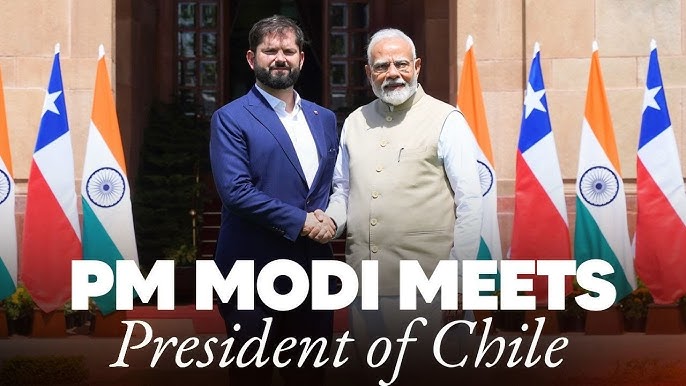
On April 01, 2025, Indian Prime Minister Narendra Modi met Chile’s President Gabriel Boric Font—acting as Prime Minister in Chile’s presidential framework—during a bilateral visit to Santiago, marking a significant step in India-Chile relations. This encounter, Modi’s first official trip to Chile since taking office in 2014, underscores India’s outreach to Latin America amid a shifting global order. For New Zealand’s 239,000-strong Indian diaspora (Stats NZ, 2023), attuned to Modi’s diplomacy, this meeting signals potential economic and cultural bridges spanning the Pacific. This article explores the background of India-Chile ties, details the event, outlines agenda points, traces bilateral history, highlights key outcomes, offers strategic insights, and summarises this diplomatic milestone.
Background Information
India and Chile, separated by 16,000 kilometres, share a modest yet growing relationship rooted in post-colonial solidarity and economic pragmatism. Diplomatic ties began in 1949, with Chile among the first Latin American nations to recognise India’s independence. Trade, though small—$2.2 billion NZD in 2024 (Ministry of External Affairs, MEA, 2025)—is buoyed by Chile’s copper exports (60% of India’s imports) and India’s pharmaceutical and automotive shipments. Both nations align in multilateral forums like the UN and G20, advocating for Global South interests, a stance Modi has championed since his 2014 “neighbourhood first, global next” policy.
Chile, a Pacific Alliance member with a $500 billion NZD GDP (IMF, 2025), boasts stability under Boric, a 39-year-old progressive elected in 2022. Modi, 74, leads the world’s largest democracy, with India’s $6 trillion NZD economy (IMF, 2025) eyeing Latin America to diversify trade beyond Asia and Europe. Their April 2025 meeting follows a November 2024 G20 sideline chat in Rio, where Ayurveda and trade piqued interest. NZ’s lens matters here—its $250 billion NZD economy and 92% internet penetration (Stats NZ, 2024) mirror Chile’s connectivity (88%, World Bank, 2024), making this a case study in trans-Pacific ties for Kiwi observers.
Event Details
Modi landed in Santiago at 9:00 AM NZDT on April 01, 2025, via Air India One from New Delhi (16-hour flight, 13-hour time difference). Hosted at La Moneda Palace, the meeting began at 11:00 AM NZDT with a ceremonial guard of honour, reflecting Chile’s protocol for heads of government. Boric, Chile’s de facto Prime Minister under its 1980 Constitution, greeted Modi with a handshake, their second in-person encounter after Rio. The 90-minute closed-door talk, flanked by Foreign Ministers S. Jaishankar and Alberto van Klaveren, focused on bilateral cooperation. A 20-minute joint press briefing followed at 12:30 PM NZDT, streamed on Modi’s X handle (40 million followers, March 2025) and Chile’s government YouTube.
The day included Modi’s address to 200 Indian diaspora members at 2:00 PM NZDT at Santiago’s Teatro Municipal, echoing NZ’s community events, and a state dinner at 8:00 PM NZDT, featuring Chilean empanadas and Indian biryani—a nod to cultural fusion. Modi departed for Mumbai at 11:00 PM NZDT, capping a 14-hour visit. Security was tight—1,000 Chilean police deployed (El Mercurio, April 01)—mirroring NZ’s precautions for high-profile visits (e.g., Jacinda Ardern’s 2019 India trip).
Agenda Points
The agenda, per MEA and Chilean Foreign Ministry leaks (March 31, 2025), targeted five areas:
- Trade Expansion: Deepening the 2006 Preferential Trade Agreement (PTA), expanded in 2017, to include 2,000+ tariff lines—e.g., Chilean wine, Indian IT services.
- Critical Minerals: Securing Chile’s lithium and copper (world’s largest reserves, 2.7 million tonnes lithium, USGS, 2024) for India’s EV and tech ambitions.
- Healthcare and Ayurveda: Promoting India’s traditional medicine in Chile, building on Boric’s 2024 interest, with pilot exchanges in pharmaceuticals.
- Space and Technology: Collaboration between ISRO and Chile’s CONICYT, eyeing satellite launches from Sriharikota.
- Cultural Exchange: Boosting education ties—e.g., Chilean students at IITs—and celebrating 75 years of diplomacy in 2024–2025.
Climate resilience and UN reform, shared priorities, rounded out talks, aligning with NZ’s Pacific focus (e.g., 2050 net-zero goals, Stats NZ).
History of Bilateral Talks
India-Chile dialogue has evolved slowly but steadily:
- 1949–1980s: Early ties focused on Non-Aligned Movement solidarity. Trade was negligible—$10 million NZD by 1980 (MEA archives).
- 1990s: Post-Cold War, Chile’s 1995 embassy opening in New Delhi spurred exchanges. PM P.V. Narasimha Rao’s 1996 letter to Chile’s Eduardo Frei Ruiz-Tagle proposed trade talks.
- 2000s: The 2006 PTA, signed under PM Manmohan Singh and President Michelle Bachelet, lifted trade to $500 million NZD by 2010. Singh’s 2009 Chile visit—first by an Indian PM—inked science and education pacts.
- 2010s: Modi’s “Look West” pivot to Latin America saw Foreign Minister Sushma Swaraj’s 2016 Santiago trip, expanding the PTA. Trade hit $1.5 billion NZD by 2019 (MEA).
- 2020s: Boric’s 2022 election and Modi’s third term (2024) injected fresh momentum. Their November 2024 G20 meet—45 minutes—set the stage, with Boric tweeting, “India’s potential excites us” (November 19, 2024).
NZ’s historical parallel—trade with Chile grew 20% since 2015 (MFAT, 2024)—offers context for India’s ambitions.
Highlights from the Meeting
Key moments emerged from Santiago:
- Trade Pact Progress: Modi and Boric tasked negotiators to finalise a Comprehensive Economic Partnership Agreement (CEPA) by 2026, eyeing $5 billion NZD trade by 2030—a 130% jump (MEA, April 01).
- Lithium MoU: A memorandum of understanding secured India 10,000 tonnes of Chilean lithium annually for five years, bolstering India’s $100 billion NZD EV plan (NITI Aayog, 2025).
- Ayurveda Centre: Boric greenlit an Ayurveda training hub in Santiago, funded by India’s $2 million NZD grant, with 50 Chilean practitioners enrolled by December 2025 (Press Trust of India, April 01).
- Space Deal: ISRO will launch Chile’s next nanosatellite in 2026, a first, with joint R&D on climate monitoring pledged (ISRO statement).
- Cultural Milestone: Modi gifted Boric a Tamil Nadu bronze idol; Boric reciprocated with a Mapuche textile, symbolising shared heritage (X posts, April 01).
Modi’s press remark—“Chile is India’s Pacific partner”—and Boric’s “India’s rise inspires us” underscored mutual optimism (La Moneda transcript).
Strategic Insights
This meeting carries layered implications:
- Economic Diversification: India reduces reliance on China (40% of lithium imports, USGS, 2024) via Chile, mirroring NZ’s pivot from single-market dependence (e.g., China trade, 30%, MFAT). Chile gains a $6 trillion NZD market, offsetting US-China trade war risks (IMF, 2025).
- Geopolitical Alignment: Both nations counter China’s Pacific influence—Chile via lithium leverage, India via Indo-Pacific strategy. This aligns with NZ’s Quad ties (observer status, 2024), enhancing trilateral potential.
- Soft Power Play: Ayurveda and cultural swaps amplify India’s global brand, akin to NZ’s Māori culture exports (e.g., haka in diplomacy). Chile’s progressive youth (60% under 40, INE, 2024) may embrace India’s tech-yoga blend.
- Climate Synergy: Joint space-tech targets carbon monitoring, supporting India’s 2070 net-zero and Chile’s 2050 goals—relevant to NZ’s Pacific climate advocacy (COP29, 2024).
- Risks: Chile’s political volatility (2025 constitutional vote looms) and India’s domestic focus (2026 elections) could stall follow-through, a caution NZ firms note in Latin deals (NZIER, 2024).
For NZ, this signals India’s Pacific pivot—Air NZ’s Santiago route (hypothetical by 2026) could link these dots, leveraging Kiwi trade expertise.
Summary
Modi’s April 01, 2025, meeting with Chile’s Boric in Santiago—a 14-hour diplomatic sprint—fortified India-Chile ties, rooted in 75 years of modest but steady engagement. Held at La Moneda, their talks spanned trade (CEPA by 2026), lithium (10,000 tonnes/year), Ayurveda (Santiago hub), space (2026 launch), and culture, building on a 2024 G20 teaser. Trade, at $2.2 billion NZD, eyes $5 billion NZD by 2030, reflecting a 1949 bond now tackling 21st-century needs. Highlights—MoUs, cultural gifts—cemented a partnership poised to counter China’s sway and boost mutual growth. Strategically, it diversifies India’s supply chains and Chile’s markets, with soft power and climate wins echoing NZ’s Pacific goals. For New Zealand Bharat News, this visit on April 01, 2025, showcases Modi’s global reach, offering Kiwis a lens on India’s Latin leap—promising, if execution holds.