



 Imogen King
 Trump administration hints at uranium extraction operation as regional powers scramble and diplomatic channels narrow in West Asia’s most dangerous confrontation in decades.
By Imogen King
Political Science and International Affairs Writer
Zealandia News
March 31, 2026 — WASHINGTON D.C.
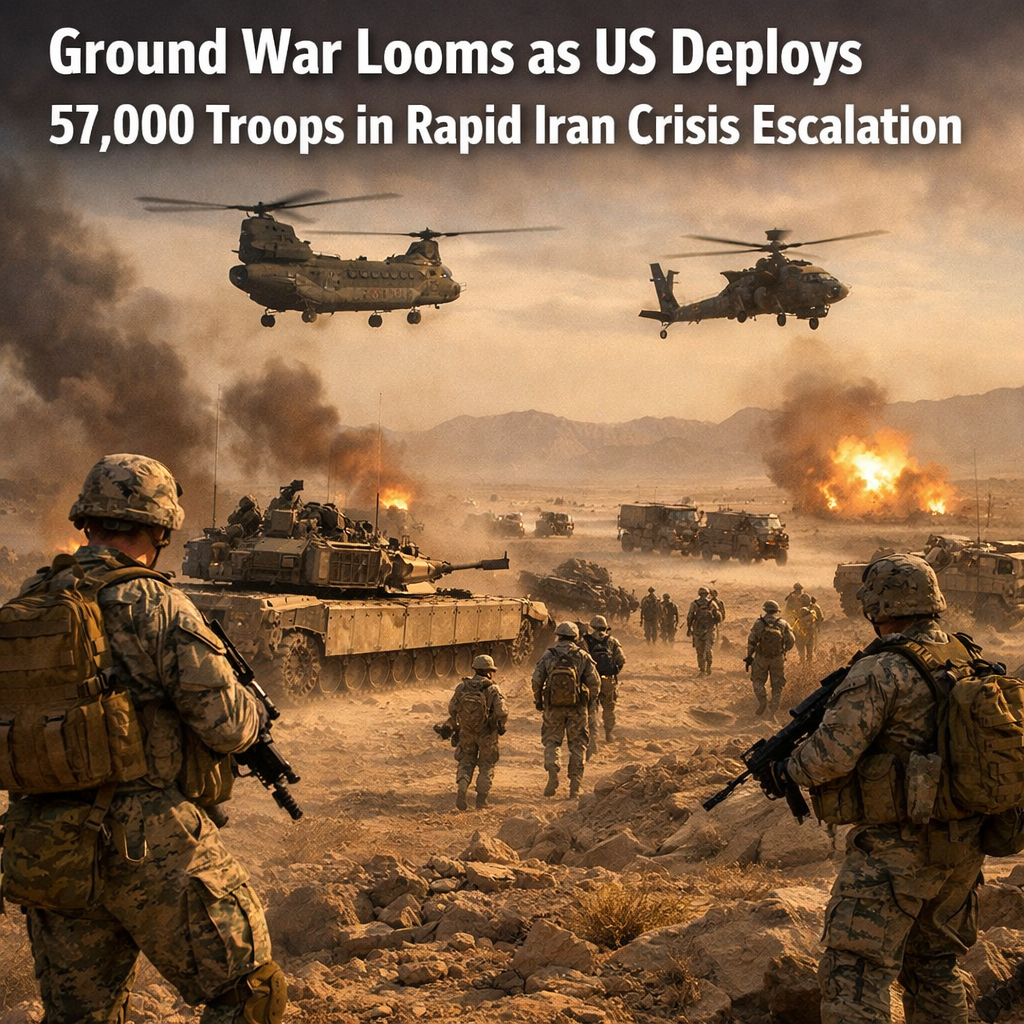
The United States has rushed 57,000 troops to the West Asia region as tensions with Iran reach a critical juncture, with reports emerging that the Trump administration is considering a ground operation to extract hundreds of kilograms of enriched uranium from Iranian nuclear facilities. The rapid military buildup, confirmed by multiple defence sources, marks one of the largest American force deployments to the region since the 2003 invasion of Iraq and signals a dramatic escalation in the already volatile confrontation.
The deployment comes just days after President Donald Trump suggested he had received a “gift” from Iranian Parliament Speaker Mohammad Bagher Ghalibaf, a remark interpreted by analysts as hinting at a potential seizure of Iran’s Kharg Island oil terminal. The cryptic statement, made during a public appearance over the weekend, has fuelled speculation that the administration is preparing for a direct military strike aimed at crippling Iran’s energy infrastructure and nuclear programme in a single, decisive blow.
According to intelligence sources cited in international media, the planned operation would target Iran’s uranium stockpile, estimated to exceed 400 kilograms of material enriched to levels approaching weapons-grade. The extraction mission, if executed, would represent an unprecedented direct confrontation with Iranian forces and risks triggering a wider regional war involving Tehran’s network of allied militias across Lebanon, Syria, Iraq, and Yemen.
Iran’s Defiant Stance
Iranian officials have responded with characteristic defiance. Speaker Ghalibaf, in remarks directed at American investors, offered a pointed warning about the consequences of military action on global energy markets. “If they pump it,” Ghalibaf said, referring to Iranian oil, “they will need to consider the price.”
The speaker’s comments reflect Tehran’s calculation that its primary leverage lies in its ability to disrupt shipping through the Strait of Hormuz, through which approximately one-fifth of the world’s petroleum passes. Any sustained military conflict would almost certainly trigger a sharp spike in global oil prices, with potentially destabilising effects on already fragile world economies.
Iran’s Supreme Leader Ayatollah Ali Khamenei has not yet addressed the nation directly on the latest escalation, but state media outlets have framed the American deployment as a “bluff” and warned that any attack would be met with “overwhelming retaliation” targeting US assets throughout the region.
Regional Alliances Tested
The crisis has placed America’s regional allies in an acutely difficult position. Saudi Arabia and the United Arab Emirates, while deeply hostile to Tehran’s regional ambitions, have shown little appetite for being drawn into a direct military confrontation that could see their own infrastructure targeted by Iranian missiles and proxy forces.
Israel, long considered the most likely regional actor to initiate military action against Iran’s nuclear programme, is watching the American buildup with intense interest. Reports suggest Israeli intelligence has been sharing target data with US Central Command, though Israeli officials have declined to comment publicly on whether they would participate in any American-led operation.
Hezbollah, Iran’s most powerful proxy, has reportedly reached out through diplomatic channels seeking India’s potential role in de-escalating the conflict. The Lebanese militant group, which fought a devastating war with Israel in 2006 and has since amassed an arsenal of precision-guided missiles, has maintained open lines of communication with New Delhi, which maintains diplomatic relations with both Tehran and Washington.
Russian Calculations
The crisis has also drawn in Russia, with Ukrainian President Volodymyr Zelensky alleging that Moscow provided intelligence support to Iranian targeting of US bases in the region. The claim, if verified, would represent a significant escalation in the shadow war between Washington and Moscow, potentially opening a second front in the already strained relationship between the nuclear powers.
Kremlin spokesman Dmitry Peskov declined to comment on Zelensky’s allegations, stating only that Russia “supports stability in the Gulf region and urges all parties to exercise restraint.” However, Russian naval vessels have been observed shadowing US Navy carrier strike groups in the Arabian Sea, raising concerns about potential miscalculation or direct confrontation between the two militaries.
Diplomatic Pathways Narrow
Efforts to de-escalate through diplomatic channels have so far yielded little progress. The United Nations Security Council held an emergency session over the weekend, but members remained deeply divided, with Russia and China blocking any statement that would explicitly condemn Iran or endorse the American military posture.
European allies, while publicly supportive of America’s right to defend its interests, have privately expressed alarm at the speed and scale of the military buildup. Several European foreign ministers have urged the Trump administration to exhaust diplomatic options before launching any strike, warning that the consequences of a full-scale war with Iran would be catastrophic for the region and the global economy.
The International Atomic Energy Agency, whose inspectors have been monitoring Iran’s nuclear facilities under the terms of the 2015 nuclear agreement from which the US withdrew in 2018, has called for unimpeded access to all sites. IAEA Director General Rafael Grossi warned that military action against nuclear facilities would carry “unacceptable radiological risks” and urged all parties to allow inspectors to continue their work.
Nuclear Proliferation Fears
The crisis has revived fears of nuclear proliferation across the Middle East. Analysts warn that a US strike on Iranian facilities would almost certainly drive Tehran to withdraw from the Nuclear Non-Proliferation Treaty and accelerate efforts to produce a nuclear weapon, a capability it has consistently denied seeking.
Saudi Arabia, which has long signalled its intention to pursue a civilian nuclear programme, would face renewed pressure to consider its own weapons option. Turkish President Recep Tayyip Erdoğan has already hinted that Ankara would not accept a nuclear monopoly in the region, raising the spectre of a cascade of proliferation across the most volatile region on earth.
In Brief
The deployment of 57,000 American troops to West Asia represents a significant escalation in the long-simmering confrontation between Washington and Tehran. With reports of a planned ground operation to extract Iran’s enriched uranium stockpile and the president hinting at oil infrastructure strikes, the region stands on the brink of a war that could dwarf the conflicts of the past two decades.
Diplomatic pathways remain open but narrowing rapidly. The involvement of Russia, the concerns of European allies, and the potential for nuclear proliferation all add layers of complexity to a crisis that may soon reach a point of no return. For the hundreds of thousands of Indian expatriates living and working across the Gulf, the stakes could not be higher.