 Vinay Karanam
 Excerpt
Green Net Present Value (GNPV) is transforming how organisations evaluate investments by integrating environmental impacts-especially carbon emissions-directly into financial analysis. This article explores the mechanics of GNPV, how it differs from traditional NPV, and demonstrates its application through a real-world-inspired renewable energy project case study.
Understanding Net Present Value (NPV) and Its Green Evolution
What Is NPV?
Net Present Value (NPV) is a foundational concept in project finance and investment analysis. It calculates the present value of all expected future cash flows-both inflows and outflows-discounted at a rate that reflects the project’s risk and the time value of money. The basic formula is:

Where:
- Ct = net cash flow at time tt
- r = discount rate (reflecting required rate of return or cost of capital)
- t = time period (years)
A positive NPV indicates a project is expected to generate value above its cost and is typically considered viable. A negative NPV suggests the opposite.
The Shift to Green NPV (GNPV)
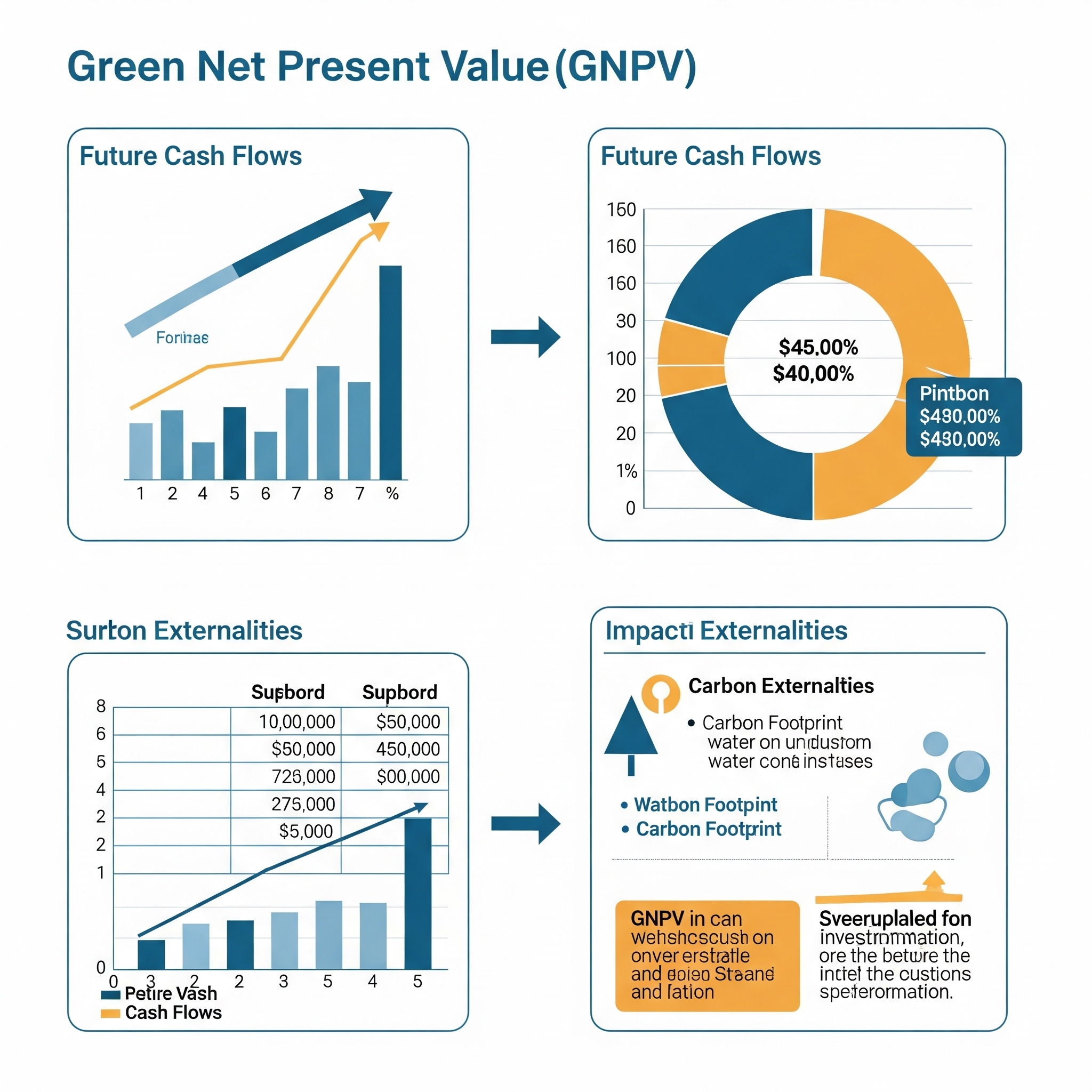
Traditional NPV focuses solely on financial cash flows. Green NPV (GNPV) extends this by explicitly incorporating the costs and benefits associated with environmental impacts-most notably, carbon emissions. This means GNPV adjusts future cash flows for:
- Carbon costs: Taxes, trading scheme costs, or internal carbon pricing for emissions.
- Green incentives: Subsidies, grants, or revenue from green certificates.
- Risk adjustments: Changes in discount rates or cash flows to reflect climate-related risks or regulatory changes.
By integrating these factors, GNPV aligns investment decisions with both financial and sustainability goals.
GNPV: Calculation and Components
Step 1: Identify All Relevant Cash Flows
- Traditional cash flows: Revenues, operating costs, capital expenditures, maintenance, etc.
- Carbon-related outflows: Anticipated carbon taxes, costs of emission allowances, penalties for exceeding emission caps.
- Green-related inflows: Government incentives, carbon credits, renewable energy certificates, or cost savings from lower emissions.
Step 2: Apply an Appropriate Discount Rate
The discount rate should reflect not only financial risk but also climate and regulatory risk. Some organisations use a lower discount rate for green projects to reflect their strategic value or reduced long-term risk.
Step 3: Calculate Present Value of Each Cash Flow
Discount each future cash flow (positive or negative) to its present value using the selected discount rate.
Step 4: Sum All Present Values
Add up all discounted cash flows-including both traditional and green components-to determine the GNPV.
Case Study: GNPV Analysis of a Solar Power Plant
Project Overview
A company is considering investing in a 10 MW solar photovoltaic (PV) plant. The project will replace electricity that would otherwise be generated from a coal-fired power plant.
Key Assumptions
- Initial investment: $10 million (Year 0)
- Project lifetime: 20 years
- Annual electricity generation: 18,000 MWh
- Electricity sale price: $60/MWh
- Annual O&M costs: $100,000
- Discount rate: 7%
- Carbon price: $50/tonne CO₂ (applies to emissions avoided)
- Grid emission factor: 0.9 tCO₂/MWh (coal baseline)
- Government green incentive: $10/MWh for renewable generation
Step 1: Estimate Traditional Cash Flows
Revenue from Electricity Sales
Annual revenue=18,000 MWh×$60=$1,080,000Annual revenue=18,000 MWh×$60=$1,080,000
Operating Costs
Annual O&M cost=$100,000Annual O&M cost=$100,000
Net Cash Flow (before green adjustments)
Net cash flow=$1,080,000−$100,000=$980,000Net cash flow=$1,080,000−$100,000=$980,000
Step 2: Quantify Green Cash Flows
Carbon Credits (Emissions Avoided)
Annual CO2 avoided=18,000 MWh×0.9=16,200 tCO2Annual CO2 avoided=18,000 MWh×0.9=16,200 tCO2Value of carbon credits=16,200×$50=$810,000Value of carbon credits=16,200×$50=$810,000
Government Green Incentive
Annual green incentive=18,000 MWh×$10=$180,000Annual green incentive=18,000 MWh×$10=$180,000
Total Green Cash Inflows
Total green inflow=$810,000+$180,000=$990,000Total green inflow=$810,000+$180,000=$990,000
Step 3: Calculate Total Annual Net Cash Flow
Total annual net cash flow=$980,000+$990,000=$1,970,000Total annual net cash flow=$980,000+$990,000=$1,970,000
Step 4: Discount All Cash Flows to Present Value
The present value (PV) of an annual cash flow over 20 years at a 7% discount rate is calculated using the present value of an annuity formula:PV=CF×1−(1+r)−nrPV=CF×r1−(1+r)−n
Where:
- CF=$1,970,000CF=$1,970,000
- r=0.07r=0.07
- n=20n=20
PV=$1,970,000×1−(1+0.07)−200.07PV=$1,970,000×0.071−(1+0.07)−20PV=$1,970,000×10.594PV=$1,970,000×10.594PV≈$20,857,180PV≈$20,857,180
Step 5: Subtract Initial Investment
GNPV=PVtotal inflows−Initial investmentGNPV=PVtotal inflows−Initial investmentGNPV=$20,857,180−$10,000,000=$10,857,180GNPV=$20,857,180−$10,000,000=$10,857,180
Step 6: Compare with Traditional NPV
If only traditional cash flows were considered (no carbon credits or green incentives):PV of traditional cash flows=$980,000×10.594=$10,381,120PV of traditional cash flows=$980,000×10.594=$10,381,120Traditional NPV=$10,381,120−$10,000,000=$381,120Traditional NPV=$10,381,120−$10,000,000=$381,120
Interpretation
- Traditional NPV: $381,120 (barely profitable)
- GNPV: $10,857,180 (highly attractive due to green value streams)
Insights from the Case Study
The Power of Green Value Streams
This example shows how GNPV can dramatically change investment decisions. The solar project, only marginally profitable on electricity sales alone, becomes a highly attractive investment once carbon credits and green incentives are included. This demonstrates the real financial value of emissions reductions and climate-aligned policy.
Sensitivity to Carbon Price and Policy
If the carbon price drops or green incentives are removed, the GNPV falls. Conversely, higher carbon prices or additional green premiums (such as renewable energy certificates) make green projects even more competitive.
Risk and Discount Rate
Some investors may apply a lower discount rate to green projects, reflecting their lower regulatory and reputational risk, further boosting GNPV.
Practical Applications of GNPV
Corporate Capital Budgeting
Companies use GNPV to prioritise projects that not only generate financial returns but also reduce carbon risk and enhance sustainability credentials. This is increasingly important for firms with net zero targets or those seeking ESG investment.
Project Finance and Green Bonds
Banks and investors may require GNPV analysis for green bonds or sustainability-linked loans, ensuring that financed projects deliver measurable environmental benefits.
Policy and Public Sector
Governments use GNPV to evaluate public investments, ensuring taxpayer money is directed toward projects with the greatest climate and social impact.
Implementing GNPV: Best Practices
- Robust data: Accurate forecasts for emissions, carbon prices, and green incentives are essential.
- Scenario analysis: Test sensitivity to changes in policy, carbon pricing, and technology costs.
- Transparent assumptions: Disclose all inputs and methodologies for credibility.
- Integration into decision-making: Use GNPV alongside traditional financial metrics for a holistic view.
Summary
Green Net Present Value (GNPV) is a powerful tool for aligning investment decisions with both financial and environmental goals. By incorporating carbon costs, green incentives, and climate risks into cash flow analysis, GNPV provides a true picture of a project’s value in a low-carbon economy. As shown in the solar power plant case study, GNPV can reveal the hidden value of green projects and help drive the transition to a sustainable future.