Lara Zijl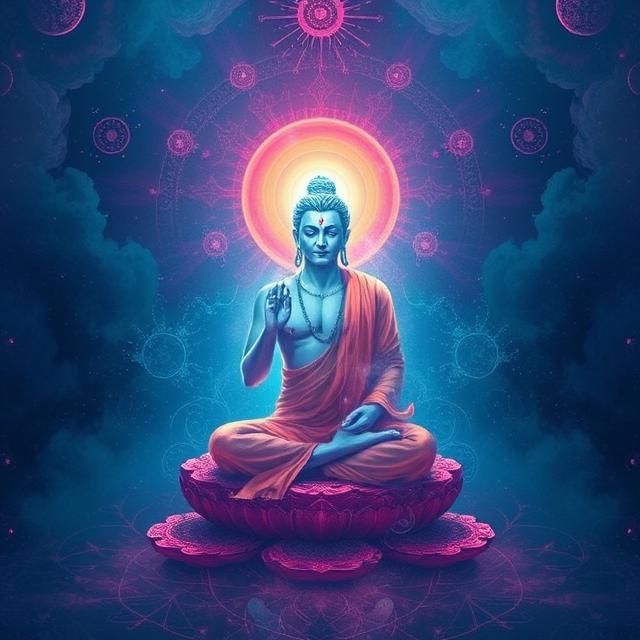
Article 54: “Dharma-jyotir-ādi-karmaṇām aśūnyam”—The Unbroken Chain of Karma and the Soul’s Journey
Introduction: The Next Sutra in the Cosmic Inquiry
The Brahmasutras, in their relentless pursuit of metaphysical clarity, now bring us to a topic that sits at the very heart of Vedantic philosophy: the continuity and inexhaustibility of karma. After exploring the return of the soul from heavenly realms and the role of residual karma, the next logical question arises—does the soul ever exhaust its store of karma, or is this chain truly unbroken? The sutra under discussion addresses this profound question, illuminating the law that governs the fate of every living being.
Let us present the sutra in its classical Sanskrit form:
धर्मज्योति-रादिकर्मणामशून्यम्
dharma-jyotir-ādi-karmaṇām aśūnyam
dharmā-jyotiḥ-ādi-karmaṇām—of virtuous actions, light, and other karmas; aśūnyam—not empty, not exhausted.
Translation:
“The store of virtuous actions, light, and other karmas is never empty.”
Setting the Stage: The Infinite Web of Karma
The previous sutra established that souls return to earthly existence with residual karma after their sojourn in heavenly worlds. This leads to a deeper inquiry: Is there ever a point when the soul’s karma is fully exhausted, allowing it to break free from the cycle of birth and death by its own merit? Or is the chain of karma so vast and intricate that it is, for all practical purposes, inexhaustible?
This question is not merely academic. It touches the core of human existence—our sense of agency, destiny, and the possibility of liberation. The answer provided by the Brahmasutras is both sobering and liberating: the chain of karma, by its very nature, is never empty. The soul’s journey is shaped by an unbroken sequence of actions and their consequences, stretching across countless lifetimes.
The Sutra Unpacked: The Nature of Karma’s Inexhaustibility
धर्मज्योति-रादिकर्मणामशून्यम्
dharma-jyotir-ādi-karmaṇām aśūnyam
This aphorism asserts that the store of karma—comprising both virtuous actions (dharma), experiences of light and joy (jyotiḥ), and all other karmic impressions—is never completely depleted. Even after enjoying the fruits of good deeds in heavenly realms, the soul returns to earth with a storehouse of unresolved karma, which continues to shape its destiny.
This inexhaustibility is not a curse, but a law—a reflection of the moral order that governs the universe. Every action, thought, and intention leaves an imprint on the soul, creating a tapestry of causes and effects that cannot be unraveled by human effort alone.
The Cosmic Implication: Why Karma is Never Exhausted
Why is the store of karma never empty? The answer lies in the infinite complexity of life and the subtlety of the law of karma. Every action generates not only immediate consequences but also subtle tendencies (samskaras) that persist across lifetimes. Even the most virtuous soul, after enjoying the fruits of its merits, returns with a residue of unfulfilled desires, attachments, and impressions.
Moreover, as long as the soul identifies with the body, mind, and ego, it continues to act, think, and desire—thereby generating new karma even as it exhausts the old. The cycle is self-perpetuating, sustained by ignorance (avidya) and the illusion of separateness.
The Dvaita Perspective: The Role of Divine Grace
In Dvaita Vedānta, this inexhaustibility of karma underscores the soul’s dependence on the Supreme Lord. Human effort alone, however heroic, cannot break the chain of karma. Liberation (moksha) is not the result of self-effort or the mere exhaustion of karma, but the gift of divine grace.
The soul, recognizing its helplessness in the face of the infinite web of karma, turns to the Lord in humility and surrender. It is through the Lord’s compassion and grace that the chain is finally broken, and the soul is lifted out of the cycle of birth and death.
Creative Exploration: The Endless Loom
Imagine karma as an endless loom, weaving the fabric of destiny with threads of action, thought, and intention. Each soul is both the weaver and the woven—a participant in the great cosmic tapestry. The loom never stops, the threads never run out, and the pattern is ever-changing.
Yet, there is a master weaver—the Lord—who alone can cut the thread and release the soul from the loom. Until that moment, the weaving continues, beautiful and terrible, intricate and inexhaustible.
Scriptural Resonance: Echoes in the Upanishads and the Gītā
The Upanishads and the Bhagavad Gītā reinforce this teaching. The Gītā declares, “Even the wise are helplessly driven by their own nature, O Arjuna; what can restraint accomplish?” The Upanishads speak of the soul’s journey through countless births, driven by the inexhaustible force of karma.
These texts do not counsel despair, but humility. They teach that the path to liberation lies not in the vain hope of exhausting karma, but in the recognition of one’s dependence on the Divine.
The Practical Implication: Living with Awareness
If karma is never exhausted, what is the point of ethical living and spiritual practice? The answer is that every action matters—not because it will one day empty the store of karma, but because it shapes the soul’s journey and prepares it for the moment of grace.
Ethical living, self-discipline, and devotion are not means to an end, but expressions of the soul’s longing for the Divine. They purify the mind, soften the heart, and make the soul receptive to the Lord’s grace.
The Sādhaka’s Meditation: Surrender and Aspiration
For the spiritual seeker, this sutra is a call to surrender. The soul, recognizing the futility of self-effort alone, turns to the Lord with humility and trust. The prayer of the sādhaka is simple and profound:
“O Lord, I am bound by the chains of karma, helpless in the face of my own nature. Only Your grace can set me free. I surrender all my actions, my merits and demerits, at Your feet. Lead me from bondage to freedom, from darkness to light, from death to immortality.”
The Path to Liberation: Beyond Karma
While karma governs the cycles of birth and death, liberation lies beyond karma. The soul, through knowledge, devotion, and surrender, transcends the law of cause and effect. This is not a denial of karma, but its fulfillment—the recognition that the soul’s true nature is ever free, ever pure, ever one with the Divine.
In Dvaita Vedānta, liberation is the eternal service of the Lord, free from the bondage of karma, yet forever distinct and individual.
Comparative Perspectives: Advaita, Viśiṣṭādvaita, and Dvaita
Each school of Vedānta interprets the law of karma in its own way:
- Advaita Vedānta sees karma as part of the illusion of individuality. Liberation is the realization of non-duality, where karma ceases to bind because the self is recognized as the Absolute.
- Viśiṣṭādvaita Vedānta teaches that karma binds the soul until it is purified by devotion and knowledge, leading to union with the Lord.
- Dvaita Vedānta affirms the eternal distinction of the soul and the Lord, the reality of karma, and the necessity of divine grace for liberation.
These perspectives enrich the tradition, offering multiple paths for the seeker.
The Mystery of Life: Hope Amidst the Infinite
The teaching that karma is never exhausted can seem daunting, but it is also a source of hope. It means that every moment is an opportunity for growth, transformation, and grace. The soul is never trapped, never abandoned—every action, however small, is a step on the journey toward the Divine.
The Lord, in His infinite compassion, watches over every soul, guiding, correcting, and uplifting. The chain of karma, though unbroken, is not unbreakable. The key lies in surrender, devotion, and the recognition of one’s dependence on the Supreme.
Conclusion: The Sutra as a Lamp on the Path
धर्मज्योति-रादिकर्मणामशून्यम्
dharma-jyotir-ādi-karmaṇām aśūnyam
“The store of virtuous actions, light, and other karmas is never empty.”
This sutra stands as a lamp on the path of the seeker. It teaches humility, vigilance, and surrender. The journey is long, the web of karma is vast, but the goal is certain. The soul, through devotion, knowledge, and the grace of the Lord, will find its way home.
Next in the Series:
We will continue our exploration of the Brahmasutras, delving into the subsequent aphorisms that unravel the mysteries of fate, free will, and the soul’s ultimate destiny. Let the journey continue, guided by the wisdom of the sages and the light of the Eternal.