




 Vincent Mathews
 Data streaming is revolutionising how data scientists work, enabling real-time insights, immediate decision-making, and the deployment of responsive machine learning systems. This guide demystifies data streaming from a data scientist’s perspective, covering what it is, why it matters, the core technologies involved, and practical strategies for integrating streaming into analytics and machine learning workflows.
What Is Data Streaming?
Data streaming is the practice of processing and analysing data continuously as it’s generated, rather than waiting for data to be collected and stored in batches. In the streaming paradigm, every event-such as a website click, a financial transaction, or a sensor reading-is handled as it arrives, allowing for immediate action and insight.
Key characteristics of data streaming:
- Continuous: Data flows in an ongoing stream, not in discrete chunks.
- Real-time: Processing and analysis happen instantly, with minimal delay.
- Event-driven: Each data point (event) is processed as it occurs, supporting rapid responses.
Examples of streaming data sources:
- Website clickstreams and user interactions
- Financial transactions and fraud detection
- IoT sensor networks and smart devices
- Social media feeds and messaging platforms
- GPS and telemetry from vehicles or delivery fleets
Why Data Streaming Matters for Data Scientists
The Shift from Batch to Real-Time
Traditional data science often relies on static datasets-snapshots of what’s already happened. However, the world is increasingly real-time. Streaming allows data scientists to:
- React to the present: Build models and dashboards that reflect live data, not just historical trends.
- Enable instant decisions: Power applications that need to respond in milliseconds, such as fraud detection or personalised recommendations.
- Shorten feedback loops: Test, retrain, and evaluate models on fresh data, improving adaptability and accuracy.
When to Use Streaming vs. Batch
- Streaming: Best for scenarios where low latency, high frequency, or continuous monitoring is critical (e.g., anomaly detection, live dashboards, real-time recommendations).
- Batch: Still valuable for long-term trend analysis, large-scale model training, or when data can be processed offline.
Impact on Business Decisions
Real-time data empowers organisations to respond immediately to emerging trends, operational issues, or customer needs. For example, a retailer can adjust pricing based on live demand, or a logistics company can reroute deliveries in response to traffic or weather updates.
Core Concepts in Data Streaming
Stream Processing vs. Batch Processing
- Batch Processing: Collects and stores data over time, then processes it in bulk. Suitable for historical analysis but lacks immediacy.
- Stream Processing: Analyses each data point as it arrives, supporting real-time insights and actions.
Stateless vs. Stateful Processing
- Stateless Processing: Each event is processed independently, with no memory of previous events. Fast and simple, but limited in scope.
- Stateful Processing: The system maintains context over time (e.g., running totals, moving averages, session windows), enabling more complex analytics and machine learning use cases.
Essential Tools and Technologies
Apache Kafka
A distributed event streaming platform, Kafka is the backbone of many real-time data systems. It allows you to:
- Ingest: Collect data from multiple sources in real time.
- Store: Retain streams of events reliably for later processing.
- Distribute: Publish and subscribe to streams, enabling multiple consumers to process the same data simultaneously.
Apache Flink
A powerful stream processing engine, Flink excels at:
- Processing: Handling millions of events per second with low latency.
- Stateful analytics: Supporting complex operations like windowing, aggregations, and joins.
- Fault tolerance: Ensuring exactly-once processing guarantees, even in the face of failures.
Integration Patterns
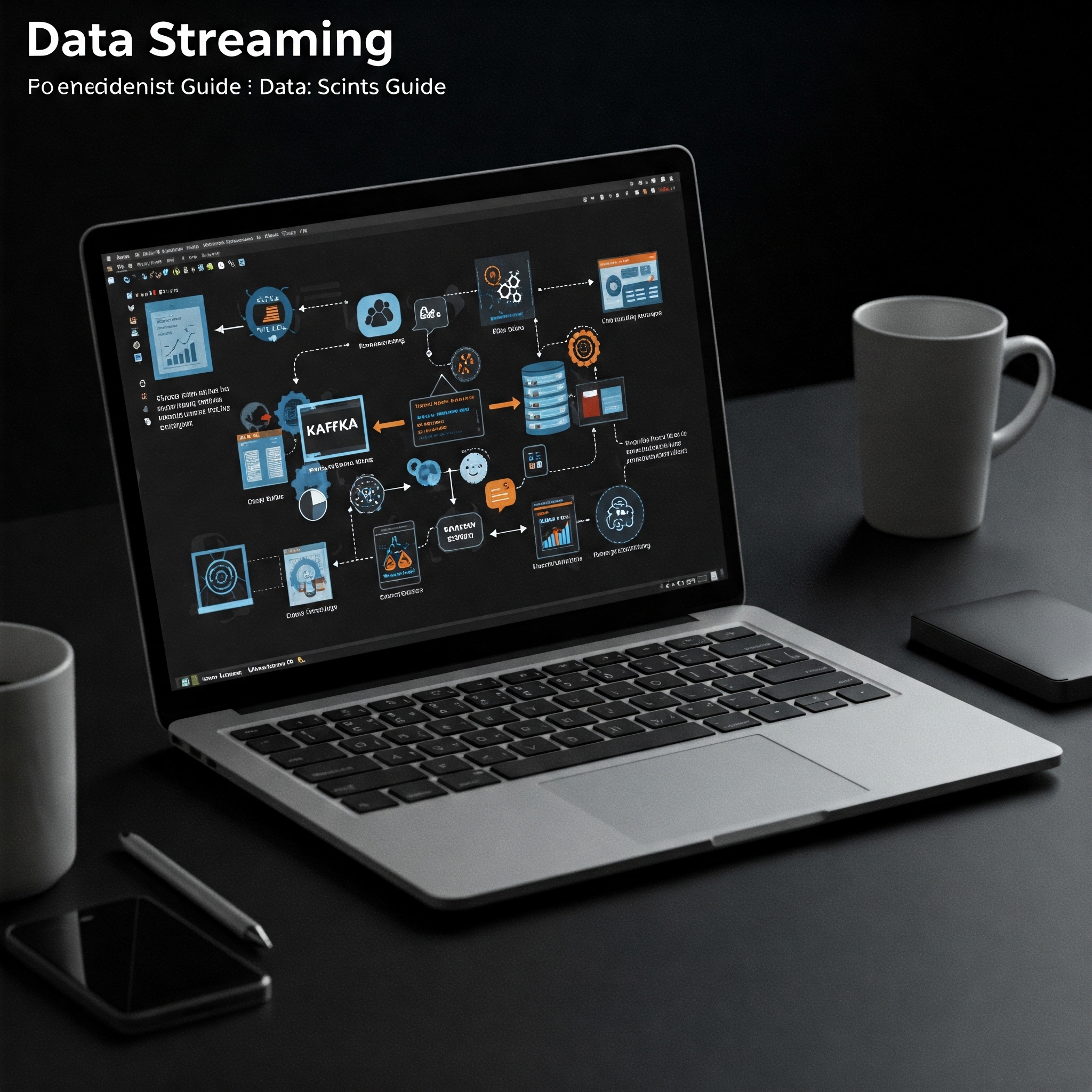
A typical streaming pipeline looks like this:
- Data Ingestion: Kafka collects events from sources (websites, IoT devices, etc.).
- Stream Processing: Flink subscribes to Kafka topics, processes events in real time (e.g., scoring, anomaly detection).
- Output: Processed data is sent to dashboards, databases, or downstream applications for action or further analysis.
Practical Applications for Data Scientists
Online Predictions
Instead of generating recommendations or predictions in scheduled batches, streaming enables on-the-fly inference. For example, an e-commerce site can offer real-time discounts based on what a user is browsing right now.
Real-Time Monitoring
Streaming allows for live monitoring of models and systems. Data scientists can compute metrics, detect drift, and flag anomalies as soon as they occur, reducing response times and improving reliability.
Continual Learning
With a constant flow of new data, streaming supports rapid feedback loops. Data scientists can test retraining strategies, evaluate updated models, and adapt to changing data distributions much faster than with batch workflows.
Anomaly Detection
By processing each event as it arrives, streaming systems can flag unusual patterns-such as fraudulent transactions or equipment failures-immediately, enabling proactive intervention.
Building a Streaming Pipeline: Step-by-Step
- Define Your Use Case
- Identify where real-time insights will add value (e.g., fraud detection, live recommendations, sensor monitoring).
- Choose Data Sources
- Select the systems or devices generating data (web logs, sensors, transaction systems).
- Set Up Data Ingestion
- Use Kafka or similar tools to collect and transport events from sources to your processing engine.
- Implement Stream Processing
- Use Flink or another stream processor to analyse, transform, and enrich data in real time.
- Apply machine learning models for prediction or classification as data flows through.
- Output and Action
- Send processed results to dashboards, alerting systems, or automated actuators.
- Monitor and Optimise
- Continuously monitor pipeline performance, latency, and data quality.
- Tune processing logic, scaling, and resource allocation as needed.
Challenges and Best Practices
Data Integration
Combining data from diverse, high-velocity sources can be complex. Ensure robust ingestion pipelines and schema management to handle changes in data formats or sources.
Scalability
Streaming systems must handle fluctuating data volumes. Use distributed architectures and auto-scaling to maintain performance as traffic grows.
Fault Tolerance
Design for resilience. Use tools that guarantee data is not lost or duplicated during failures, and test recovery procedures regularly.
Latency
Minimise processing delays by optimising code, using efficient serialization formats, and tuning system parameters.
Machine Learning in Streaming
- Model Deployment: Deploy lightweight, efficient models that can score events in real time.
- Feature Engineering: Use windowing functions and stateful processing to compute features on the fly.
- Model Monitoring: Track prediction performance, drift, and data quality continuously.
Real-World Examples
Netflix
Uses Kafka as the backbone of its personalisation engine. Every click, pause, and playback feeds into Kafka streams, enabling the service to refine recommendations for each user in real time.
Relies on Kafka and stream processing to power its recommendation engine. As users engage with content, their actions are processed instantly, surfacing new, relevant pins within seconds.
Financial Services
Banks and payment processors use streaming to flag suspicious transactions as they happen, reducing fraud and improving customer trust.
IoT and Smart Devices
Sensor networks stream data to central systems for real-time monitoring and control, supporting applications from smart homes to industrial automation.
Getting Started: Skills and Learning Path
Essential Skills
- Programming: Proficiency in Python, Java, or Scala (Flink and Kafka APIs).
- Data Engineering: Understanding of distributed systems, data pipelines, and cloud infrastructure.
- Stream Processing Concepts: Familiarity with event time, windowing, stateful vs. stateless processing.
- Machine Learning: Ability to deploy and monitor models in real-time environments.
Learning Resources
- Online Courses: Look for courses on Kafka, Flink, and real-time data engineering.
- Documentation: Study official docs and tutorials for the tools you plan to use.
- Community Forums: Engage with open-source communities for troubleshooting and best practices.
Summary
Data streaming is a cornerstone of modern data science, enabling real-time analytics, responsive machine learning, and immediate business impact. By mastering tools like Apache Kafka and Flink, and understanding the principles of stream processing, data scientists can unlock new opportunities for innovation and insight. Whether you’re detecting fraud, personalising user experiences, or monitoring complex systems, data streaming brings your analytics closer to the moment decisions are made-empowering you to act on data as it happens.