



 Dorothy Brown
 This is the 78th instalment of the Bharat Is Not for Beginners series. Having explored Bharat’s ancient water architecture in Article 77, we now turn our attention to a profound and often misunderstood dimension of Indian civilisation—its deep and nuanced understanding of gender.
In a world where debates on gender identity have become loud, polarised, and often reductive, ancient Bharat offers a remarkably complex, inclusive, and spiritually elevated framework for gender and identity. Here, gender was never simply male or female, nor limited to biological determinism. It encompassed fluidity, sacred duality, unity, and transcendence.
This article uncovers the sophisticated gender philosophy of Bharat—not as a modern concession to progressivism, but as a timeless truth encoded in its myths, deities, rituals, philosophies, and lived culture. Bharat did not ‘tolerate’ the third gender or fluid identities. It honoured them, enshrined them, and wove them into the fabric of its sacred cosmology.
I. Understanding Gender in the Indian Philosophical Tradition
1. Beyond Biological Essentialism
Indian metaphysics does not see identity as confined to the body.
- Atman (Self) is genderless, eternal, and beyond form.
- Gender, like body and caste, is part of prakriti (material nature), not purusha (consciousness).
- Therefore, while social roles existed, ultimate truth lies beyond dualities—male/female, dark/light, self/other.
2. Ardha-Nāriśvara: The Divine Unity
One of the most profound expressions of this is Ardha-Nāriśvara, the half-man, half-woman form of Shiva and Parvati.
- Ardha (half), Nāri (woman), Ishvara (Lord): the synthesis of masculine and feminine principles.
- Philosophically, it represents the unity of Shakti (dynamic energy) and Shiva (conscious stillness).
- This iconography asserts that creation requires both forces in balance, not dominance of one.
This concept is not about gender roles, but about cosmic polarity, complementarity, and harmony.
II. The Sacred Feminine: Shakti as Source
1. Devi as Primal Power
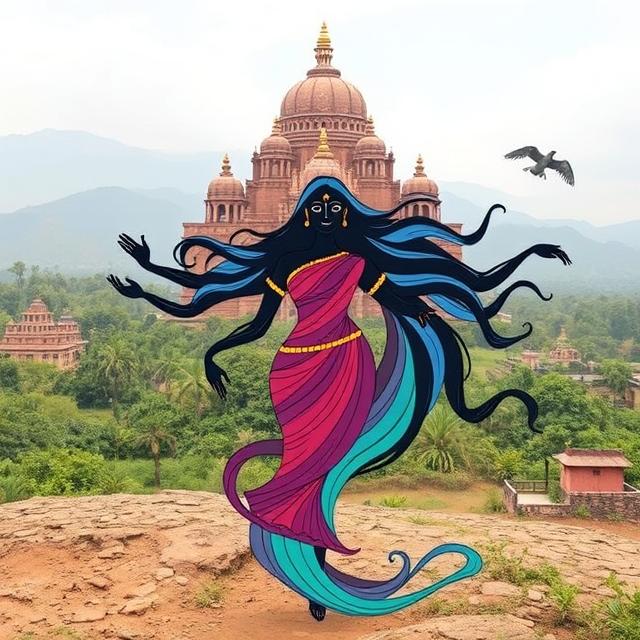
Bharat’s spiritual tradition reveres the Devi not as an adjunct to the divine masculine, but as the primordial power behind creation.
- In the Devi Mahatmyam, the Goddess is celebrated as Mahakali, Mahalakshmi, and Mahasaraswati—each representing destruction, wealth, and wisdom.
- She is Adishakti—the first cause, mother of all.
2. Feminine Autonomy and Leadership
Indian mythology is replete with female deities and heroines who:
- Lead battles (Durga, Kali, Lalita Tripurasundari)
- Instruct sages (Gargi, Maitreyi, Anasuya)
- Provide spiritual liberation (Meera, Andal, Akka Mahadevi)
In contrast to societies where goddesses are rare or auxiliary, Bharat abounds in female divinity, not as exceptions but as cosmic constants.
III. The Third Gender in Dharma and Society
1. The Category of Tritiya-Prakriti
Ancient texts like the Manusmriti, Narada Smriti, and Kamasutra acknowledge tritiya-prakriti (third nature), which refers to people who are neither strictly male nor female.
- Not criminalised, but categorised, named, and legally recognised.
- They had roles in society—from palace attendants to temple caretakers.
- Their existence was seen as part of nature’s diversity, not as a deviation.
2. The Hijra Tradition
The Hijra community, often misunderstood today, is rooted in ancient roles:
- They are associated with Bahuchara Mata in Gujarat, a goddess who blesses gender-nonconforming individuals.
- At weddings and births, Hijras were invited to bless the couple or child—reflecting sacred potency.
- In the Mughal era, they held roles in the royal courts and harems, respected for their neutral status.
Hijras were once seen as auspicious intermediaries between binaries—neither male nor female, but bridging the two.
IV. Fluidity in Myth and Narrative
1. Vishnu as Mohini
One of the most popular narratives of gender fluidity is that of Mohini, the female form of Lord Vishnu:
- In the churning of the ocean (Samudra Manthan), Vishnu becomes Mohini to trick the demons.
- Shiva himself is enamoured by Mohini, resulting in Ayyappa, a deity with both Shiva and Vishnu as progenitors.
The Mohini narrative is not a comedic trope but a metaphysical statement—divinity transcends and includes all forms.
2. Bhakti Saints and Androgyny
- Chaitanya Mahaprabhu exhibited behaviour that blurred gender lines during divine ecstasy.
- Akkamahadevi rejected marriage, wandered naked, and sang hymns to Lord Shiva—considering herself married to the divine.
- Andal, a Tamil Alvar saint, considered herself the bride of Vishnu and merged feminine longing with devotional ecstasy.
These figures represent a devotional transcendence of gender identity—moving from form to formless love.
V. Gender Roles vs. Dharma: A Nuanced Reading
1. Dharma Not Equal to Patriarchy
Dharma has often been misread as enforcing rigid roles. But contextually:
- Dharma varies by age, stage, varna, and inner disposition.
- It is adaptive, not fossilised.
- Women and gender-diverse individuals had independent dharma, often exercised with autonomy.
2. Matrilineal and Feminine Honour Systems
- Kerala’s Nair society and Meghalaya’s Khasi people followed matrilineal inheritance.
- In tribal communities, women were often ritual specialists, priestesses, or landholders.
Thus, gender was culturally contextual, not universally hierarchical.
VI. Colonial Distortion and Modern Misreadings
1. Victorian Morality’s Disruption
British colonialism brought:
- Christian moral frameworks that viewed non-binary identities as sinful.
- Laws like Section 377, criminalising “unnatural offences”.
- Bans and ridicule of Hijras, despite centuries of social integration.
The colonial state disrupted indigenous systems of inclusion, reverence, and fluidity, replacing them with moral policing.
2. The Modern Binary Problem
Post-independence India absorbed many Western binaries:
- Man/Woman, Straight/Gay, Cis/Trans—rather than fluid samskara-based roles.
- Activist movements, though necessary, often overlook cultural context and civilisational depth.
Yet, India’s Supreme Court (2014) recognising third gender status legally marks a return to civilisational memory, not merely a progressive novelty.
VII. Towards a Civilisational Reclamation of Gender
1. Temple Iconography
Temples across Bharat display:
- Androgynous deities (Ardha-Nāriśvara)
- Fertility symbols (lingam–yoni union)
- Erotic sculptures (Khajuraho, Konark) as metaphors of divine union, not pornography
These are sacred symbols of balance, not moral taboos.
2. Integrating the Sacred Feminine Today
To reclaim India’s gender wisdom:
- Education must reintroduce shakta and tantric philosophies.
- Art and literature should recover bhakti narratives of fluid love.
- Public discourse must shift from Western import to Indic insight.
Conclusion: The Gender of the Divine and the Divinity of Gender
In Bharat, the divine is not male or female. It is both and beyond.
- It births as Devi,
- protects as Vishnu,
- destroys as Kali,
- dances as Shiva,
- transforms as Mohini,
- and blesses as Bahuchara Mata.
To be Indian is to live within this tapestry of gendered transcendence.
Bharat is not for beginners, because it never begins with binaries. It begins with the One that becomes the Many—and sees each form as sacred.
What’s Next?
In Article 79: Bharat Is Not for Beginners – The Sacred Craft: Handlooms, Heritage Textiles, and the Soul of Indian Weaving, we’ll explore the spiritual and civilisational significance of Indian textiles—from Varanasi’s brocades and Kanchipuram silks to tribal weaves, block prints, and the metaphysics of the loom.