 Tracey Beatrice
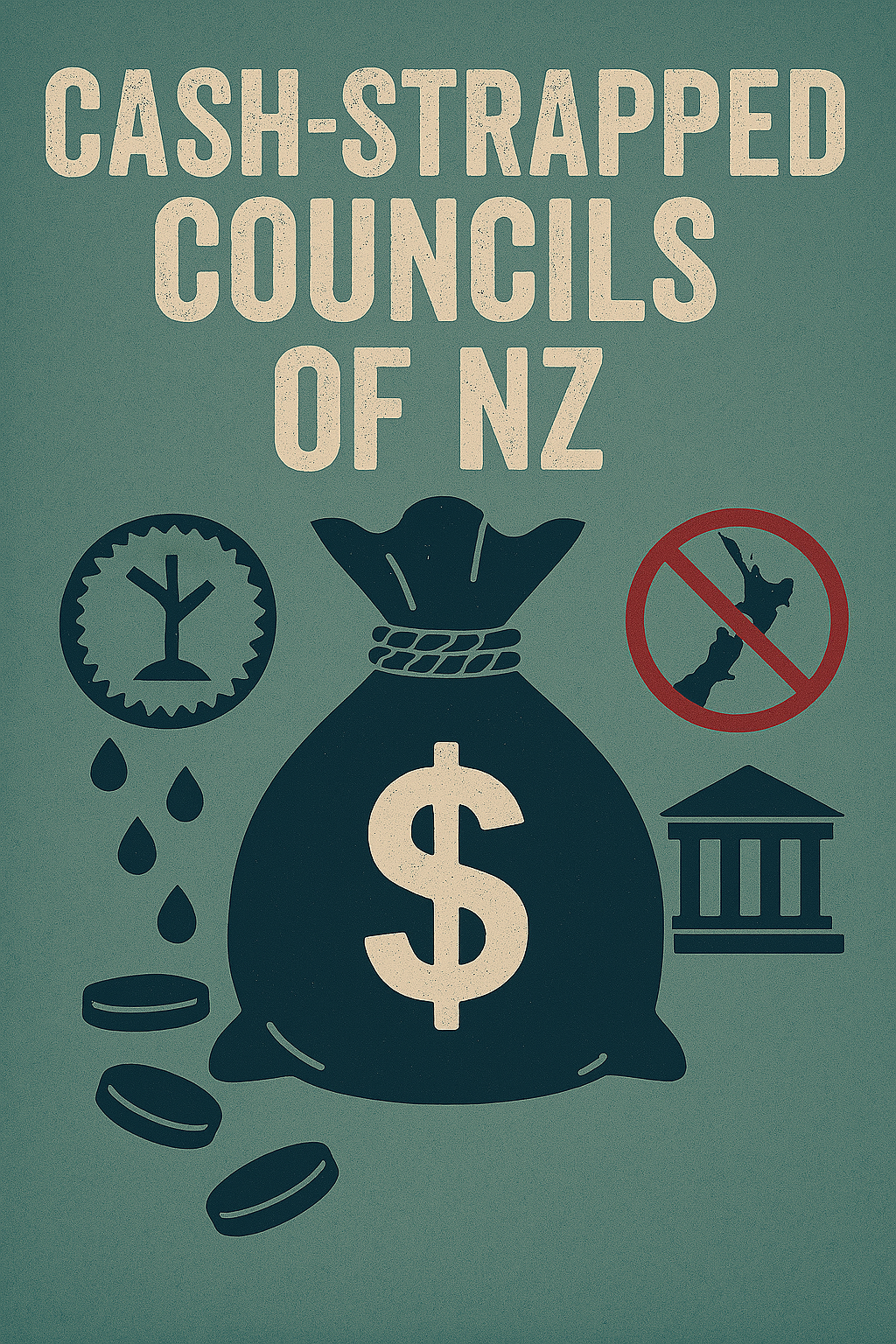
 New Zealand’s local councils are facing a financial crisis that threatens their ability to deliver essential services and maintain the infrastructure communities rely on. Mounting debt, rising costs, and limited revenue options have left many councils teetering on the edge of insolvency. As demands grow and the country’s population expands, the question of how to sustainably fund local government has become one of the most pressing challenges for Aotearoa. This article explores the latest developments, the historical roots of the problem, and what can be done to ensure councils remain viable and communities thrive.
The Current State: Debt, Downgrades, and Diminishing Options
Mounting Debt and Credit Downgrades
Recent years have seen New Zealand’s councils accumulate unprecedented levels of debt. According to S&P Global, council debt has soared to 197% of operating revenue, prompting the agency to downgrade 18 councils and three council-controlled organisations, with negative outlooks for several more. Only a handful of councils maintain a stable credit rating, and even these face growing fiscal pressure.
The debt burden is driven by a perfect storm of factors: rising construction and insurance costs, the need to replace ageing infrastructure, and the impact of government reforms such as new water standards and disaster reconstruction. Many councils are also grappling with the legacy of deferred maintenance and underinvestment in core assets. The Local Government Funding Agency (LGFA), which lends to 97% of councils, remains a financial lifeline thanks to its high credit rating, but the overall sector’s credit quality is deteriorating.
Rates: The Only Lever Left
Rates remain the primary source of income for councils, accounting for around 60% of local authority revenue. However, the reliance on rates is reaching breaking point. Many councils have announced double-digit rate rises for 2025, with the national average increase around 15%-over four times the rate of inflation. This is fuelling public anger and raising concerns about affordability, especially in lower-income communities.
The government has floated the idea of capping rates increases, but Local Government New Zealand (LGNZ) and independent experts warn that this would only worsen the crisis by restricting councils’ ability to invest in infrastructure and maintain financial stability. The experience in Australia, where rate caps have led to underinvestment and service cuts, is cited as a cautionary tale.
Central Government’s Role
Central government funding accounts for only about 10% of council operating income-a far lower share than in comparable OECD countries. While the government provides some grants and subsidies, it has largely responded to council woes by urging a focus on “core tasks” and introducing benchmarking and performance reporting. Recent policy changes have also increased volatility and uncertainty, with the quick passage and repeal of key laws, the cancellation of Crown grant programmes, and an increase in unfunded mandates-where councils are required to implement new policies without receiving the funding to do so.
Historical Perspective: How Did We Get Here?
The Changing Role of Local Government
Historically, New Zealand’s local government sector has undergone major transformations. In the mid-20th century, councils played a central role in “nation building,” with significant government transfers supporting large-scale infrastructure projects. However, the reforms of 1989 saw many public utilities and revenue-generating assets removed from council control, narrowing their funding base and increasing reliance on rates.
Since then, successive governments have shifted more responsibilities onto councils-such as earthquake strengthening, water quality, and climate adaptation-without providing the necessary resources. This “cost-shifting” has left councils with ever-growing obligations but few tools to meet them.
The Cost-Driven Model
New Zealand councils operate on a cost-driven model: they determine what services are needed, calculate the cost, and then set rates to cover the gap. While this process is democratic-requiring community consultation and approval-it means that rates are the default solution for every new challenge, whether it’s fixing potholes, upgrading water pipes, or building new housing infrastructure.
The Consequences: What’s at Stake?
Infrastructure Deficit and Service Cuts
The most immediate risk is the growing infrastructure deficit. Councils are struggling to maintain roads, water systems, and public facilities. Deferred maintenance is becoming the norm, with repairs and upgrades postponed due to lack of funds. This not only affects quality of life but also increases long-term costs, as assets deteriorate further.
Service cuts are also on the horizon. Libraries, parks, community centres, and other “non-core” services may face reductions or closures as councils are forced to prioritise the basics. This has significant social and economic consequences, particularly for vulnerable populations who rely on these services.
Economic and Social Impacts
The financial instability of councils threatens local economies. Infrastructure delays can stifle housing development and business investment, while rising rates put pressure on households and small businesses. There is also a risk of growing inequality, as wealthier areas are better able to absorb rate increases or attract private investment.
What Could Be Done? Solutions and Reform Options
1. Diversifying Revenue Streams
One of the most urgent reforms is to give councils more flexibility to raise revenue. Options include:
- Local Sales Taxes or Levies: Allowing councils to introduce targeted taxes for tourism, hospitality, or retail sectors.
- GST Sharing: Returning a portion of the GST collected on rates or new housing developments to local councils.
- Congestion Charges and User Fees: Implementing road pricing or charging for specific services to fund infrastructure.
These tools, already used in many OECD countries, would reduce the over-reliance on rates and align funding with those who benefit most from local services.
2. Increased Central Government Support
Central government could increase its contribution to local government funding, particularly for projects with national benefits-such as water and wastewater upgrades in tourism hotspots, or climate adaptation measures. This could take the form of direct grants, co-funding arrangements, or taking over responsibility for certain high-cost assets.
3. Reforming Unfunded Mandates
A major source of council stress is the imposition of new responsibilities without funding. Central government should commit to fully funding any new mandates or regulatory requirements it imposes on councils, ensuring that local authorities are not forced to choose between compliance and financial sustainability.
4. Encouraging Inter-Council Collaboration
The government’s Regional Deals Strategic Framework encourages councils to work together on shared challenges, such as infrastructure and economic development. Pooling resources and expertise can help achieve economies of scale and improve service delivery, especially for smaller or rural councils.
5. Asset Management and Innovation
Councils can also explore better asset management, including the use of public-private partnerships, long-term maintenance contracts, and innovative funding models. Selling or leasing underutilised assets, or developing new revenue-generating ventures, may provide additional income streams.
6. Community Engagement and Democratic Renewal
Low voter turnout and disengagement from local elections are persistent problems. Improving transparency, accountability, and public involvement in council decision-making can help restore trust and ensure that funding decisions reflect community priorities.
Lessons from History
The Nation-Building Era
The post-war period saw significant government investment in local infrastructure, with central and local government working in partnership. This era delivered lasting benefits, from water supply systems to public transport networks. The lesson is clear: major challenges require shared responsibility and coordinated investment.
The 1989 Reforms
The removal of revenue-generating assets from councils in the late 1980s was intended to streamline local government, but it also reduced financial resilience. Today’s councils have fewer levers to pull and are more exposed to economic shocks. Restoring some of these tools, or creating new ones, could help councils weather future crises.
International Comparisons
Many OECD countries provide a much higher share of funding to local governments and allow broader taxation powers. For example, Australian and Canadian councils can levy a range of taxes and receive substantial transfers from state or provincial governments. New Zealand’s highly centralised model leaves councils uniquely vulnerable.
The Road Ahead: Building a Sustainable Future
Government Initiatives and Ongoing Debates
The current government has announced measures to refocus councils on “core services,” introduce performance benchmarks, and review transparency rules. While these steps may improve efficiency, they do not address the underlying funding gap. LGNZ and other stakeholders are advocating for a “toolbox” approach, giving councils a range of funding and financing options to suit local needs.
Climate Change and Future Challenges
Climate adaptation, disaster recovery, and population growth will only add to the pressures on councils. Sustainable funding solutions must be forward-looking, enabling councils to invest in resilience and innovation.
The Importance of Partnership
Ultimately, a sustainable solution will require genuine partnership between central and local government, with shared responsibility for funding, planning, and delivering the services and infrastructure that New Zealanders depend on.
Summary
New Zealand’s cash-strapped councils are at a crossroads. Decades of cost-shifting, limited revenue options, and rising demands have created a funding crisis that threatens essential services and infrastructure. Rates alone will never be enough. The path forward requires bold reform: diversifying revenue streams, increasing central government support, reforming unfunded mandates, and empowering councils to innovate and collaborate. History shows that when central and local government work together, communities thrive. Now is the time for a new partnership to secure the future of local government and the wellbeing of all New Zealanders.