


 Shivaprasad T R
 Spanning nearly a quarter century of continuous executive leadership — from Gujarat’s state secretariat to New Delhi’s South Block — Narendra Modi has broken a record that may stand for generations.
By Shivaprasad T R Editor, Bharat1 Group | Contributing Editor, Zealandia News
30 March 2026 — Wellington
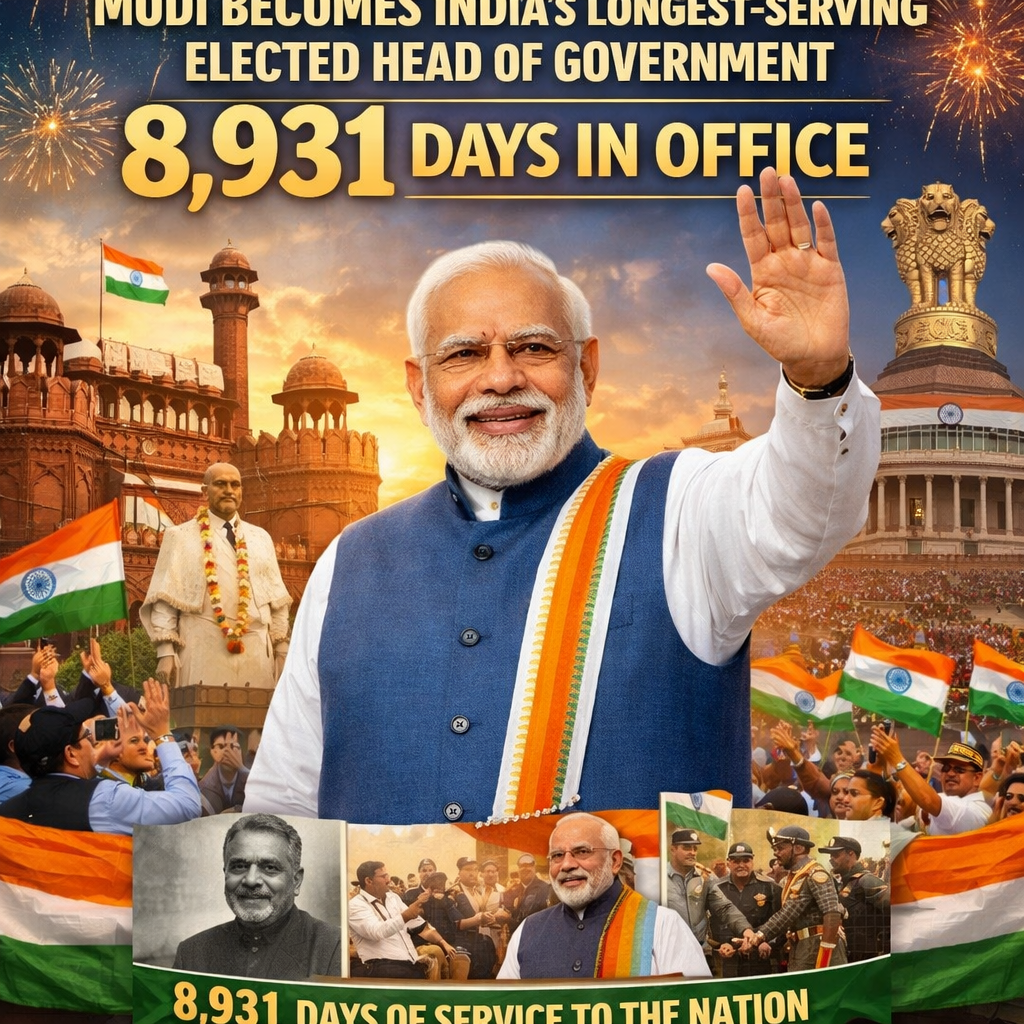
On 22 March 2026, Narendra Modi crossed a threshold that no elected leader in Indian history had reached before him. With 8,931 cumulative days in executive office — surpassing the previous record held by former Sikkim Chief Minister Pawan Kumar Chamling by a single day — India’s Prime Minister became the longest-serving elected head of government the country has ever produced.
The milestone is not the product of a single unbroken stint in one office. It is the sum of two chapters: thirteen years as Chief Minister of Gujarat, from 7 October 2001 to 21 May 2014, followed by an ongoing tenure as Prime Minister of India that began on 26 May 2014 and continues today. Modi has now entered his 25th consecutive year in elected executive leadership — a span that has encompassed four general elections, the transformation of the Indian economy, the upheaval of a global pandemic, and a fundamental reshaping of the country’s domestic politics and international identity.
The record had stood in Chamling’s name for years, accumulated across an extraordinary five-term run as Sikkim’s Chief Minister. Chamling’s tenure — characterised by remarkable consistency in a small, mountainous northeastern state — was for a long time considered untouchable. That Modi, operating at the scale and pressure of India’s national government, would one day exceed it was not always the obvious prediction. That he has done so is a measure of both his political durability and the scale of his electoral success.
The BJP under Modi’s leadership has won three consecutive general elections — 2014, 2019, and 2024 — each time securing enough seats in the Lok Sabha to govern with authority. The 2024 victory, which extended his Prime Ministerial tenure into a third term, set the stage for the record that has now been broken. Less than a year ago, in July 2025, Modi had already surpassed Indira Gandhi’s tenure to become India’s longest-serving Prime Minister. The March milestone adds the broader historical dimension — measuring not just his time as PM but his cumulative years in elected governance.
For observers of Indian politics, the record prompts reflection on how thoroughly Modi has restructured the country’s political landscape. When he was first sworn in as Gujarat’s Chief Minister in 2001, he was a relatively unknown party functionary stepping into a caretaker role following a sudden vacancy. Within months, the state faced the devastation of the Godhra riots — a defining and deeply contested episode that shaped both his national profile and the subsequent two decades of debate about his leadership. He went on to win three state elections in Gujarat and transform the state into what his government and supporters described as a model of economic development and administrative efficiency.
His transition to national politics in 2014 was built on that record and on a campaign that rewrote the rules of Indian electoral communication — deploying digital tools, mass rallies, and a personalised political narrative at a scale the country had not previously seen. The BJP’s landslide that year ended a decade of Congress-led coalition government and began what has become the longest sustained period of single-party dominance at the national level since Rajiv Gandhi’s post-assassination majority in 1984.
The record is not without its critics. Opposition leaders and civil society voices have consistently argued that Modi’s tenure has concentrated executive power, weakened institutional independence, and hardened majoritarian politics in ways that carry long-term costs for Indian democracy. Supporters counter that he has delivered economic growth, improved infrastructure, brought hundreds of millions of citizens into formal financial and welfare systems, and raised India’s global standing to a degree unmatched in recent memory. The debate between those two readings of his legacy is unlikely to be settled any time soon — and a record in longevity does not, by itself, resolve it.
What the record does confirm is that Narendra Modi has demonstrated an almost singular capacity to remain politically relevant, electorally dominant, and institutionally central across a span of time and change that would have ended most careers long before this point.
In Summary
Narendra Modi’s 8,931st day in elected executive office marks a genuine historical landmark for Indian democracy, whatever one’s assessment of what he has done with the power entrusted to him during that time. For the Indian diaspora in Aotearoa and across the world, it is a moment to note — a reminder that the country their families came from continues to write political history of a scale and consequence that commands attention well beyond its borders.