
 Dorothy Brown
 When the New Zealand Indian Central Association (NZICA) released its statement on 5 January 2026, calling for “unity against hate and racism”, it echoed a familiar yet urgent sentiment: that New Zealand’s multicultural promise remains fragile in the face of growing intolerance. The association’s press release, expressing “deep concern” over recent incidents of intimidation, hate, and extremist behaviour, underscores an unsettling trend that challenges New Zealand’s long-held reputation as an inclusive, diverse nation.
As New Zealand navigates a rapidly changing social, political, and technological landscape, incidents of racial tension have become more frequent and more visible—often amplified by social media and political discourse. Against this backdrop, NZICA’s call for firm law enforcement, responsible leadership, and intercommunity solidarity carries added weight, urging both governmental accountability and civic responsibility.
A Century-Old Voice for Indian New Zealanders
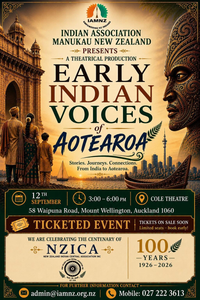
Founded in 1926, the New Zealand Indian Central Association is one of the country’s oldest cultural organisations, representing generations of Indian New Zealanders who have contributed to the nation’s economic, cultural, and social fabric. From its inception, NZICA has served as an umbrella body, uniting regional Indian associations across the country—from Auckland and Wellington to Invercargill.
Its formation was deeply rooted in the Indian community’s struggle for equality during a time when racial discrimination was legally sanctioned. The 1920s were marked by restrictive immigration policies and the infamous “White New Zealand” ethos, which discouraged non-European settlement. Early Indian settlers—many of whom were small business owners, farmers, or labourers—faced severe restrictions on land ownership, voting rights, and social participation.
Leaders such as Sardar Harnam Singh Golian and V.G. Patel were instrumental in organising the community to advocate for civil rights, setting the foundation for what became a century-long pursuit of inclusion and respect within New Zealand society.
The Legacy of Settlement: From Early Struggles to Recognition
The history of Indians in New Zealand began in the late 19th century, with the earliest recorded arrivals coming from the Punjab and Gujarat regions. By the early 1900s, small but vibrant communities had taken root in towns like Pukekohe, Taumarunui, and Wellington. However, racial prejudice was a persistent challenge.
In the 1920s, Indians were often restricted to specific trades, such as running fruit and vegetable shops or market gardens. Local councils imposed zoning and licensing laws that implicitly targeted non-European traders, restricting where they could operate. Public sentiment reflected broader imperial ideologies of racial hierarchy.
It was in this environment that the New Zealand Indian Central Association was formed—to advocate collectively for fairness, cohesion, and understanding. Over the decades, the NZICA has played an instrumental role in representing Indian voices on national platforms, promoting both integration and cultural preservation.
The post-war decades saw gradual progress, particularly after the introduction of the Immigration Act 1987, which abolished race-based immigration criteria. From that point onward, New Zealand’s demography changed dramatically, welcoming migrants from South and East Asia, the Pacific, Africa, and the Middle East.
New Zealand’s Modern Multicultural Identity
Today, Indian New Zealanders form one of the largest ethnic groups in the country, numbering over 240,000 according to the 2023 census. They are prominent in all walks of life—from business and medicine to ICT, academia, and politics. Indian festivals like Diwali are national events, celebrated in Auckland, Wellington, and Christchurch with official government support.
This demographic transformation has broadened New Zealand’s cultural landscape, enriching its cuisine, arts, and values. Yet, it has also tested the nation’s ability to manage social diversity amidst economic inequality and political polarisation.
Recent years have seen increasing concern about hate crimes and racialised rhetoric—especially online. Reports to the Human Rights Commission (HRC) have risen steadily, reflecting both heightened awareness and a real increase in incidents.
The Recent Wave of Racist Intimidation
Though NZICA did not name specific incidents in its statement, community leaders have privately expressed alarm over a string of racially charged events in late 2025. These include organised online harassment targeting South Asian and Middle Eastern communities, vandalism of religious centres, and inflammatory remarks on social media linked to local and national political debates.
In Auckland and Wellington, Sikh and Hindu temples reported threats or graffiti containing xenophobic messages. In one widely reported case, a local mosque had its entrance defaced in December. While police have increased monitoring of hate-related offences, community leaders argue that law enforcement alone cannot prevent hate—it must be countered by political and social leadership.
NZICA President Veer Khar stated that the association’s online meeting on 4 January 2026, attended by over thirty representatives nationwide, underscored a shared concern about “growing racism in New Zealand.” The participants noted that “irresponsible statements from senior politicians” had inflamed societal divisions rather than helped resolve them, echoing earlier criticisms made by civil rights advocates in 2024 and 2025.

A Climate of Polarisation: The Political Dimension
Political rhetoric has become an increasingly contentious factor in conversations about race in New Zealand. While New Zealand remains one of the few Western democracies without a strong far-right party in Parliament, extremist sentiment has found expression through fringe groups, online movements, and independent candidates.
The Christchurch mosque attacks of 2019 were a watershed moment in New Zealand’s collective consciousness. The massacre, driven by white supremacist ideology, shocked the world and prompted soul-searching at every level of government. The Royal Commission of Inquiry into the terrorist attack made sweeping recommendations, including improving hate crime laws, regulating online extremism, and supporting victims.
Yet, seven years later, implementation remains partial. The Human Rights Commission’s 2025 “Race Relations Report” noted that many recommendations—such as criminalising incitement to hatred—had not yet been fully enacted. In that vacuum, extremist elements have continued to exploit online spaces, spreading misinformation and fear.
Political leaders across the spectrum have been accused of racial “dog-whistling”—the use of coded language that appears neutral but subtly targets specific communities. The NZICA’s call for “clear political leadership condemning hate and racialised rhetoric” reflects frustration with this trend. As one NZICA delegate reportedly said during the January meeting, “Words matter. When leaders minimise or mock diversity, they give cover to those who promote division.”
Law Enforcement and Reporting: The Gaps in the System
One of NZICA’s key demands is firm law enforcement against hate-related offences, including those committed via social media. While New Zealand Police have a Hate Crime Response Unit, established after the 2019 attacks, community organisations say that reporting mechanisms remain fragmented and intimidating.
A 2023 study by Massey University’s Centre for Cultural Exchange found that only one in five victims of racial abuse report their experiences to authorities. Reasons include fear of retaliation, distrust in police responsiveness, and uncertainty over what legally constitutes a “hate crime.”
Currently, New Zealand’s laws against incitement are limited. Under the Human Rights Act 1993, only extreme cases—those causing violence or ill-will against a group—can be prosecuted, often requiring the Attorney-General’s consent. Many advocates, including NZICA, believe these protections do not keep pace with the proliferation of hate speech online.
The press release’s emphasis on “safe and accessible reporting pathways” signals a growing push from ethnic and faith-based organisations for reform. Several community bodies have called for a unified national hate incident reporting system, integrated across police, the Human Rights Commission, and online safety agencies.
The Role of Social Media and Digital Extremism
The digital dimension of hate has become increasingly urgent in the post-COVID era. Research by the Digital Safety Branch of the Department of Internal Affairs found that hate-related online content targeting ethnic groups increased by 47% between 2020 and 2025.
Platforms such as Facebook, X (formerly Twitter), and TikTok have been both sources of connection and arenas for harassment. Community leaders have repeatedly urged these companies to take stronger action against incitement and misinformation.
Global trends also play a role: international extremist networks, conspiracy theories, and white nationalist narratives often find local followers. The Christchurch attacker’s radicalisation, largely conducted online, remains a chilling reminder of how internet culture can incubate violence.
For New Zealand’s Indian and other migrant communities, online hate translates into real-world anxiety. The lines between virtual hostility and physical intimidation continue to blur, especially for younger generations who engage online more frequently.
Interfaith and Community Solidarity
Beyond enforcement and law reform, NZICA’s call places equal emphasis on community solidarity—what they term “interfaith initiatives” and “restraint on faith-related events that occupy shared public spaces.” The statement encourages empathy and responsible collaboration among religious and cultural groups during public observances, especially at sensitive times.
This emphasis on mutual understanding rather than competition for visibility reflects a long-standing ethos within the Indian community. Many NZICA chapters have historically worked with Māori organisations, Pacific groups, and other Asian associations to promote joint cultural events and civic dialogue.
Such collaboration has borne fruit. Programmes like the Interfaith Exchange Project and Ethnic Communities Action Forum have successfully built networks between temples, mosques, synagogues, and churches across New Zealand’s main centres. These initiatives often serve as safe spaces for education and dialogue, reducing stereotypes and fostering cooperation.
Responsible Public Discourse: The Media’s Role
NZICA’s appeal for “responsible public discourse that targets extremism, not communities” directly implicates traditional and social media in shaping public attitudes. The media’s framing of issues involving migrants, religion, or security can significantly influence perceptions of entire communities.
Following the Christchurch attacks, several journalism schools and media organisations reviewed their editorial practices. The Media Council and Broadcasting Standards Authority jointly issued guidelines encouraging culturally sensitive reporting, particularly around terrorism and immigration stories. However, many community advocates still perceive bias in coverage—especially in how crimes are reported depending on a perpetrator’s background.
Indian New Zealanders have not been immune to stereotyping, particularly around topics like student migration, work visas, or international education fraud. NZICA and others have consistently pressed for fair representation, stressing that isolated incidents should not define a community’s image.
Lessons from History: From the White New Zealand Policy to the Kiwi-Indian Era
To understand why NZICA’s message resonates today, it helps to trace the trajectory of race relations in New Zealand over the last century. The White New Zealand policy, though never legally codified as in Australia, heavily influenced immigration from the 1890s through the 1950s. South Asians, Chinese, and other non-European migrants faced quotas, higher fees, and social exclusion.
Even after World War II, when New Zealand publicly supported the United Nations Declaration of Human Rights, racism persisted domestically. Schools and local clubs often practised informal segregation. It was not until the 1970s and 1980s, amid global decolonisation and domestic activism, that the tide began to turn.
The establishment of the Race Relations Office in 1972 (now part of the Human Rights Commission) marked a milestone in institutional recognition of multiculturalism. Parallel to this were growing Māori movements for self-determination, which placed biculturalism—partnership between Māori and the Crown—at the heart of New Zealand’s national identity.
For Indian and other ethnic communities, biculturalism provided both an opportunity and a challenge: the opportunity to be part of a broad justice movement, and the challenge of ensuring multiculturalism did not get sidelined in the bicultural framework.
Today, with third- and fourth-generation Indian New Zealanders fully embedded in Kiwi life, the term “Kiwi-Indian” reflects a mature, hybrid identity. Politicians like Priyanca Radhakrishnan, Gaurav Sharma, and Vanushi Walters, among others, symbolise this integration. They represent an electorate that expects not just tolerance but equality. Yet, as NZICA’s statement reminds us, equality still requires vigilance.
The Broader Ethnic Landscape
The issue of racism in New Zealand is not confined to any single group. Pasifika and African communities have long voiced similar grievances about systemic bias, from education to law enforcement. Māori, as tangata whenua, continue to confront disparities rooted in colonisation.
NZICA’s collaboration with other minority organisations signals a recognition that combating racism is a collective effort, transcending individual identities. Unity among communities—without erasing differences—is the essence of multiculturalism done right.
The Federation of Islamic Associations of New Zealand (FIANZ), Shakti Women’s Refuge, and Chinese New Zealand Historical Society, among others, have supported comparable initiatives. Together, they form a patchwork of ethnic and interfaith solidarity that strengthens democracy.
The Human Toll: Voices Behind the Statistics
Behind every hate incident lies a human story. In interviews conducted in recent months, community members have described feelings of alienation, fear, and frustration. A Sikh taxi driver in South Auckland recounted being verbally abused multiple times since late 2025. A Hindu student in Dunedin reported receiving online threats after posting about Diwali.
For many, these experiences reopen wounds from the Christchurch tragedy or earlier episodes such as the 2017 “Love Aotearoa Hate Racism” protests. The emotional burden often extends to families, who must balance pride in their cultural identity with anxiety about safety.
Organisations like the Asian Family Services and Ethnic Communities Council of Wellington have noted increased demand for counselling and mediation services. These groups play a crucial role in healing the psychological scars of racism—support that formal institutions often overlook.
Government Response and Future Directions
The Government’s response to rising hate incidents has been mixed. While successive administrations have reaffirmed commitments to inclusion, critics argue that policy follow-through remains inconsistent.
In 2024, the Ministry for Ethnic Communities launched the “Belonging and Inclusion Strategy,” aiming to foster understanding through education and public campaigns. Yet, funding limitations and changing political priorities hinder sustained impact.
Police, for their part, have pledged to strengthen data collection on hate crimes and improve cultural awareness training. Community liaison officers, particularly in Auckland, serve as important bridges between law enforcement and ethnic groups.
However, as NZICA’s press release emphasises, laws and policing must be matched by leadership and moral clarity. The association’s call for “clear political leadership condemning hate and racialised rhetoric” challenges leaders to move beyond performative gestures and demonstrate solidarity in word and action.
The Global Context: Learning from Abroad
New Zealand’s challenge is not unique. Across Western democracies, multicultural societies face resurgent populism and identity politics. The UK’s Brexit debate, Australia’s voice referendum, and the United States’ racially charged elections all illustrate how economic anxiety and social media can fuel division.
However, New Zealand also offers a comparative advantage: a smaller population, robust civil society, and a national narrative rooted in fairness and empathy. The Christchurch response, led by then-Prime Minister Jacinda Ardern, epitomised global admiration for compassion-led governance. NZICA’s latest message appears to draw from that same spirit—reminding the nation that unity is not automatic but must be actively cultivated.
Education and the Next Generation
Education remains a critical front in combating racism. Schools are where identities form, and inclusion must be taught as a lived reality, not a slogan. Programmes like Te Tiriti-based Multicultural Education (TMBE), piloted in several Auckland schools, integrate Māori principles of manaakitanga (hospitality) and whanaungatanga (kinship) with multicultural awareness.
Indian New Zealanders have also contributed to civic education by introducing cultural learning modules around Diwali, Holi, and Indian Independence Day, helping students appreciate diversity through shared celebration.
Yet, young Indians themselves face modern pressures—balancing traditional expectations with Kiwi lifestyles, or dealing with cultural stereotypes in schools and workplaces. Racism’s subtler forms—microaggressions, exclusion, or tokenism—remain pervasive. NZICA’s initiative, therefore, resonates especially strongly with younger generations who demand more than tolerance—they seek genuine equity.
Building an Inclusive Future
As New Zealand enters 2026, questions of identity, belonging, and coexistence will continue to define its national conversation. Economic inequality, migration pressures, and the politics of difference will test the nation’s character.
NZICA’s reminder—that “community solidarity” and responsible leadership are essential—offers a roadmap for resilience. By emphasising collective action over blame, their message cuts across political lines and cultural divides.
The practical steps they advocate—strengthened enforcement, leadership accountability, safer reporting, and interfaith cooperation—are realistic and actionable. Their moral appeal, however, carries perhaps even greater weight: to reaffirm the shared humanity that underpins Aotearoa’s multicultural democracy.
Conclusion: A Call That Echoes Beyond the Indian Community
The NZICA’s 5 January 2026 statement is more than a press release—it is a reflection of the pulse of multicultural New Zealand. It arrives at a time when global turbulence, digital toxicity, and political uncertainty threaten to erode social trust.
For the Indian community, the call echoes a long tradition of advocacy rooted in dignity and perseverance. For New Zealand as a whole, it is a reminder that racism, if ignored, corrodes the collective well-being of all citizens—Pākehā, Māori, and ethnic alike.
As the country marks nearly two centuries since the signing of Te Tiriti o Waitangi, and a century since NZICA’s formation, the path forward lies not in complacency but in active solidarity. The real test of New Zealand’s maturity as a multicultural nation will be its ability to turn words like “unity” and “respect” into habitual, lived practices.
In the words of one NZICA member from Hamilton, “We don’t ask for special treatment. We ask for shared responsibility to keep Aotearoa safe, fair, and kind—for everyone.”