





 Vincent Mathews
 Quasars, short for “quasi-stellar radio sources,” are among the most extraordinary and enigmatic objects in the cosmos. Discovered in the 1960s as star-like points emitting prodigious amounts of radio waves, they soon revealed themselves to be the blazing cores of distant galaxies, powered by the most powerful engines known: supermassive black holes devouring matter at a staggering rate. Today, quasars are not only cosmic lighthouses visible across billions of light-years, but also key probes of the early universe, galaxy evolution, and the physics of extreme gravity. This article delves into what quasars are, the theoretical and mathematical frameworks that underpin our understanding of them, and how their study continues to shape modern astrophysics.
What Are Quasars?
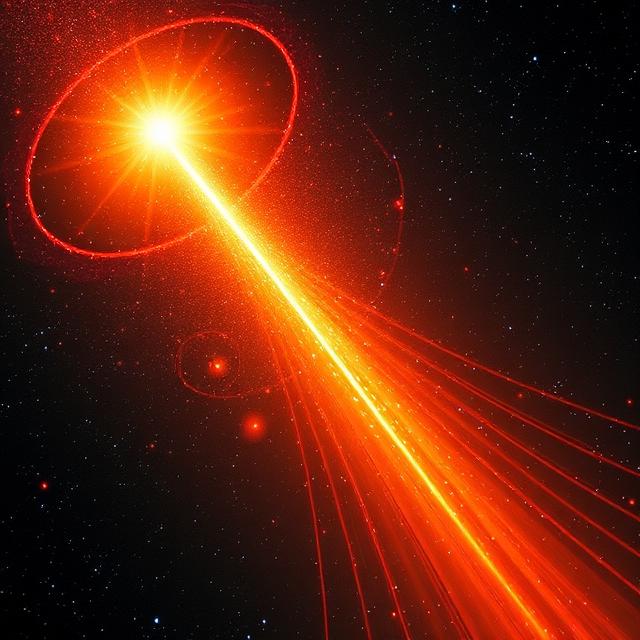
At their core, quasars are a type of active galactic nucleus (AGN): the luminous, energetic centre of a galaxy where a supermassive black hole (SMBH) is actively accreting matter. Unlike dormant SMBHs, quasars are “switched on,” radiating energy across the electromagnetic spectrum—from radio waves to gamma rays—often outshining their entire host galaxy.
Key Characteristics
- Luminosity: Quasars can emit up to 100,000 times the light of a typical galaxy, with luminosities reaching 10401040 to 10471047 watts.
- Distance: Most quasars are extremely distant, with redshifts indicating they are seen as they were billions of years ago, when the universe was young.
- Size: The region emitting this energy is surprisingly compact, often just light-days to light-years across.
- Central Engine: The energy is powered by accretion of gas and dust onto a SMBH, typically millions to billions of times the mass of the Sun.
- Jets and Outflows: Many quasars exhibit powerful jets of relativistic particles, extending thousands of light-years from the core.
Theoretical Understanding: Anatomy of a Quasar
1. The Supermassive Black Hole
At the centre of every quasar lies a SMBH. While black holes themselves emit no light, the infalling matter forms an accretion disk—a swirling, flattened structure where gravitational and frictional forces heat the gas to millions of degrees, causing it to radiate intensely.
Accretion Physics
The gravitational potential energy of infalling matter is converted to thermal energy and then to electromagnetic radiation. The efficiency (ηη) of this process is much higher than nuclear fusion; typically, η∼0.1 (10% of rest mass energy is radiated away).
The Eddington luminosity (LEddLEdd) is the theoretical maximum luminosity where outward radiation pressure balances inward gravitational pull:LEdd=4πGMmpcσTLEdd=σT4πGMmpc
where:
- G is the gravitational constant,
- M is the black hole mass,
- mp is the proton mass,
- c is the speed of light,
- σT is the Thomson scattering cross-section.
For a 108 solar mass black hole, LEdd is about 1.3×1046 erg/s.
2. The Accretion Disk
The accretion disk is the primary source of a quasar’s luminosity. According to the Shakura-Sunyaev disk model, the disk is geometrically thin and optically thick, with temperature and emission varying with radius.
The temperature profile is given by:T(r)=[3GMM˙8πσr3(1−rinr)]1/4
where:
- M˙ is the mass accretion rate,
- σ is the Stefan-Boltzmann constant,
- rin is the inner radius of the disk (close to the innermost stable circular orbit).
The disk emits a multi-temperature blackbody spectrum, peaking in the ultraviolet or soft X-rays.
3. The Broad and Narrow Line Regions
Surrounding the accretion disk are clouds of gas at varying distances:
- Broad Line Region (BLR): Dense, fast-moving clouds (velocities of thousands of km/s) produce broad emission lines (e.g., Hαα, Hββ) via photoionisation and recombination.
- Narrow Line Region (NLR): More distant, less dense clouds (velocities of hundreds of km/s) produce narrow lines.
The widths of these lines provide estimates of the velocity and, via the virial theorem, the mass of the central black hole:MBH≈RBLRv2
where RBLRRBLR is the radius (inferred from reverberation mapping) and vv is the velocity dispersion.
4. Relativistic Jets
Many quasars, especially those classified as blazars, launch powerful jets of plasma at nearly the speed of light. These jets are thought to be powered by the extraction of rotational energy from the spinning black hole (the Blandford-Znajek mechanism) or the accretion disk (Blandford-Payne mechanism).
Jets emit synchrotron radiation (from relativistic electrons spiralling in magnetic fields) and inverse Compton radiation (photons boosted to higher energies by collisions with relativistic electrons).
Mathematical Modelling of Quasars
1. Accretion Disk Luminosity
The bolometric luminosity (LL) of a quasar can be estimated by:L=ηM˙c2L=ηM˙c2
where:
- η is the efficiency (typically 0.1),
- M˙ is the mass accretion rate,
- c is the speed of light.
2. Spectral Energy Distribution (SED)
Quasars emit across the electromagnetic spectrum. The SED is a sum of several components:
- Thermal emission from the accretion disk (optical/UV).
- Non-thermal emission from jets (radio, X-ray, gamma-ray).
- Infrared emission from dust heated by the quasar.
The SED is modelled as:Fν=Fν,disk+Fν,jet+Fν,dust
where Fν is the flux at frequency ν.
3. Black Hole Mass Estimation
Using the width of broad emission lines and the size of the BLR:MBH=fRBLRv2
where f is a scaling factor accounting for geometry and orientation.
- RBLRRBLR is often determined via reverberation mapping, measuring the time lag between continuum and line emission variations.
4. Jet Power
The kinetic power of a jet (PjetPjet) can be estimated by:Pjet≈πr2Γ2βcUPjet≈πr2Γ2βcU
where:
- r is the jet radius,
- Γ is the Lorentz factor,
- β=v/c,
- U is the energy density.
Observational Evidence and Cosmological Context
Redshift and Distance
Quasars are among the most distant objects observed, with redshifts (zz) up to 10.1, corresponding to epochs less than a billion years after the Big Bang. Their spectra show strong emission lines, often highly redshifted, allowing astronomers to probe the early universe.
Host Galaxies and Evolution
High-resolution imaging (e.g., Hubble Space Telescope) reveals that quasars reside in the centres of massive galaxies, often showing signs of mergers or interactions. This supports the theory that galaxy collisions funnel gas to the central SMBH, triggering quasar activity.
Quasars as Probes
Because of their brightness and distance, quasars serve as backlights for studying intervening matter, such as the intergalactic medium and cosmic web. Absorption lines in quasar spectra reveal the composition and evolution of the universe’s baryonic content.
Theoretical Challenges and Advances
The Formation of Supermassive Black Holes
One of the biggest puzzles is how SMBHs grew so massive so quickly in the early universe. Theories include:
- Direct collapse of massive gas clouds.
- Rapid accretion at or above the Eddington limit.
- Mergers of smaller black holes.
Feedback and Galaxy Evolution
Quasars are not just passive consumers of matter; their powerful radiation and jets can drive outflows, regulating star formation in the host galaxy—a process known as AGN feedback. This feedback is a key ingredient in models of galaxy evolution.
Variability and Multi-Messenger Astronomy
Quasars are variable on timescales from days to years, reflecting changes in accretion rates, disk instabilities, or jet activity. Monitoring these variations provides insights into the physics of the accretion process. With the advent of gravitational wave astronomy, future detections of SMBH mergers could link directly to quasar activity.
Modern Mathematical and Computational Modelling
Magnetohydrodynamics (MHD)
Simulations of accretion disks and jet formation use the equations of magnetohydrodynamics (MHD), combining fluid dynamics and Maxwell’s equations to model the behaviour of ionised gas in strong magnetic fields.
General Relativity
The strong gravity near SMBHs requires Einstein’s theory of general relativity. The Kerr metric describes the spacetime around a rotating black hole, influencing the innermost stable orbits and the efficiency of energy extraction.
Radiative Transfer
To model the emission from accretion disks and jets, astronomers solve the radiative transfer equation:dIνds=jν−ανIνdsdIν=jν−ανIν
where IνIν is the specific intensity, jνjν is the emission coefficient, and αναν is the absorption coefficient.
Numerical Simulations
State-of-the-art simulations track billions of particles, modelling the dynamics of gas, magnetic fields, and radiation in the vicinity of SMBHs. These simulations help explain observed features such as variability, jet structure, and spectral properties.
Summary
Quasars are among the most luminous and fascinating objects in the universe, powered by the accretion of matter onto supermassive black holes. Their study combines observations across the electromagnetic spectrum with sophisticated theoretical and mathematical models, from accretion physics and jet dynamics to general relativity and radiative transfer. Quasars illuminate not only the farthest reaches of the cosmos but also the fundamental processes that shape galaxies and black holes. As telescopes and computational models grow ever more powerful, the next decades promise to unlock even deeper secrets of these cosmic beacons, offering new insights into the origins and fate of the universe itself.