





 Vinay Karanam
 The universe is a mystery, a dance of forces and forms that has captivated mystics and scientists alike. In Hindu mythology, Lord Shiva’s Tandava embodies this dance—a cosmic rhythm of creation, preservation, and dissolution. In modern physics, quantum mechanics unveils a subatomic world of probabilities, entanglement, and vibrations, challenging our perceptions of reality. Bridging these domains, the Bimba-Pratibimba theory from Advaita Vedanta offers a philosophical lens: the world as a reflection of a deeper truth. This article explores how Shiva’s Tandava, quantum phenomena like Bell’s Theorem and Schrödinger’s equations, and the interplay of science and spirituality illuminate the cosmic realm.
Shiva Tandava: The Dance of the Cosmos
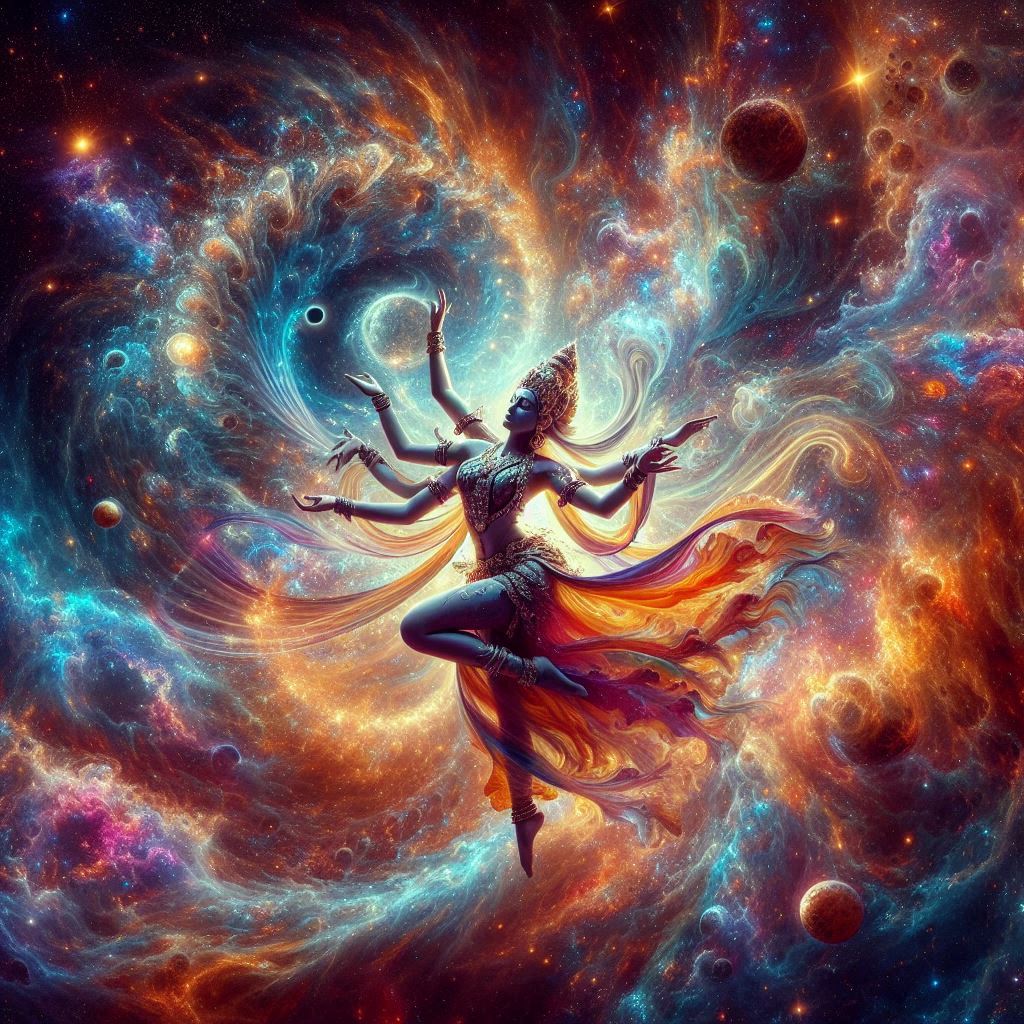
Shiva, the destroyer and transformer in the Hindu trinity, is celebrated as Nataraja, the Lord of Dance. The Tandava is his divine performance, a dynamic act that encapsulates the lifecycle of the universe. In the Shiva Tandava Stotram, composed by the demon-king Ravana, the dance is described with vivid imagery: “With his resounding drum, he shakes the earth; with his fiery locks, he stirs the heavens.” This is no mere metaphor—it’s a vision of cosmic power, where rhythm and motion govern existence.
The Nataraja iconography is rich with symbolism. Shiva dances within a prabhamandala, a ring of flames representing the eternal cycle of time (samsara). His right hand holds a damaru, a drum whose beats birth the universe through primordial sound (nada). His left hand wields fire, symbolizing destruction. One foot crushes the demon Apasmara (ignorance), while the other is raised in grace, offering liberation. His serene face amid the chaos reflects a profound truth: beneath the tumult lies unity.
This dance mirrors the cosmos itself—a interplay of opposites, order emerging from chaos, creation dissolving into destruction. As we’ll see, these themes resonate deeply with quantum mechanics, where particles flicker between states, entangled across vast distances, driven by unseen vibrations.
Quantum Mechanics: Unveiling the Subatomic Dance
Quantum mechanics, developed in the early 20th century, revolutionized our understanding of reality. Unlike classical physics, where objects follow predictable paths, the quantum realm is governed by probabilities. Particles exhibit wave-particle duality, behaving as both waves and discrete entities. They exist in superposition—multiple states at once—until observed, when they collapse into a definite state. This strangeness extends further with quantum entanglement, where particles become linked, their fates intertwined regardless of separation.
Schrödinger’s Equation: The Rhythm of Probability
At the heart of quantum mechanics lies Schrödinger’s equation, formulated by Erwin Schrödinger in 1925. This mathematical framework describes how a quantum system evolves over time. Written as:
iℏ∂ψ∂t=H^ψ
where
ψ
is the wavefunction (a probability amplitude),
ℏ
is the reduced Planck constant,
H^
is the Hamiltonian (energy operator), and
t
is time, the equation governs the “dance” of particles. The wavefunction
ψ
encodes all possible states of a system, its squared magnitude
∣ψ∣2
yielding the likelihood of finding a particle in a given position or state..
Imagine an electron orbiting an atom. Schrödinger’s equation doesn’t pinpoint its location but describes a cloud of probabilities—a wave rippling through space. When measured, this wave collapses, much like Shiva’s dance shifts from boundless potential to a specific act. The damaru’s beats could symbolize these quantum waves, their rhythm shaping the fabric of reality.
The Observer Effect: Perception Shapes Reality
A key quantum enigma is the observer effect. Until measured, a particle’s state is indeterminate—superposed across possibilities. Observation forces a collapse, fixing the outcome. This raises profound questions: Does reality exist independently, or does consciousness play a role in its manifestation? Experiments like the double-slit test, where electrons form interference patterns as waves but behave as particles when watched, underscore this mystery.
This echoes Shiva’s Tandava as a dance of illusion (maya). The cosmos appears chaotic, yet observation—whether divine or human—crystallizes it into form. The Nataraja’s raised hand, offering moksha (liberation), hints at transcending this illusion, aligning with quantum insights into perception and reality.
Bimba-Pratibimba: Reflection of the Absolute
The Bimba-Pratibimba theory, from Advaita Vedanta, provides a philosophical bridge. “Bimba” means the original image, and “pratibimba” its reflection. The ultimate reality (Brahman) is the bimba, while the individual self (jiva) and the world are pratibimba—reflections distorted by maya. Just as a mirror reflects an object imperfectly, our perceptions veil the oneness of existence.
Advaita’s founder, Adi Shankara, likened this to a dream: the world seems real until awakening reveals its illusory nature. Brahman, pure consciousness, remains unchanging, while the reflections dance like shadows. Shiva, as Chidambaram (“space of consciousness”), embodies this unity—his Tandava both creates and dissolves the mirage.
Quantum mechanics aligns with this view. The wavefunction’s superposition reflects infinite possibilities, collapsing into a perceived reality upon observation—much like pratibimba arising from bimba. The dance of particles, governed by Schrödinger’s equation, mirrors the Tandava’s interplay of form and formlessness.
Quantum Entanglement: The Threads of Unity
Quantum entanglement deepens this synthesis. When particles interact, their states become correlated. Measuring one instantly determines the other’s state, even across light-years. This defies classical locality, suggesting a non-separable reality.
Bell’s Theorem: Proving the Spooky
In 1964, physicist John Bell formulated Bell’s Theorem to test entanglement’s implications. Classical physics assumes “local realism”—objects have definite properties, and influences travel no faster than light. Quantum theory predicts otherwise. Bell’s inequality, a mathematical limit, distinguishes these views. If experiments violate this inequality, local realism fails.
Tests, like those by Aspect in 1982, confirmed quantum predictions. Entangled photons, separated by kilometres, showed correlated behaviours exceeding Bell’s limit. This “spooky action” implies the universe is fundamentally interconnected—particles dancing in unison, like Shiva’s cosmic rhythm binding all existence.
In Tandava, the damaru’s vibrations could symbolize this entanglement, weaving a web where every beat resonates across the cosmos. The Nataraja’s serene gaze suggests awareness of this unity, transcending apparent separation.
Cosmic Parallels: Science Meets Spirituality
Modern discoveries amplify these connections, blurring lines between Shiva’s dance and quantum reality.
The Quantum Vacuum: Creation from Nothing
The quantum vacuum isn’t empty but a sea of fluctuations—virtual particles emerging and vanishing due to the uncertainty principle
ΔE⋅Δt≥ℏ/2
This zero-point energy mirrors Shiva’s dual role: creation arising from destruction, a dance of ephemeral forms. The Tandava’s fiery ring could represent this restless void, birthing universes in its wake.
String Theory: Vibrations of Reality
String theory posits that particles are one-dimensional “strings” vibrating at different frequencies, not point-like objects. These vibrations, within a multidimensional spacetime, generate the cosmos—matter, forces, even gravity. The damaru’s nada finds a striking parallel here: sound as the origin of all, resonating through dimensions. Shiva’s dance, pulsing with rhythm, evokes these strings, their harmonies shaping reality.
The Holographic Principle: A Cosmic Reflection
The holographic principle suggests the universe is a projection, its information encoded on a lower-dimensional boundary. Proposed by physicists like Gerard ’t Hooft and Leonard Susskind, it aligns with Bimba-Pratibimba: the 3D world as a pratibimba of a deeper bimba. Shiva’s Tandava, encircling the prabhamandala, might symbolize this boundary—reality unfolding from a hidden source.
Schrödinger, Bell, and Shiva: A Deeper Dive
Let’s explore these scientific pillars further, tying them to the Tandava.
Schrödinger’s Equation in Action
Consider a quantum harmonic oscillator—a system like a vibrating string. Schrödinger’s equation yields quantized energy levels, described by wavefunctions
ψn(x)=Ane−x2/2Hn(x) = A_n e^{-x^2/2} H_n(x), where
Hn are Hermite polynomials). Each state vibrates at a distinct frequency, echoing the Tandava’s rhythmic beats. The transition between states—creation to destruction—parallels the dance’s cycle, energy flowing through maya’s veil.
Bell’s Experiments: Cosmic Choreography
Bell’s Theorem tested entangled particles’ spin. If two electrons are entangled with total spin zero, measuring one as “up” forces the other “down”—instantly. Classical hidden variables (pre-set properties) predict correlations within Bell’s inequality; quantum mechanics exceeds it. Experiments consistently favor the latter, suggesting Shiva’s dance binds the cosmos beyond space and time.
The Delayed-Choice Experiment
John Wheeler’s delayed-choice experiment adds intrigue. A photon’s path (wave or particle) depends on a choice made after it begins. This retroactive influence mirrors Advaita’s timeless Brahman—reality shaped by awareness, not linear causality. Shiva’s raised foot, offering liberation, transcends such bounds.
The Cosmic Realm: A Unified Vision
Synthesizing these threads, the cosmic realm emerges as a dance of unity and multiplicity. Shiva’s Tandava reflects quantum mechanics’ probabilistic waves, collapsing via observation (Schrödinger’s legacy) into a perceived world—Bimba-Pratibimba in action. Entanglement (Bell’s proof) weaves a non-local tapestry, vibrations (string theory) birthing form, and holography projecting it all from a deeper truth.
The Nataraja stands as a timeless symbol: the damaru’s nada as quantum fluctuations, the fire as entropy’s decay, the ring as spacetime’s edge. Science and spirituality converge here—the Tandava isn’t just myth but a poetic grasp of existence’s rhythm. From Advaita’s non-dualism to entanglement’s unity, from Schrödinger’s waves to Bell’s correlations, the cosmos dances as one.
Excerpt: The Eternal Dance
This article reveals a profound interplay. Shiva’s Tandava, with its cosmic scope, anticipates quantum mechanics’ strangeness—probability, entanglement, and perception shaping reality. Bimba-Pratibimba bridges them, casting the world as a reflection of the infinite. Discoveries like Bell’s Theorem, Schrödinger’s equations, and the holographic principle affirm this vision, hinting at a universe alive with rhythm and consciousness.
The dance continues—fierce yet graceful, chaotic yet unified. In Shiva’s steps, we glimpse the quantum realm; in science’s equations, we hear the damaru’s echo. The cosmic realm, vast and mysterious, invites us to join the dance, reflecting on the bimba within.