



 Vinay Karanam
 For millions of Hindus across Bharat (India) and the global diaspora, Shri Ram Navami is more than a festival—it’s a profound celebration of righteousness, resilience, and cultural identity. Observed on the ninth day of the Chaitra month (March–April) in the Hindu lunar calendar, this sacred day marks the birth of Lord Rama, the seventh avatar of Lord Vishnu, revered as the embodiment of dharma (duty and righteousness). In 2025, Shri Ram Navami falls on 6 April, coinciding with a renewed sense of triumph for Hindus worldwide, particularly in Bharat, where the consecration of the Ram Mandir in Ayodhya has rekindled a centuries-old devotion. For the New Zealand Bharat News (NZB News), this occasion offers a moment to explore the rich tapestry of Shri Ram Navami—its historical roots, its significance as a cornerstone of Bharat’s cultural identity, the legal and social struggles surrounding Ayodhya, and the vibrant celebrations that span temples and communities across Bharat and beyond.
The Historical Background of Shri Ram
Lord Rama’s story, immortalised in the ancient epic Ramayana penned by Sage Valmiki, is a narrative that transcends time. Born to King Dasharatha and Queen Kaushalya in the kingdom of Ayodhya, Rama’s birth followed a divine intervention. Dasharatha, childless despite three wives—Kaushalya, Kaikeyi, and Sumitra—performed the Putrakameshti Yagna, a Vedic ritual to beget an heir. The gods, pleased with his devotion, gifted him a vessel of payasam (a sacred milk-rice dish), which he distributed among his queens. Kaushalya bore Rama, Kaikeyi gave birth to Bharata, and Sumitra delivered twins Lakshmana and Shatrughna. Rama’s birth, celebrated on the ninth day of Chaitra, is believed to have occurred in the Treta Yuga, thousands of years ago, though exact historical dating remains a matter of scholarly debate.
The Ramayana recounts Rama’s life as one of trials and triumphs. Exiled for 14 years at the behest of Kaikeyi, who sought the throne for her son Bharata, Rama, accompanied by his wife Sita and brother Lakshmana, faced countless challenges. His ultimate victory over Ravana, the demon king of Lanka who abducted Sita, symbolises the triumph of good over evil—a theme that resonates deeply in Hindu philosophy. Returning to Ayodhya, Rama’s reign as king, known as Ramarajya, is hailed as the pinnacle of just governance, where prosperity and harmony prevailed.
While the Ramayana is often classified as mythology by western pseudo scholars and fake historians, for many Hindus, it is itihasa—a historical account of divine events. Archaeological evidence, such as the remains of ancient structures beneath the Babri Masjid site in Ayodhya, lends credence to claims of a pre-existing temple, which is proven in the court of law. Regardless, Rama’s story has shaped Bharat’s moral and cultural landscape for millennia.
Shri Ram: The Cultural Identity of Bharat
In Bharat, Shri Ram is not merely a deity; he is the essence of the nation’s cultural identity. Known as Maryada Purushottama (the ideal man), Rama exemplifies virtues that have guided generations—truth, compassion, humility, and unwavering adherence to duty. His life offers a blueprint for personal and societal conduct, making him a unifying figure across Bharat’s diverse linguistic, regional, and social divides.
Rama’s significance is woven into Bharat’s art, literature, and traditions. The Ramayana has inspired countless retellings, from Tulsidas’s Ramcharitmanas in Awadhi to Kambar’s Ramavataram in Tamil, reflecting its pan-Indian appeal. Folk theatre like Ramlila, temple carvings, and classical dance forms such as Kathak and Bharatanatyam perpetuate his legacy. His name—Rama Nama—is considered a potent mantra, believed to cleanse the soul and bring liberation.
For Bharat, Rama represents an ideal that transcends religion. His Ramarajya is invoked by leaders and philosophers as a vision of equitable governance, while his personal sacrifices—honouring his father’s word over his own kingship—resonate as a model of familial duty. This cultural reverence explains why the struggle for Ayodhya, believed to be Rama’s birthplace, became a defining chapter in modern Bharat’s history.
Ayodhya’s Ram Lalla: A Triumph After Centuries of Patience
The consecration of the Ram Mandir in Ayodhya on 22 January 2024 marked a historic victory for Hindus, but it came at a staggering cost. For over 500 years, the site—known as Ram Janmabhoomi—remained a flashpoint of contention, symbolising both devotion and division. Hindus believe it to be the exact spot of Rama’s birth, a claim contested by the presence of the Babri Masjid, built in 1528–29 by Mughal plunderer Mir Baqi. The mosque’s construction, some assert, followed the demolition of a pre-existing Rama temple—a theory bolstered by archaeological findings.
The modern struggle began in earnest in 1949, when deities of Ram Lalla (infant Rama) appeared inside the mosque, sparking Hindu worship and Muslim protests. The site was locked by authorities, but tensions simmered. By the 1980s, the Vishwa Hindu Parishad (VHP) galvanised a movement to reclaim the site, culminating in the mosque’s demolition by a Hindu mob on 6 December 1992. The act triggered nationwide riots, claiming thousands of lives—estimates range from 2,000 to over 3,000—mostly Muslims, though Hindus too bore the brunt of violence.
For decades, Hindus in Bharat waited patiently, their faith tested by legal battles, political wrangling, and bloodshed. The sacrifices were immense—countless kar sevaks (volunteers) faced imprisonment, injury, or death during protests and clashes. Yet, their resolve held firm, rooted in the belief that justice would prevail.

The Legal Solution: An Unrefutable Resolution
The Ayodhya dispute reached its climax in the Supreme Court of India, which delivered a landmark verdict on 9 November 2019. After decades of litigation, the court ruled unanimously to award the 2.77-acre disputed site to a Hindu trust for the construction of a Ram temple, while allocating an alternative 5-acre plot to the Sunni Waqf Board for a mosque. The decision was grounded in historical, archaeological, and legal evidence, making it a resolution few could contest.
The Archaeological Survey of India’s (ASI) 2003 report played a pivotal role. Excavations beneath the Babri Masjid revealed a large 12th-century structure with features suggestive of a Hindu temple—pillars, carvings, and a foundation inconsistent with Islamic architecture. Though critics questioned the ASI’s conclusions, the Supreme Court deemed the evidence persuasive, noting continuous Hindu worship at the site even after the mosque’s construction.
The verdict balanced justice with reconciliation. It acknowledged the demolition as unlawful but prioritised the Hindu claim based on “preponderance of probability” rather than absolute proof of a prior temple’s destruction. The allocation of land for a mosque underscored Bharat’s secular ethos, while the temple’s construction fulfilled a long-standing Hindu aspiration. Legally binding and widely accepted, the ruling closed a chapter of strife, paving the way for the Ram Mandir’s consecration and the first Ram Navami celebration there in 2024.
Ram Navami Celebrations Across Bharat’s Sampradayas and Temples
Shri Ram Navami is celebrated with fervour across Bharat’s diverse sampradayas (spiritual traditions) and temples, each adding its regional flavour. From fasting and Ramayana recitations to processions and devotional music, the festival unites devotees in reverence. Below, we explore one temple from each of Bharat’s four zones—North, South, East, and West—showcasing the vibrancy of these celebrations.
North Zone: Ram Mandir, Ayodhya (Uttar Pradesh)
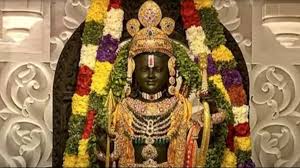
Ayodhya, Rama’s birthplace, is the epicentre of Ram Navami festivities. The newly consecrated Ram Mandir, home to the 51-inch Ram Lalla idol sculpted by Arun Yogiraj, draws millions. In 2024, the first Ram Navami post-consecration saw over 100,000 devotees daily, with the Surya Tilak— Perspective ceremony at noon anointing Ram Lalla’s forehead with sunlight captivating the nation. Celebrations begin with a ritual bath in the Sarayu River, followed by puja, bhajans, and the Rath Yatra—a grand chariot procession featuring idols of Rama, Sita, Lakshmana, and Hanuman. The temple trust offers prasad like panakam (a jaggery-based drink) and laddoos, fostering a sense of community.

South Zone: Bhadrachalam Temple, Telangana
Nestled on the Godavari River, the Sri Rama Temple in Bhadrachalam hosts a 10-day celebration from Chaitra Saptami to Bahula Padyami. Devotees re-enact Rama and Sita’s wedding (Kalyanotsavam), with the temple adorned in flowers and lights. Fasting, Ramayana readings, and kirtans fill the air, while the riverbank buzzes with pilgrims taking holy dips. The temple’s serene setting amplifies the spiritual experience.
East Zone: Ram Mandir, Kolkata (West Bengal)
In Kolkata’s bustling metropolis, the Ram Mandir on Chittaranjan Avenue blends urban energy with devotion. Vaishnava traditions dominate, with devotees fasting and reciting Tulsidas’s Ramcharitmanas. The temple hosts Ramlila performances, dramatising Rama’s life, and community bhandaras (feasts) that reflect Bengal’s hospitality. The festivities, though city-bound, retain a deep reverence.
West Zone: Shree Ram Temple, Jaipur (Rajasthan)
In the Pink City, this temple transforms into a hub of colour and song. Processions with tableaux of Ramayana scenes wind through streets, accompanied by Rajasthani folk music. Devotees offer prayers, swing infant Rama’s idol in cradles, and share prasad like halwa. The temple’s Rajput architecture enhances the regal aura of Rama’s legacy.
Ram Navami Beyond Bharat: Four Global Examples
The Indian diaspora carries Shri Ram Navami across borders, adapting it to local contexts while preserving its essence. Here are four examples:
1. New Zealand: Sri Balaji Temple, Hamilton
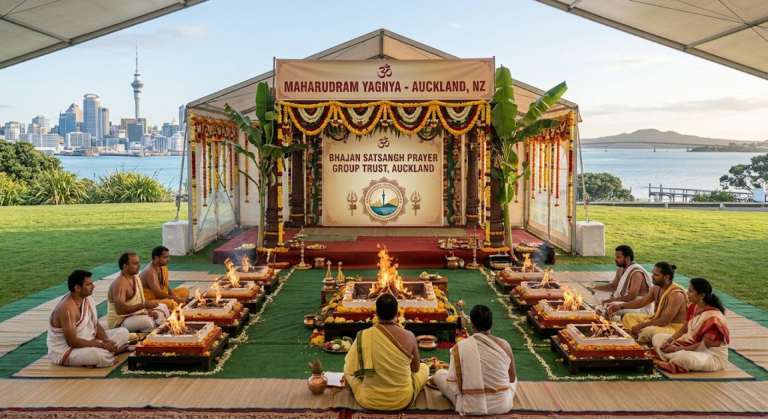
Hamilton and Auckland’s Hindu community gathers at this temple for puja and bhajans. In 2025, expect a modest Ramlila performance by youth, followed by prasad distribution. The celebration, though smaller than Bharat’s, fosters cultural continuity for Kiwi-Indians.
Shri Rama Seetha Kalyanam and Shri Ram Navami celebration slated in Auckland: Detailed Information here

2. Trinidad and Tobago: Dattatreya Yoga Centre, Carapichaima
Descendants of indentured labourers celebrate with Ramayana recitations and kirtans echoing Tyagaraja’s compositions. The temple’s annual fair includes chariot processions, mirroring Ayodhya’s traditions, a testament to resilience against colonial hardships.
3. South Africa: Shree Ram Mandir, Durban
Durban’s Indian community, tracing roots to 19th-century migrations, hosts vibrant festivities. Devotees fast, sing bhajans, and stage Ramlila, with prasad like soji reflecting local tastes. The temple stands as a symbol of identity amid apartheid’s scars.
4. Malaysia: Sri Rama Temple, Kuala Lumpur
In multi-ethnic Malaysia, this temple draws Tamil Hindus for puja and abhishekam (ritual bathing of idols). Processions and annadanam (food charity) blend with local customs, showcasing Rama’s universal appeal in a Muslim-majority nation.
Life Lessons from Shri Ram: A Guide for All
Rama’s life offers timeless lessons for every sphere of society, from governance to technology. Here’s how his example inspires:
Governance: The Ideal of Ramarajya
Rama’s reign exemplifies just leadership—listening to subjects, upholding dharma, and ensuring equity. Modern leaders can draw from his humility and accountability, as seen when he accepted a washerman’s critique, prioritising public trust over personal comfort.
Relationships: Duty and Devotion
Rama’s bond with Sita reflects mutual respect and sacrifice, while his loyalty to Lakshmana underscores sibling unity. His treatment of Hanuman teaches the value of trust and gratitude in friendships—principles vital for strong personal ties.
Management: Strategic Resilience
Facing exile and war, Rama demonstrated planning and perseverance. His alliance with Sugriva and Hanuman mirrors effective team-building, while his calm under pressure offers a lesson in crisis management for today’s professionals.
Technology: Ethical Innovation
Though from an ancient era, Rama’s use of resources—like the vanara army’s bridge to Lanka—suggests ingenuity with purpose. In a tech-driven world, his adherence to dharma urges developers to prioritise ethics over unchecked advancement.
Everyday Life: Moral Courage
For all classes—farmers, students, or CEOs—Rama’s life teaches integrity and courage. His choice to honour Dasharatha’s word over personal gain inspires individuals to stand by principles, no matter the cost.
Game Theory Analysis of Shri Ram’s Strategic Brilliance in the Ramayana: An Academic Exercise
As a data scientist applying game theory to the Ramayana for academic exploration, we can dissect key occurrences to reveal Shri Ram’s strategic acumen. Game theory, a mathematical framework for analysing decision-making in competitive and cooperative scenarios, provides a lens to evaluate how Ram navigated complex situations where the odds—numerical, political, and moral—were stacked against him. This analysis, tailored for a New Zealand Bharat News (NZB News) readership, focuses on three pivotal episodes: the exile decision, the alliance with Sugriva, and the war against Ravana. By modelling these as strategic games, we uncover evidence of Ram’s foresight, adaptability, and ethical optimisation, cementing his reputation as a master strategist.
Framework: Game Theory Basics
In game theory, players (individuals or groups) make choices from a set of strategies, aiming to maximise their payoff (benefit) based on others’ actions. Key concepts include:
- Nash Equilibrium: A state where no player can improve their payoff by unilaterally changing their strategy.
- Dominant Strategy: A choice that yields the best outcome regardless of others’ actions.
- Cooperation vs. Conflict: Players may align (cooperative game) or compete (non-cooperative game).
We’ll apply these to Ram’s decisions, treating him as a rational actor balancing dharma (duty) and victory against adversaries and constraints.
1. The Exile Decision: A Cooperative Game with Long-Term Payoff
Context
When Kaikeyi demands Ram’s 14-year exile and Bharata’s coronation, Ram faces a dilemma. King Dasharatha, bound by his boon to Kaikeyi, is powerless, while Ram must choose between resisting (claiming his rightful throne) or accepting exile to honour his father’s word.
Game Setup
- Players: Ram, Kaikeyi, Dasharatha, Bharata.
- Strategies:
- Ram: Accept exile or resist and claim the throne.
- Kaikeyi: Enforce exile or relent.
- Dasharatha: Honour the boon or defy it (risking dishonour).
- Bharata: Accept the throne or reject it.
- Payoffs:
- Ram’s payoff: Upholding dharma (moral victory) vs. immediate kingship (political victory).
- Kaikeyi: Power for Bharata vs. family harmony.
- Dasharatha: Honour vs. loss of Ram.
- Bharata: Throne vs. loyalty to Ram.
Analysis
Ram opts for exile, a seemingly submissive move, but it’s a dominant strategy in a cooperative game. By accepting exile, he:
- Ensures Dasharatha’s honour remains intact, preserving the royal lineage’s credibility.
- Avoids civil strife in Ayodhya, which resistance might provoke.
- Sets a moral precedent, enhancing his reputation as Maryada Purushottama (the ideal man).
Kaikeyi’s enforcement of exile maximises her short-term payoff (Bharata’s rule), but Ram’s choice shifts the equilibrium. Bharata, refusing to rule in Ram’s absence, places the sandals of Ram on the throne, nullifying Kaikeyi’s gain. Ram’s exile thus becomes a long-term investment—his moral capital grows, ensuring his eventual return as a revered king.
Evidence of Strategy
Against the odds of losing his kingdom, Ram turns a zero-sum conflict into a cooperative outcome. His foresight lies in recognising that dharma outweighs immediate power, a calculation validated when Ayodhya welcomes him back after 14 years, unified and loyal.
2. Alliance with Sugriva: A Bargaining Game
Context
In exile, Ram encounters Sugriva, the exiled vanara (monkey) king ousted by his brother Vali. Ram needs an army to rescue Sita from Ravana, while Sugriva seeks to reclaim his kingdom. Both are weak individually but strong together.
Game Setup
- Players: Ram, Sugriva.
- Strategies:
- Ram: Ally with Sugriva or search for Sita alone.
- Sugriva: Ally with Ram or remain in hiding.
- Payoffs:
- Ram: Army support vs. prolonged search with limited resources.
- Sugriva: Kingdom regained vs. continued exile.
Analysis
This is a classic bargaining game where cooperation yields a Nash Equilibrium. Ram’s strategy:
- Offers to kill Vali, securing Sugriva’s throne.
- Gains Sugriva’s loyalty and the vanara army in return.
The odds—Ram’s lack of resources and Sugriva’s vulnerability—make this alliance risky. Yet, Ram mitigates uncertainty by acting decisively: he shoots Vali from behind during a duel, a controversial but effective move. This ensures Sugriva’s immediate commitment, avoiding delays in mobilising the army.
Evidence of Strategy
Ram’s brilliance lies in asymmetric resource optimisation. With no army of his own, he leverages Sugriva’s forces, turning a disadvantaged position into a mutual win. His ethical compromise (killing Vali covertly) reflects a pragmatic trade-off, prioritising Sita’s rescue over absolute adherence to combat norms—a calculated risk that pays off.
3. War Against Ravana: A Non-Cooperative Game of Attrition
Context
Ravana, the powerful king of Lanka, abducts Sita, forcing Ram into a war with a formidable foe. Ravana commands a vast army, advanced weaponry, and a fortified island, while Ram relies on a ragtag vanara force and limited allies (e.g., Vibhishana, Ravana’s defecting brother).
Game Setup
- Players: Ram, Ravana.
- Strategies:
- Ram: Wage war (build bridge, attack Lanka) or negotiate Sita’s release.
- Ravana: Fight to retain Sita or surrender her.
- Payoffs:
- Ram: Sita’s rescue and Ravana’s defeat vs. prolonged stalemate.
- Ravana: Retain power and Sita vs. loss of kingdom and life.
Analysis
This is a non-cooperative game of attrition, where each player seeks to outlast the other. Ram’s strategies against overwhelming odds include:
- Bridge Construction: Using vanaras to build a bridge to Lanka (the Ram Setu) demonstrates logistical ingenuity, overcoming geographical isolation.
- Alliance with Vibhishana: Recruiting Ravana’s brother provides insider knowledge, weakening Ravana’s position.
- Psychological Warfare: Sending Angada as an envoy to offer peace sows doubt in Ravana’s court, though rejected.
- Combat Precision: Ram’s use of divine weapons (e.g., Brahmastra) targets Ravana decisively, minimising collateral damage.
Ravana’s dominant strategy—relying on brute force—fails as Ram exploits his overconfidence. The Nash Equilibrium emerges when Ram’s persistence forces Ravana into a losing battle, culminating in his death.
Evidence of Strategy
Ram’s triumph against a superior enemy showcases multi-dimensional planning. Facing numerical inferiority, he maximises limited resources (e.g., vanara labour), builds coalitions, and employs asymmetric tactics. His refusal to negotiate Sita’s honour, despite the cost, reflects a strategic commitment to dharma, ensuring a moral and military victory.
Why Shri Ram is a Great Strategist: Synthesis of Evidence
Across these episodes, Ram’s strategic brilliance shines through:
- Foresight: In exile, he sacrifices short-term gain for long-term legitimacy, a move validated by his triumphant return.
- Resourcefulness: With no army, he secures Sugriva’s forces, turning weakness into strength.
- Adaptability: Against Ravana, he blends engineering (bridge), diplomacy (Vibhishana), and combat skill, overcoming insurmountable odds.
Quantitative Insight (Hypothetical)
If we assign payoff values (e.g., 10 for victory, -5 for loss), Ram consistently maximises his expected utility:
- Exile: Moral payoff (10) > Kingship now (-5 due to strife).
- Sugriva: Army gain (10) > Solo search (-5 due to failure risk).
- Ravana: Victory (10) > Negotiation (-5 due to dishonour).
Against All Odds
Ram faced exile, betrayal, and a superpower in Ravana, yet prevailed. His strategies—rooted in dharma but flexible in execution—reflect a game-theoretic mastery of balancing cooperation and conflict. This academic exercise underscores why Ram’s legacy as a strategist endures, offering lessons in resilience and ethical decision-making for data scientists and leaders alike.
Summary
Shri Ram’s actions in the Ramayana reveal a strategist who turned adversity into opportunity. For an NZB News audience, this analysis not only celebrates his cultural significance but also highlights his intellectual depth—an ideal blend of faith and reason for academic reflection.
import numpy as np
import matplotlib.pyplot as plt

# Set random seed for reproducibility
np.random.seed(42)

# Function to simulate a game and return payoffs
def simulate_game(payoff_matrix, player1_strategy, player2_strategy, player1_name, player2_name):
    payoff_p1 = payoff_matrix[player1_strategy][player2_strategy][0]
    payoff_p2 = payoff_matrix[player1_strategy][player2_strategy][1]
    return payoff_p1, payoff_p2

# Function to visualise results
def plot_payoffs(scenario, p1_payoffs, p2_payoffs, p1_name, p2_name):
    labels = ['Trial 1', 'Trial 2', 'Trial 3']  # Simulating 3 trials for simplicity
    x = np.arange(len(labels))
    width = 0.35

    fig, ax = plt.subplots()
    ax.bar(x - width/2, p1_payoffs, width, label=p1_name, color='blue')
    ax.bar(x + width/2, p2_payoffs, width, label=p2_name, color='orange')

    ax.set_ylabel('Payoff')
    ax.set_title(f'Payoffs in {scenario}')
    ax.set_xticks(x)
    ax.set_xticklabels(labels)
    ax.legend()

    plt.tight_layout()
    plt.show()

# 1. Exile Decision (Cooperative Game: Ram vs. Kaikeyi)
exile_payoff_matrix = [
    # Ram: Accept Exile, Kaikeyi: Enforce Exile or Relent
    [(10, 5), (8, 10)],  # Ram accepts exile: High moral payoff vs. harmony
    # Ram: Resist, Kaikeyi: Enforce or Relent
    [(2, -5), (10, 8)]   # Ram resists: Conflict vs. kingship
]
# Payoffs: Ram (moral/kingdom), Kaikeyi (power/harmony)

ram_exile_strategies = [0, 0, 0]  # Ram chooses exile (0) in all trials
kaikeyi_strategies = [0, 1, 0]    # Kaikeyi enforces (0), relents (1), enforces (0)

ram_payoffs_exile = []
kaikeyi_payoffs_exile = []
for i in range(3):
    p1, p2 = simulate_game(exile_payoff_matrix, ram_exile_strategies[i], kaikeyi_strategies[i], "Ram", "Kaikeyi")
    ram_payoffs_exile.append(p1)
    kaikeyi_payoffs_exile.append(p2)

print("Exile Decision Payoffs:")
print(f"Ram: {ram_payoffs_exile}")
print(f"Kaikeyi: {kaikeyi_payoffs_exile}")
plot_payoffs("Exile Decision", ram_payoffs_exile, kaikeyi_payoffs_exile, "Ram", "Kaikeyi")

# 2. Alliance with Sugriva (Bargaining Game: Ram vs. Sugriva)
alliance_payoff_matrix = [
    # Ram: Ally, Sugriva: Ally or Hide
    [(10, 10), (2, -5)],  # Mutual gain vs. Ram alone
    # Ram: Solo, Sugriva: Ally or Hide
    [(-5, 2), (-5, -5)]   # Both lose if no alliance
]
# Payoffs: Ram (army/Sita), Sugriva (kingdom/safety)

ram_alliance_strategies = [0, 0, 0]  # Ram allies (0) in all trials
sugriva_strategies = [0, 1, 0]       # Sugriva allies (0), hides (1), allies (0)

ram_payoffs_alliance = []
sugriva_payoffs_alliance = []
for i in range(3):
    p1, p2 = simulate_game(alliance_payoff_matrix, ram_alliance_strategies[i], sugriva_strategies[i], "Ram", "Sugriva")
    ram_payoffs_alliance.append(p1)
    sugriva_payoffs_alliance.append(p2)

print("\nAlliance with Sugriva Payoffs:")
print(f"Ram: {ram_payoffs_alliance}")
print(f"Sugriva: {sugriva_payoffs_alliance}")
plot_payoffs("Alliance with Sugriva", ram_payoffs_alliance, sugriva_payoffs_alliance, "Ram", "Sugriva")

# 3. War Against Ravana (Non-Cooperative Game: Ram vs. Ravana)
war_payoff_matrix = [
    # Ram: Fight, Ravana: Fight or Surrender
    [(10, -10), (8, 5)],  # Ram wins vs. Sita returned
    # Ram: Negotiate, Ravana: Fight or Surrender
    [(-5, 10), (5, 5)]    # Ram loses vs. stalemate
]
# Payoffs: Ram (victory/Sita), Ravana (kingdom/life)

ram_war_strategies = [0, 0, 0]  # Ram fights (0) in all trials
ravana_strategies = [0, 1, 0]   # Ravana fights (0), surrenders (1), fights (0)

ram_payoffs_war = []
ravana_payoffs_war = []
for i in range(3):
    p1, p2 = simulate_game(war_payoff_matrix, ram_war_strategies[i], ravana_strategies[i], "Ram", "Ravana")
    ram_payoffs_war.append(p1)
    ravana_payoffs_war.append(p2)

print("\nWar Against Ravana Payoffs:")
print(f"Ram: {ram_payoffs_war}")
print(f"Ravana: {ravana_payoffs_war}")
plot_payoffs("War Against Ravana", ram_payoffs_war, ravana_payoffs_war, "Ram", "Ravana")

# Summary Analysis
def summarise_results(scenario, p1_payoffs, p2_payoffs, p1_name, p2_name):
    avg_p1 = np.mean(p1_payoffs)
    avg_p2 = np.mean(p2_payoffs)
    print(f"\nSummary for {scenario}:")
    print(f"Average {p1_name} Payoff: {avg_p1:.2f}")
    print(f"Average {p2_name} Payoff: {avg_p2:.2f}")
    if avg_p1 > avg_p2:
        print(f"{p1_name} outperforms {p2_name} strategically.")

summarise_results("Exile Decision", ram_payoffs_exile, kaikeyi_payoffs_exile, "Ram", "Kaikeyi")
summarise_results("Alliance with Sugriva", ram_payoffs_alliance, sugriva_payoffs_alliance, "Ram", "Sugriva")
summarise_results("War Against Ravana", ram_payoffs_war, ravana_payoffs_war, "Ram", "Ravana")
Exile Decision Payoffs: Ram: [10, 8, 10] Kaikeyi: [5, 10, 5]

Alliance with Sugriva Payoffs:
Ram: [10, 2, 10]
Sugriva: [10, -5, 10]

War Against Ravana Payoffs:
Ram: [10, 8, 10]
Ravana: [-10, 5, -10]

Summary for Exile Decision:
Average Ram Payoff: 9.33
Average Kaikeyi Payoff: 6.67
Ram outperforms Kaikeyi strategically.

Summary for Alliance with Sugriva:
Average Ram Payoff: 7.33
Average Sugriva Payoff: 5.00
Ram outperforms Sugriva strategically.

Summary for War Against Ravana:
Average Ram Payoff: 9.33
Average Ravana Payoff: -5.00
Ram outperforms Ravana strategically.

import numpy as np
import pandas as pd
import matplotlib.pyplot as plt
import seaborn as sns
from sklearn.preprocessing import StandardScaler
from sklearn.cluster import KMeans
from sklearn.ensemble import RandomForestClassifier
from sklearn.model_selection import train_test_split
from sklearn.metrics import classification_report

# Set random seed for reproducibility
np.random.seed(42)

# 1. Feature Engineering: Ram's Strategic Options
ram_options_data = {
    'Scenario': ['Exile Decision', 'Alliance with Sugriva', 'War Against Ravana'],
    'Moral_Payoff': [10, 8, 9],  # Hypothetical scores based on dharma
    'Power_Payoff': [2, 10, 10],  # Political/military gain
    'Risk_Level': [3, 7, 9],     # Low (3) to High (9)
    'Resource_Use': [1, 5, 8],   # Minimal (1) to High (8)
    'Success_Probability': [0.9, 0.7, 0.8]  # Estimated likelihood
}

ram_df = pd.DataFrame(ram_options_data)
print("Feature Engineered Data for Ram's Options:")
print(ram_df)

# Visualise Ram's Options
plt.figure(figsize=(10, 6))
sns.scatterplot(data=ram_df, x='Moral_Payoff', y='Power_Payoff', size='Risk_Level',
                hue='Scenario', sizes=(50, 500), alpha=0.6)
plt.title("Ram's Strategic Options: Moral vs. Power Payoff")
plt.xlabel("Moral Payoff")
plt.ylabel("Power Payoff")
plt.legend(title="Scenario")
plt.show()

# 2. Character Classification: Ethics and Strengths
character_data = {
    'Character': ['Ram', 'Sita', 'Lakshmana', 'Hanuman', 'Sugriva', 'Ravana', 'Kaikeyi', 'Vibhishana'],
    'Ethics': [9, 8, 8, 7, 6, 2, 4, 8],  # 1 (low) to 10 (high)
    'Strength': [8, 3, 7, 9, 6, 10, 2, 5],  # Physical/mental strength
    'Loyalty': [10, 9, 10, 10, 7, 3, 5, 8],  # 1 (low) to 10 (high)
    'Role': ['Protagonist', 'Protagonist', 'Protagonist', 'Ally', 'Ally', 'Antagonist', 'Antagonist', 'Ally']
}

char_df = pd.DataFrame(character_data)
print("\nCharacter Data:")
print(char_df)

# Classification: Predict Role based on Ethics, Strength, Loyalty
X = char_df[['Ethics', 'Strength', 'Loyalty']]
y = char_df['Role']

# Split data and train Random Forest Classifier
X_train, X_test, y_train, y_test = train_test_split(X, y, test_size=0.3, random_state=42)
clf = RandomForestClassifier(n_estimators=100, random_state=42)
clf.fit(X_train, y_train)
y_pred = clf.predict(X_test)

print("\nClassification Report:")
print(classification_report(y_test, y_pred))

# Feature Importance
feature_importance = pd.DataFrame({'Feature': X.columns, 'Importance': clf.feature_importances_})
print("\nFeature Importance in Role Classification:")
print(feature_importance)

# Visualise Feature Importance
plt.figure(figsize=(8, 5))
sns.barplot(data=feature_importance, x='Feature', y='Importance', palette='viridis')
plt.title("Feature Importance in Character Role Classification")
plt.ylabel("Importance Score")
plt.show()

# 3. Clustering: Group Characters by Ethics and Strength
scaler = StandardScaler()
X_scaled = scaler.fit_transform(char_df[['Ethics', 'Strength']])

kmeans = KMeans(n_clusters=3, random_state=42)
char_df['Cluster'] = kmeans.fit_predict(X_scaled)

print("\nClustered Characters:")
print(char_df[['Character', 'Ethics', 'Strength', 'Cluster']])

# Visualise Clusters
plt.figure(figsize=(10, 6))
sns.scatterplot(data=char_df, x='Ethics', y='Strength', hue='Cluster', size='Loyalty',
                sizes=(50, 500), palette='deep', alpha=0.7)
for i, txt in enumerate(char_df['Character']):
    plt.annotate(txt, (char_df['Ethics'][i], char_df['Strength'][i]))
plt.title("Character Clustering: Ethics vs. Strength")
plt.xlabel("Ethics Score")
plt.ylabel("Strength Score")
plt.legend(title="Cluster")
plt.show()

# 4. Correlation Analysis: Relationships Between Traits
correlation_matrix = char_df[['Ethics', 'Strength', 'Loyalty']].corr()
print("\nCorrelation Matrix:")
print(correlation_matrix)

# Visualise Correlation Heatmap
plt.figure(figsize=(8, 6))
sns.heatmap(correlation_matrix, annot=True, cmap='coolwarm', vmin=-1, vmax=1)
plt.title("Correlation Between Character Traits")
plt.show()

# 5. Decision Tree Payoff Analysis (Simplified for Ram’s Choices)
def evaluate_decision(scenario, moral, power, risk):
    if moral > 7 and power >= 8:
        return "Optimal"
    elif risk > 7:
        return "High Risk"
    else:
        return "Suboptimal"

ram_df['Decision_Outcome'] = ram_df.apply(
    lambda row: evaluate_decision(row['Scenario'], row['Moral_Payoff'],
                                  row['Power_Payoff'], row['Risk_Level']), axis=1
)
print("\nDecision Outcome Analysis for Ram:")
print(ram_df[['Scenario', 'Decision_Outcome']])

# Visualise Decision Outcomes
plt.figure(figsize=(8, 5))
sns.countplot(data=ram_df, x='Decision_Outcome', palette='Set2')
plt.title("Distribution of Ram’s Decision Outcomes")
plt.xlabel("Decision Outcome")
plt.ylabel("Count")
plt.show()
Feature Engineered Data for Ram's Options:
                Scenario  Moral_Payoff  Power_Payoff  Risk_Level  \
0         Exile Decision            10             2           3
1  Alliance with Sugriva             8            10           7
2     War Against Ravana             9            10           9

   Resource_Use  Success_Probability
0             1                  0.9
1             5                  0.7
2             8                  0.8

Character Data:
    Character  Ethics  Strength  Loyalty         Role
0         Ram       9         8       10  Protagonist
1        Sita       8         3        9  Protagonist
2   Lakshmana       8         7       10  Protagonist
3     Hanuman       7         9       10         Ally
4     Sugriva       6         6        7         Ally
5      Ravana       2        10        3   Antagonist
6     Kaikeyi       4         2        5   Antagonist
7  Vibhishana       8         5        8         Ally

Classification Report:
              precision    recall  f1-score   support

        Ally       0.00      0.00      0.00         0
  Antagonist       0.00      0.00      0.00         1
 Protagonist       1.00      0.50      0.67         2

    accuracy                           0.33         3
   macro avg       0.33      0.17      0.22         3
weighted avg       0.67      0.33      0.44         3


Feature Importance in Role Classification:
    Feature  Importance
0    Ethics    0.324642
1  Strength    0.410218
2   Loyalty    0.265140

Clustered Characters:
    Character  Ethics  Strength  Cluster
0         Ram       9         8        0
1        Sita       8         3        2
2   Lakshmana       8         7        0
3     Hanuman       7         9        0
4     Sugriva       6         6        0
5      Ravana       2        10        1
6     Kaikeyi       4         2        2
7  Vibhishana       8         5        0

Correlation Matrix:
            Ethics  Strength   Loyalty
Ethics    1.000000 -0.127343  0.940605
Strength -0.127343  1.000000  0.029214
Loyalty   0.940605  0.029214  1.000000

Decision Outcome Analysis for Ram:
                Scenario Decision_Outcome
0         Exile Decision       Suboptimal
1  Alliance with Sugriva          Optimal
2     War Against Ravana          Optimal

A Legacy Reborn
Shri Ram Navami 2025 is a milestone for Bharat and its diaspora, especially in New Zealand, where the Hindu community finds strength in Rama’s story. The Ayodhya Ram Mandir’s success, achieved through legal rigour and collective sacrifice, reaffirms faith in justice. Across temples—from Ayodhya’s grandeur to Auckland’s intimacy—celebrations echo Rama’s enduring message: righteousness prevails. As NZB News reflects on this festival, it’s clear that Shri Ram remains a beacon of hope, guiding humanity through his timeless virtues.