
 Kara Riggs
 By Kara Riggs
NZB News Sports Correspondent
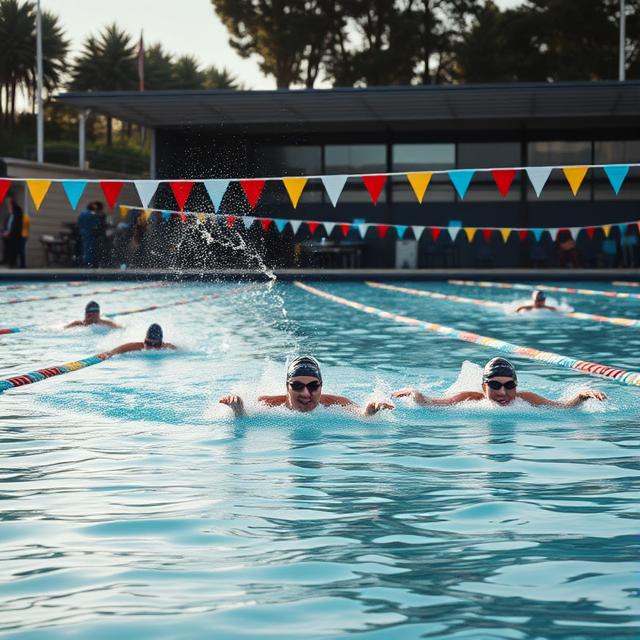
The 2025 World Aquatics Championships in Singapore concluded on August 3 with a spectacular display of athletic excellence that rewrote the record books and established new benchmarks for international swimming competition. The 22nd edition of the championships, held from July 11-August 3 at the purpose-built World Aquatics Championships Arena, delivered thrilling performances across eight days of finals competition that captivated audiences worldwide.
French swimming sensation Léon Marchand emerged as the standout male performer, shattering the 14-year-old world record in the men’s 200m individual medley with a breathtaking time of 1:52.69—obliterating Ryan Lochte’s previous mark by an extraordinary 1.31 seconds. Meanwhile, Canada’s Summer McIntosh dominated the women’s events, claiming four individual gold medals and earning recognition as the Female Swimmer of the Championships.
World Records and Championship Marks Fall
The Singapore championships witnessed an unprecedented assault on swimming’s most prestigious records. Marchand’s 200m individual medley performance represented one of the most significant single improvements to a world record in recent swimming history, reducing Lochte’s long-standing 1:54.00 benchmark to what now appears almost pedestrian by comparison.
The United States team, which earned the Team of the Championships award, contributed significantly to the record-breaking festivities. American sprinter Gretchen Walsh delivered a dominant performance in the women’s 100m butterfly, recording 54.73 seconds—the second-fastest time in history and a new championship record that underscored her status as one of the sport’s premier speed merchants.
The mixed 4x100m freestyle relay provided another historic moment when the American quartet of Jack Alexy, Patrick Sammon, Kate Douglass, and Torri Huske combined for a world record time of 3:18.48. This performance highlighted the depth and versatility of the US swimming programme, with the team seamlessly blending established stars with emerging talent.
Individual Excellence Across Multiple Events
Summer McIntosh’s championship campaign exemplified sustained excellence across diverse disciplines. The Canadian teenager captured gold medals in the 200m butterfly (2:01.99), 200m individual medley (2:06.69), 400m individual medley (4:25.78), and 400m freestyle, establishing herself as arguably the most versatile swimmer of her generation.
McIntosh’s performances were characterised by tactical intelligence and an ability to respond to competitive pressure. Her 200m butterfly triumph featured a championship record that demonstrated her capacity to excel in events requiring both speed and endurance—a combination that bodes well for her continued development.
Katie Ledecky continued her remarkable distance freestyle dominance, claiming her sixth world title in the women’s 1500m freestyle with a commanding performance that saw her finish more than five seconds ahead of her nearest competitor. At 28, Ledecky’s continued excellence in distance events represents one of sport’s most sustained periods of individual dominance.
International Depth and Emerging Talent
The championships showcased the increasingly global nature of elite swimming, with 203 countries participating alongside refugee and neutral athlete teams. Tunisia’s Ahmed Jaouadi completed an impressive distance double, capturing gold in both the men’s 800m and 1500m freestyle events, demonstrating that swimming excellence extends well beyond traditional powerhouse nations.
Australia’s Kaylee McKeown reinforced her status as the world’s premier backstroker, claiming victories in the 100m and 200m backstroke events with championship record performances. Her dominance in these events, combined with strong showings from teammates across multiple disciplines, highlighted Australia’s emergence as a comprehensive swimming force.
The emergence of young talent provided particular excitement, with swimmers like 12-year-old Yu Zidi from China qualifying for finals and demonstrating the sport’s impressive depth of emerging talent. Such performances suggest that the current high standards in international swimming will continue to rise.
Technical and Tactical Evolution
The Singapore championships revealed significant technical evolution in swimming, particularly in stroke mechanics and race strategy. Marchand’s individual medley world record stemmed from revolutionary approaches to underwater phases and stroke transitions that maximised efficiency across all four strokes.
The sprint events demonstrated the continuing refinement of start and turn techniques, with marginal gains in these areas often determining medal positions. The prevalence of sub-25-second times in men’s 50m events and the increasing number of swimmers breaking psychological barriers highlighted the sport’s technical sophistication.
Relay events proved particularly compelling, with team chemistry and changeover precision playing crucial roles in determining outcomes. The world record performance by the American mixed freestyle relay exemplified how tactical preparation and individual excellence can combine to produce extraordinary results.
Organisational Excellence and Global Impact
Singapore’s hosting of the championships established new standards for international aquatic competition. The purpose-built temporary venue at the Singapore Sports Hub provided optimal conditions for athletes whilst delivering an exceptional spectator experience. The “Water Shapes Us” theme resonated throughout the competition, emphasising swimming’s role in personal and cultural development.
The championships’ global reach was enhanced by comprehensive digital coverage, with live streaming available worldwide through the World Aquatics website and dedicated broadcasting partnerships. This accessibility ensured that swimming fans across all time zones could engage with the competition, contributing to the sport’s growing international profile.
Prize money totalling US$8.5 million recognised athletes’ performances, with individual event winners receiving US$70,000 and world record bonuses of US$100,000 providing additional incentives for exceptional achievement. This financial structure reflects World Aquatics’ commitment to supporting athlete development and recognising elite performance.
Legacy and Future Implications
The Singapore championships’ success provides a template for future international competitions, demonstrating how innovative venue solutions and comprehensive event management can deliver world-class competition. The temporary arena concept proved particularly effective, showing that major championships can be hosted without requiring permanent aquatic facilities.
The performance standards established in Singapore will influence training methodologies and competitive preparation for the upcoming World Athletics Championships in Tokyo and the Los Angeles 2028 Olympics. Marchand’s individual medley breakthrough, in particular, suggests that swimming’s traditional performance boundaries continue to be redefined by improved training science and athlete development.
The championships also highlighted the importance of international cooperation in sport, with neutral athlete teams demonstrating how competition can transcend political divisions whilst maintaining sporting integrity. This approach offers valuable lessons for managing international sport during periods of geopolitical tension.
Summary
The 2025 World Aquatics Championships in Singapore delivered a compelling combination of record-breaking performances, emerging talent, and organisational excellence that established new benchmarks for international swimming competition. Léon Marchand and Summer McIntosh emerged as the dominant individual performers, whilst team competitions demonstrated the sport’s increasing global depth and competitiveness. With world records falling and championship standards reaching unprecedented levels, Singapore 2025 will be remembered as a watershed moment that redefined expectations for elite swimming performance. The championships’ success provides momentum for the sport’s continued growth and sets ambitious standards for future international competition, ensuring that swimming remains at the forefront of global sporting excellence.