






 Dr. Rukumangada Acharya
 Article 52: “Antastaddharmopadeshāt”—The Immanence of the Divine and the Soul’s Journey
Introduction: The Next Sutra in Focus
The Brahmasutras, with their terse yet profound aphorisms, continue to guide the seeker through the labyrinth of metaphysics, theology, and the lived experience of the soul. Each sutra is a lamp, illuminating a unique aspect of the relationship between the finite and the Infinite. In this article, we turn to the next crucial sutra in the sequence:
अन्तस्तद्धर्मोपदेशात्
antastaddharmopadeśāt
antas—within; tad-dharma-upadeśāt—because of the teaching of its attributes.
Translation:
“Within, because of the teaching of its attributes.”
This sutra, deceptively simple, opens a vast landscape of philosophical inquiry. It addresses the presence of the Supreme within the heart of all beings, the nature of divine immanence, and the implications for the soul’s journey toward liberation. Let us embark on a detailed, creative, and comprehensive exploration of this sutra, drawing on the Dvaita Vedānta tradition and the broader Vedantic context.
The Sutra in Context: The Heart of the Upanishadic Vision
The preceding sutras have established the qualified reality of Brahman and the plurality of worlds accessible to the soul. Now, the focus shifts inward—to the very core of the soul’s existence. The Upanishads repeatedly declare that the Supreme dwells within the hearts of all beings, as the innermost Self, the witness, the guide, and the source of all knowledge and bliss.
The question arises: What does it mean for the Supreme to be “within” (antas)? Is this presence merely metaphorical, or is it a real, ontological fact? Does the Supreme lose His transcendence by becoming immanent? How does this immanence relate to the soul’s journey and its ultimate destiny?
The Dvaita Perspective: Immanence without Identity
In the Dvaita Vedānta tradition, as expounded by Śrī Madhvāchārya, the presence of the Supreme within all beings is a central tenet. However, this immanence is never equated with identity. The Supreme Lord, Viṣṇu, is present in the heart of every soul, yet remains eternally distinct from the soul itself. This distinction is not a limitation but the very ground of the soul’s individuality and its capacity for devotion.
The Dvaita commentators emphasize that the “teaching of its attributes” (taddharmopadeśāt) refers to the scriptural declarations that describe the Supreme as the inner controller (antaryāmin), the witness (sākṣī), and the giver of knowledge and liberation. These attributes are not imposed from without but arise from the very nature of the Supreme’s relationship to the soul.
Creative Exploration: The Lamp within the Lotus
Imagine the heart as a lotus, delicate and hidden in the depths of the lake of consciousness. At the center of this lotus burns a lamp—a flame that neither flickers nor fades. This lamp is the presence of the Divine, illuminating the soul’s journey, dispelling the darkness of ignorance, and guiding the seeker toward the ultimate goal.
The soul, though distinct from the lamp, is bathed in its light. It draws knowledge, inspiration, and strength from this inner presence. Yet, the lamp remains ever itself, untouched by the limitations of the lotus, ever free, ever sovereign.
The Scriptural Foundation: Upanishadic Echoes
The Upanishads are replete with declarations of the Divine’s immanence:
- “He who dwells in the earth, yet is other than the earth, whom the earth does not know, whose body the earth is, who controls the earth from within—He is your Self, the inner controller, the immortal.”
- “He who, dwelling in all beings, is within all beings, whom all beings do not know, whose body all beings are, who controls all beings from within—He is your Self, the inner controller, the immortal.”
These passages affirm both the immanence and the transcendence of the Supreme. The Lord is within all, yet beyond all; intimately present, yet utterly distinct.
The Soul’s Journey: From Ignorance to Illumination
The presence of the Divine within is not a static fact but a dynamic relationship. The soul, in its journey through samsara, is often unaware of this inner presence. Ignorance, desire, and attachment cloud the mind, obscuring the light of the lamp. Yet, the lamp never ceases to shine. It is the source of conscience, intuition, and the longing for truth.
As the soul turns inward, through meditation, devotion, and self-inquiry, the light becomes clearer. The teachings of the scriptures, the guidance of the guru, and the grace of the Lord all work together to remove the veils of ignorance. The soul begins to recognize the presence of the Divine within, not as its own self, but as the ever-present witness and guide.
The Eightfold Divine Activity: The Lord’s Work Within
The Dvaita tradition describes the cosmic activity of the Lord as eightfold: creation, maintenance, dissolution, regulation, obscuration of knowledge, illumination, bondage, and emancipation. Of these, the last four pertain directly to the soul’s inner journey.
- Obscuration of Knowledge: The Lord, as the inner controller, allows the soul to experience ignorance as a consequence of its past actions and desires.
- Illumination: When the soul turns toward the Divine, the Lord grants knowledge, dispelling the darkness.
- Bondage: The soul’s entanglement in samsara is sustained by the Lord’s will, in accordance with the soul’s karma.
- Emancipation: Liberation is bestowed by the Lord, out of grace, when the soul is ready.
This inner activity is not mechanical or impersonal. It is the expression of the Lord’s love, justice, and mercy. The soul is never alone; the Divine is always present, guiding, correcting, and uplifting.
The Nature of the Soul: Dependent Yet Distinct
Dvaita Vedānta affirms that the soul (jīva) is an enduring, non-composite entity. It is conscious, capable of knowledge and action, yet fundamentally dependent on the Supreme. The soul’s individuality is preserved even in liberation; it never becomes identical with the Lord.
The presence of the Divine within does not erase this distinction. Instead, it grounds the soul’s existence, knowledge, and bliss. The soul is like a reflection in a mirror—the image is real, dependent, and similar, yet always distinct from the original.
The Hierarchy of Souls: Diversity in Unity
Dvaita Vedānta recognizes a natural hierarchy among souls, based on their inherent capacities and destinies. This hierarchy persists even in liberation. Some souls are destined for eternal service, others for perpetual transmigration, and a few for eternal separation. This diversity is not a flaw but a reflection of the richness of creation.
The presence of the Divine within is universal, yet the response of each soul is unique. Some recognize and embrace the inner presence, others ignore or resist it. The journey of each soul is shaped by its own nature and choices, yet always under the guidance of the Lord.
The World as the Arena of Divine Immanence
The immanence of the Divine is not limited to the soul. The entire world is pervaded by the presence of the Lord. Space and time, matter and energy, life and consciousness—all are sustained by the inner controller.
Dvaita Vedānta affirms the reality of the world as the creation of God. The world is not an illusion to be transcended, but an arena for the soul’s growth and realization. The presence of the Divine within the world gives meaning and purpose to every aspect of existence.
The Problem of Evil: Divine Presence Amidst Suffering
One of the great challenges of philosophy is the problem of evil. If the Divine is present within all, how can there be ignorance, suffering, and evil? Dvaita Vedānta addresses this by emphasizing the role of free will and karma. The Lord, as the inner controller, allows souls to exercise their freedom, to learn and grow through experience.
Evil and suffering are not the will of the Lord, but the consequences of the soul’s own actions. The Divine presence is always working to guide the soul toward knowledge, virtue, and liberation. Even in the midst of suffering, the lamp within continues to shine, offering hope and guidance.
The Practice of Devotion: Turning Inward to the Lord
For the spiritual aspirant, the recognition of the Divine within is the foundation of all practice. Devotion (bhakti) is the means by which the soul turns inward, seeking the presence of the Lord in the heart. Prayer, meditation, and self-surrender are all ways of attuning the mind to the inner light.
The devotee prays:
“O Lord, You who dwell within my heart, guide me, illumine me, and lead me to Your feet. Let me never forget Your presence, even for a moment.”
This inner devotion transforms every aspect of life. The world becomes a temple, every action an offering, every moment an opportunity to recognize and serve the Divine within.
The Mystical Experience: The Vision of the Inner Lord
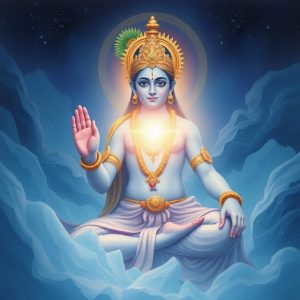
The highest experience in Dvaita Vedānta is not the dissolution of individuality, but the direct vision of the Lord within. The soul, in meditation, beholds the radiant form of the Divine, shining in the heart like a thousand suns. This vision is not the end of the journey, but the beginning of eternal service and joy.
The mystics describe this experience in poetry and song:
“In the cave of the heart, the Lord sits enthroned,
Clad in light, crowned with glory,
He smiles upon His devotee,
And the soul, awestruck, bows in adoration.”
The Sutra’s Legacy: Immanence and Transcendence in Harmony
अन्तस्तद्धर्मोपदेशात्
antastaddharmopadeśāt
“Within, because of the teaching of its attributes.”
This sutra stands as a testament to the harmony of immanence and transcendence. The Lord is within all, yet beyond all; nearer than the nearest, yet greater than the greatest. The soul’s journey is to recognize, embrace, and serve this inner presence, without ever losing its own individuality.
Comparative Perspectives: Dvaita, Advaita, and Viśiṣṭādvaita
Each school of Vedānta interprets this sutra in its own way:
- Advaita Vedānta sees the presence of the Divine within as the identity of the individual self with the Absolute. The distinctions are ultimately illusory, to be transcended in the realization of non-duality.
- Viśiṣṭādvaita Vedānta affirms the qualified non-duality of the soul and God. The soul is a mode of the Divine, distinct yet inseparable.
- Dvaita Vedānta insists on the eternal distinction. The Divine is within, yet always other; the soul is dependent, yet never identical.
This diversity of interpretation reflects the richness of the Vedantic tradition. Each perspective offers insights, challenges, and inspiration for the seeker.
The Sādhaka’s Daily Life: Living the Presence
How does the recognition of the Divine within transform daily life?
- Mindfulness: Every thought, word, and deed is performed in the awareness of the Lord’s presence.
- Ethics: The inner presence is a constant reminder to act with integrity, compassion, and humility.
- Resilience: In times of difficulty, the soul draws strength from the inner lamp, trusting in the Lord’s guidance.
- Gratitude: Every blessing is received as a gift from the Divine within.
The practice of living in the presence of the Lord is the essence of spiritual life. It is both the means and the goal, the journey and the destination.
The End of the Journey: Eternal Service in the Presence of the Lord
In Dvaita Vedānta, liberation (moksha) is not the dissolution of the soul into the Absolute, but its eternal service in the presence of the Lord. The soul retains its individuality, its unique relationship with the Divine, and its capacity for love and devotion.
The presence of the Lord within is the beginning of this relationship; the vision of the Lord face to face is its fulfillment. The journey is from ignorance to knowledge, from separation to union, from darkness to light.
Conclusion: The Sutra as a Living Truth
अन्तस्तद्धर्मोपदेशात्
antastaddharmopadeśāt
“Within, because of the teaching of its attributes.”
This sutra is not merely a philosophical assertion; it is a living truth, to be realized in the depths of the heart. The Lord is within, guiding, sustaining, and loving. The soul’s task is to recognize this presence, to respond with devotion, and to live in the light of the inner lamp.
May this sutra inspire us to turn inward, to seek the Divine within, and to journey ever closer to the eternal distinction and the infinite embrace of the Supreme.
Next in the Series:
We will continue our exploration of the Brahmasutras, delving into the subsequent aphorisms that reveal the nature of liberation, the destiny of the soul, and the ultimate harmony of immanence and transcendence. Let the journey continue, guided by the light within and the wisdom of the sages.
























very informative