 Vinay Karanam
 By Vinay Karanam, New Zealand Bharat News
March 30, 2025, 07:31 AM NZDT
In the vibrant tapestry of global calendars, few systems rival the intricacy and depth of Yugadi, the Hindu New Year celebrated across India and its diaspora, including here in New Zealand. Known as Ugadi in Karnataka and Andhra Pradesh, Gudi Padwa in Maharashtra, and by other regional names, Yugadi marks the beginning of a new cycle in the Hindu lunar calendar. Far beyond a mere festival, it embodies a sophisticated scientific framework rooted in ancient Vedic wisdom, offering a lens into the universe’s vastness and humanity’s place within it. As we approach Yugadi 2025—falling on April 9 in many regions—this article delves into its background, cultural celebrations, cosmological underpinnings, detailed timekeeping tables, and why it stands as a testament to one of the most precise calendrical systems known to humankind.
Background and Overview: The Genesis of Yugadi
Yugadi, derived from the Sanskrit words yuga (age) and adi (beginning), translates to “the start of a new era.” It is traditionally believed that Lord Brahma, the creator in Hindu cosmology, commenced the act of creation on this day, setting the cosmic clock in motion. Celebrated on the first day of the lunar month of Chaitra (March-April), Yugadi aligns with the spring season, symbolizing renewal and growth. Unlike the Gregorian calendar’s fixed solar basis, Yugadi operates within a lunisolar framework, harmonizing the lunar phases with the solar year through periodic adjustments—an early testament to its scientific precision.
The festival’s origins trace back to the Vedic period, with references in texts like the Rig Veda and later Puranas, which articulate a cyclical view of time. This cyclicality—spanning microseconds to trillions of years—distinguishes Hindu timekeeping from linear Western models. Yugadi isn’t just a cultural milestone; it’s a gateway to understanding Hindu cosmology, where time unfolds in rhythmic cycles of creation, preservation, and dissolution.
In 2025, Yugadi heralds the year Vishwavasu in the 60-year Samvatsara cycle, a system named after celestial and philosophical concepts. This year, as communities in New Zealand prepare to celebrate, the festival’s global resonance underscores its enduring relevance.
Greetings: A Universal Wish for attuned Prosperity
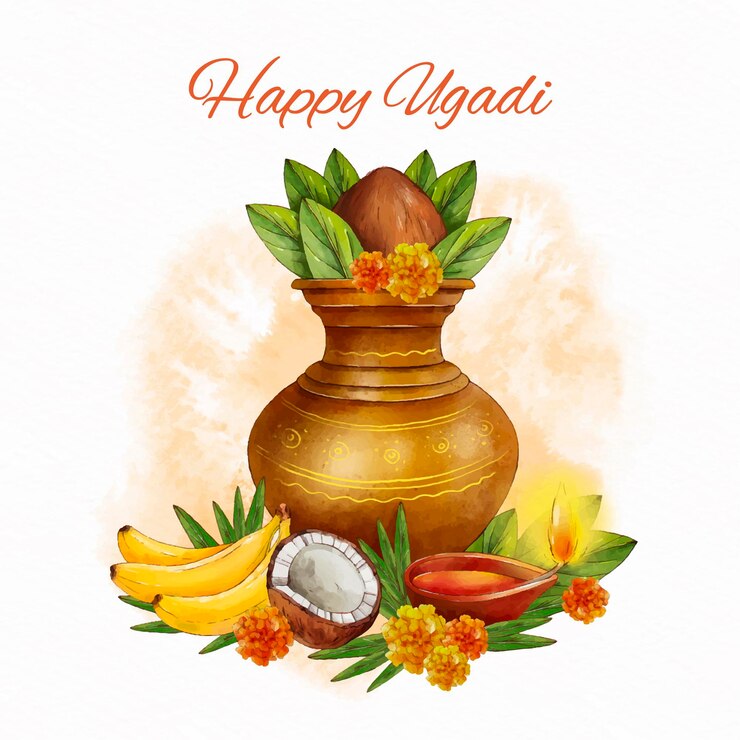
Yugadi greetings echo the festival’s spirit of renewal. In Kannada, people say, “Yugadi Habbada Shubhashayagalu” (Happy Yugadi), while Telugu speakers offer, “Ugadi Subhakankshalu” (Wishes for a Happy Ugadi). In Marathi, it’s “Gudi Padwyachya Hardik Shubheccha” (Heartfelt Wishes for Gudi Padwa). These greetings, often paired with prayers for health, wealth, and harmony, reflect a shared optimism across linguistic divides, uniting celebrants in a collective hope for the year ahead.
Yugadi Celebrations Across Cultures
Kannada Culture: A Blend of Tradition and Taste
In Karnataka, Yugadi is a sensory affair. Homes are cleaned and adorned with mango leaves and rangolis (intricate floor designs), symbolizing prosperity and warding off negativity. The day begins with an oil bath, a ritual purification, followed by prayers to Lord Vishnu or Brahma. A highlight is the preparation of Bevu Bella, a mixture of neem leaves (bitter) and jaggery (sweet), symbolizing life’s dualities—accepting both joy and sorrow. Families gather to read the Panchanga (almanac), listening to predictions for the year ahead during Panchanga Sravanam. Festive meals feature dishes like obbattu (sweet flatbread) and kosambari (lentil salad), blending tradition with culinary delight.

Telugu Culture: Predictions and Festivity
In Andhra Pradesh and Telangana, Ugadi mirrors Kannada traditions but with distinct flair. The Ugadi Pachadi—a concoction of neem, jaggery, tamarind, raw mango, salt, and pepper—embodies the six tastes of life, a philosophical reminder of balance. Temples bustle with devotees, and households hoist mango-leaf toranas. The Panchanga Sravanam is a communal event, with priests forecasting harvests, rains, and personal fortunes based on planetary alignments. Feasts include pulihora (tamarind rice) and bobbatlu, reinforcing familial bonds.

Marathi Culture: The Gudi’s Triumph
In Maharashtra, Gudi Padwa celebrates the victory of good over evil, linked to King Shalivahana’s triumph and the onset of spring. The gudi—a bamboo stick topped with a bright cloth, neem leaves, and a sugar garland—is hoisted outside homes, symbolizing prosperity and protection. Women draw rangolis, and families savor puran poli (sweet stuffed bread) and shrikhand (sweet yogurt). The day also marks the start of the agricultural season, with farmers offering prayers for bountiful crops.

Other Variants: A Pan-Indian Celebration
Yugadi takes on regional hues elsewhere. In Tamil Nadu, it’s Puthandu, celebrated with kolams and mango-based dishes. Sindhis mark it as Cheti Chand, honoring Lord Jhulelal with processions and tairi (sweet rice). In Punjab, Baisakhi aligns with the solar New Year, celebrating harvests with bhangra and feasts. Each variant, while unique, ties back to the lunisolar calendar and the cosmic renewal Yugadi represents.
Hindu New Year and Cosmology: The Rig Vedic Roots
Yugadi’s significance transcends festivity, anchoring itself in Hindu cosmology as articulated in the Rig Veda. This ancient text, dating back over 3,000 years, offers a poetic yet profound view of creation. The Nasadiya Sukta (Hymn of Creation, RV 10.129) ponders the universe’s origin, suggesting a state beyond being and non-being, where a divine principle—often interpreted as Brahman—self-manifests as the cosmos. Brahma, born from Vishnu’s navel atop a lotus, emerges as the creator, initiating time and space on Yugadi.
Brahma’s Start of Creation
Hindu texts narrate that Brahma’s first act was to fashion the universe from the cosmic egg (Hiranyagarbha). This creation unfolds in cycles, with Yugadi marking the annual renewal within a grander temporal framework. The Rig Veda doesn’t specify a singular moment but frames creation as eternal, oscillating between manifestation and dissolution—a concept mirrored in modern cyclic universe theories.
Age of the Universe and Brahma’s Day
Brahma’s lifespan defines the universe’s duration. One maha-kalpa, or Brahma’s 100-year life, spans 311.04 trillion human years. Each year comprises 360 days, and each day—a kalpa—lasts 4.32 billion years, followed by an equal pralaya (night of dissolution). Today, March 30, 2025, we are in the 51st year of Brahma’s life, the first day of the Shveta-Varaha Kalpa, halfway through his cosmic existence. This aligns roughly with scientific estimates of the universe’s age (13.8 billion years), though Hindu scales dwarf modern cosmology.

Kalpa, Manvantara, and Yuga: The Cosmic Hierarchy
- Kalpa: A day of Brahma (4.32 billion years), comprising 1,000 chatur-yugas (four-yuga cycles) and 14 manvantaras. The current kalpa is Shveta-Varaha.
- Manvantara: An era ruled by a Manu (progenitor of humanity), lasting 306.72 million years (71 chatur-yugas). We are in the 7th of 14 manvantaras, Vaivasvata.
- Yuga: A sub-cycle within a chatur-yuga (4.32 million years), declining in virtue and duration: Satya (1.728 million years), Treta (1.296 million), Dvapara (864,000), and Kali (432,000). We are 5,126 years into Kali Yuga, begun in 3102 BCE.
These units, detailed in texts like the Bhagavata Purana and Matsya Purana, reflect a logarithmic scale of time, from human lifespans to cosmic epochs, grounded in astronomical observations.
Hindu Time Units: From Nimesha to Maha-Kalpa
Hindu timekeeping spans the infinitesimal to the infinite:
- Nimesha (blink, ~0.2 seconds)
- Truti (1/100th of a nimesha)
- Kshana (moment, ~0.8 seconds)
- Muhurta (48 minutes)
- Tithi (lunar day, ~19-26 hours)
- Masa (lunar month, ~29.5 days)
- Samvatsara (year, ~361 days in Jovian reckoning)
- Up to maha-kalpa (311.04 trillion years).
This granularity, codified in the Surya Siddhanta, showcases a system attuned to both daily life and cosmic rhythms.
Panchanga: The Fivefold Almanac
The Panchanga (from pancha, five, and anga, limbs) is Yugadi’s operational backbone, a lunisolar almanac guiding rituals and agriculture. Its five components are:
- Vara: Day of the week (e.g., Ravivara/Sunday).
- Tithi: Lunar day (e.g., Pratipada/first day).
- Nakshatra: Lunar mansion (e.g., Ashwini).
- Yoga: Angular relationship between Sun and Moon (e.g., Siddhi).
- Karana: Half-tithi unit (e.g., Bava).
These elements, calculated via sidereal astronomy, adjust for Earth’s precession using ayanamsa, ensuring long-term accuracy.

Sankalpam: Establishing Space and Time
Before any ritual, the sankalpam is recited to anchor the act in cosmic context. A typical recitation might be:
- “Shubhe shobhane muhurte, Adya Brahmana dwitiya parardhe, Shveta-Varaha Kalpe, Vaivasvata Manvantare, Kali Yuge, Prathama Pade, Jambudvipe, Bharata Varshe, Bharata Khande…”
- Word-by-word:
- Shubhe shobhane muhurte: In this auspicious moment.
- Adya: Today.
- Brahmana dwitiya parardhe: In Brahma’s second half-life (51st-100th year).
- Shveta-Varaha Kalpe: In the Shveta-Varaha Kalpa.
- Vaivasvata Manvantare: In the Vaivasvata Manvantara.
- Kali Yuge, Prathama Pade: In Kali Yuga’s first quarter.
- Jambudvipe: On Jambudvipa (Earth/India).
- Bharata Varshe, Bharata Khande: In Bharata (India).

This invocation situates the practitioner in a vast spatio-temporal grid, reflecting Hindu cosmology’s holistic worldview.
Comprehensive Tables of Hindu Time Cycles
Table 1: Kalpa Names (30 as per Matsya Purana)
A Kalpa is a day of Brahma, with the Matsya Purana listing 30 notable kalpas across his lifespan. The current one, Shveta-Varaha, is highlighted.
| No. | Kalpa Name | Significance |
|---|---|---|
| 1 | Shveta-Varaha | Current kalpa, “White Boar” |
| 2 | Padma | Lotus-related |
| 3 | Brahma | Named for the creator |
| 4 | Vishnu | Preservation aspect |
| 5 | Pitr | Ancestral cycles |
| 6 | Tapasa | Austerity-related |
| 7 | Bhava | Existence |
| 8 | Raurava | Fierce or terrible |
| 9 | Prana | Life force |
| 10 | Brhata | Vast or great |
| 11 | Kshira | Milk-related |
| 12 | Soma | Moon-related |
| 13 | Nirmana | Creation |
| 14 | Sarasvata | Knowledge or Saraswati-related |
| 15 | Udana | Upward breath |
| 16 | Garuda | Vishnu’s eagle |
| 17 | Kaurma | Tortoise (Vishnu’s avatar) |
| 18 | Laksha | Hundred thousand |
| 19 | Savitra | Sun-related |
| 20 | Aghora | Non-terrible (Shiva aspect) |
| 21 | Vamana | Dwarf (Vishnu’s avatar) |
| 22 | Archi | Radiance |
| 23 | Vaisvata | Solar lineage |
| 24 | Savarni | Belonging to all |
| 25 | Dharma | Righteousness |
| 26 | Rudra | Shiva-related |
| 27 | Ruchi | Taste or desire |
| 28 | Bhauta | Elemental |
| 29 | Tamas | Darkness |
| 30 | Shukla | White or bright |
Table 2: Manvantara Names (14 per Kalpa)
| No. | Manvantara Name |
|---|---|
| 1 | Svayambhuva |
| 2 | Svarochisha |
| 3 | Auttami |
| 4 | Tamasa |
| 5 | Raivata |
| 6 | Chakshusha |
| 7 | Vaivasvata (current) |
| 8 | Savarni |
| 9 | Daksha-savarni |
| 10 | Brahma-savarni |
| 11 | Dharma-savarni |
| 12 | Rudra-savarni |
| 13 | Deva-savarni |
| 14 | Indra-savarni |
Table 3: Samvatsara Names (60-Year Cycle)
| No. | Samvatsara Name | No. | Samvatsara Name | No. | Samvatsara Name |
|---|---|---|---|---|---|
| 1 | Prabhava | 21 | Sarvajit | 41 | Plavanga |
| 2 | Vibhava | 22 | Sarvadhari | 42 | Kilaka |
| 3 | Shukla | 23 | Virodhi | 43 | Saumya |
| 4 | Pramoda | 24 | Vikriti | 44 | Sadharana |
| 5 | Prajapati | 25 | Khara | 45 | Virodhakrit |
| 6 | Angirasa | 26 | Nandana | 46 | Paridhavi |
| 7 | Shrimukha | 27 | Vijaya | 47 | Pramadi |
| 8 | Bhava | 28 | Jaya | 48 | Ananda |
| 9 | Yuva | 29 | Manmatha | 49 | Rakshasa |
| 10 | Dhatri | 30 | Durmukha | 50 | Nala |
| 11 | Ishvara | personally | Hemalamba | 51 | Pingala |
| 12 | Bahudhanya | 32 | Vilamba | 52 | Kalayukta |
| 13 | Pramathi | 33 | Vikari | 53 | Siddhartha |
| 14 | Vikrama | 34 | Sharvari | 54 | Raudra |
| 15 | Vishu | 35 | Plava | 55 | Durmati |
| 16 | Chitrabhanu | 36 | Shubhakrit | 56 | Dundubhi |
| 17 | Svabhanu | 37 | Shobhakrit | 57 | Rudhirodgari |
| 18 | Tarana | 38 | Krodhi (2025) | 58 | Raktaksha |
| 19 | Parthiva | 39 | Vishvavasu | 59 | Krodhana |
| 20 | Vyaya | 40 | Parabhava | 60 | Kshaya |
Table 4: Ritu (Seasons, 6 per Year)
| No. | Ritu Name | English Equivalent | Months (Approximate) |
|---|---|---|---|
| 1 | Vasanta | Spring | Chaitra-Vaishakha |
| 2 | Grishma | Summer | Jyeshtha-Ashada |
| 3 | Varsha | Monsoon/Rainy | Shravana-Bhadrapada |
| 4 | Sharad | Autumn | Ashvina-Kartika |
| 5 | Hemanta | Pre-Winter | Margashirsha-Pausha |
| 6 | Shishira | Winter | Magha-Phalguna |
Table 5: Masa (Lunar Months, 12 per Year)
| No. | Masa Name | Gregorian Equivalent (Approximate) |
|---|---|---|
| 1 | Chaitra | March-April |
| 2 | Vaishakha | April-May |
| 3 | Jyeshtha | May-June |
| 4 | Ashada | June-July |
| 5 | Shravana | July-August |
| 6 | Bhadrapada | August-September |
| 7 | Ashvina | September-October |
| 8 | Kartika | October-November |
| 9 | Margashirsha | November-December |
| 10 | Pausha | December-January |
| 11 | Magha | January-February |
| 12 | Phalguna | February-March |
Table 6: Vara (Days of the Week, 7)
| No. | Vara Name | English Equivalent |
|---|---|---|
| 1 | Ravivara | Sunday |
| 2 | Somavara | Monday |
| 3 | Mangalavara | Tuesday |
| 4 | Budhavara | Wednesday |
| 5 | Guruvara | Thursday |
| 6 | Shukravara | Friday |
| 7 | Shanivara | Saturday |
Table 7: Nakshatra (Lunar Mansions, 27)
| No. | Nakshatra Name |
|---|---|
| 1 | Ashwini |
| 2 | Bharani |
| 3 | Krittika |
| 4 | Rohini |
| 5 | Mrigashira |
| 6 | Ardra |
| 7 | Punarvasu |
| 8 | Pushya |
| 9 | Ashlesha |
| 10 | Magha |
| 11 | Purva Phalguni |
| 12 | Uttara Phalguni |
| 13 | Hasta |
| 14 | Chitra |
| 15 | Swati |
| 16 | Vishakha |
| 17 | Anuradha |
| 18 | Jyeshtha |
| 19 | Mula |
| 20 | Purva Ashadha |
| 21 | Uttara Ashadha |
| 22 | Shravana |
| 23 | Dhanishtha |
| 24 | Shatabhisha |
| 25 | Purva Bhadrapada |
| 26 | Uttara Bhadrapada |
| 27 | Revati |
Table 8: Yoga (27 Daily Combinations)
| No. | Yoga Name |
|---|---|
| 1 | Vishkumbha |
| 2 | Priti |
| 3 | Ayushman |
| 4 | Saubhagya |
| 5 | Shobhana |
| 6 | Atiganda |
| 7 | Sukarma |
| 8 | Dhriti |
| 9 | Shula |
| 10 | Ganda |
| 11 | Vriddhi |
| 12 | Dhruva |
| 13 | Vyaghata |
| 14 | Harshana |
| 15 | Vajra |
| 16 | Siddhi |
| 17 | Vyatipata |
| 18 | Variyan |
| 19 | Parigha |
| 20 | Shiva |
| 21 | Siddha |
| 22 | Sadhya |
| 23 | Shubha |
| 24 | Shukla |
| 25 | Brahma |
| 26 | Indra |
| 27 | Vaidhriti |
Table 9: Karana (11 Half-Tithi Units)
| No. | Karana Name |
|---|---|
| 1 | Bava |
| 2 | Balava |
| 3 | Kaulava |
| 4 | Taitila |
| 5 | Gara |
| 6 | Vanija |
| 7 | Vishti |
| 8 | Shakuni |
| 9 | Chatushpada |
| 10 | Naga |
| 11 | Kimstughna |
The Cosmic Tapestry: Expanding the Kalpa Framework
The inclusion of 30 kalpa names from the Matsya Purana—a key Puranic text—offers a richer glimpse into Hindu cosmology’s breadth. Each kalpa, lasting 4.32 billion years, encapsulates a unique phase of creation, often tied to divine attributes or natural phenomena (e.g., Soma for the Moon, Kaurma for Vishnu’s tortoise avatar). This expansive list underscores the system’s ability to conceptualize time on a scale unimaginable to most ancient cultures. The current Shveta-Varaha Kalpa, named after Vishnu’s boar incarnation, positions humanity within a narrative that spans trillions of years, with each kalpa resetting the cosmic stage.
This framework isn’t mere mythology; it reflects an astronomical awareness of cyclical patterns—eclipses, planetary orbits, and precession—woven into a philosophical tapestry. The Matsya Purana’s enumeration of kalpas, alongside the Panchanga’s daily precision, bridges the macrocosmic and microcosmic, a duality that resonates with modern scientific quests to unify quantum and cosmic scales.
Why Yugadi’s Calendar is the Most Scientific
Yugadi’s calendar excels in precision due to its lunisolar integration, sidereal adjustments, and vast temporal scope. Unlike the Gregorian calendar’s solar rigidity, it balances lunar months with solar years via adhik masa (intercalary months), maintaining seasonal alignment over millennia. The ayanamsa correction for precession—shifting equinoxes by ~1° every 72 years—ensures astronomical fidelity, a feat unmatched by early Western systems.

Its hierarchical time units, from nimesha to maha-kalpa, reflect an intuitive grasp of logarithmic scales, paralleling modern physics’ exploration of time dilation and cosmic epochs. The Panchanga’s reliance on observable celestial events—lunar phases, planetary positions—grounds it in empirical science, while its predictive capacity for eclipses and monsoons showcases applied astronomy. The 60-year Samvatsara cycle, tied to Jupiter’s orbit, and the 27 nakshatras, mapping the Moon’s path, demonstrate a system rooted in observable cycles, refined over centuries.

Evidence from Quantum Cosmology
Recent discoveries in quantum cosmology bolster Yugadi’s scientific credentials. The cyclic model of the universe, proposed by physicists like Paul Steinhardt and Neil Turok, echoes Hindu cosmology’s kalpa-pralaya cycles, suggesting an oscillating cosmos rather than a singular Big Bang. The Rig Veda’s non-linear time aligns with quantum theories of time as emergent, not absolute. Moreover, the 4.32-billion-year kalpa approximates Earth’s geological age (~4.54 billion years), hinting at an ancient intuition of deep time. The Matsya Purana’s 30 kalpas, spanning 129.6 billion years collectively, prefigure multiverse theories, where each cycle could represent a distinct cosmic iteration—a concept gaining traction in string theory.


The Surya Siddhanta’s calculations—e.g., Earth’s diameter (~12,742 km, close to the modern 12,714 km)—further attest to this system’s empirical roots. Yugadi’s calendar, thus, isn’t just a cultural artifact; it’s a proto-scientific marvel, harmonizing human experience with universal rhythms.
The Hindu Calendar’s Echoes in Greek Timekeeping
The intricate timekeeping system underpinning Yugadi didn’t remain confined to the Indian subcontinent; it reverberated across ancient civilizations, leaving subtle yet profound imprints on Greek culture. Scholars suggest that the Hellenistic world, particularly after Alexander the Great’s conquests in the 4th century BCE, became a crucible for Indo-Greek exchange along the Silk Road and maritime routes. The Hindu concept of hora—a unit of time roughly equivalent to an hour, derived from ahoratri (a day-night cycle of 24 horas)—found its way into Greek lexicon as hora, meaning “season” or “time,” and eventually evolved into the modern English hour. This linguistic borrowing reflects more than coincidence; it hints at a deeper transmission of astronomical knowledge, as Greek philosophers like Hipparchus and Ptolemy engaged with Indian treatises, possibly including the Surya Siddhanta, which meticulously divided the day into 60 ghatikas (24 minutes each) and further into smaller units like horas.
The seven-day week, a cornerstone of Western calendars, also bears traces of Hindu influence. In the Vedic system, the vara (days of the week) are named after celestial bodies—Ravivara (Sun), Somavara (Moon), Mangalavara (Mars), and so forth—reflecting planetary rulerships observed in Vedic astrology. This structure parallels the Greek hebdomadal system, where days were similarly dedicated to planetary deities: hēmera heliou (Sun’s day, Sunday), hēmera selenes (Moon’s day, Monday), and others. While Mesopotamia is often credited with the seven-day week, the specific planetary association and sequence align closely with Hindu traditions, suggesting that Greek astronomers, encountering Indian scholars in Bactria or Taxila, adapted this framework. The Rig Veda’s emphasis on seven—seven rivers, seven sages—may have reinforced this numerical symbolism, filtering into Greek thought via cultural osmosis.
Further evidence lies in the ahoratri concept, the day-night cycle central to Hindu timekeeping, which resonates with Greek diurnal divisions. The Panchanga’s use of tithi, nakshatra, and yoga to mark time’s progression offered a precision that impressed Hellenistic observers, who refined their own calendars post-Alexander. The Greek horoskopos (horoscope, literally “watcher of the hour”), rooted in hora, mirrors the Hindu practice of muhurta—auspicious timings calculated via planetary positions—indicating a shared obsession with celestial influence. While direct causation remains debated, the parallels are striking: India’s scientific calendar, with its logarithmic scales and sidereal adjustments, likely seeded ideas that the Greeks polished into their own systems, bequeathing terms like hours and weekday names to the Western world. This cross-pollination underscores Yugadi’s calendar as not just a regional marvel but a global progenitor of timekeeping.
Summary: A Timeless Legacy
Yugadi is more than a New Year; it’s a bridge between ancient wisdom and modern science. Its celebrations—in Karnataka’s neem-jaggery lessons, Telugu almanac readings, Marathi gudi hoistings, and beyond—unite diverse cultures under a shared cosmic narrative. Rooted in the Rig Veda, detailed in the Matsya Purana, and refined through millennia, its calendar offers unparalleled precision, weaving human life into the universe’s vast rhythms. As quantum cosmology uncovers cyclic patterns, Yugadi stands vindicated—a testament to humanity’s oldest, most scientific timekeeping system, resonating from India to New Zealand.