 Dorothy Brown
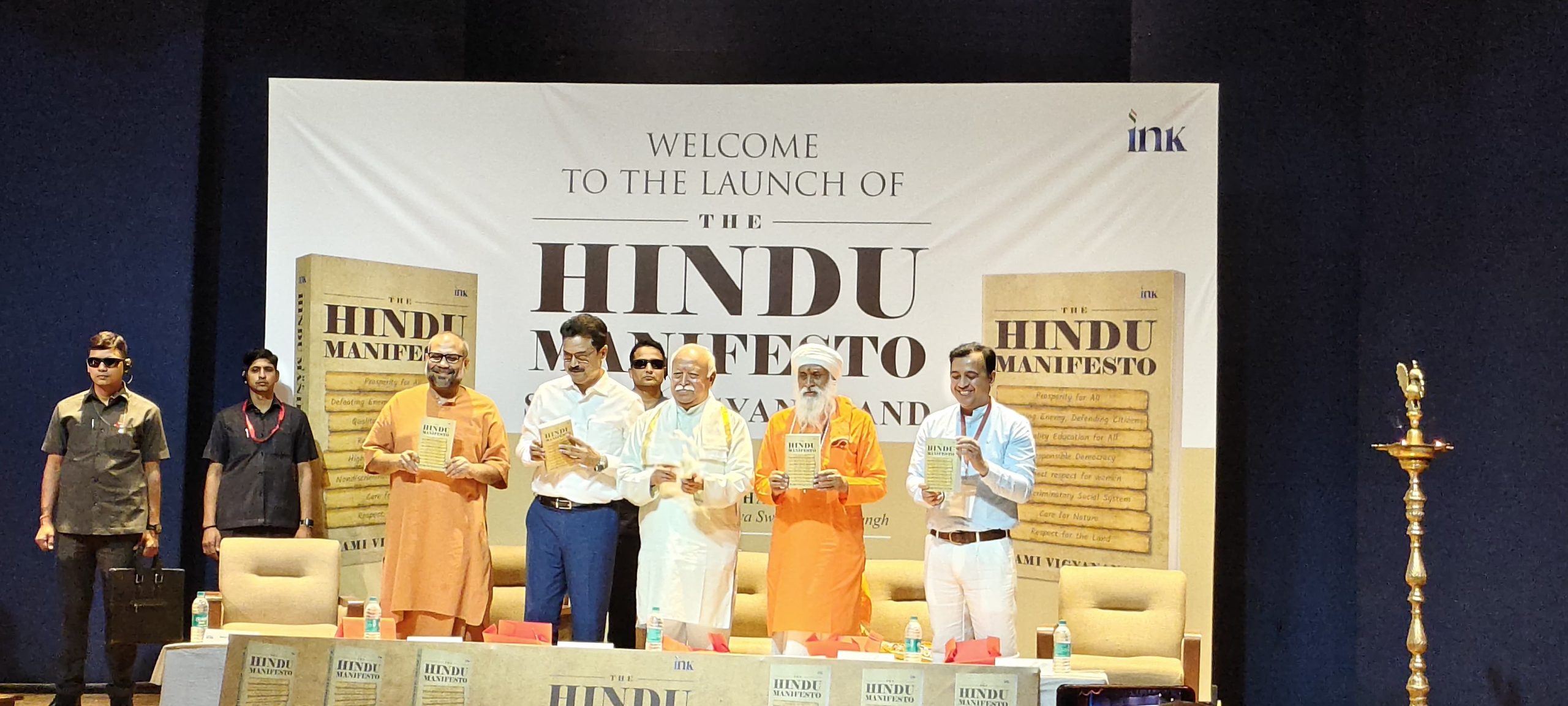
 Delhi – Against the sombre backdrop of mourning for the victims of the recent Pahalgam terror attack, a landmark moment unfolded in Delhi with the launch of The Hindu Manifesto, a powerful blueprint for civilisational resurgence authored by Swami Vigyananand. The event commenced with a solemn two-minute silence, setting a deeply reflective tone for the proceedings.
The launch of The Hindu Manifesto represents not just the release of a book but the articulation of a renewed vision for one of the world’s oldest civilisations — Bharat. The text brings together profound ancient wisdom, spiritual insights, and contemporary relevance, offering a comprehensive guide for future generations of Hindus and thinkers worldwide.
A Legacy Rooted in Eternal Wisdom
Introducing the author, Dr. Prerna Malhotra, Joint Director of the Centre for Hindu Studies, noted Swami Vigyananand’s lineage — both spiritual and ideological. Walking in the footsteps of Adi Shankaracharya while drawing inspiration from the modern tradition of the Rashtriya Swayamsevak Sangh (RSS), Swamiji embodies a living bridge between ancient philosophy and present-day activism.
Dr. Malhotra described the manifesto as a culmination of years of meticulous research, drawing upon dozens of sacred texts and traditional commentaries. In an era often dominated by Western paradigms, The Hindu Manifesto brings indigenous knowledge systems back to the centre of civilisational discourse.
Speaking at the launch, Swami Vigyananand highlighted that Hindu thought has always engaged dynamically with its times — meeting contemporary needs while being anchored in timeless Dharma. He explained that the rishis, the ancient seers of Bharat, codified eternal truths into compact Sutras that were designed to remain ever-relevant. The Hindu Manifesto follows this spirit, distilling key principles for today’s age.


The Eight Foundational Sutras
At the heart of the book lie eight foundational Sutras, presenting a balanced and holistic roadmap for society:
- Prosperity for All – Economic models rooted in Dharma, not exploitation.
- National Security – A righteous duty to defend society without misplaced compassion towards aggressors.
- Quality Education – Revival of indigenous education systems destroyed during colonial rule.
- Responsible Democracy – Encouraging participatory governance and rejecting passive obedience to rulers.
- Respect for Women – Inspired by historical figures like Draupadi, ensuring dignity and safety for women.
- Social Harmony – A Dharmic society without artificial discrimination, correctly understanding Varna and Jati.
- Sacredness of Nature – Environmental stewardship rooted in reverence for creation.
- Cultural Unity – Respect for Bharat’s sacred geography and cultural cohesiveness.
Swami Vigyananand stressed that Hindu philosophy offers a middle path between the exploitative materialism of capitalism and the rigid controls of socialism. Hindu economic thought values both wealth creation and fair distribution, guided by Dharma.
He also urged Hindus to embrace the righteous responsibility of defence: “Teaching a lesson to evil-doers is also non-violence (Ahimsa),” Swamiji affirmed, quoting the Mahabharata and other classical sources.
A Call for Civilisational Renaissance
The second half of The Hindu Manifesto lays the blueprint for a renaissance, stressing that spiritual revival must be grounded in material strength, social justice, environmental balance, and cultural pride.
Prof. Yogesh Singh, Vice Chancellor of Delhi University, lauded the book’s insights, noting that true education is a blend of knowledge (vidya) and wisdom (buddhi). He emphasised the need for a strong treasury and a robust defence apparatus to ensure a resilient and sovereign Bharat.
Adding a unique perspective, Swami Krishnashah Vidyarthi, Mahant of the Rashtriya Valmiki Mandir, expressed optimism that The Hindu Manifesto would serve as a transformative work for marginalised communities by promoting an authentic, non-discriminatory Dharmic order.
RSS Chief Dr Mohan Bhagwat’s Address: Dharma Beyond Ritualism
The keynote address by Dr. Mohan Bhagwat, Sarsanghchalak (Chief) of RSS, added gravitas to the event. Drawing upon historical lessons and global realities, Dr. Bhagwat underlined the failure of purely materialistic development models, which have led to widespread dissatisfaction, social decay, and environmental crises.
He presented Bharat’s path — a harmonious balance of material well-being and spiritual depth — as the “third path” for the world. Not capitalism, not communism, but Dharma-centred living.
“Before inspiring the world, Hindus must embody these principles ourselves,” he asserted.
Dr. Bhagwat reminded the audience that Bharat historically influenced large parts of the world — from Southeast Asia to Central Asia — not through military conquest but through cultural magnetism. However, complacency, internal divisions, and the erosion of Dharmic values had historically weakened Bharat’s civilisational strength.
He urged Hindus to reject passive ritualism and embrace Adhyatmikta (spirituality) — the core of Dharma that transcends ritual and addresses universal truths.
The message was clear: it is not enough to celebrate the past; the principles of Dharma must be dynamically lived and actualised today. The Hindu Manifesto, according to Dr. Bhagwat, offers such a framework.
Reaffirmation of Dharmic Social Values
An important feature of the event was the reiteration of the position taken recently by Hindu saints gathered in Udupi — that discrimination of any form has no religious sanction in Sanātana Dharma. Acknowledging past distortions, religious leaders have collectively agreed that corrections must be made in practice while preserving the essential purity of traditional thought.
Swami Vigyananand and Dr. Bhagwat both stressed that true Dharma upholds equality, righteous action, and mutual respect, rejecting both sectarianism and dogmatism.
“True Dharma does not seek vengeance; it seeks righteous action,” said Dr. Bhagwat.
Engaging the Youth and Scholars
Swami Vigyananand appealed to scholars, researchers, writers, and young activists to engage with The Hindu Manifesto. He urged them to study its principles deeply and apply them meaningfully in public life.
In an age where cultural narratives are often manipulated, The Hindu Manifesto offers a chance for a genuine, self-confident engagement with global challenges — based not on borrowed ideas, but rooted in the civilisational ethos of Bharat.
The hope, echoed by several speakers, is that this book will stimulate new debates, encourage a reawakening among Hindus, and contribute to building a resilient and harmonious society.
A Message for the Global Hindu Community
The launch also served as a call for unity among Hindus worldwide. From Wellington to London, from Toronto to Durban, the message resonated: Hindus must reclaim their narrative with courage, compassion, and clarity.
It is not a call to dominate, but a call to uplift — to share a civilisation of balance, wisdom, and sustainability with a world increasingly looking for alternatives to divisive ideologies.
As the event concluded with chants of “Om Shanti Shanti Shantiḥ,” there was a palpable sense that The Hindu Manifesto could indeed become a seminal text for a new era.
In these tumultuous times, the ancient wisdom of Sanātana Dharma — reinterpreted for today — offers not merely solace, but a powerful, actionable path forward.
The book can be purchased here: https://www.amazon.in/Hindu-Manifesto-Swami-Vigyananand/dp/9365474973
For more information, interviews, and media requests:
📞 Abhishek Katiyar: +91 9810358804
📧 info@thehindumanifesto.com
🌐 www.thehindumanifesto.com