


 Dorothy Brown
 The funeral of Pope Francis, held on 26 April 2025 in St Peter’s Square, Vatican City, marked a historic moment of mourning and reflection for the world’s 1.39 billion Catholics and countless others touched by his 12-year papacy. The Argentine pontiff, who died at 88 on Easter Monday, 21 April 2025, was laid to rest in a ceremony that blended solemn tradition with the simplicity he championed. Attended by tens of thousands, including global leaders, the funeral underscored Francis’ legacy as a pope of the marginalised, while setting the stage for the conclave to select his successor. This article examines the funeral’s context, details, perspectives, historical parallels, and potential implications for the Catholic Church and beyond.
A Legacy of Simplicity: Background of Pope Francis’ Papacy
Born Jorge Mario Bergoglio in Buenos Aires, Argentina, on 17 December 1936, Pope Francis became the 266th pope on 13 March 2013, the first Jesuit and non-European pontiff in over a millennium. His papacy was defined by humility, advocacy for the poor, and efforts to reform the Catholic Church. Known as the “pope of the people,” Francis eschewed Vatican opulence, living in the modest Domus Sanctae Marthae guesthouse and driving a simple Fiat. His encyclicals, like Laudato Si’ (2015) on environmental stewardship and Fratelli Tutti (2020) on global fraternity, addressed pressing global issues, while his outreach to migrants, prisoners, and interfaith communities earned widespread admiration.
Francis’ health declined in later years, with hospitalisations for respiratory issues and a stroke in April 2025 leading to a coma and cardiovascular failure. His death triggered a global outpouring of grief, with flags at half-mast in nations like Italy, Brazil, and Argentina. Francis had revised papal funeral rites in November 2024, simplifying traditions to reflect his ethos of humility, requesting a single wooden coffin and burial outside the Vatican at the Basilica of Santa Maria Maggiore, a site dear to him for its Marian devotion.
Papal funerals are steeped in centuries-old rituals, governed by the Ordo Exsequiarum Romani Pontificis, yet Francis’ changes made his farewell distinct. The event was not only a religious milestone but a geopolitical moment, drawing leaders from over 50 nations and highlighting the Vatican’s global influence. As the Church prepares for a conclave, the funeral encapsulated Francis’ vision of a Church for “everyone, everyone, everyone,” while raising questions about its future direction.
The Context of the Funeral: A World in Mourning
Pope Francis’ death on Easter Monday, following a public appearance in St Peter’s Square, shocked the world, coming just weeks after his recovery from pneumonia. The Vatican announced his passing due to a cerebral stroke, prompting memorial Masses from Sydney’s St Mary’s Cathedral to Manila Cathedral. Social media platforms buzzed with tributes, with hashtags like #PapaFrancisco and #PopeFrancis trending globally. In Argentina, thousands gathered at Buenos Aires’ Plaza de Mayo, while in Rome, pilgrims flocked to St Peter’s Basilica.
The funeral occurred amid global tensions, including the Russia-Ukraine conflict and Middle Eastern unrest, contexts Francis often addressed through peace appeals. His death also coincided with a polarised Catholic Church, with progressive reforms—like blessings for same-sex couples—clashing with conservative resistance. The funeral thus served as a unifying moment, bringing together diverse factions to honour a pontiff who navigated these divides.
Preparations were swift, led by Cardinal Kevin Farrell, the camerlengo, who oversaw Vatican operations during the interregnum. The College of Cardinals met on 22 April to set the funeral date, opting for a Saturday to accommodate global attendees. Security was heightened in Rome, with Italian authorities deploying 5,000 personnel, recalling the massive crowds at Pope John Paul II’s 2005 funeral. The Vatican extended public viewing hours due to high turnout, with over 60,000 mourners paying respects during the three-day lying-in-state.
Details of the Funeral: A Ceremony of Tradition and Simplicity
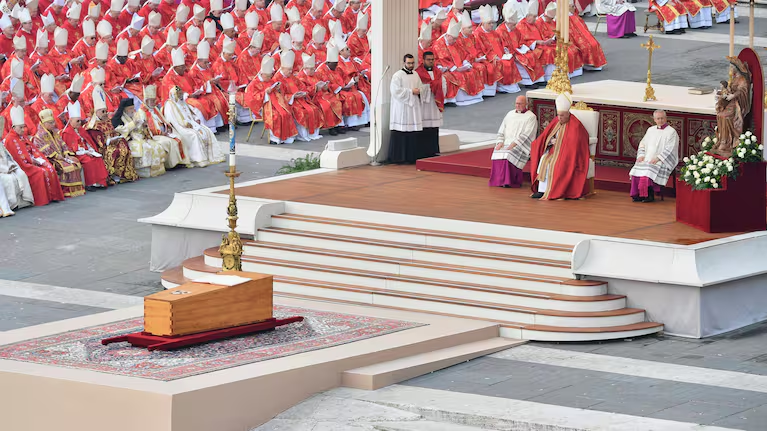
The funeral unfolded in St Peter’s Square at 10:00 AM local time (8:00 PM NZST), presided over by Cardinal Giovanni Battista Re, dean of the College of Cardinals. The 90-minute Mass, broadcast worldwide, was attended by an estimated 100,000 people, including 50 heads of state, 10 reigning monarchs, and 130 delegations. Notable attendees included U.S. President Donald Trump, Ukrainian President Volodymyr Zelensky, Argentine President Javier Milei, UK Prime Minister Keir Starmer, Prince William (representing King Charles III), French President Emmanuel Macron, and Spanish royals King Felipe VI and Queen Letizia. Russia’s Vladimir Putin, restricted by an ICC warrant, did not attend, nor did Chinese leaders, reflecting Vatican-Beijing tensions.
Public Viewing and Preparations
From 23–25 April, Francis’ body lay in state in St Peter’s Basilica, dressed in red vestments with a white mitre and pallium. The open wooden coffin, lined with zinc, stood at the Altar of the Confessio, near St Peter’s tomb, a departure from the traditional three-casket practice. Mourners, including nuns singing Ave Maria and pilgrims from Mexico and India, queued for hours, with the Vatican keeping doors open until midnight on Thursday. On Friday at 8:00 PM, Cardinal Farrell sealed the coffin in a private rite, attended by cardinals and Francis’ nephew, José Ignacio Bergoglio.
The Funeral Mass
The Mass, conducted mostly in Latin, followed the Ordo Exsequiarum Romani Pontificis, revised by Francis to emphasise a pastor’s burial over worldly pomp. The Sistine Chapel Choir performed psalms, alternating with antiphons, as cardinals, patriarchs, and priests concelebrated. Readings included Francis’ favourite passages from Laudato Si’, and the homily, delivered by Cardinal Re, praised his compassion for the “last ones”—the poor and marginalised. Wreaths from world leaders adorned the square, and a concluding prayer entrusted Francis to God’s mercy.
The Procession and Burial
Post-Mass, a four-mile procession carried the coffin through Rome to the Basilica of Santa Maria Maggiore, a first for a pope in over a century. Crowds lined Via della Conciliazione, chanting “Santo Subito” (saint now), echoing John Paul II’s funeral. The slow, walking-pace journey allowed Romans to bid farewell near the Salus Populi Romani icon, which Francis visited before and after his 47 apostolic journeys. At the basilica, a group of homeless and migrant faithful, symbolising Francis’ heart for the disadvantaged, greeted the coffin. The burial, private and untelevised, occurred in an underground tomb, with the inscription “Franciscus” in Latin.
Broadcast and Engagement
The funeral was livestreamed on Vatican News, BBC, CNN, and EWTN, with coverage beginning at 6:00 AM BST. In New Zealand, TVNZ aired highlights, while Catholic communities in Auckland and Wellington held memorial Masses. Social media amplified the event, with posts sharing Francis’ quotes on peace and poverty, though some criticised the presence of controversial leaders like Trump, citing his clashes with Francis on migration.
Perspectives on the Funeral: A Spectrum of Views
The funeral elicited varied reactions, reflecting Francis’ polarising yet unifying legacy.
Catholic Faithful
For Catholics, the funeral was a moment of grief and gratitude. Pilgrims like Maria Gonzalez from Mexico, who travelled to Rome, praised Francis’ empathy, recalling his 2016 gesture of bringing Syrian refugees to Italy. Clergy, including Cardinal Gianfranco Ravasi, lauded his promotion of women’s roles and interfaith dialogue. However, conservative Catholics, critical of his liberal reforms, expressed mixed feelings, with some hoping the conclave would elect a traditionalist pope.
Global Leaders and Diplomacy
World leaders viewed the funeral as a diplomatic milestone. Zelensky, who met Francis multiple times, called him a “voice for peace,” while Trump described him as a “fantastic guy” despite past tensions. The Vatican’s protocol office noted the event’s scale, rivalled only by John Paul II’s funeral. Critics, however, questioned the attendance of leaders with policies Francis opposed, like Milei’s austerity measures, highlighting the funeral’s geopolitical complexity.
Secular and Interfaith Communities
Non-Catholics and interfaith leaders, from Muslim imams to Jewish rabbis, honoured Francis’ outreach. His 2019 Abu Dhabi declaration with Grand Imam Ahmed Al-Tayeb was cited as a landmark. Secular observers, like UN Secretary-General António Guterres, praised his climate advocacy, though some activists argued his reforms fell short on gender equality and abuse scandals.
Media and Public Sentiment
Media coverage was extensive, with outlets like The New York Times framing Francis as a “pope of simplicity” and the BBC noting the funeral’s global reach. Social media reflected public sentiment, with X posts ranging from heartfelt tributes to debates over the Church’s future. Some users questioned the funeral’s cost, estimated at €5 million, given Francis’ focus on poverty, while others defended its spiritual significance.
Historical Parallels: Papal Funerals Past
Papal funerals have long been moments of global attention, evolving with each pontiff’s wishes and era:
1903: Pope Leo XIII’s funeral was the last before Vatican City’s 1929 establishment, held in Rome’s Lateran Basilica. It drew European royalty, setting a precedent for diplomatic attendance.
1978: Pope John Paul I’s sudden death after 33 days led to a modest funeral, overshadowed by conspiracy theories. It contrasted with Francis’ planned simplicity.
2005: Pope John Paul II’s funeral drew 300,000 mourners and 200 world leaders, including four kings and five queens. The “Santo Subito” chants and nine-day novendiali mourning period mirrored Francis’ rites, though John Paul’s was more ornate.
2013: Pope Benedict XVI’s funeral, following his resignation, was smaller, with 50,000 attendees. As a retired pope, his rites differed, but Francis’ lying-in-state echoed Benedict’s public viewing.
Historical disruptions, like World War II’s impact on Pius XII’s 1958 funeral, highlight the Vatican’s adaptability. Francis’ burial outside the Vatican recalls early popes interred in Roman basilicas, while his simplified rites align with John Paul I’s unadorned farewell. The novendiali tradition, dating to Roman times, persists, with nine Masses planned post-funeral.
Connecting the Dots: The Funeral’s Implications
The funeral sets the stage for the Catholic Church’s next chapter, with several trajectories emerging:
Conclave Dynamics
The conclave, expected between 5–10 May 2025, will see 135 cardinals under 80 elect a new pope. Francis’ funeral, attended by many cardinals, likely shaped early discussions, with factions debating progressive versus conservative priorities. A non-European pope, perhaps from Africa or Asia, could follow Francis’ precedent, reflecting the Church’s global shift—40% of Catholics now live in the Global South.
Church Reforms
Francis’ legacy—women’s inclusion, synodality, and abuse accountability—will influence the conclave. His funeral’s emphasis on the marginalised may pressure the next pope to prioritise social justice, though conservative pushback could stall reforms. The burial at Santa Maria Maggiore, symbolising Marian devotion, might inspire a renewed focus on spirituality over institutional power.
Geopolitical Role
The funeral’s diplomatic weight reinforces the Vatican’s soft power. Zelensky’s attendance, amid Ukraine’s war, and the absence of Putin and Chinese leaders highlight the Holy See’s mediation potential. The next pope may inherit Francis’ peace advocacy, navigating tensions like U.S.-China relations or Middle East conflicts.
Public Engagement
The funeral’s global viewership, estimated at 500 million, underscores the Church’s reach. Digital platforms, from Vatican News to X, will shape post-funeral narratives, with hashtags like #Conclave2025 already trending. However, the Church must address criticisms of extravagance, ensuring future rites align with Francis’ simplicity.
Challenges include managing internal divisions, with 60% of U.S. Catholics favouring liberal reforms per a 2024 Pew survey, versus resistance in Africa and Eastern Europe. External pressures, like secularisation in Europe, where only 24% attend Mass regularly, may push the Church to innovate, perhaps through digital evangelisation or interfaith coalitions.
Personal Opinion: A Farewell That Resonates
Witnessing the funeral’s coverage, I am struck by its blend of grandeur and intimacy. The sight of St Peter’s Square, filled with mourners from every continent, reflects Francis’ universal appeal, yet the wooden coffin and procession through Rome’s streets feel deeply personal, like a parish priest’s farewell. His burial at Santa Maria Maggiore, surrounded by the poor he loved, is a poignant final act.
I admire Francis’ courage in simplifying rites, a rebuke to worldly power that challenges the Church to stay true to its mission. However, the presence of leaders like Trump, whose policies clashed with Francis’ teachings, raises questions about the funeral’s politicisation. The Vatican must guard against such events becoming diplomatic spectacles rather than spiritual moments.
As a journalist, I see the funeral as a pivot point. The conclave looms, and with it, the question of whether Francis’ vision—a Church of mercy and inclusion—will endure. I hope the next pope builds on his outreach to the Global South and interfaith communities, while addressing unresolved issues like clergy abuse. For now, the funeral reminds us of Francis’ call to care for “the least of these,” a message that transcends faith.
Summary: A Pontiff’s Lasting Echoes
Pope Francis’ funeral on 26 April 2025 was a global event that honoured a pontiff who reshaped the Catholic Church through humility and compassion. From the lying-in-state, where 60,000 mourners paid respects, to the St Peter’s Square Mass attended by world leaders, the ceremony balanced tradition with Francis’ simplified rites. His burial at Santa Maria Maggiore, following a poignant procession, marked a historic break from Vatican interments. Perspectives ranged from Catholic devotion to diplomatic calculations, reflecting Francis’ broad impact. Historically, the funeral echoes John Paul II’s global farewell, while setting a precedent for future rites. Looking ahead, it signals a transformative conclave, with Francis’ legacy of inclusion and peace shaping the Church’s path. As the novendiali begins, the world pauses to mourn a pope who, in death as in life, championed the marginalised.
























Very good