



 Col. (retd.) Dinesh Ramaswamy
 India’s emergence as a nuclear power is anchored by the operationalisation of its nuclear triad-the capability to deliver nuclear weapons from land, sea, and air. This triad is the cornerstone of India’s “credible minimum deterrence” doctrine, ensuring the survivability and effectiveness of its nuclear arsenal against any adversary. As of 2025, India’s triad is not only fully operational but also undergoing rapid modernisation, making it one of the most robust and sophisticated deterrent forces in Asia.
What Is a Nuclear Triad?
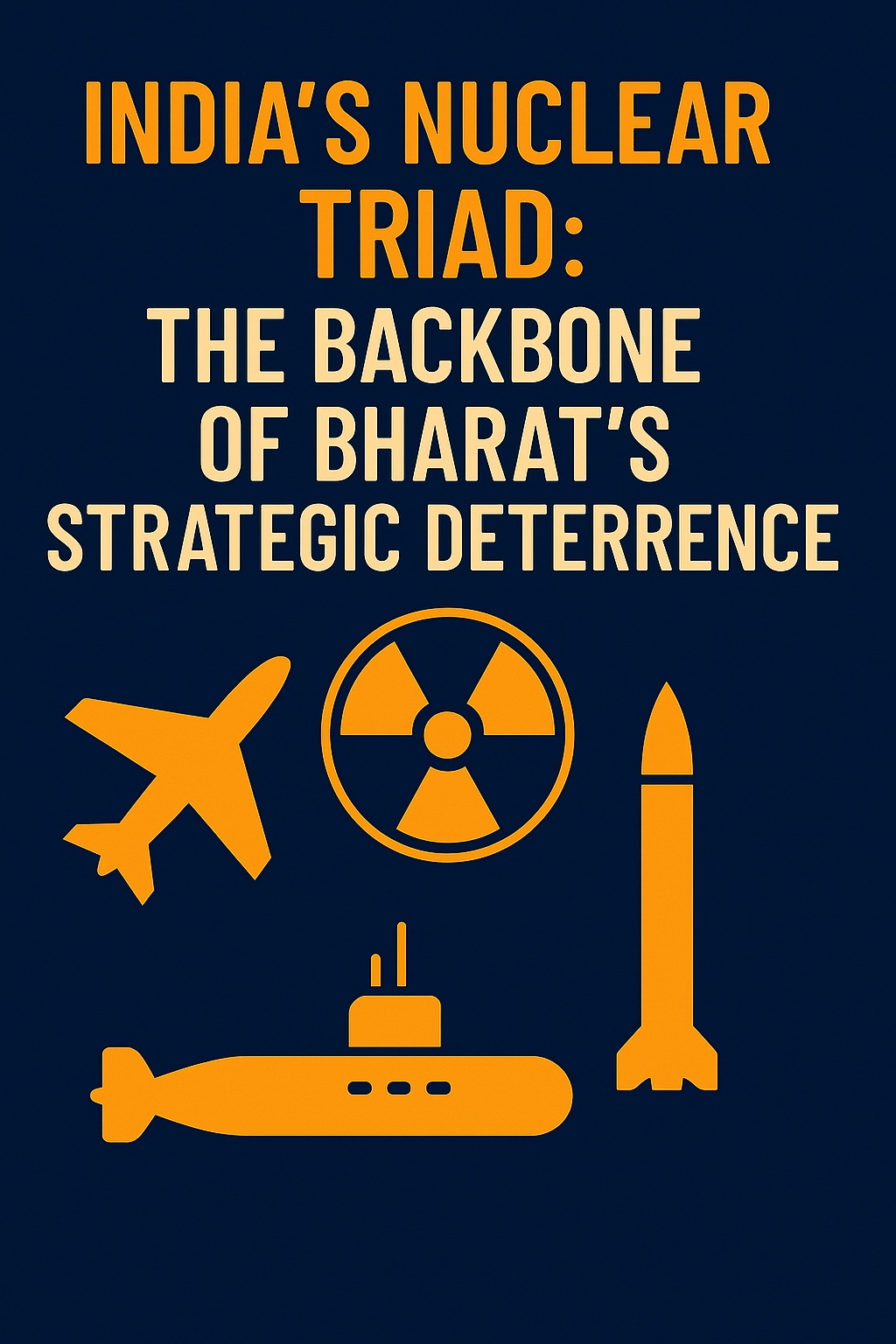
A nuclear triad consists of three distinct platforms for delivering nuclear weapons:
- Land-based ballistic missiles
- Submarine-launched ballistic missiles (SLBMs)
- Strategic bombers (air-launched nuclear weapons)
The purpose of the triad is to guarantee a credible second-strike capability. Even if an adversary attempts a devastating first strike, at least one leg of the triad is expected to survive and retaliate, thereby deterring any nuclear aggression.
1. Land-Based Nuclear Forces
Agni and Prithvi Missile Series
India’s land-based nuclear deterrent is centred on the Agni and Prithvi ballistic missile families, which provide coverage against both regional and extra-regional threats.
- Agni-I to Agni-V: Ranges from 700 km (Agni-I) to over 5,000 km (Agni-V), with Agni-V capable of reaching all of China and beyond. The Agni-V is road-mobile, highly survivable, and now features Multiple Independently Targetable Reentry Vehicle (MIRV) technology, allowing a single missile to strike multiple targets.
- Prithvi Series: Shorter-range missiles (150–350 km), designed for tactical and battlefield roles.
These missiles are operated by the Strategic Forces Command (SFC) and are frequently tested and upgraded. Agni-VI, with even longer range and advanced MIRV capabilities, is reportedly in development.
Survivability and Mobility
Land-based missiles are deployed on mobile launchers and in hardened silos, making them difficult to locate and destroy in a first strike. Their dispersal across the country further enhances survivability.
2. Sea-Based Nuclear Forces
Arihant-Class SSBNs and the “K” Series SLBMs
The sea leg of India’s triad is its most recent and strategically significant development. Ballistic missile submarines (SSBNs) provide the most survivable nuclear deterrent, as they can remain hidden underwater for extended periods.
- Arihant-Class SSBNs: India’s indigenous nuclear-powered submarines, capable of carrying nuclear-tipped ballistic missiles. INS Arihant and INS Arighat are operational, with more advanced boats under construction.
- K-15 Sagarika SLBM: Range of 750 km, operational on Arihant-class submarines.
- K-4 SLBM: Range of 3,500–4,000 km, tested and being integrated, allowing strikes deep into China from the Bay of Bengal.
- K-5 and K-6 SLBMs: Next-generation missiles under development, with projected ranges of 6,000–8,000 km and beyond. These will arm larger S-4* and S-5 class submarines, doubling or tripling missile capacity and extending India’s reach to cover all of Asia and parts of Europe and Africa.
Second-Strike Assurance
The core value of the sea leg is survivability. SSBNs can patrol vast ocean areas undetected, ensuring that even in the event of a devastating first strike on India’s land and air bases, a retaliatory nuclear strike can still be launched. India is investing in new submarine bases and command infrastructure to support continuous at-sea deterrence.
3. Air-Based Nuclear Forces
Strategic Bombers and Strike Aircraft
India’s air-based nuclear delivery systems were the first operational leg of its triad and remain an important component.
- Mirage 2000H/I: Modified for nuclear strike roles, these aircraft are capable of delivering gravity nuclear bombs and stand-off missiles.
- SEPECAT Jaguar IS/IB: Also nuclear-capable, with squadrons based at Ambala and Gorakhpur Air Force Stations.
- Su-30MKI and Rafale: The Su-30MKI can be configured for nuclear missions, while the Rafale, with its extended range and advanced avionics, provides a survivable and highly capable nuclear strike platform.
India’s strategic bombers offer flexibility and the ability to penetrate deep into adversary territory, especially when armed with stand-off nuclear missiles.
Airbase Dispersal
India maintains multiple airbases with nuclear-capable squadrons, ensuring that a surprise attack cannot neutralise the entire air-based deterrent.
4. Command, Control, and Doctrine
Nuclear Command Authority (NCA)
India’s nuclear arsenal is under strict civilian control, with the NCA, chaired by the Prime Minister, responsible for policy and authorisation. The Strategic Forces Command (SFC) executes operational control and ensures readiness across all three legs of the triad.
No First Use and Massive Retaliation
India’s official doctrine is No First Use (NFU): nuclear weapons will only be used in retaliation to a nuclear attack (or a major chemical/biological attack) on Indian territory or Indian forces anywhere. The doctrine promises “massive retaliation,” ensuring that any nuclear use against India would result in unacceptable damage to the attacker.
5. Modernisation and Future Developments
MIRV and Hypersonic Technologies
India’s successful test of MIRV technology on the Agni-V missile marks a leap in capability, allowing a single missile to deliver multiple warheads to different targets. This complicates enemy missile defence and enhances deterrence against both Pakistan and China.
Hypersonic glide vehicles and new cruise missile projects are also in advanced stages, promising even greater flexibility and survivability for the triad.
Expansion of SSBN Fleet
India is rapidly expanding its SSBN fleet, with new S-4* and S-5 class submarines under construction. These will carry more missiles with greater range, ensuring continuous at-sea deterrence-a hallmark of mature nuclear powers.
New SLBMs
The K-5 and K-6 SLBMs, with ranges up to and beyond 8,000 km, will allow Indian submarines to strike targets far beyond Asia, from safe patrol zones in the Indian Ocean.
6. Strategic Significance: Deterrence and Stability
The operationalisation of the nuclear triad gives India a survivable, flexible, and credible deterrent against both regional and extra-regional adversaries. It ensures that no adversary can contemplate a disarming first strike without facing devastating retaliation.
- Against Pakistan: The triad neutralises Pakistan’s tactical nuclear weapons and ensures that India’s second-strike capability cannot be undermined.
- Against China: Long-range Agni missiles and SLBMs put all major Chinese cities and military installations within reach, strengthening deterrence.
7. Challenges and Next Steps
- Continuous At-Sea Deterrence: India is working to ensure that at least one SSBN is always on patrol, a complex logistical and technical challenge.
- Command and Control: As the arsenal grows, maintaining secure, reliable, and survivable command and control across all legs of the triad is paramount.
- Arms Race Dynamics: India’s modernisation efforts, especially in MIRV and SLBM technology, are likely to spur further competition with Pakistan and China, necessitating careful management of escalation risks.
Excerpt
India’s nuclear triad, fully operational and rapidly modernising, forms the backbone of its strategic deterrence in 2025. With land-based Agni missiles, Arihant-class SSBNs armed with K-series SLBMs, and a fleet of nuclear-capable strike aircraft, India ensures that its nuclear arsenal remains survivable, flexible, and credible. As new technologies like MIRVs and long-range SLBMs come online, the triad will only grow in sophistication, reinforcing India’s role as a responsible and resilient nuclear power in an increasingly complex security environment.