 Vinay Karanam
 In 2025, the question of identity has become inseparable from our digital lives. Every login, transaction, video call, or biometric scan invokes not just the “what” of digital activity but the crucial “who.” As we increasingly rely on artificial intelligence, decentralised systems, and biometric verification, ensuring the integrity of digital identity has never been more critical. At the heart of this assurance lies cryptography.
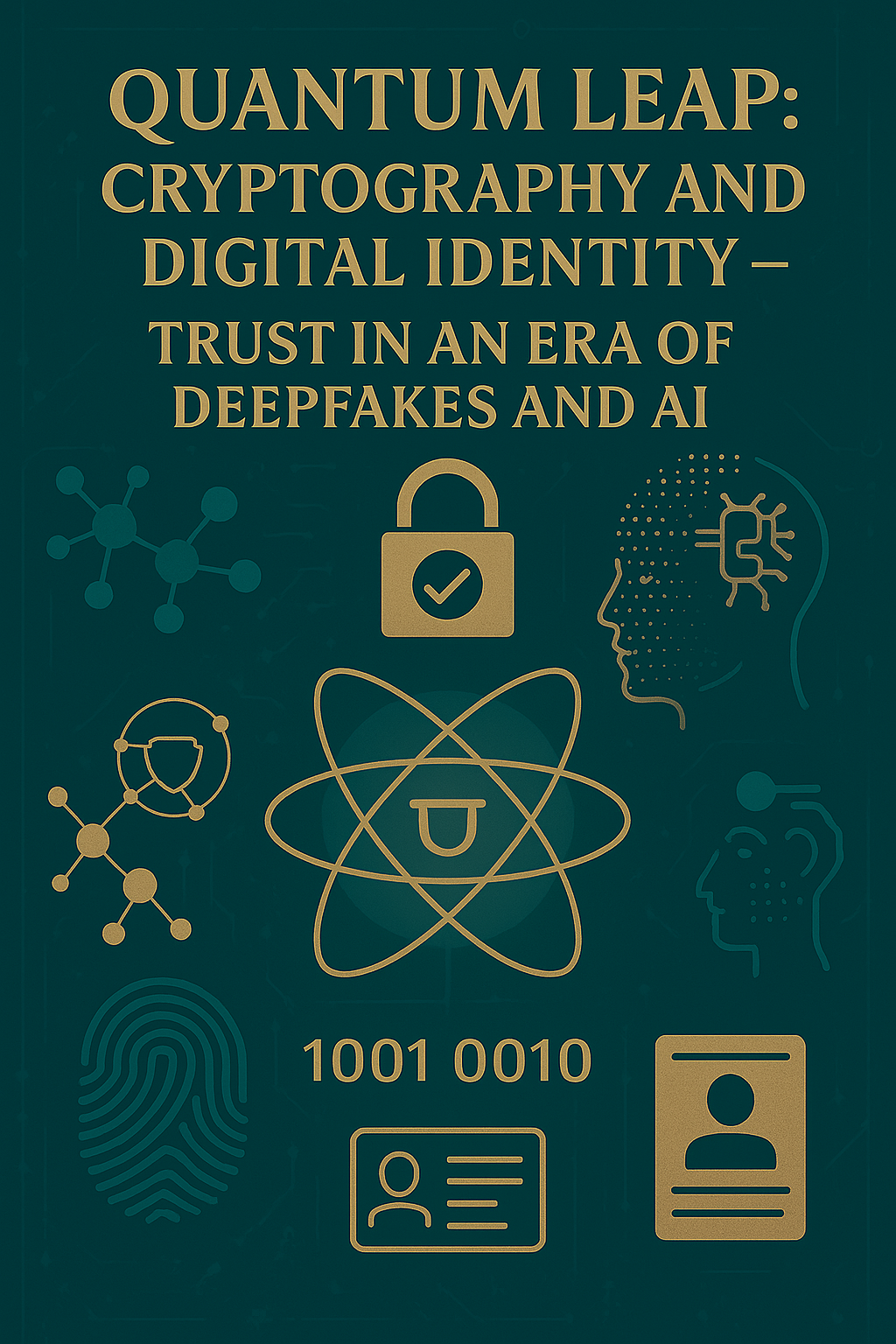
This article—sixty-eighth in our 100-part Quantum Leap series—explores how cryptographic methods underpin the concept of digital identity in an age threatened by deepfakes, identity theft, data breaches, and the collapse of traditional trust structures. From the Aadhaar ecosystem in Bharat to RealMe in Aotearoa New Zealand, we examine how cryptographic innovation is essential to maintaining authenticity in a world where seeing is no longer believing.
Section I: What Is Digital Identity?
Digital identity refers to the set of electronically stored attributes and credentials that can uniquely identify a person or entity. This may include:
- Username/password combinations
- Biometric data (fingerprints, iris scans, facial recognition)
- Public-private key pairs
- Digital certificates and signatures
- Behavioural patterns and device fingerprints
Unlike physical identity, which relies on documents or face-to-face verification, digital identity must be verifiable, portable, and secure against duplication or impersonation—conditions that cryptography is uniquely positioned to fulfil.
In practical terms, digital identity plays a role in:
- Access to financial systems
- E-governance and voting
- Border control and immigration
- Academic certification and employment
- Healthcare records and prescriptions
Section II: The Cryptographic Bedrock of Digital Identity
1. Public Key Infrastructure (PKI)
One of the most enduring cryptographic foundations for digital identity is Public Key Infrastructure (PKI). PKI enables secure communications through the use of asymmetric key pairs—one public, one private. Digital certificates bind these keys to an individual or entity and are issued by a Certificate Authority (CA).
Applications of PKI in Identity:
- Digital Signatures: Used for secure emails, contracts, and legal documents.
- TLS Certificates: Verify websites and encrypt browser-server communication.
- Authentication Protocols: Employed in VPNs, smart cards, and login systems.
2. Cryptographic Hashes
Cryptographic hash functions like SHA-256 are used to validate the integrity of data, passwords, or biometric templates without revealing the underlying information. They provide non-reversible, fixed-length outputs that are essential in digital identity management.
3. Zero-Knowledge Proofs (ZKPs)
An emerging technique in privacy-focused identity systems, ZKPs allow a user to prove possession of a credential (like age or citizenship) without revealing the credential itself. This preserves privacy while ensuring trust—a delicate balance in the digital age.
Section III: Threats to Digital Identity in the AI Era
1. Deepfakes and Synthetic Media
AI-generated content can now convincingly mimic a person’s voice, face, and even behaviour. Deepfakes have already been weaponised in political misinformation, financial fraud, and revenge-based cybercrimes.
Implications for Identity:
- Video-based KYC (Know Your Customer) protocols can be bypassed.
- Biometric authentication systems may be fooled by generative AI.
- Public trust in legitimate media and identities is deteriorating.
2. Identity Theft and Data Breaches
Stolen credentials from large-scale data breaches often form the basis of impersonation attacks. Even encrypted databases can be compromised if poor key management or weak encryption standards are used.
3. Synthetic Identities
A synthetic identity is a combination of real and fabricated data to create a new, fictitious person. These identities can be used to open bank accounts, commit financial fraud, or manipulate electoral systems.
Stat Snapshot:
As per 2024 data from Bharat CERT and New Zealand CERT NZ, identity fraud now accounts for over 40% of reported cybercrimes in both countries, with generative AI flagged as a key enabler.
Section IV: Cryptographic Countermeasures and Frameworks
1. Decentralised Identifiers (DIDs) and Self-Sovereign Identity (SSI)
DIDs are cryptographically verifiable identifiers that do not require a central registry. Combined with Self-Sovereign Identity, they allow users to control their own identity credentials without depending on a central authority.
How It Works:
- A user creates a DID anchored in a blockchain or distributed ledger.
- Verifiable Credentials (VCs) are issued and signed by trusted parties.
- The user can present these VCs to third parties without needing to contact the issuer.
This model is especially powerful for marginalised populations without traditional ID access—such as rural communities in Bharat or displaced individuals in disaster-prone Pacific nations.
2. Blockchain and Identity
Blockchain provides immutability and transparency, which are crucial in identity verification systems. Initiatives like Bharat’s UIDAI Aadhaar or Estonia’s e-Residency programme explore or employ aspects of blockchain to secure identity-related metadata.
3. Multi-Factor Authentication (MFA) with Biometrics and Tokens
MFA systems use combinations of:
- Something you know (password)
- Something you have (token, smartphone)
- Something you are (biometric trait)
Cryptographic protocols like FIDO2 use public-key cryptography for passwordless authentication, increasing resilience against phishing and credential stuffing.
Section V: The Bharat and Aotearoa Landscapes
Bharat: Aadhaar and Beyond
With over 1.3 billion enrolees, Aadhaar is the largest biometric ID system in the world. While its use in banking, welfare, and telecom has boosted efficiency, concerns remain about privacy, consent, and surveillance.
The Supreme Court of India has mandated tighter controls on the use of Aadhaar data, including:
- End-to-end encryption
- Purpose limitation and minimal disclosure
- Offline verification capabilities using QR codes and cryptographic signatures
New Zealand: RealMe and E-Governance
RealMe is a government-operated digital identity service that integrates cryptographic safeguards for identity verification across sectors—from driver licensing to university admissions.
However, there is growing momentum in New Zealand’s tech community to shift toward SSI models, especially for iwi (tribal) and community-based identification systems that respect tikanga (customary values) and promote data sovereignty.
Section VI: Looking Ahead – Post-Quantum Identity
Quantum computing poses a direct threat to many cryptographic primitives used in today’s identity frameworks. Shor’s algorithm could break RSA and ECC, leaving digital identities vulnerable.
Post-Quantum Cryptography (PQC) for Identity
The National Institute of Standards and Technology (NIST) has selected algorithms like Kyber and Dilithium for standardisation. These will eventually replace RSA/ECC in identity-related applications.
Transition Strategies:
- Hybrid certificates using both classic and post-quantum algorithms
- Agility in identity systems to swap out cryptographic schemes
- Education and regulatory alignment to ensure smooth transitions
Section VII: Challenges and Ethical Considerations
- Digital Exclusion
Reliance on digital identity may exclude individuals without access to the internet, literacy, or mobile devices. - Surveillance and Consent
The same cryptographic tools that enable secure ID can also be co-opted into surveillance architectures if not governed responsibly. - Interoperability
Lack of international standards limits cross-border usability of identity credentials. - Data Sovereignty
As cloud-hosted identity platforms grow, issues of national jurisdiction over identity data become increasingly critical.
Conclusion: Trust, But Cryptographically Verify
In the age of AI-generated deception and quantum disruption, the humble question “Who are you?” has become a cryptographic challenge. As we seek to preserve privacy, resist impersonation, and uphold trust, digital identity systems must evolve with the precision of mathematics and the wisdom of ethics.
Whether through the blockchain-powered DIDs of tomorrow or the FIDO-secured logins of today, cryptography is not just protecting our passwords—it is safeguarding our very personhood in the digital realm.
In the next article, we’ll explore cryptographic applications in global humanitarian efforts—from refugee ID to cross-border aid logistics—as Quantum Leap continues to map the future of trust.
© 2025 New Zealand Bharat News. All rights reserved.
For re-publication enquiries or feedback, contact: admin@nzb.news