 Dorothy Brown
 Introduction
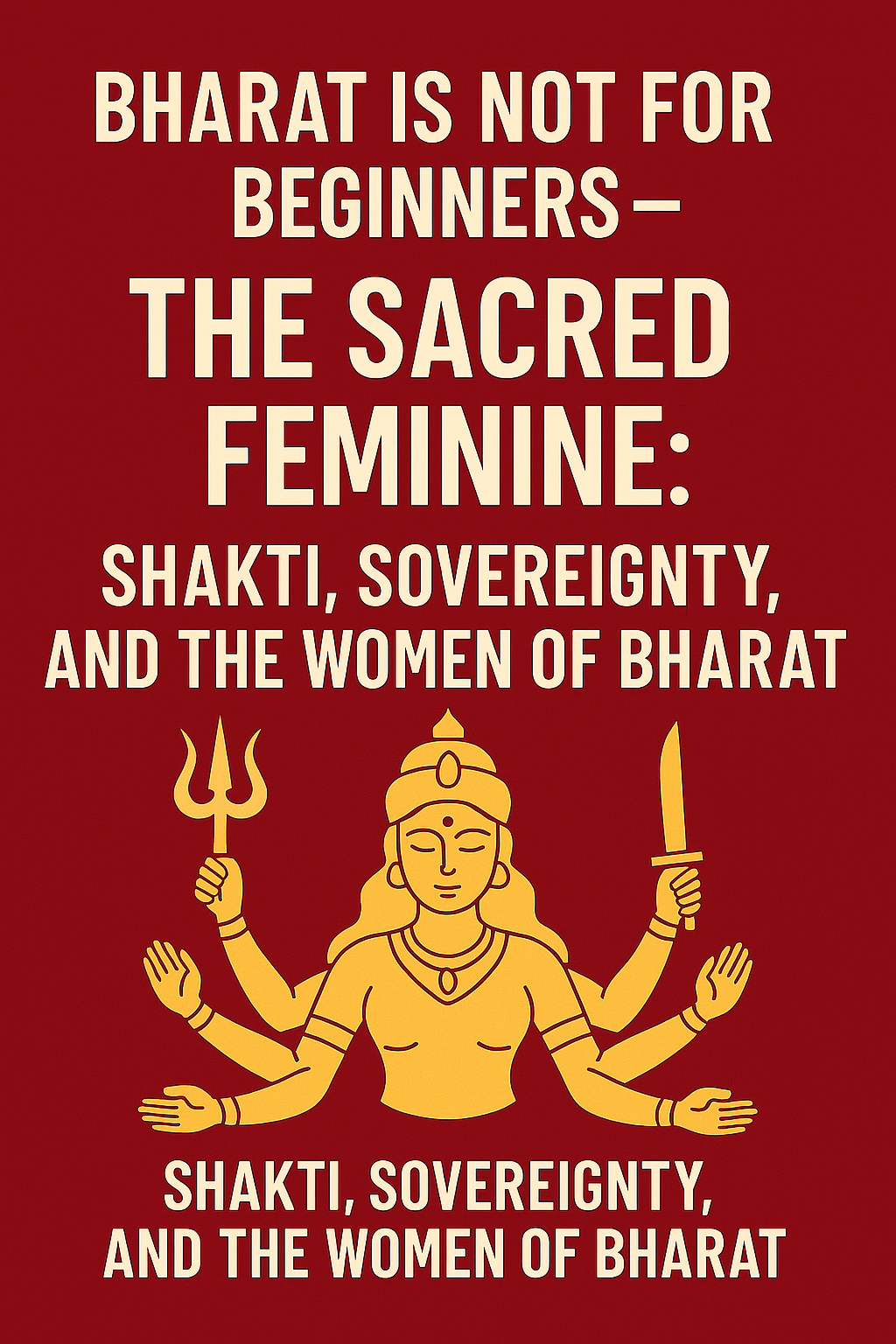
In much of the world, the history of women has been a story of silence, subjugation, and struggle for recognition. In Bharat, the narrative is far more complex—and often, far more empowering. While no civilisation is perfect, Bharat’s approach to the feminine has long been informed by the philosophy of Shakti—the cosmic principle that the divine is both masculine and feminine, and that energy, creativity, and power itself are feminine in nature.
This 69th instalment of the Bharat Is Not for Beginners series explores the multifaceted role of women in India’s civilisational journey—from Vedic seers and tantric goddesses to warrior queens, reformers, artists, and leaders in science and politics. Rather than treating women as passive observers of history, Bharat has often seen them as its makers, guardians, and spiritual anchors.
This is not a mere celebration of femininity. It is an honest reckoning with the highs and lows of women’s status in India across centuries—where spiritual reverence, legal recognition, and cultural honour have coexisted with episodes of neglect, restriction, and injustice.
I. Shakti: The Divine Feminine as Cosmos
The Indian spiritual imagination begins not with the image of a patriarchal god, but with Shakti—primordial feminine energy that animates all of creation.
Devi: Not Just Worshipped, but Invoked
From the Devi Mahatmya to the Lalita Sahasranama, the goddess is not a passive consort but the very embodiment of:
- Power (Shakti) – Durga and Kali.
- Wisdom (Vidya) – Saraswati.
- Wealth and Fertility (Lakshmi).
- Compassion and Devotion (Parvati, Radha, Sita).
Temples to goddesses are not peripheral—they are central to Indic spiritual geography. The Shakta tradition, and especially Tantra, sees the feminine as the ultimate reality (Para Shakti), with the male divine as inert without her activation.
In this metaphysics, women are not to be saved from sin—they are often seen as expressions of the divine, worthy of reverence and partnership.
II. Women in the Vedic Age: Seers, Scholars, and Spiritual Teachers
The Vedas (1500–500 BCE) are among the earliest Indian texts, and they preserve a memory of a society where women were active participants in intellectual, spiritual, and ritual life.
Vedic Rishikas
Women like Lopamudra, Gargi, Maitreyi, and Ghosha were not just mentioned—they were authors of Vedic hymns. Gargi debated Yajnavalkya in the Brihadaranyaka Upanishad with philosophical rigour that still stuns modern readers.
Maitreyi famously questioned the value of wealth versus knowledge: “What should I do with that by which I cannot become immortal?”—a question that still underpins India’s spiritual ethos.
Education and Rites
In early Vedic society, girls were entitled to the Upanayana ceremony (initiation into study), and were known as Brahmavadinis if they chose a life of learning and spiritual pursuit.
III. Royal Sovereignty and Warrior Queens
Bharat’s history is filled with powerful women rulers, commanders, and strategists—often leading armies and empires.
Rani Durgavati and Rani Lakshmibai
- Rani Durgavati (16th century) ruled Gondwana and fought valiantly against Mughal forces.
- Rani Lakshmibai of Jhansi (19th century), a symbol of resistance in the 1857 revolt, remains one of the most revered figures in Indian freedom history.
Ahilyabai Holkar
As queen of the Malwa kingdom, Ahilyabai Holkar (1725–1795) was a paragon of good governance and public welfare. She built temples, ghats, wells, and dharamshalas across Bharat—from Kashi to Rameswaram—while maintaining a just and efficient administration.
Velu Nachiyar and Abbakka Chowta
- Velu Nachiyar (18th century Tamil Nadu) organised a women’s army and launched the first recorded suicide attack against the British.
- Abbakka Chowta, a 16th-century queen in Karnataka, repelled Portuguese forces for over four decades.
IV. Women in Bhakti and Sufi Movements
The Bhakti movement (8th–17th centuries) revolutionised religion by emphasising personal devotion over ritual orthodoxy. It also opened a spiritual space for women, transcending caste and gender norms.
Mystic Poets and Saints
- Meerabai: A Rajput princess turned mystic, she defied royal expectations to sing her love for Krishna.
- Akkamahadevi: A 12th-century Kannada poet-saint, who renounced worldly life, wore only her long hair, and composed spiritually radical vachanas.
- Lal Ded: A Kashmiri mystic who blended Shaiva and Sufi thought in her vakhs (sayings).
- Janabai: A Dalit poet and housemaid in Maharashtra who found divine meaning in everyday chores.
Their poems—often in the vernacular—conveyed spiritual truths with raw immediacy, rejecting the male-dominated priesthood and empowering common people, especially women.
V. Colonial and Nationalist Eras: Feminism in a Dharmic Frame
The 19th and early 20th centuries saw growing concern over women’s rights in colonial India. Reformers emerged—but so did women leaders who shaped the narrative on their own terms.
Educators and Reformers
- Savitribai Phule: Along with her husband Jyotirao Phule, she started India’s first girls’ school and defied caste and gender restrictions.
- Pandita Ramabai: A Sanskrit scholar who advocated for widow remarriage, female education, and social justice.
- Begum Rokeya: A Muslim feminist in Bengal who promoted secular education for Muslim girls.
Freedom Fighters
- Sarojini Naidu: Poet, orator, and President of the Indian National Congress.
- Aruna Asaf Ali, Usha Mehta, and Matangini Hazra played key roles in underground resistance and civil disobedience.
- Captain Lakshmi Sahgal led the women’s wing of Subhas Chandra Bose’s Indian National Army.
Unlike Western feminism, Indian women leaders often worked within a dharmic worldview—seeking equality without always rejecting tradition, and often harmonising modern rights with cultural roots.
VI. Women in Independent India: Progress and Paradox
Post-1947, the Indian Constitution enshrined equality for women, including voting rights, property ownership, education, and employment. Yet, the journey has been uneven.
Trailblazers in Modern India
- Indira Gandhi: India’s first and only woman Prime Minister.
- Kalpana Chawla: First Indian-born woman in space.
- Kiran Mazumdar-Shaw, Falguni Nayar, Nirmala Sitharaman: Leaders in biotech, business, and finance.
- P.V. Sindhu, Mary Kom, Neerja Bhanot, and Sania Mirza: Icons in sports, heroism, and public life.
Women today are at the helm of startups, in Parliament, in science labs, in the armed forces, and across every domain.
The Ongoing Struggles
Yet, challenges persist:
- Gender-based violence and patriarchal attitudes.
- Disparities in political representation and corporate leadership.
- Social stigma around menstruation, widowhood, and female sexuality.
- The digital divide, particularly in rural areas.
However, grassroots change is underway—led by women sarpanchs, teachers, health workers, and entrepreneurs who are reshaping their communities one step at a time.
VII. Shakti in the Present: Reclaiming the Feminine Principle
In many ways, the return to Shakti is not just a religious gesture—it’s a civilisational imperative.
The Feminine as Leadership
India’s ancient philosophy offers a model where feminine qualities—nurturing, intuition, community-centric action—are not seen as weaknesses, but as essential aspects of leadership and innovation.
As Bharat moves toward becoming a vishwaguru, the spiritual principle of balance between masculine and feminine—Shiva and Shakti, Purusha and Prakriti—may offer the world a new model of societal equilibrium.
Conclusion: From Reverence to Realisation
Bharat has always known that woman is not just ardhangini—half of the whole—but often the more powerful half. And yet, reverence without rights, praise without participation, and symbolism without substance is not enough.
Reclaiming the power of Shakti today means:
- Ensuring full access to education, health, and opportunity.
- Redefining success through a more holistic, feminine lens.
- Honouring traditional wisdom while fighting systemic injustice.
- Supporting women not just as beneficiaries of development, but as drivers of change.
The sacred feminine is not locked in temples. She walks the streets, fights court cases, teaches children, flies aircraft, and votes. When she rises, Bharat rises.
What’s Next?
In Article 70: Bharat Is Not for Beginners – The Spiritual Cartography of India: Pilgrimage, Sacred Geography, and Cosmic Consciousness, we’ll explore how India’s landscape is mapped not just with political boundaries, but with sacred energies—from the Char Dhams and Jyotirlingas to Shakti Peethas and river confluences—revealing how geography itself is divinised in the Indian worldview.