 Vinay Karanam
 Democracy, once a paper-based institution of trust and consensus, now exists in an increasingly digital, disinformation-saturated world. From online voter registration to electronic voting machines and blockchain-based audit trails, elections have become high-stakes digital operations—rife with vulnerabilities, both real and perceived.
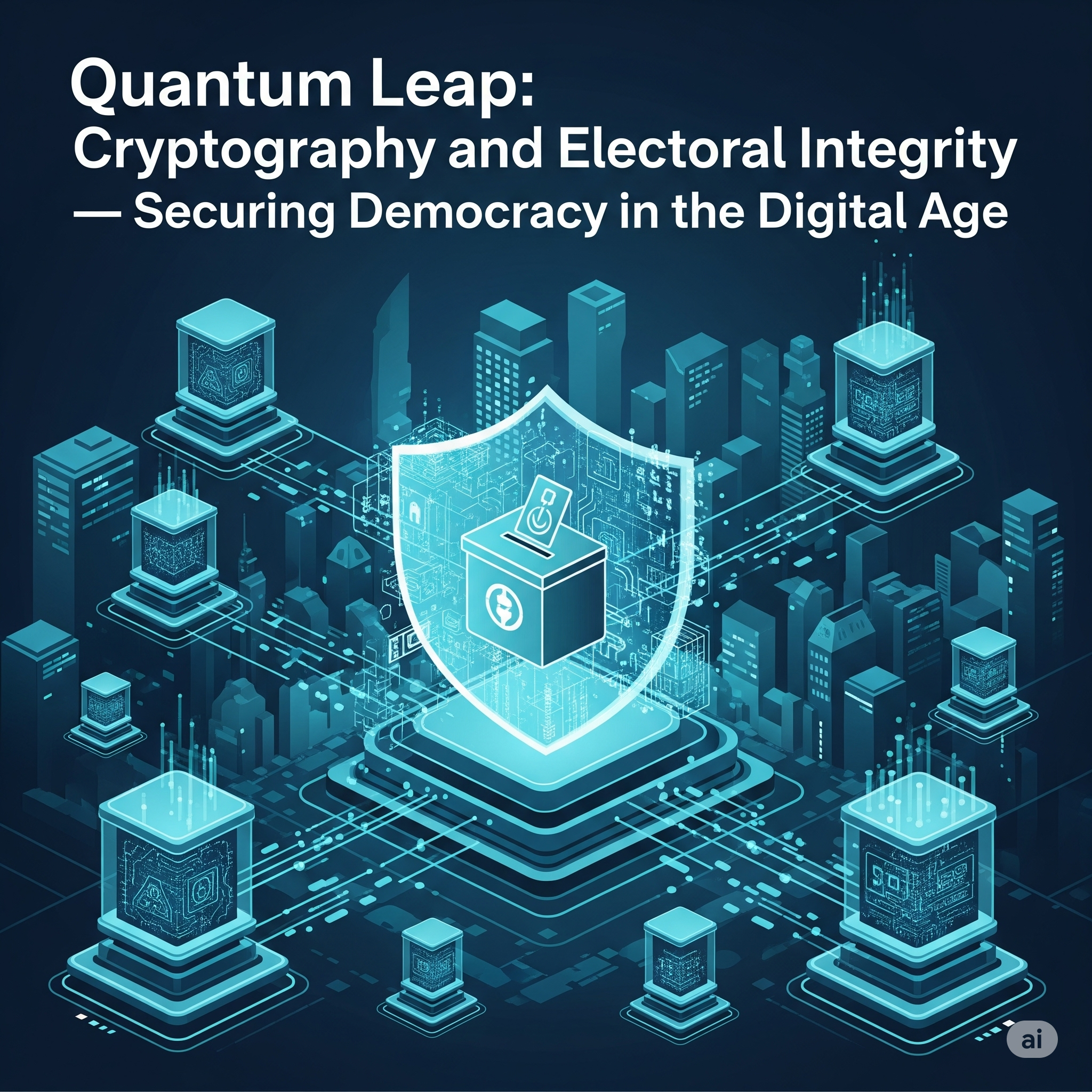
This 71st instalment of the Quantum Leap series explores how cryptography is being deployed to secure electoral integrity—not only the confidentiality of the vote, but also the transparency, auditability, and resilience of democratic systems in the face of cyber warfare, state-sponsored interference, deepfakes, and quantum threats.
Drawing on global case studies and emerging protocols, we examine how classical and post-quantum cryptography can underpin free and fair elections—from voter ID authentication and secure ballot casting to verifiable counting and misinformation countermeasures.
Section I: The Digitisation of Democracy – A Double-Edged Sword
Modern elections have rapidly evolved beyond polling booths and ballot boxes. Today’s electoral processes incorporate:
- Online voter registration platforms
- Electronic voting machines (EVMs) and optical scan systems
- Vote-by-mail tracking apps
- Blockchain-based tallying
- AI-driven disinformation detection
While these digital tools promise efficiency and accessibility, they introduce unprecedented risks:
- Hacking of voter databases (e.g. 2016 US election breaches)
- Malware compromising EVM firmware
- Vote manipulation via phishing and ransomware
- Deepfakes and algorithmic propaganda distorting public discourse
Without robust cryptographic protections, the very foundation of democratic legitimacy—public trust—may erode beyond repair.
Section II: Core Cryptographic Principles for Electoral Security
Cryptography secures elections not just by encrypting data, but by enforcing verifiability, anonymity, and transparency. Key goals include:
1. Ballot Secrecy
Each voter’s choice must remain private, even from the election authority.
2. Voter Authentication
Only eligible voters should cast ballots, and only once.
3. End-to-End Verifiability
Voters should be able to verify their vote was counted as cast, without compromising secrecy.
4. Tamper Resistance
Any attempt to modify votes or results should be detectable and preventable.
Cryptographic tools—ranging from digital signatures and zero-knowledge proofs to homomorphic encryption and mixnets—are at the heart of these guarantees.
Section III: Secure Voter Authentication – The First Gate
1. Digital ID and Public Key Infrastructure (PKI)
In jurisdictions where online registration or remote voting is permitted, secure voter authentication is paramount. This involves:
- Issuing digital voter IDs anchored to national ID systems (e.g. Aadhaar in India, RealMe in New Zealand)
- Binding these IDs to cryptographic key pairs
- Using PKI to validate identities without exposing private data
For instance, Estonian e-voting allows voters to authenticate via national ID smartcards, using a digital signature that proves identity but not voting choice.
2. Zero-Knowledge Proofs (ZKPs)
ZKPs can be used to prove eligibility without revealing sensitive details—such as age, address, or political affiliation. This ensures:
- Privacy preservation
- Resistance to profiling and voter suppression
- Anonymous, provably legitimate voting
Section IV: Ballot Casting – Confidential Yet Verifiable
Casting a vote securely involves a paradox: it must be anonymised to protect privacy, but also auditable to prevent fraud.
1. Mixnets and Onion Routing
Inspired by Tor, mixnets shuffle encrypted votes through randomised paths, breaking the link between voter and ballot. Cryptographic shuffling and decryption (by multiple authorities) ensures:
- Ballot secrecy
- Distributed trust
- Tamper-proofing via digital signatures
2. Homomorphic Encryption
Homomorphic encryption allows mathematical operations to be performed on encrypted data without decrypting it. This enables:
- Encrypted vote tallying
- No exposure of individual choices
- Cryptographic proofs of correct computation
Examples include the Paillier and ElGamal schemes, which are used in systems like Helios and Microsoft’s ElectionGuard.
Section V: Counting and Verifiability – Trust in the Tally
1. End-to-End Verifiable Voting Systems
End-to-end verifiable (E2E-V) systems allow voters to:
- Receive a cryptographic receipt of their vote
- Verify that their vote was included unaltered
- Check that the final tally matches all votes cast
These systems employ hash chains, Merkle trees, and zero-knowledge proofs to create public, auditable records without compromising privacy.
2. Blockchain Voting – Promise and Pitfalls
While blockchain offers immutability and decentralisation, its application to elections is controversial. Critics argue that:
- Blockchain may be too transparent, risking coercion or vote buying
- Node compromise can bias results
- Digital divides may disenfranchise some voters
However, hybrid models (e.g. blockchain for audit trails but not vote storage) are gaining traction, especially in municipal and shareholder elections.
Section VI: Case Studies – Global Applications and Innovations
Estonia: The Pioneer of E-Voting
Estonia has conducted secure national elections online since 2005. Key elements include:
- Two-factor digital ID authentication
- Encrypted votes cast via a client app
- Mixnet anonymisation
- Cryptographically verifiable results published post-election
Estonia’s system has withstood international scrutiny, offering a model for scalable, secure e-voting.
India: Securing the World’s Largest Democracy
India’s Electronic Voting Machines (EVMs) and Voter Verifiable Paper Audit Trail (VVPAT) systems are designed for robustness, not online use. However, cryptography underpins:
- Firmware integrity verification via digital signatures
- Voter list authentication using Aadhaar-linked biometrics
- Encrypted storage of vote data for audit purposes
India is also testing remote voting via blockchain for migrant workers, using identity-anchored key pairs and zero-knowledge eligibility proofs.
New Zealand: A Trust-Based Model
While New Zealand has not adopted electronic voting for general elections, it does allow electronic vote transmission for overseas voters. Cybersecurity measures include:
- PGP encryption
- Secure file transfer protocols
- Manual audit trails for cross-checking
There are ongoing discussions about introducing cryptographic methods to improve absentee voting integrity and civic engagement in remote regions.
Section VII: Cryptography vs Disinformation – The Battle for Minds
In the age of social media, the greatest threat to electoral legitimacy may not be vote tampering but perception hacking.
1. Deepfake Detection and Verification
Cryptographic digital watermarking and zero-knowledge media authentication protocols are being explored to:
- Prove whether a video or image is genuine
- Allow whistleblowers to submit anonymous yet authenticated evidence
- Fight viral misinformation ahead of polls
2. Verified Election Reporting
News outlets, NGOs, and electoral commissions are using cryptographic timestamps (via blockchain) to authenticate reports, images, and poll data. This:
- Prevents tampering or retrospective alteration
- Builds trust among observers and citizens
- Deters coordinated misinformation campaigns
Section VIII: Quantum Threats to Democracy
With the rise of quantum computing, existing public-key cryptographic systems (RSA, ECC) that underpin:
- Digital signatures
- Voter authentication
- Vote tally verification
…will be rendered insecure, potentially undermining the trustworthiness of electoral data.
1. Post-Quantum Cryptography (PQC)
Governments and election tech providers are transitioning to quantum-resistant algorithms, such as:
- Dilithium and FALCON for digital signatures
- Kyber for key exchange
- SPHINCS+ for stateless voting verification receipts
These are already being embedded into secure election software for future-proofing democratic processes.
2. Quantum Key Distribution (QKD)
Though not yet widely deployed, QKD is being piloted in high-security environments for:
- Secure transmission of vote tallies from remote areas
- Inter-agency communications during election nights
- Diplomatic election monitoring operations
Section IX: Ethical Considerations and the Digital Divide
1. Access and Inclusion
While digital voting systems promise convenience, they risk excluding:
- Rural and indigenous populations
- The elderly or digitally illiterate
- Citizens with disabilities
Cryptographic voting systems must be accompanied by accessibility by design, and offline alternatives to preserve universal suffrage.
2. Transparency vs Secrecy
How much transparency is too much? Over-reliance on blockchain or public cryptographic proofs could enable coercion or violate ballot secrecy. Systems must be auditable, but not traceable.
3. Cryptographic Colonialism
The imposition of foreign-made cryptographic voting technologies in the Global South raises questions about sovereignty, accountability, and long-term dependency.
Open-source, verifiable systems—adapted to local contexts—are essential for ethical electoral tech.
Conclusion: Cryptography as Democracy’s Last Line of Defence
In an era when confidence in democratic institutions is waning and digital disruption is accelerating, cryptography stands as a critical safeguard. It ensures that votes are cast as intended, recorded as cast, and counted as recorded—even in the face of quantum computers, AI-driven propaganda, and cyberwarfare.
Securing democracy is no longer just about policing ballot boxes. It is about securing the algorithms, protocols, and perceptions that define truth in the 21st century.
In our next article, we will explore the intersection of cryptography and digital identity—focusing on self-sovereign identity (SSI), decentralised identifiers (DIDs), and the role of zero-knowledge proofs in creating privacy-respecting yet verifiable global identity systems.
© 2025 New Zealand Bharat News. All rights reserved.
Contact: admin@nzb.news | Follow us @nzb.news