




 Dorothy Brown
 Introduction
This is the 76th article in the Bharat Is Not for Beginners series. Following our exploration of India’s mathematical brilliance in Article 75, where zero was shown to be both a numeral and a metaphysical concept, we now move into a dimension where mathematics becomes visible, astronomy becomes architecture, and spirituality shapes stone.
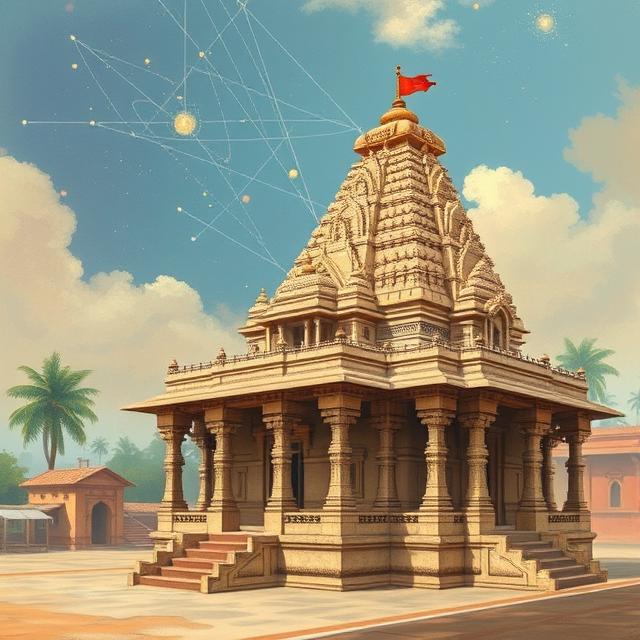
To the modern tourist, an Indian temple is often viewed as an exotic structure—rich in carvings, full of rituals, perhaps spiritually charged, but rooted in “religion”. This is a severe reduction. In Bharat, temples were cosmological machines, celestial instruments, sacred calculators, and microcosmic universes.
This article explores how ancient Indian temples were designed not merely as places of devotion, but as living embodiments of astronomical alignment, sacred geometry, musical ratios, planetary cycles, and philosophical insight. These temples were not just homes for deities—they were instruments of perception. They were, quite literally, telescopes carved in stone.
I. Cosmology in Stone: The Idea of a Mandala
At the heart of every Indian temple lies the mandala—a geometric diagram that maps the universe in symbolic form. The most common is the vastu-purusha-mandala, a square subdivided into smaller squares, each corresponding to a cosmic principle, deity, or natural element.
This square:
- Mirrors the cosmic order (ṛta).
- Embeds cardinal directions and aligns the temple along north-south and east-west axes.
- Connects the body of the devotee to the body of the cosmos.
As the devotee circumambulates the temple (in a ritual called pradakṣiṇā), they are not merely walking—they are moving through the structure of the universe. The temple is not just architecture. It is meta-architecture.
II. Temples as Astronomical Observatories
Contrary to common perception, Indian temples were precision instruments aligned to the movements of the sun, moon, and planets.
1. Solar Alignments
Many temples were built so that light enters the sanctum sanctorum on equinoxes or solstices, illuminating the deity:
- Konark Sun Temple (Odisha): Oriented so that the first rays of the sun fall on the idol in the morning.
- Brihadisvara Temple (Thanjavur): No shadow of the vimana (tower) falls on the ground at noon—demonstrating knowledge of solar zenith angles.
- Virupaksha Temple (Hampi): Displays a pinhole projection of the sun, acting as a camera obscura.
These are not coincidences. They reflect deep astronomical knowledge, encoded into spatial design.
2. Lunar and Planetary Cycles
- Meenakshi Temple (Madurai) has features tracking lunar phases.
- Some temples incorporate the 27 nakṣatras (lunar mansions) into their layout, aligning with the Indian sidereal calendar.
Timekeeping was built into the temple—dials of stone, shadows on thresholds, calendars in corridors.
III. Sacred Geometry and Temple Proportions
1. The Canon of Proportions
Temple architects followed śilpa śāstras and vāstu śāstras, ancient treatises that specified precise proportions, angles, and measurements:
- The ratio of garbhagṛha (sanctum) to the prakāra (outer hall) followed fixed mathematical patterns.
- Temples were often proportioned using musical ratios: 1:2, 2:3, 3:5—mirroring harmonics.
This is not arbitrary decoration. It reflects the Indian insight that form is sound, and sound is form—the essence of nāda brahma.
2. The Golden Ratio and Fractals
- Many temples exhibit proportions close to the golden ratio (φ).
- The recursive carvings on temple walls resemble fractal patterns—self-similarity across scales, from the lotus to the cosmos.
The temple thus becomes geometry made sacred, guiding the devotee into the experience of cosmic order.
IV. The Temple as Human and Cosmic Body
In the Indian worldview, the temple is a body—both divine and human:
- The garbhagṛha (sanctum) is the womb or the heart chakra.
- The śikhara (spire) is the head or crown chakra.
- The mandapa (hall) is the body or torso, through which the devotee journeys.
This correspondence is not metaphorical. It is experiential. As one walks through the temple, one awakens each inner centre, mimicking the journey of kundalini energy rising to spiritual liberation.
The temple thus functions as a yogic structure—a facilitator of inner transformation.
V. Musical Temples: Sound, Architecture, and Consciousness
Some temples in Bharat don’t just house idols—they sing:
1. The Saṅgīta Mandapas
- Temples like Hampi’s Vittala Temple have musical pillars. When tapped, these stone columns produce notes of the Indian scale (saptasvara).
- The Sundararaja Perumal Temple (TN) features pillars that echo like drums.
This isn’t a gimmick—it reflects acoustic engineering embedded in sacred architecture. The ancients knew how to tune stone to frequency.
2. Temple Bells and Harmonics
- Temple bells are made with specific metallic alloys that resonate at 7 Hz, believed to be ideal for synchronising brain hemispheres.
- Their sound is not random—it’s calibrated to clear energy channels.
Every vibration in the temple—whether from bell, chant, or mantra—is designed to retune consciousness.
VI. Temples as Timekeepers and Celestial Maps
1. Gnomonic Instruments
- The Jantar Mantar observatories, built later during the 18th century, are direct descendants of temple-based astronomy.
- Earlier temples used pillars, walls, and openings to measure solar angles, mark seasonal transitions, and fix festivals.
2. The Cosmic Calendar
Many temples embedded calendrical codes:
- 12 pillars for 12 zodiac signs
- 27 shrines for 27 nakṣatras
- 108 carvings corresponding to the sacred number of creation
Numbers weren’t arbitrary—they were mnemonic devices encoding cosmological wisdom.
VII. Regional Styles, Universal Ideas
From Nagara temples of the north to Drāviḍa temples of the south, from Vesara hybrids to rock-cut marvels, each style had unique flourishes—but the core principles remained the same.
Whether you stood before:
- The Khajuraho temples, with their erotic metaphors and tantric geometry
- The Dilwara Jain Temples, carved in marble so fine they seem translucent
- The Kailasa Temple (Ellora), hewn from a single rock, like an inverted mountain
You encountered the same sacred algorithm: space turned to sound, stone turned to spirit.
VIII. The Politics of Preservation and the Crisis of Continuity
Colonial and post-colonial regimes viewed temples as:
- Archaic monuments, not living structures
- Objects of tourism, not transmission
- Targets of neglect, distortion, or secular sanitisation
Yet these temples were libraries in stone, housing not only gods but worldviews. The crisis today is one of continuity:
- Are temples merely archaeological sites, or spiritual centres of civilisational energy?
- Can the knowledge systems that built them be revived, not merely restored?
To honour a temple is not just to photograph it—it is to decode it, experience it, and transmit its embedded knowledge.
Conclusion – The Temple is a Telescope
When you enter an Indian temple, you are not stepping into a “place of worship” in the modern Western sense. You are:
- Entering a diagram of the cosmos
- Moving through a psychological and astronomical journey
- Interacting with geometry, light, sound, and consciousness
- Participating in an ancient algorithm of self-realisation
Temples in Bharat were designed to orient the human toward the infinite, using architecture as philosophy, ritual as science, and stone as scripture.
Truly, Bharat is not for beginners—because here, a temple is not a building. It is a universe you can walk through.
What’s Next?
In Article 77: Bharat Is Not for Beginners – The Water Civilisation: Stepwells, Tanks, and the Science of Sacred Hydraulics, we will explore how India’s water systems were not only environmentally sustainable, but ritually integrated, mathematically precise, and aesthetic masterpieces. From stepwells in Gujarat to temple tanks in Tamil Nadu, we’ll examine the civilisational philosophy of water.