



 Tracey Beatrice
 By Tracey Beatrice | NZB News | 27 April 2025
Background
In today’s multipolar world, trade is no longer just a matter of economics — it is a tool of diplomacy, regional security, and geopolitical strategy. As countries reconfigure supply chains and diversify alliances post-pandemic, the Indo-Pacific has emerged as the most dynamic and contested economic theatre of the 21st century.
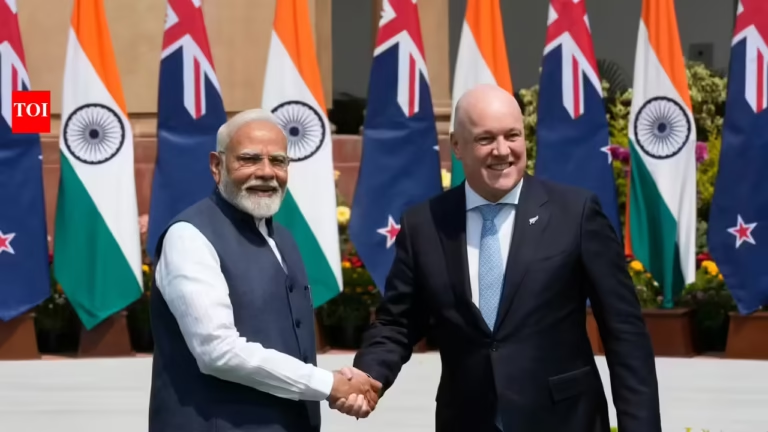
For New Zealand, a traditionally Pacific-oriented nation, expanding its eastward focus — especially towards India — is not just pragmatic, it’s necessary.
India: The Emerging Economic Giant
India’s economic trajectory in recent years has been remarkable:
- GDP growth consistently hovers above 6.5%
- India recently overtook Japan as the world’s third-largest economy by PPP
- Its consumer base of 1.4 billion, growing tech sector, and infrastructural push make it a magnet for investment
While New Zealand’s trade with India remains modest compared to China or Australia, this may be the most opportune time to rethink economic priorities.
New Zealand’s Positioning
New Zealand’s economy, while small, is agile and export-driven. Its strengths lie in:
- High-quality agricultural products, especially dairy and meat
- Advanced agritech, food science, and sustainability innovation
- A stable regulatory environment with strong ethical governance
The question is: Can these advantages be leveraged to deepen trade ties with India, bypassing long-standing policy deadlocks?
Trade Landscape and Key Developments
1. Bilateral Trade:
- As of 2024, India–New Zealand trade stands at approximately NZD 2.6 billion
- India’s major imports from NZ: wool, timber, fruit, and education services
- New Zealand’s imports from India: pharmaceuticals, jewellery, machinery, and IT services
2. Trade Agreements and Barriers:
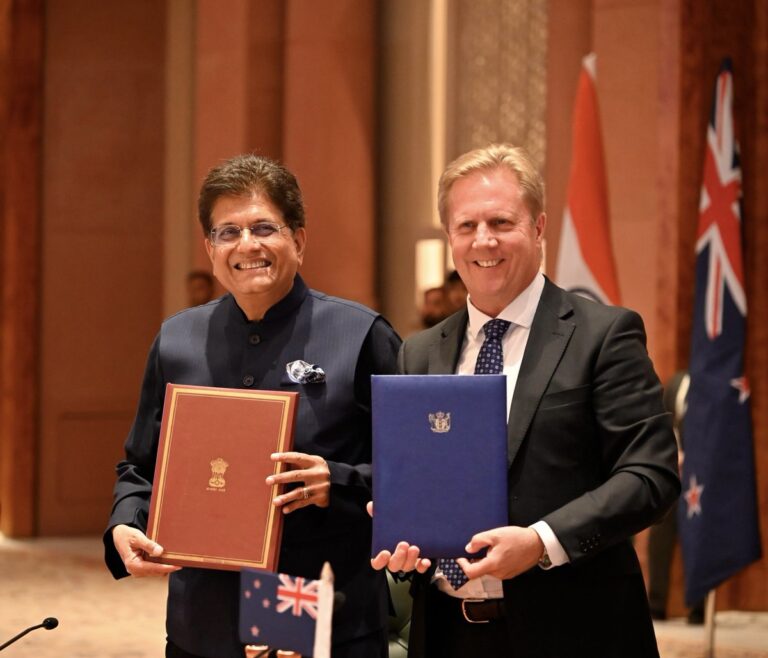
- The India-NZ Free Trade Agreement (FTA) has been stalled for over a decade, primarily due to India’s dairy sector sensitivities.
- Yet, new trade instruments like Digital Economy Agreements (DEAs) and sectoral MOUs may bypass traditional bottlenecks.
3. Indo-Pacific Economic Framework (IPEF):
- Both countries are part of this U.S.-led initiative that focuses on:
- Clean economy
- Supply chain resilience
- Digital governance
- Fair trade principles
This framework may be the stepping stone toward a broader multilateral understanding involving India and New Zealand.
Discussion: Strategic Opportunities
1. Green Trade Partnerships:
India is investing heavily in green hydrogen, EV infrastructure, and solar manufacturing — areas where New Zealand’s research and ethics-first model can collaborate fruitfully.
2. Dairy Diplomacy:
New Zealand can explore value-added dairy niches (like high-protein nutrition products) rather than bulk exports, easing India’s domestic industry concerns.
3. Tech and Services Collaboration:
With India’s booming tech sector and NZ’s interest in digital trade, co-development of platforms, data regulation frameworks, and fintech partnerships hold promise.
4. Logistics and Ports:
India’s investment in deep-water ports and NZ’s need for diversified shipping routes open new corridors via Southeast Asia and Australia.
5. Migration and Talent Flow:
The mobility of professionals and students under skills recognition pacts can create soft power bridges that enable stronger business ecosystems.
Summary: Vision Beyond the Tariffs
The era of trade being defined by tariffs and quotas is evolving.
Modern trade is shaped by:
- Trust-based ecosystems
- Shared technological innovation
- Green transitions and digital diplomacy
For New Zealand and India, aligning strategically within the Indo-Pacific offers geopolitical insulation and economic diversification in uncertain times.
It’s time to move from missed opportunities to mutual advantage, from negotiation deadlocks to sectoral breakthroughs.
The future corridor between Aotearoa and Bharat is not just feasible — it’s strategically essential.