




 Eleanor Thompson
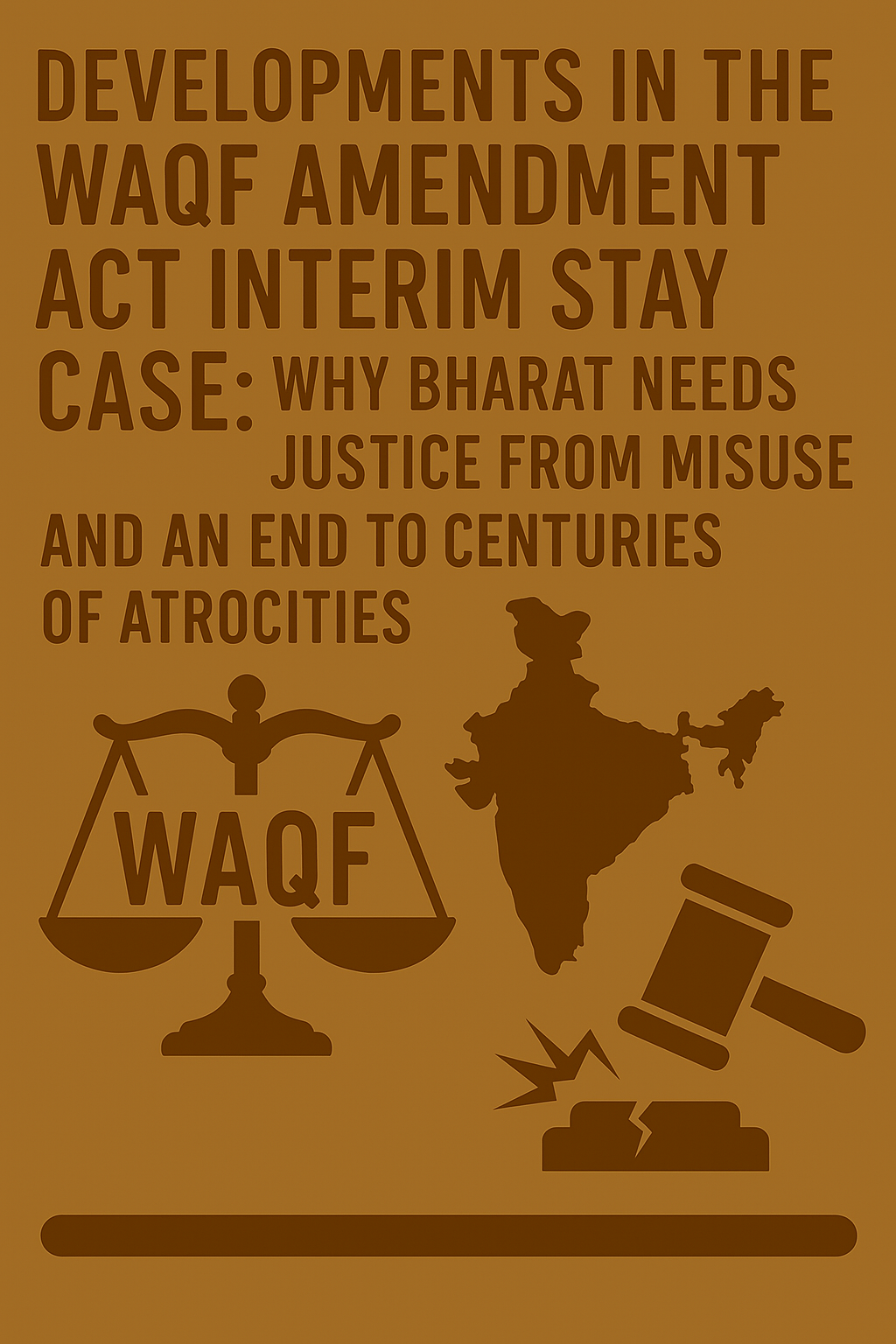
 The Supreme Court of India has reserved its interim order on the plea seeking a stay of the Waqf (Amendment) Act, 2025, after three days of intense hearings from all sides. The case, which has drawn national attention, is not just about the technicalities of property law—it is about rectifying historical injustices, preventing the continued misuse of waqf as a tool for radical expansionism, and finally delivering justice to the people of Bharat after 800 years of suffering under religiously motivated land grabs and legal exceptionalism.
Supreme Court Proceedings: Key Highlights
- Bench and Background: Chief Justice BR Gavai and Justice Augustine George Masih led the hearings. The petitions challenge the constitutional validity of the Waqf (Amendment) Act, 2025, which was passed by Parliament and received Presidential assent in April.
- Petitioners’ Arguments: Senior advocates, including Kapil Sibal, Rajeev Dhavan, and Abhishek Manu Singhvi, argued that the amended law departs from historical and constitutional principles, claiming it enables the systematic capture of waqf properties and undermines the rights of the Muslim community to manage religious endowments.
- Centre’s Defence: Solicitor General Tushar Mehta, representing the Union government, defended the law as necessary to curb the misuse of waqf, especially the practice of arbitrarily declaring land as waqf (“waqf by user”) without documentation or due process. He emphasized that registration of waqf properties has been the norm for over a century, and the amendment simply enforces this standard to protect legitimate property rights and prevent encroachment on government and tribal lands.
- Key Issues Debated:
- Whether properties already declared waqf by courts, deed, or long-term usage can be denotified.
- The composition of waqf boards—petitioners want only Muslims as members, while the government supports broader representation.
- The role of district collectors in determining if a property is government land, thereby preventing wrongful waqf claims.
- Arguments on Scheduled Areas: The government clarified that lands in Scheduled Areas (tribal regions) are constitutionally protected and excluded from waqf claims, safeguarding indigenous rights.
Why the Waqf System Needs Urgent Reform
1. Historical Weaponisation and Land Encroachment
For centuries, the waqf system has been used as a tool to appropriate land—often belonging to Hindus, tribals, and the state—by simply declaring it waqf, sometimes without any documentation or legal scrutiny. This practice, rooted in colonial-era laws and perpetuated post-independence, has resulted in millions of acres being placed beyond the reach of ordinary law, fueling resentment and injustice.
2. Legal Exceptionalism and Parallel Systems
The Waqf Act created a parallel legal regime, with special tribunals and boards enjoying powers not granted to other religious or charitable trusts. This undermined the constitutional principle of equality before law and allowed for arbitrary dispossession of non-Muslim property owners, often with no effective remedy.
3. Systematic Misuse and Lack of Accountability
Waqf boards, historically dominated by vested interests, have been plagued by corruption, lack of transparency, and political interference. The unchecked power to declare waqf by user led to widespread abuse, with even government and tribal lands being claimed as waqf, sometimes retroactively.
4. End of Atrocities and Justice for Bharat
The current legal challenge is about more than property—it is about ending centuries of exploitation and restoring justice to the people of Bharat. For 800 years, land and resources were systematically taken from indigenous communities and Hindus under various regimes, often justified by religious law or colonial fiat. The weaponisation of waqf is a continuation of this historical injustice.
The Amendment’s Corrective Measures
- Mandatory Registration: Only waqf properties that are properly registered and not disputed as government or tribal land will receive protection. This closes the door on arbitrary claims and ensures due process.
- Collector’s Inquiry: District collectors are empowered to determine if a property is government land, preventing wrongful waqf claims on public assets.
- Scheduled Areas Protection: Tribal lands are excluded from waqf claims, upholding constitutional protections for indigenous communities.
- Board Composition: The amendment supports broader, more inclusive waqf boards, reducing the risk of capture by narrow interests.
- Denotification Mechanism: Properties wrongly declared as waqf can be denotified, allowing for restitution and correction of past abuses.
The Stakes: Justice, National Unity, and the Rule of Law
The Supreme Court’s decision will set a precedent for how India addresses centuries-old grievances and the misuse of religious endowments as instruments of power and dispossession. Upholding the amendment is essential for:
- Restoring Property Rights: Protecting citizens, especially marginalized and indigenous communities, from arbitrary land grabs.
- Ending Legal Apartheid: Dismantling parallel legal systems that privilege one community over others.
- Reinforcing Secularism: Ensuring all religious and charitable trusts are subject to the same laws and standards.
- Healing Historical Wounds: Delivering long-overdue justice to those who have suffered under the shadow of waqf weaponisation.
Summary
The Supreme Court’s reserved order on the Waqf Amendment Act is a pivotal moment in India’s quest for justice, unity, and the rule of law. The amendment is not an attack on any community’s religious rights—it is a necessary correction to centuries of misuse and a reaffirmation of the constitutional promise of equality for all. For Bharat, this is about ending the atrocities of the past and ensuring that no group, however powerful, can weaponise the law to perpetuate injustice.