





 Genevieve Montgomery
 Hampi, a UNESCO World Heritage Site in Karnataka, India, stands as a testament to the architectural and cultural zenith of the Vijayanagara Empire (1336–1646 CE). Once a thriving metropolis and one of the wealthiest cities in medieval India, Hampi’s ruins today sprawl across 4,100 hectares, offering a window into ancient Indian ingenuity. As of March 29, 2025, this ancient city continues to captivate historians, architects, and travelers with its intricate temples, monolithic sculptures, and urban planning marvels. This article delves into Hampi’s historical context, architectural details, engineering feats, enigmatic sculptures, and comparisons with contemporaries like Pattadakal, Badami, and Halebidu, culminating in personal recommendations for visiting this timeless wonder.
Context and Historical Background
Hampi’s origins trace back to the 14th century when Harihara I and Bukka Raya, founders of the Vijayanagara Empire, established it as their capital in 1336 CE. Strategically located on the banks of the Tungabhadra River, Hampi served as a bulwark against northern invasions, growing into a bustling hub of trade, religion, and art by the 15th century. At its peak under Krishnadevaraya (1509–1529 CE), it rivaled contemporary cities like Beijing and Rome, with a population estimated at 500,000 and a marketplace dealing in diamonds, pearls, and silks, as noted by Persian traveler Abdur Razzaq in 1443.
The city’s golden era ended abruptly in 1565 CE when a coalition of Deccan Sultanates razed it following the Battle of Talikota. Abandoned yet remarkably preserved, Hampi’s ruins were rediscovered in the 19th century by British archaeologists like Colonel Colin Mackenzie. Declared a UNESCO site in 1986, its 1,600+ surviving monuments—including temples, palaces, and aqueducts—reflect the empire’s Dravidian architectural prowess and its synthesis of Hindu, Jain, and Islamic influences.
Architectural Details
Hampi’s architecture is a masterclass in Dravidian style, characterized by towering gopurams (gateway towers), intricately carved pillars, and expansive courtyards. The city’s layout reveals a sophisticated urban plan, with distinct zones for religious, royal, and civic functions, encircled by seven layers of fortification walls spanning 32 kilometers.
Vitthala Temple Complex
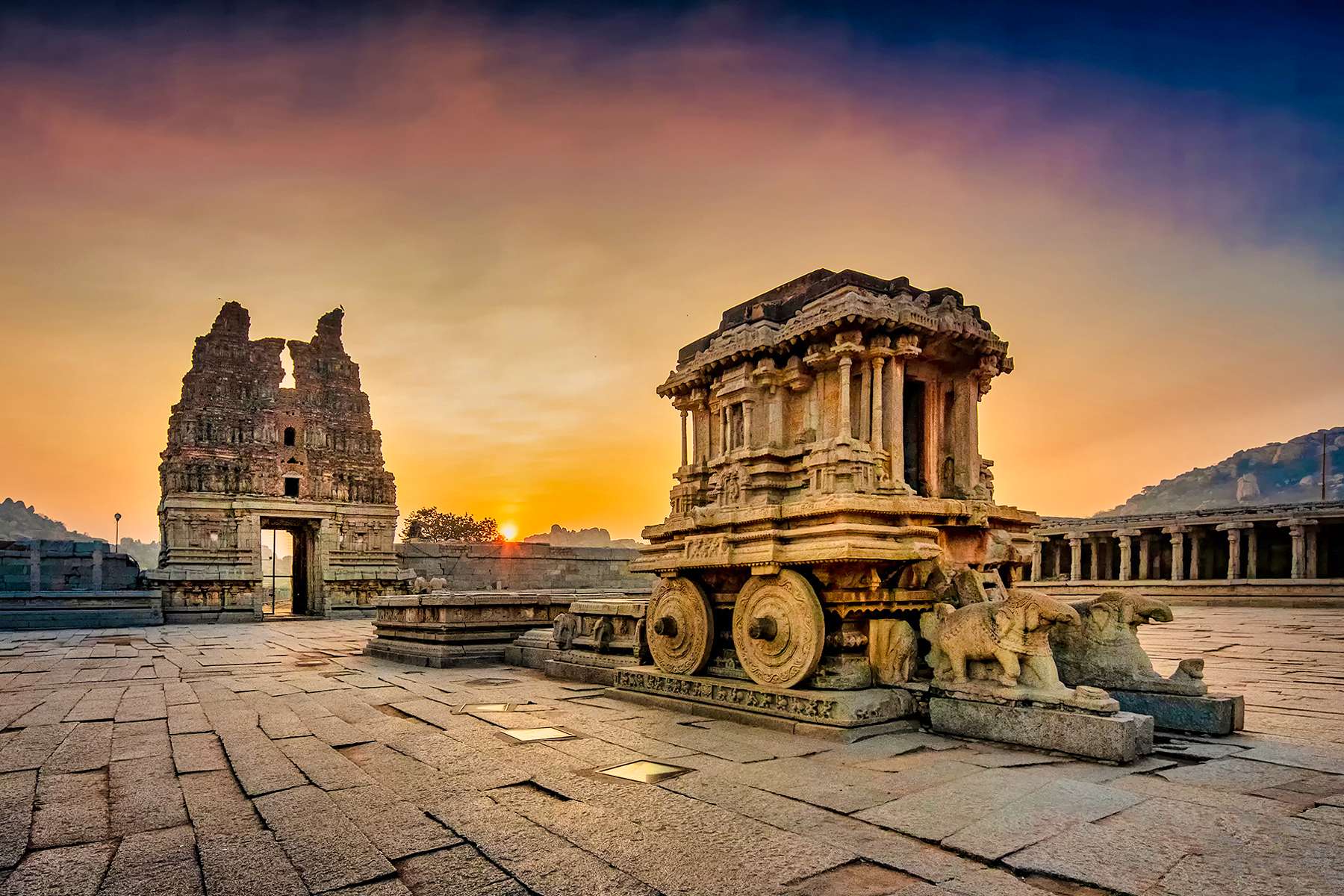
The Vitthala Temple, dedicated to Lord Vishnu, is Hampi’s architectural crown jewel. Its 56 musical pillars—slender granite columns that resonate when struck—exemplify acoustic engineering. The main gopuram, though partially ruined, rises 15 meters, adorned with reliefs of deities and mythical creatures. The temple’s garbhagriha (sanctum) houses a now-missing deity, surrounded by mandapas (pillared halls) with carvings of dancers, warriors, and floral motifs. The stone chariot, a 6.6-meter-high monolithic structure, is an iconic feature, its wheels designed to rotate (though now fixed for preservation).
Virupaksha Temple
Still an active worship site, the Virupaksha Temple dates to the 7th century, with Vijayanagara-era expansions. Its 49-meter gopuram dominates the skyline, featuring nine tiers of stucco figures depicting Shiva’s exploits. The temple’s 100-pillar hall showcases yali (lion-like) motifs, while its sanctum aligns with the river, reflecting geomantic principles.
Royal Enclosure
The secular architecture of Hampi shines in the Royal Enclosure, a 59-hectare complex housing the Lotus Mahal—a two-story, Indo-Islamic pavilion with arched windows—and the Mahanavami Dibba, a 12-meter-high platform for ceremonial events. The stepped tank, a 22-meter-square reservoir with symmetrical granite steps, highlights precision in civic design.
Materials and Techniques
Hampi’s builders favored locally quarried granite, prized for durability, supplemented by schist and sandstone for finer carvings. Mortarless construction, using interlocking stones, ensured structural integrity, while lime plaster coated select surfaces for aesthetic finish. The scale—e.g., the 3-meter-wide Hazara Rama Temple frieze—demonstrates mastery over stone masonry.
Engineering Marvels
Hampi’s engineering achievements rival its aesthetics, blending functionality with grandeur.
- Irrigation and Water Management: The Tungabhadra River fed an extensive network of canals, aqueducts, and tanks. The 15th-century Anjaneya Hill aqueduct, stretching 2 kilometers, used gravity-fed channels to irrigate fields and supply the city, supporting its agrarian economy. The Pushkarani tanks, like the stepped tank, doubled as ritual baths, with depths up to 7 meters and watertight joints.
- Musical Pillars: The Vitthala Temple’s 56 pillars, each 3.6 meters tall and 0.3 meters wide, are hollowed to produce distinct musical notes. Modern acoustic analysis (Indian Institute of Science, 2022) suggests they were tuned by varying thickness and density, a feat of sonic engineering still unmatched in scale.
- Monolithic Structures: The 6.7-meter Narasimha statue and the stone chariot exemplify Hampi’s ability to sculpt massive single-stone works. Weighing over 50 tonnes, these structures required precise quarrying, transportation, and carving—likely using ramps and levers, though specifics remain speculative.
- Urban Fortification: Hampi’s seven concentric walls, reinforced with watchtowers and gateways, spanned rugged terrain. The outer wall, 4 meters thick, deterred siege engines, while inner layers protected the core, reflecting advanced military engineering.
Famous Sculptures: Wonders of Craftsmanship
Hampi’s sculptural legacy includes works that defy explanation, sparking debate among archaeologists.
- Ugra Narasimha: This 6.7-meter monolithic statue of Vishnu’s lion-man avatar, carved in 1528 CE under Krishnadevaraya, looms over a courtyard. Its fierce expression, bulging eyes, and detailed claws—etched into granite—suggest tools and techniques lost to time. The missing Lakshmi figure on its lap hints at later damage.
- Stone Chariot: A 6.6-meter shrine-on-wheels, this Vitthala Temple icon features rotating granite wheels (now static) and a garuda-topped dome. Its seamless joints and balanced proportions—crafted from a single boulder—baffle engineers, with no clear evidence of how such precision was achieved.
- Sasivekalu Ganesha: A 2.4-meter Ganesha statue, carved in situ from a boulder, depicts the deity with a serpent belt and rice bowl. Its scale and fluidity, despite granite’s hardness, underscore Vijayanagara sculptors’ skill.
- Kadalekalu Ganesha: At 4.5 meters, this colossal Ganesha inside a pillared hall amazes with its anatomical detail—curved trunk, potbelly, and modak in hand. The logistics of carving within a confined space remain a mystery.
These works, often attributed to divine inspiration in local lore, likely involved chisels, hammers, and abrasives, yet their scale and finesse suggest advanced planning and possibly unrecorded tools.
Comparison with Pattadakal, Badami, and Halebidu
Hampi’s contemporaries—Pattadakal, Badami, and Halebidu—offer a lens to assess its architectural stature, all rooted in Karnataka’s rich heritage.
Pattadakal
A UNESCO site from the Chalukya dynasty (6th–8th centuries), Pattadakal’s 10 temples blend Nagara and Dravidian styles. The Virupaksha Temple here, with its 12-meter gopuram and 540 carved panels, predates Hampi’s by centuries, influencing its design. However, Hampi’s scale (1,600+ structures vs. Pattadakal’s 10) and urban complexity outstrip Pattadakal’s ceremonial focus.
Badami
The Badami cave temples (6th century), also Chalukyan, showcase rock-cut architecture—four caves hewn into sandstone cliffs, adorned with Vishnu, Shiva, and Jain reliefs. Hampi, built later with free-standing structures, prioritizes scale over Badami’s intimacy. Badami’s engineering lies in excavation precision, while Hampi excels in surface construction and irrigation.
Halebidu
The Hoysala-era Hoysaleswara Temple (12th century) in Halebidu dazzles with soapstone carvings—over 1,000 figures on its walls, from elephants to dancers. Hampi’s granite works lack Halebidu’s microscopic detail but surpass it in structural diversity (temples, forts, tanks) and civic planning. Halebidu’s single-temple focus contrasts with Hampi’s sprawling cityscape.
Hampi stands apart for its integration of architecture, engineering, and urban design, synthesizing earlier traditions into a grander vision, though it lacks Pattadakal’s stylistic fusion or Halebidu’s ornamental intricacy.
Personal Recommendations to Visit
Visiting Hampi is a journey into India’s past, best planned with intent:
- Timing: October to February offers pleasant weather (20–30°C), avoiding summer’s 40°C heat. Early mornings (6–9 AM) reveal the ruins in soft light, ideal for photography.
- Must-Sees: Start at Vitthala Temple for the chariot and musical pillars, then explore Virupaksha for its living heritage. Don’t miss the Royal Enclosure’s stepped tank and Narasimha statue.
- Tips: Wear sturdy shoes for rocky terrain, hire a local guide (₹500–1000/day) for insights, and rent a bicycle (₹100/day) to navigate the 26-square-kilometer site. Coracle rides across the Tungabhadra (₹50) offer a unique perspective.
- Stay: Hampi Bazaar or nearby Hospet (15 km) provide budget guesthouses (₹1,000/night) or mid-range hotels like Heritage Resort Hampi (₹5,000/night).
A 2–3-day visit allows immersion without rush—linger at the Hazara Rama Temple’s Ramayana frieze and savor local dosas at roadside stalls.
Summary
Hampi, the erstwhile capital of the Vijayanagara Empire, is a monumental showcase of ancient Indian architecture and engineering. Its Dravidian temples, like Vitthala and Virupaksha, boast towering gopurams and musical pillars, while civic feats—irrigation networks, fortified walls—reveal a sophisticated society. Sculptures like the Ugra Narasimha and stone chariot, carved from single stones, defy modern replication, blending artistry with enigma. Compared to Pattadakal’s stylistic roots, Badami’s cave intimacy, and Halebidu’s ornate finesse, Hampi excels in scale, urban integration, and engineering breadth. As of March 2025, its 4,100 hectares of ruins remain a living museum, drawing global admiration. For travelers, Hampi is an unmissable pilgrimage—walk its boulder-strewn paths, marvel at its genius, and connect with a civilization that once rivaled the world’s greatest. New Zealand Bharat News urges readers to explore this architectural marvel, a bridge between past and present.