


 Imogen King
 By Imogen King | NZB News
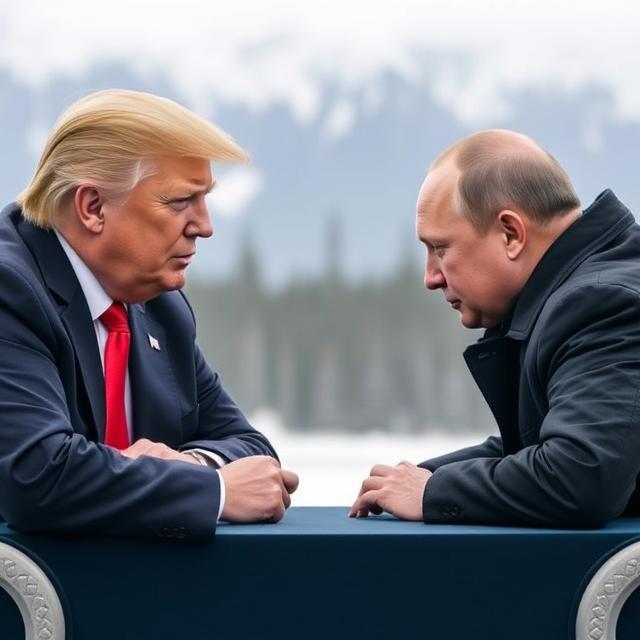
The world’s attention turns to Alaska tomorrow as United States President Donald Trump and Russian President Vladimir Putin prepare for their first face-to-face meeting since 2019, with the ongoing war in Ukraine hanging in the balance. The summit, scheduled for August 15, 2025, at Joint Base Elmendorf-Richardson in Anchorage, Alaska, represents a pivotal moment in international diplomacy as both leaders seek to chart a path toward ending the devastating conflict that has raged for over three years.
The Alaska meeting comes after months of diplomatic manoeuvring and escalating tensions, with Trump’s self-imposed deadline for Russia to agree to a ceasefire passing on Friday without any new agreement. The choice of venue carries significant symbolic weight, as Alaska was once part of the Russian Empire — sold to the U.S. for $7.2 million in 1867. The state’s mainland sits approximately 88 kilometres – or 55 miles – away from Russia across the Bering Strait.
Diplomatic Stakes and Territorial Concerns
The summit has generated considerable anxiety among Ukrainian and European leaders, particularly regarding potential territorial concessions. Trump previewed terms of a potential peace deal that could include “some swapping of territories”, a prospect that has alarmed Kyiv and its allies. Ukraine’s President Volodymyr Zelensky quashed the idea of any territory formally changing hands, saying Ukraine is “also ready to work together with President Trump,” but vowed his people “will not give their land to the occupier.”
European leaders have expressed unified concern about being excluded from discussions that directly affect their security interests. Over the weekend, leaders from the U.K., France, Italy, Germany, Poland, Finland and the European Commission issued a statement insisting Kyiv be included in any talks about its own future. “The path in Ukraine cannot be decided without Ukraine,” the Europeans said in the statement.
The White House has attempted to address these concerns by considering inviting Ukrainian President Volodymyr Zelenskyy to Alaska, though Trump indicated that Ukrainian President Volodymyr Zelenskyy was unlikely to be included in talks he described as a “feel-out meeting” to better understand Russia’s demands for ending the war.
Trump’s Evolving Approach to Putin
The summit marks a notable shift in Trump’s relationship with the Russian leader. While the US President once boasted of his personal rapport with Putin, his tone has hardened considerably in recent months. Last week, Trump denounced Russia’s renewed attacks on Kyiv. “I think it’s disgusting what they’re doing. I think it’s disgusting,” he said.
“I go home, I tell the first lady, ‘You know, I spoke to Vladimir today. We had a wonderful conversation.’ And she said, ‘Oh really? Another city was just hit,'” said Trump in a July 14 meeting with NATO Secretary General Mark Rutte in the Oval Office. This personal frustration appears to have driven Trump’s increasingly firm stance toward Moscow.
The President has expressed confidence in his ability to gauge Putin’s sincerity quickly. “Probably in the first two minutes I’ll know if a deal can be made,” said Trump speaking before the press at the White House on Monday. When a journalist asked how, Trump responded: “Because that’s what I do.”
Russian Perspectives and Expectations
Moscow has welcomed the summit opportunity with apparent enthusiasm. Kremlin aide Yuri Ushakov confirmed that a meeting between the two leaders was scheduled, describing the Alaska location for the summit as “quite logical”. Russians have largely celebrated news of the Alaskan summit — which appeared to at least postpone a Trump threat to impose massive secondary sanctions and tariffs on most Russian energy exports.
Russian commentators have framed the bilateral format as a diplomatic victory. “In general, the very fact that a summit being held in Alaska without Zelensky and his European sponsors — is a substantial diplomatic victory,” Russian pro-war blogger Yury Podolyak wrote in the daily tabloid Moskovsky Komsomolets.
The Kremlin has also suggested broader topics for discussion beyond Ukraine. Moscow also suggested arms control and economic cooperation could be on the agenda. Kremlin aide Yuri Ushakov spoke of Alaska being a great place to talk economic cooperation between Washington and Moscow, and suggested a return summit in Russia had already been proposed.
Potential Outcomes and Global Implications
The summit’s potential outcomes remain highly uncertain, with significant implications for international stability. Putin has already raised the possibility of claiming two territories in Ukraine (Donetsk and Luhansk), while holding Russia’s current positions in Zaporizhia and Kherson. Such proposals have been consistently rejected by Ukrainian officials, who maintain that they may be prepared to make difficult concessions, but only after Russia agrees to a ceasefire.
The timing of the summit, which comes on the day Trump had set as the deadline for Putin to make peace or face severe economic punishment, suggests both urgency and flexibility in the American approach. However, the conditions around Friday’s summit so wildly favor Moscow, it is obvious why Putin leapt at the chance, after months of fake negotiation, and it is hard to see how a deal emerges from the bilateral that does not eviscerate Ukraine.
Critics have drawn historical parallels, with Europe wary of mirroring the failure of former UK Foreign Secretary Neville Chamberlain to stand up to Nazi Germany in 1938 – of the worthlessness of a “piece of paper” signed by a Kremlin that has repeatedly agreed to deals in Ukraine only to break them.
Summary
As Trump and Putin prepare to meet in Alaska’s frozen landscape, the summit represents both an opportunity for diplomatic breakthrough and a moment of considerable risk for Ukraine and European security. The bilateral format, territorial discussions, and absence of Ukrainian representation have generated widespread concern among allies, while the Kremlin appears optimistic about securing favourable terms. With the war in Ukraine having claimed hundreds of thousands of lives and displaced millions, the stakes could not be higher as these two leaders attempt to reshape the geopolitical landscape through direct negotiation. The world will be watching closely to see whether this historic encounter in America’s northernmost state can deliver genuine progress toward peace or merely serves to legitimise Russian territorial gains at Ukraine’s expense.