 Dorothy Brown
 By Dorothy Brown, Religion, Culture, Social Behaviour and Group Theory Specialist
NZB News – July 6, 2025
Summary
The Catholic Church has entered a new era of female leadership as Sister Raffaella Petrini assumes her groundbreaking role as the first woman to govern Vatican City State. This historic appointment, implemented under Pope Leo XIV’s continued progressive reforms, challenges centuries of male-dominated ecclesiastical governance whilst signalling the Church’s evolving approach to women’s roles in religious authority and administrative leadership.
A Watershed Moment in Vatican History
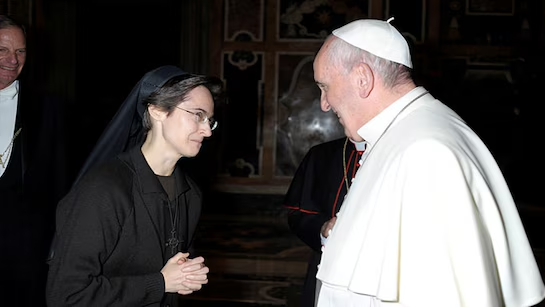
On March 1, 2025, the 2,000-year history of the Catholic Church witnessed an unprecedented transformation as Sister Raffaella Petrini, FSE, became the first woman to hold the highest administrative position in Vatican City State. Her appointment as President of the Pontifical Commission for Vatican City State and President of the Governorate represents more than administrative change—it symbolises a fundamental shift in how the world’s oldest continuous institution approaches gender, authority, and governance.
The significance of this appointment cannot be overstated. For nearly two millennia, the Vatican’s administrative structure has remained exclusively under male clerical control, with cardinals traditionally holding the most powerful positions within the Holy See’s complex bureaucracy. Sister Petrini’s elevation breaks this tradition definitively, establishing a precedent that may influence the Church’s trajectory for generations to come.
Born in Rome on January 15, 1969, Sister Petrini brings exceptional academic credentials and extensive Vatican experience to her historic role. A member of the Franciscan Sisters of the Eucharist—a pontifical institute founded in the United States in 1973—she holds degrees in political science from Rome’s LUISS University, organisational behaviour from the University of Hartford, and a doctorate from the Pontifical University of Saint Thomas Aquinas, where she currently serves as professor.
Her appointment succeeded Spanish Cardinal Fernando Vérgez Alzaga, who stepped down upon reaching the mandatory retirement age of 80. The transition, while representing administrative continuity—Sister Petrini had served as Secretary General since November 2021—also marks a powerful symbolic shift that reverberates throughout global Catholicism.
The Architecture of Vatican Governance
Understanding the magnitude of Sister Petrini’s appointment requires examination of the Vatican’s unique governmental structure. Vatican City State, though covering merely 0.17 square miles, operates as a fully sovereign nation with complex administrative requirements encompassing everything from law enforcement and postal services to museum operations and diplomatic protocols.
As President of the Governorate, Sister Petrini oversees approximately 2,000 Vatican employees and manages the day-to-day operations of the world’s smallest state. Her responsibilities include supervising the Vatican Gendarmerie (law enforcement), health and postal services, fire brigade, museums, and other essential operations that maintain Vatican City’s functioning as both spiritual centre and sovereign state.
The Pontifical Commission for Vatican City State, which she also now presides over, consists of six cardinals who traditionally have governed the temporal affairs of the Holy See. In this capacity, Sister Petrini becomes the second woman in Vatican history to hold a position superior to cardinals, following Sister Simona Brambilla’s appointment as Prefect of the Dicastery for Institutes of Consecrated Life and Societies of Apostolic Life.
This governance structure reflects the Vatican’s dual nature as both spiritual institution and temporal state, requiring sophisticated management of religious, diplomatic, cultural, and administrative functions. Sister Petrini’s role places her at the intersection of these complex requirements, managing everything from security protocols during papal audiences to conservation of priceless artistic treasures.
Canonical Controversies and Legal Complexities
Sister Petrini’s appointment has not proceeded without controversy, particularly among canonical rigorists who question the legal validity of a non-ordained person exercising certain forms of ecclesiastical authority. The fundamental issue centres on whether dicastery prefects and similar high-ranking officials share in papal authority in ways that require Holy Orders.
According to Vatican law established under Pope Francis’s 2023 reforms, Article 8 of the Fundamental Law of Vatican City State traditionally required that the president be a cardinal. However, Francis implemented this appointment without formally changing the law, setting a precedent that challenges traditional interpretations of ecclesiastical governance requirements.
Canon lawyers debate whether positions involving binding decisions on members of Holy Orders require ordination, arguing that such authority flows from apostolic succession rather than administrative competence. This theological controversy reflects deeper tensions within the Church about the relationship between Holy Orders and governance authority.
Pope Francis’s constitutional reform Praedicate Evangelium specifically authorised laypeople, including women, to lead Vatican departments, representing a deliberate separation of governance from ordination requirements. This reform philosophy emphasises competence and experience over clerical status for administrative positions, though its implementation continues to generate debate among traditionalist Catholics.
Sister Petrini’s success in her role may influence how these canonical questions develop, potentially establishing precedents that could affect future appointments and the broader evolution of Church law regarding women’s participation in ecclesiastical governance.
Pope Leo XIV’s Continuity Vision
The continuation of Sister Petrini’s appointment under Pope Leo XIV signals important aspects of the new pontificate’s priorities and approach to reform. Following Pope Francis’s resignation and Leo’s election, observers questioned whether the new pope would maintain his predecessor’s progressive initiatives regarding women’s roles in Church leadership.
Pope Leo’s decision to retain Sister Petrini and Sister Simona Brambilla in their groundbreaking positions, whilst appointing additional women to significant roles, suggests a commitment to expanding female participation in Vatican governance. His recent appointment of Sister Merletti as secretary of another Vatican dicastery indicates that women’s advancement in Church leadership will continue under his pontificate.
This continuity approach reflects Leo’s participation in Francis’s Synod on Synodality, which established study groups examining various aspects of Church governance, including women’s roles in ministry and administration. While questions remain about Leo’s positions on women’s ordination and the female diaconate, his administrative appointments clearly signal support for women’s increased participation in Church governance.
The new pope’s approach appears to balance respect for traditional Church teaching with pragmatic recognition of women’s capabilities in administrative and leadership roles. This nuanced position may allow him to advance women’s participation in areas where canonical barriers are less definitive whilst avoiding direct confrontation with established doctrinal positions.
Global Catholic Reaction and Implications
Sister Petrini’s appointment has generated varied reactions across the global Catholic community, reflecting the Church’s internal diversity regarding women’s roles and Church reform. Progressive Catholics celebrate the appointment as overdue recognition of women’s capabilities and contributions to Church life, whilst traditionalists express concern about departures from established ecclesiastical practices.
In regions where the Catholic Church faces declining membership and clerical shortages, Sister Petrini’s appointment offers hope that expanded lay participation might help address institutional challenges. Countries like Germany, Ireland, and the United States, where calls for Church reform have intensified, view her appointment as evidence that change remains possible within traditional Catholic structures.
Conversely, in more conservative Catholic regions, particularly in Africa and parts of Asia where Church membership continues growing, reactions have been more cautious. Some bishops and theologians in these areas express concern that rapid changes in Church governance might undermine traditional authority structures that remain culturally relevant in their contexts.
The appointment’s timing coincides with ongoing discussions about the Church’s response to contemporary gender equality movements and changing social expectations regarding women’s participation in leadership roles. Sister Petrini’s success in her position may influence how these broader cultural conversations develop within Catholic communities worldwide.
Operational Challenges and Opportunities
Sister Petrini’s transition to Vatican leadership presents both significant challenges and unique opportunities. Managing an institution as complex as Vatican City State requires navigating competing priorities between preservation of tradition and adaptation to contemporary realities.
One immediate challenge involves balancing the Vatican’s role as global spiritual centre with its practical needs as a functioning city-state. Sister Petrini must manage relationships with international diplomats, coordinate security for papal events, oversee major construction and conservation projects, and maintain the Vatican’s extensive cultural heritage whilst ensuring efficient daily operations.
Her academic background in political science and organisational behaviour, combined with her extensive Vatican experience, positions her well to address these multifaceted responsibilities. Her previous work in the Congregation for the Evangelization of Peoples provided exposure to the Church’s global missionary activities and intercultural dynamics that inform Vatican operations.
The appointment also creates opportunities for innovative approaches to Vatican administration. Sister Petrini’s perspective as a woman religious brings different insights to institutional management, potentially fostering more collaborative and inclusive decision-making processes within traditionally hierarchical structures.
Her success could influence future Vatican appointments, demonstrating that merit-based selection of qualified women can enhance rather than threaten institutional effectiveness. This precedent might encourage more women to pursue advanced education and careers in Church administration, expanding the talent pool available for future leadership positions.
Theological Implications and Doctrinal Development
Sister Petrini’s appointment raises important questions about the theological relationship between gender, authority, and governance within Catholic ecclesiology. While the Church maintains that certain roles requiring sacramental authority remain reserved to ordained men, her appointment demonstrates that administrative and governance functions can be successfully separated from ordination requirements.
This distinction may influence broader theological discussions about women’s roles in Church leadership, potentially creating space for expanded participation without directly challenging established doctrinal positions on ordination. The success of women in high-level administrative roles could strengthen arguments for further expanding their participation in Church governance and decision-making.
The appointment also reflects evolving understanding of how charismatic authority—derived from competence, experience, and spiritual gifts—relates to institutional authority traditionally associated with ordination. Sister Petrini’s religious vows and demonstrated capabilities provide alternative sources of legitimacy that challenge traditional assumptions about ecclesiastical authority.
Theological faculties worldwide are likely to study the implications of her appointment for Catholic social teaching regarding gender equality, subsidiarity, and the common good. Her success could influence how these principles are applied to questions of Church governance and women’s participation in institutional leadership.
International Diplomatic Dimensions
Sister Petrini’s role extends beyond Vatican administration to include significant diplomatic responsibilities. As head of Vatican City State, she interacts with diplomatic missions, coordinates state visits, and helps manage the Holy See’s unique position in international relations as both religious institution and sovereign state.
Her appointment sends important signals to the international community about the Catholic Church’s evolving approach to gender equality and women’s leadership. Diplomatic representatives from countries with strong gender equality policies may find her appointment facilitates productive engagement with Vatican leadership on various global issues.
The appointment may also influence how the Vatican approaches international discussions about women’s rights, religious freedom, and social justice. Sister Petrini’s perspective could contribute to more nuanced Vatican positions on global issues affecting women and families.
Her success in diplomatic contexts could demonstrate to other religious institutions and international organisations that women’s leadership enhances rather than compromises institutional effectiveness in complex intercultural environments.
Educational and Formation Implications
Sister Petrini’s appointment has significant implications for Catholic education and religious formation programs worldwide. Her example provides concrete evidence that women can successfully assume major leadership responsibilities within Church structures, potentially encouraging more young women to pursue advanced education and careers in Church service.
Catholic universities and seminaries may need to reconsider their curricula and formation programs to better prepare both men and women for diverse leadership roles within Church institutions. The appointment challenges traditional assumptions about career paths available to women religious and lay women in Church service.
Her academic achievement—particularly her doctoral work in theology and her professorship at a pontifical university—demonstrates the importance of scholarly preparation for Church leadership. This emphasis on academic excellence may influence how religious congregations and dioceses approach preparation of future leaders.
The appointment may also affect vocations to religious life, as young women see expanded opportunities for meaningful service and leadership within traditional Catholic institutions. Religious congregations may need to adapt their formation programs to prepare sisters for increasingly diverse and responsible roles in Church administration.
Broader Social and Cultural Impact
Sister Petrini’s appointment extends beyond internal Church matters to influence broader social and cultural conversations about women’s leadership, institutional change, and the relationship between tradition and progress. Her success challenges stereotypes about religious institutions’ capacity for adaptation whilst demonstrating that meaningful change can occur within traditional structures.
The appointment provides a powerful example for other institutions grappling with questions of gender equality and leadership diversity. Corporate, academic, and political leaders may find inspiration in how an ancient institution has adapted to contemporary expectations whilst maintaining its fundamental identity and mission.
Her visibility in international media coverage brings positive attention to women’s capabilities in complex leadership roles, potentially influencing public perception of both the Catholic Church and women’s leadership more generally. This positive exposure may help counteract negative perceptions of the Church’s historical treatment of women.
The appointment also demonstrates that institutional change, even in very traditional organisations, remains possible when leaders commit to reform based on principles of justice, competence, and the common good.
Regional Perspectives and New Zealand Context
From a New Zealand perspective, Sister Petrini’s appointment resonates particularly strongly given the country’s history of progressive leadership on gender equality issues. New Zealand’s distinction as the first nation to grant women the vote, combined with its history of female prime ministers, creates cultural affinity for women’s advancement in leadership roles.
The Catholic community in New Zealand, which comprises approximately 12% of the population, includes many who have advocated for expanded women’s roles in Church leadership. Sister Petrini’s appointment provides encouragement for local initiatives promoting women’s participation in parish councils, diocesan administration, and other Church governance structures.
Her success may influence how the New Zealand Catholic Church approaches questions of lay participation in leadership roles, particularly given ongoing challenges of declining priestly vocations and aging clergy. The appointment demonstrates that qualified lay leaders can successfully assume significant administrative responsibilities traditionally held by clergy.
The appointment also provides a positive example for interfaith dialogue in New Zealand’s multicultural context, demonstrating that religious institutions can adapt to contemporary values whilst maintaining their traditional identities and commitments.
Future Trajectories and Implications
Sister Petrini’s success in her groundbreaking role will likely influence the trajectory of women’s participation in Church leadership for decades to come. Her performance will be closely monitored by both supporters and critics of expanded women’s roles, making her tenure a crucial test case for future appointments.
Success in managing Vatican City State’s complex operations could strengthen arguments for appointing women to other significant Church leadership positions, potentially including roles previously assumed to require ordination. Her example may encourage more qualified women to pursue advanced preparation for Church leadership roles.
The appointment may also influence ongoing discussions about the female diaconate and other questions regarding women’s participation in liturgical and sacramental roles. While these issues remain theologically complex, Sister Petrini’s administrative success could contribute to broader acceptance of women’s capabilities in Church leadership.
Her appointment represents part of a broader pattern of institutional change within the Catholic Church that may accelerate under Pope Leo XIV’s leadership. The combination of qualified women in significant positions and continued discussion of women’s roles in Church life suggests that further developments may emerge in coming years.
Synthesis and Broader Implications
Sister Raffaella Petrini’s appointment as the first woman to govern Vatican City State represents more than an administrative milestone—it embodies a fundamental shift in how the world’s largest religious institution approaches questions of gender, authority, and governance. Her success challenges traditional assumptions about ecclesiastical leadership whilst demonstrating that meaningful institutional change remains possible within established religious structures.
The appointment’s significance extends beyond the Catholic community to influence broader conversations about women’s leadership, institutional adaptation, and the relationship between tradition and progress. Sister Petrini’s example provides inspiration for women seeking leadership roles in various contexts whilst demonstrating that religious institutions can evolve whilst maintaining their fundamental identity and commitments.
Her tenure will be closely watched by observers worldwide, making her performance crucial for future developments in women’s participation in Church leadership. Success in managing Vatican City State’s complex operations could strengthen arguments for further expanding women’s roles in ecclesiastical governance whilst failure might reinforce traditional arguments for maintaining existing restrictions.
Ultimately, Sister Petrini’s appointment represents hope for millions of Catholic women worldwide who seek greater recognition of their capabilities and contributions to Church life. Her success could inspire a new generation of women to pursue advanced education and leadership roles within Catholic institutions, potentially transforming the Church’s approach to governance, ministry, and service.
The broader implications of her appointment will unfold over time, but its immediate impact already extends far beyond Vatican walls to influence global conversations about gender equality, institutional change, and the possibility of meaningful reform within traditional religious structures. Sister Petrini’s historic role positions her as a pivotal figure in the ongoing evolution of Catholic Church leadership and its engagement with contemporary values and expectations.
As the Catholic Church navigates the complexities of the 21st century, Sister Petrini’s appointment demonstrates that tradition and progress need not be incompatible when guided by principles of justice, competence, and service to the common good. Her success may well define how future generations understand the relationship between faith, leadership, and the full participation of women in the Church’s mission to serve humanity.