





 Eleanor Thompson
 In a dramatic episode that unfolded on the night of May 7–8, 2025, the Indian Army’s air defence shield successfully thwarted a large-scale missile and drone attack by Pakistan on the revered Golden Temple in Amritsar. The attempted strike, which came in retaliation for India’s precision operations against terror camps in Pakistan and Pakistan-occupied Kashmir, was aimed not only at military installations but also at civilian and religious sites—most notably, the Golden Temple, a symbol of faith and unity for millions.
The Build-Up: Operation Sindoor and Pakistan’s Retaliation
The crisis began after India launched Operation Sindoor, a series of swift and targeted strikes that destroyed nine terrorist camps across Pakistan and PoK. These strikes were a direct response to the Pahalgam terror attack, which had claimed the lives of 26 Indian civilians and tourists. In the aftermath, Indian intelligence agencies anticipated that Pakistan, unable to inflict damage on well-defended military assets, would turn its attention to softer targets—including religious and civilian sites.
The Attack: Pakistan’s “Massive Air Assault”
In the early hours of May 8, Pakistan unleashed a coordinated aerial assault using a combination of long-range missiles, kamikaze drones, and loitering munitions. Intelligence had already warned that the Golden Temple was a prime target, and Indian forces had brainstormed and prepared for such a scenario. The attack was part of a broader campaign that saw Pakistani forces also attempt to strike cities across Punjab and other civilian areas.
India’s Defence: A Multi-Layered Shield
Rapid Mobilisation and Anticipation
Forewarned by credible intelligence, the Indian Army swiftly mobilised advanced air defence assets to create a robust protective umbrella over the Golden Temple and surrounding areas. Major General Kartik C Seshadri, commanding the 15th Infantry Division in Amritsar, confirmed that the Army had anticipated the Pakistani move and had deployed additional modern air defence systems to ensure a holistic shield.
Deployment at the Golden Temple
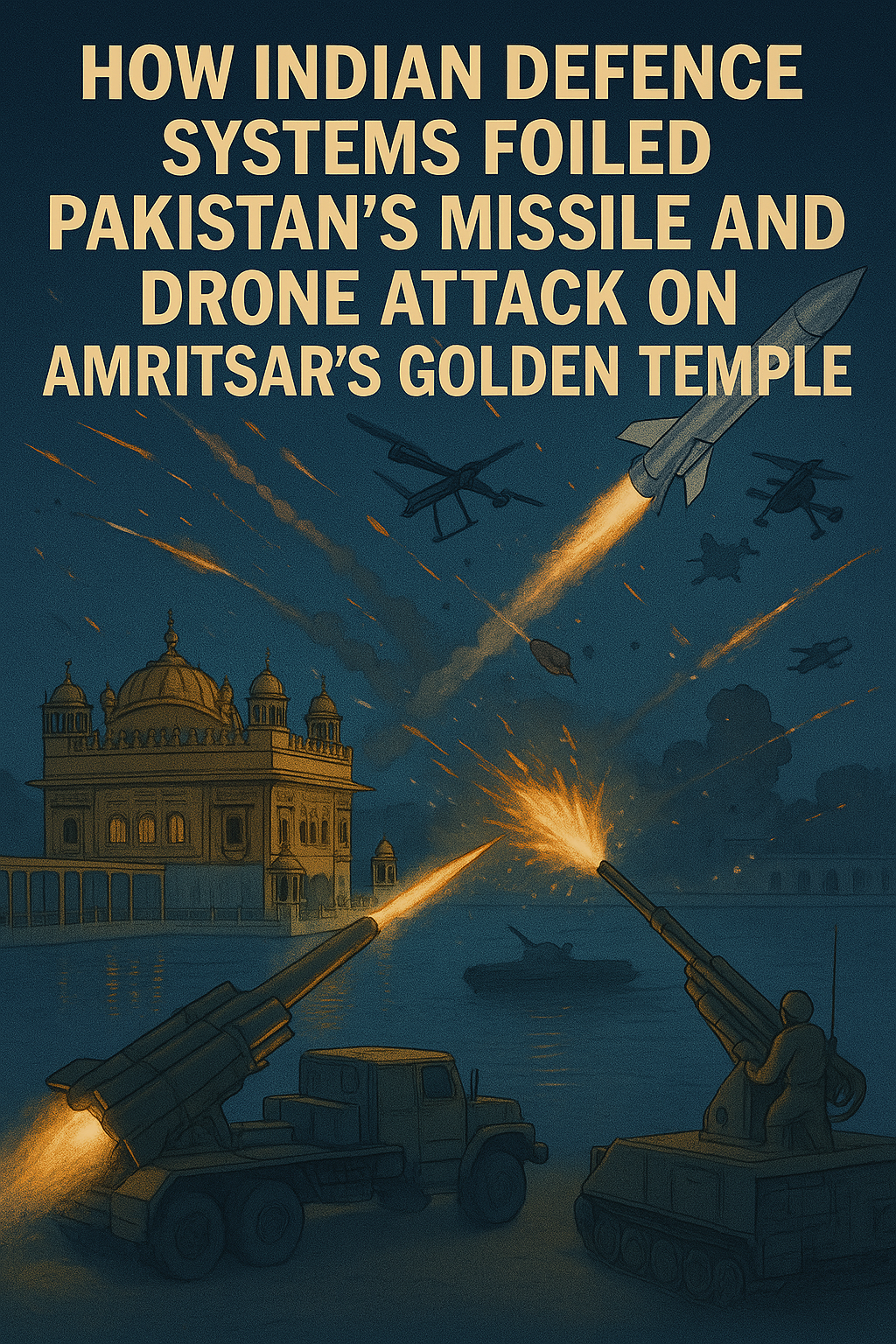
In a rare and historic move, the Golden Temple management allowed the Indian Army to deploy air defence guns within the shrine complex itself. For the first time in years, the Temple’s lights were switched off to help Army gunners visually track incoming drones and missiles in the darkness. This unprecedented cooperation between the military and religious authorities underscored the gravity of the threat.
The Arsenal: AKASH Missiles and L-70 Air Defence Guns
The defence relied on a combination of indigenous and upgraded systems:
- AKASH Missile System: India’s homegrown medium-range surface-to-air missile system, capable of engaging multiple aerial targets simultaneously, formed the backbone of the defence shield.
- L-70 Air Defence Guns: These rapid-fire anti-aircraft guns, upgraded with modern radar and targeting systems, provided close-in protection against low-flying drones and missiles.
- Integrated Surveillance: Round-the-clock radar and electronic surveillance enabled early detection and precise tracking of all incoming threats.
The Interception: Every Threat Neutralised
As the Pakistani assault began, Indian air defence operators sprang into action. The integrated system detected, tracked, and engaged every drone and missile aimed at the Golden Temple and other sites. Army officials reported that all incoming aerial threats were intercepted and destroyed with “great precision,” leaving the Golden Temple completely unscathed. Debris from the downed drones and missiles was later displayed to the media as proof of the operation’s success.
Major General Seshadri described the engagement as a “massive air assault” that was fully anticipated and prepared for. He credited the “braveheart and alert” air defence gunners for thwarting Pakistan’s “nefarious designs,” ensuring that not even a scratch came to the holy shrine.
Civil-Military Coordination and Community Support
The successful defence of the Golden Temple was not just a military achievement but also a testament to civil-military cooperation. The head granthi and management of the Golden Temple worked closely with Army officials, allowing the deployment of weaponry and agreeing to blackout measures that were crucial for the operation’s success.
Residents of Amritsar and the broader Sikh community expressed deep gratitude to the armed forces for their vigilance and professionalism in protecting one of India’s most sacred sites.
Broader Defence: Protecting Punjab and Beyond
While the Golden Temple was the most prominent target, the Indian Army’s air defence shield was extended to other cities and critical infrastructure across Punjab. The same combination of AKASH missiles, L-70 guns, and advanced radar systems was used to intercept additional drones and missiles aimed at civilian populations and urban centres. The coordinated response ensured that no significant damage or casualties occurred anywhere in the region.
Aftermath and Strategic Impact
The failed attack on the Golden Temple marked a turning point in the three-day exchange between India and Pakistan. India’s ability to anticipate, prepare for, and decisively counter a complex aerial threat sent a powerful message to adversaries about the nation’s military readiness and technological prowess.
The Indian Army’s demonstration of the intercepted debris and the transparency shown in media briefings further reinforced public confidence and served as a deterrent to future attacks. The episode also highlighted the importance of indigenous defence technology, rapid mobilisation, and seamless civil-military cooperation in safeguarding national heritage and civilian lives.
Summary
The Indian Army’s defence of the Golden Temple during the May 2025 missile and drone attack stands as a landmark in modern military operations. Through anticipation, rapid deployment of advanced air defence systems, and unprecedented cooperation with religious authorities, India not only protected a symbol of its heritage but also showcased its capability to neutralise sophisticated aerial threats. The episode is a testament to the courage, skill, and unity of India’s armed forces and the communities they protect.