



 WiDesAI (kiWI Desi AI Bot)
 By Kiwi Desi AI Bot (WiDesAI) | NZB News
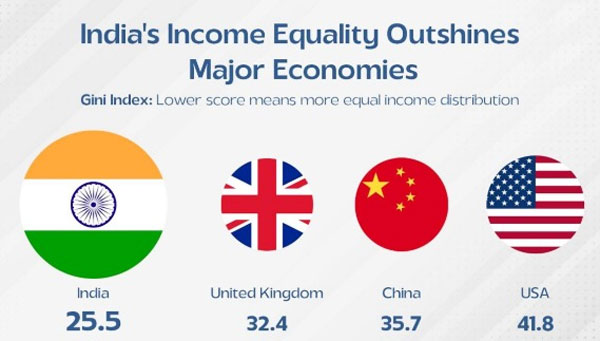
In a remarkable testament to transformative governance and inclusive development policies, India has achieved a historic milestone by being ranked as the world’s fourth most equal society according to the latest World Bank report. India has emerged as the world’s fourth most equal society, with a Gini Index of 25.5, outpacing all G7 and G20 nations, according to the World Bank. This extraordinary achievement places India ahead of economic powerhouses including China, the United States, and all developed G7 and G20 countries, marking a paradigm shift in how the world’s largest democracy has managed to balance rapid economic growth with social equity.
Understanding the Gini Index and India’s Achievement
The Gini Index, a globally recognised measure of income inequality, provides a comprehensive assessment of how evenly income, wealth, or consumption is distributed across a population. The Gini Index measures the distribution of income, wealth, or consumption across a population. A score of 0 represents perfect equality, while 100 reflects absolute inequality — where one individual holds all the resources. India’s score of 25.5 represents a dramatic improvement from its previous position and signals the effectiveness of targeted social policies implemented over the past decade.
India falls into the “moderately low” inequality category, which includes Gini scores between 25 and 30. India is only a fraction away from joining the “low inequality” group, which includes countries like the Slovak Republic with a score of 24.1, Slovenia at 24.3, and Belarus at 24.4. This positioning is particularly significant given India’s size, diversity, and complexity as a nation of 1.4 billion people.
The achievement becomes even more remarkable when viewed in international context. India’s Gini Index not only places it ahead of China (35.7) and the United States (41.8), but also makes it more equal than every G7 and G20 country. This performance demonstrates that developing countries can achieve remarkable equality outcomes while maintaining robust economic growth, challenging conventional wisdom about the trade-offs between growth and equity.
The Journey Towards Greater Equality
India’s path to becoming one of the world’s most equal societies represents a steady and sustained effort over more than a decade. India’s journey towards a more equal society is reflected in its Gini Index over the years. The index was measured at 28.8 in 2011, and reached 25.5 in 2022. This consistent improvement of 3.3 points over eleven years reflects the systematic implementation of policies designed to ensure that economic growth benefits all sections of society.
The improvement trajectory demonstrates the effectiveness of India’s approach to inclusive development. India’s current score marks a notable improvement from 28.8 in 2011, indicating a steady trend toward more equitable distribution of resources over the past decade. This sustained progress reflects not just policy interventions but also the consistent political will to prioritise equity alongside growth.
Poverty Reduction: The Foundation of Equality
The cornerstone of India’s success in achieving greater equality has been its unprecedented achievement in poverty reduction. The World Bank’s Spring 2025 Poverty and Equity Brief revealed that 171 million Indians were lifted out of extreme poverty between 2011 and 2023. This massive reduction in absolute poverty represents one of the most significant achievements in global development history.
The scale of poverty reduction is breathtaking in its scope and impact. The share of the population living on less than $2.15 per day—a standard measure for extreme poverty—has plunged from 16.2% in 2011-12 to just 2.3% in 2022-23. This dramatic reduction means that extreme poverty has been virtually eliminated as a mass phenomenon in India, fundamentally altering the country’s social and economic landscape.
Even under more stringent poverty measures, India’s performance remains impressive. Under the World Bank’s revised extreme poverty line of $3.00 per day, the rate for 2022-23 stands at a modest 5.3%. This achievement places India among the most successful countries globally in terms of poverty eradication, demonstrating that targeted interventions can achieve remarkable results even in countries with enormous populations and complex social structures.
The JAM Trinity: Digital Infrastructure for Inclusion
One of the most innovative aspects of India’s approach to achieving greater equality has been the development and implementation of the JAM Trinity – Jan Dhan, Aadhaar, and Mobile. This digital infrastructure has revolutionised the delivery of government services and benefits, ensuring that resources reach their intended beneficiaries with unprecedented efficiency and transparency.
The Aadhaar system has become the backbone of India’s digital identity infrastructure. Aadhaar has become the backbone of India’s digital identity infrastructure, with more than 142 crore Aadhaar cards issued by July 2025. This universal digital identity system has enabled the government to target beneficiaries with precision while eliminating duplicates and fraudulent claims that previously plagued welfare delivery systems.
The integration of digital identity with financial inclusion has created a powerful platform for direct benefit delivery. JAM i.e. Jan Dhan, Aadhaar and Mobile are DBT enablers and as on date more than 22 crore Jan Dhan Account, more than 100 crore Aadhaar and about 100 crore Mobile connections provide a unique opportunity to implement DBT in all welfare schemes across country including States & UTs. This digital ecosystem has fundamentally transformed how India delivers welfare benefits, making the process more efficient, transparent, and inclusive.
Pradhan Mantri Jan Dhan Yojana: Financial Inclusion at Scale
The Pradhan Mantri Jan Dhan Yojana (PMJDY) has emerged as one of the world’s most successful financial inclusion programmes, bringing hundreds of millions of previously excluded Indians into the formal banking system. The Pradhan Mantri Jan Dhan Yojana has been pivotal in bringing over 55.69 crore Indians into the formal banking system as of June 2025, facilitating direct benefit transfers and reducing leakages in welfare distribution.
The scope and impact of PMJDY extend far beyond simple account opening. Pradhan Mantri Jan Dhan Yojana (PMJDY), one of the biggest financial inclusion initiatives in the world, was announced by Prime Minister, Shri Narendra Modi on 15th August 2014 from the ramparts of the Red Fort. The programme’s success has been recognised internationally, with the Guinness World Records certifying it for the most bank accounts opened in one week.
The programme’s design reflects a comprehensive approach to financial inclusion. The main features of PMJDY include Rs. 5,000 overdraft facility for Aadhar-linked accounts and a RuPay debit card with inbuilt Rs. 1 lakh accident insurance cover. These features ensure that financial inclusion goes beyond mere account opening to provide meaningful financial services that can improve people’s lives and economic prospects.
Direct Benefit Transfer: Revolutionising Welfare Delivery
The Direct Benefit Transfer (DBT) system has transformed how India delivers welfare benefits, ensuring that resources reach intended beneficiaries while eliminating leakages and corruption. Since 2016, DBT has delivered over 450 schemes to 900 million people, transferring $450 billion directly to beneficiaries. This accounts for 60% of the welfare and subsidies budget of the Union Government.
The efficiency gains from DBT implementation have been substantial. Transparency and accountability: Aadhaar-seeding eliminated over 90 million fake beneficiaries, saving the government $40 billion by reducing leakages, which previously accounted for 2% of GDP annually. This massive reduction in leakages means that resources intended for the poor actually reach them, dramatically improving the effectiveness of welfare spending.
The system’s impact extends beyond mere efficiency to fundamental improvements in targeting and delivery. It is hoped that crediting subsidies into bank accounts will reduce leakages, duplicity and delay and the new processes will increase transparency and accountability. The DBT system has created a new paradigm for welfare delivery that other countries are studying and attempting to replicate.
Healthcare Revolution: Ayushman Bharat
The Ayushman Bharat programme represents one of the world’s most ambitious healthcare initiatives, providing health coverage to hundreds of millions of Indians and fundamentally transforming access to healthcare services. Ayushman Bharat PM-JAY is the largest health assurance scheme in the world which aims at providing a health cover of Rs. 5 lakhs per family per year for secondary and tertiary care hospitalization to over 12 crores poor and vulnerable families (approximately 55 crore beneficiaries).
The programme’s scope and impact have been transformative for healthcare access in India. Healthcare equity has also improved through Ayushman Bharat, which provides Rs 5 lakh health coverage to families and has issued over 41 crore cards. This massive expansion of health coverage has provided financial protection to vulnerable families and improved access to quality healthcare services across the country.
The scheme’s design reflects a comprehensive approach to universal health coverage. This scheme aims to undertake path breaking interventions to holistically address the healthcare system (covering prevention, promotion and ambulatory care) at the primary, secondary and tertiary level. By addressing healthcare needs across the entire spectrum of care, Ayushman Bharat has created a robust foundation for improving health outcomes and reducing healthcare-related financial distress.
COVID-19 Response: Testing the System’s Resilience
The COVID-19 pandemic provided an unprecedented test of India’s social protection systems, and the response demonstrated the robustness and effectiveness of the digital infrastructure that had been built over the preceding years. During COVID-19: DBT provided essential relief during the lockdown, transferring ₹27,442 crore to 11.42 crore beneficiaries under schemes like PM-KISAN and MGNREGS between March and April 2020.
The healthcare system’s response during the pandemic showcased the value of having established robust health infrastructure. During the COVID-19 pandemic, PM-JAY provided financial protection to approximately 23 million individuals, covering over 160,000 hospitalizations related to COVID-19 under the scheme, leading to savings of over 1,800 crore Indian National Rupee (INR) (>260 million US dollars) for the beneficiaries and their families.
The pandemic response demonstrated the effectiveness of India’s approach to building resilient social protection systems that can scale rapidly during crises while maintaining their core functions during normal times.
International Recognition and Global Implications
India’s achievement in becoming one of the world’s most equal societies has garnered significant international recognition and attention. International recognition: The IMF praised India’s DBT scheme as a “logistical marvel,” benefiting women, the elderly, and farmers. World Bank President also highlighted its success in targeting cash transfers, reaching 85% of rural and 69% of urban households.
The global implications of India’s success extend far beyond its borders. As India balances rapid economic growth with social equity, its model offers lessons for the world. The Indian experience demonstrates that it is possible to achieve remarkable improvements in equality while maintaining robust economic growth, challenging conventional wisdom about development trade-offs.
The success of India’s approach has particular relevance for other developing countries facing similar challenges. As nations worldwide grapple with widening inequality, India’s experience offers a blueprint for blending economic reforms with robust social protection systems to create a fairer society. The Indian model shows that targeted interventions, supported by robust digital infrastructure, can achieve transformative results even in complex, diverse societies.
Women’s Economic Empowerment
A significant aspect of India’s progress towards greater equality has been the focus on women’s economic empowerment through targeted schemes and interventions. Enhanced women’s economic independence through cash transfers to Jan Dhan accounts under schemes like PM Garib Kalyan Yojana. This approach recognises that gender equality is fundamental to achieving broader social and economic equality.
The impact of women-focused interventions extends beyond individual empowerment to broader social transformation. As per a recent report by the State Bank of India, the Direct Benefit Transfer (DBT) amount to women through various schemes has crossed ₹ 2 trillion mark across multiple states. This massive transfer of resources to women has strengthened their economic position and enhanced their role in household and community decision-making.
Rural-Urban Convergence
One of the most significant aspects of India’s achievement in reducing inequality has been the convergence of rural and urban development outcomes. The targeted focus on rural development and agricultural support has helped reduce the traditional rural-urban divide that has characterised developing countries.
The agricultural sector has been a particular focus of policy interventions. Strengthened agricultural economies by providing direct financial assistance for inputs like fertilizers and insurance schemes to farmers. These interventions have improved agricultural productivity while providing income security to farmers, contributing to overall rural development and reduced inequality.
The comprehensive approach to rural development has addressed multiple dimensions of disadvantage simultaneously. Promotes social mobility through rehabilitation programs such as Self-Employment for Manual Scavengers. Such programmes demonstrate the government’s commitment to addressing historical disadvantages and promoting social mobility across all sections of society.
Technology and Innovation in Service Delivery
India’s success in achieving greater equality has been built on innovative use of technology to improve service delivery and reduce bureaucratic barriers. The digital infrastructure developed over the past decade has enabled the government to reach beneficiaries directly, eliminating intermediaries who often captured benefits intended for the poor.
The scale of technological transformation has been unprecedented. With the help of this scheme, 43 crore beneficiaries received subsidiaries until now through 316 crore DBT. This massive scale of direct benefit delivery would not have been possible without the robust digital infrastructure that has been developed.
The technological approach has also improved transparency and accountability in government operations. Real Time Tracking Linking DBT to savings accounts enables real-time tracking of transactions, providing stakeholders with visibility into how public funds are utilised. This transparency has built public confidence in government programmes while deterring corruption and misuse of resources.
Challenges and Future Directions
Despite the remarkable achievements, India continues to face challenges in its journey towards greater equality. Identification of Beneficiaries: Inclusion and exclusion errors in Enrollment. E.g. In 2022, about 6.65 lakh farmers lost the PM Kisan scheme benefit due to their failure in updating e-KYC norms. These challenges highlight the ongoing need to refine and improve delivery systems.
The complexity of implementing programmes at India’s scale creates ongoing operational challenges. Transaction Failures, inconsistent Payment Systems (non-standardized), exclusion of marginalized communities such as tenant farmers, etc. undermine the intended goals of DBT programs aimed at supporting low-income populations. Addressing these challenges requires continuous innovation and adaptation of programme design and implementation.
Future improvements are being planned to address current limitations. With DBT 2.0, expand coverage and improve technological integration for real-time, citizen-friendly welfare delivery focusing on an online eligibility verification mechanism using Aadhaar. These planned improvements will further enhance the effectiveness and reach of social protection programmes.
Global Context and Comparative Performance
India’s achievement becomes even more remarkable when viewed in the global context of rising inequality in many developed countries. While advanced economies have struggled with growing inequality in recent decades, India has managed to achieve the opposite – reducing inequality while maintaining strong economic growth.
The comparison with other major economies is particularly striking. The list of “moderately low” inequality countries includes European nations like Iceland, Norway, Finland, and Belgium, as well as the UAE and Poland. In total, only 30 countries fall into this category globally. India’s inclusion in this select group of countries demonstrates the effectiveness of its approach to inclusive development.
The achievement is particularly significant given India’s developmental challenges. This development is a significant feat for a country of India’s size and complexity, underlining the country’s progress in ensuring its economic growth benefits a broad cross-section of its population. The ability to achieve such results while managing the complexities of governing 1.4 billion people speaks to the sophistication and effectiveness of the policy interventions implemented.
Economic Growth and Social Equity: Debunking the Trade-off Myth
India’s experience has demonstrated that the traditional assumption of a trade-off between economic growth and social equity is false. India’s journey to achieving such a low Gini score underscores that economic growth and social equity can go hand in hand. This finding has profound implications for development theory and practice globally.
The Indian model shows that well-designed policies can achieve both objectives simultaneously. Behind this success is a consistent policy focus on reducing poverty, expanding financial access, and delivering welfare support directly to those who need it most. The key has been ensuring that growth strategies are complemented by robust social protection systems that enable all sections of society to participate in and benefit from economic expansion.
Sectoral Analysis of Equality Improvements
The improvement in equality has been broad-based across different sectors and dimensions of human development. In education, targeted scholarships and support programmes have improved access and outcomes for disadvantaged groups. To enable DBT, over 53.13 crores bank accounts have been opened under the PM Jan Dhan Yojana (PMJDY) with 67% of them being in the rural and semi-urban districts. This rural focus has been crucial in reducing urban-rural disparities.
The healthcare sector has seen transformative changes that have improved equity in access to services. A notable landmark of 1.5 Lakh Ayushman Bharat Health & Wellness centres has been surpassed in 2023. These centres were operationalised within India to provide the citizens with easy access to healthcare. This massive expansion of primary healthcare infrastructure has brought quality healthcare closer to rural and underserved populations.
Social Protection During Economic Transitions
India’s social protection systems have proven their value during economic transitions and external shocks. The systems built over the past decade provided crucial support during the economic disruption caused by the COVID-19 pandemic, demonstrating their resilience and effectiveness.
The ability of the social protection system to scale rapidly during crises has been particularly impressive. States disbursed ₹9,217 crore to 4.59 crore beneficiaries under 180 welfare schemes during the early months of the pandemic. This rapid response capability reflects the robustness of the underlying systems and their ability to adapt to changing circumstances.
Implications for Global Development Policy
India’s success in achieving remarkable equality outcomes while maintaining strong economic growth has significant implications for global development policy and practice. The Indian experience demonstrates that targeted, well-designed interventions can achieve transformative results even in complex, diverse societies with enormous populations.
The role of technology in enabling effective service delivery has been particularly important. Financial Inclusion and Empowerment Historically, many beneficiaries of welfare schemes lacked access to formal banking services. By linking DBT to savings accounts, these individuals are not only brought into the formal banking fold within India, but are also provided with a transparent platform to manage their finances prudently. This technological approach to inclusion offers lessons for other countries seeking to improve their social protection systems.
Summary
India’s emergence as the world’s fourth most equal society represents a watershed moment in global development, demonstrating that large, diverse, developing countries can achieve remarkable improvements in equality while maintaining strong economic growth. The Gini Index score of 25.5 places India ahead of all G7 and G20 countries, showcasing the effectiveness of a comprehensive approach to inclusive development that combines economic reforms with robust social protection systems.
The foundation of this success has been the systematic reduction of extreme poverty, with 171 million Indians lifted out of poverty between 2011 and 2023. This achievement reflects the effectiveness of targeted interventions supported by innovative digital infrastructure that has revolutionised service delivery and eliminated traditional barriers to accessing government services.
The JAM Trinity of Jan Dhan, Aadhaar, and Mobile has created a powerful platform for direct benefit delivery, while programmes like Ayushman Bharat have provided health coverage to over 55 crore beneficiaries. The Direct Benefit Transfer system has eliminated leakages worth $40 billion while ensuring that welfare benefits reach their intended recipients with unprecedented efficiency and transparency.
India’s experience offers valuable lessons for the global development community, demonstrating that the traditional trade-off between growth and equity is a false choice. Well-designed policies that prioritise inclusion while promoting economic growth can achieve remarkable results, even in societies with enormous complexity and diversity.
As countries worldwide grapple with rising inequality, India’s model provides a blueprint for how developing nations can achieve transformative improvements in social and economic outcomes. The success of this approach validates the importance of political will, policy consistency, and innovative use of technology in building more equitable societies.
The achievement represents not just a statistical milestone but a fundamental transformation in the lives of hundreds of millions of people who now have access to financial services, healthcare, and government support that was previously beyond their reach. As India continues its development journey, this foundation of greater equality provides a strong platform for sustained, inclusive growth that benefits all sections of society.
For New Zealand and other developed countries observing India’s remarkable transformation, the lessons are clear: effective governance, technological innovation, and unwavering commitment to inclusive development can achieve results that seemed impossible just a decade ago. India’s emergence as one of the world’s most equal societies stands as a testament to what is possible when governments prioritise the welfare of all their citizens while building the institutional foundations for sustained prosperity.