




 Chintapally Suresh
 By Chintapally Suresh
NZB News Engineering, Energy and Science Correspondent
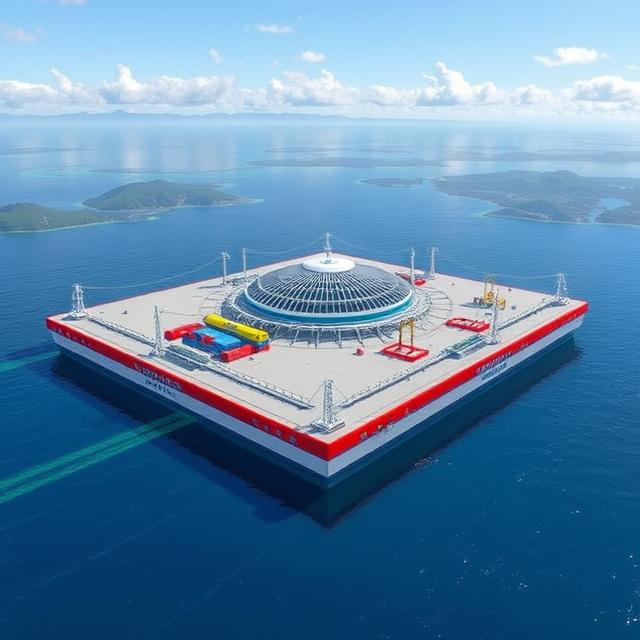
In a move that could redefine global energy geopolitics, Japan has begun construction of the world’s first floating nuclear fusion power station, designed to provide clean, stable electricity to island nations in the Pacific. Announced on July 6, 2025, by Japan’s Ministry of Economy, Trade and Industry (METI), the project will see the deployment of a floating tokamak reactor platform off the coast of Okinawa, with energy exports planned to reach Tonga, Tuvalu, and the Cook Islands by 2030.
Dubbed “Project Hikari” (meaning “light” in Japanese), the plant combines Japan’s breakthroughs in fusion containment, superconducting magnets, and maritime engineering. It represents the first real-world application of a commercially viable nuclear fusion system in a maritime environment—a feat once thought to be decades away.
Why Fusion, Why Floating?
Fusion energy—unlike traditional nuclear fission—mimics the sun’s power by fusing hydrogen atoms into helium, releasing enormous energy without radioactive waste or carbon emissions. After decades of experimentation, recent technological leaps in high-temperature plasma control and quantum field modelling have made sustained fusion reactions feasible for practical energy production.
By placing the fusion plant on a floating marine platform, Japan sidesteps land scarcity, seismic concerns, and political resistance from local communities. It also positions the country as a futuristic energy exporter to climate-vulnerable island nations in the South Pacific that suffer from high diesel costs and grid instability.
Each floating reactor will generate up to 1.4 gigawatts, enough to power more than 1 million homes. Unlike traditional offshore wind or solar farms, fusion systems produce energy consistently, day and night, rain or shine.
A Pacific Lifeline in the Climate Era
The announcement was met with optimism from Pacific Island leaders, who view the project as a lifeline. Tuvalu’s Prime Minister Ualesi Teo described the initiative as “a gift of survival,” highlighting how fusion energy could reduce both emissions and dependency on costly imported fuels.
Under Japan’s “Blue Energy Diplomacy” framework, several bilateral power purchase agreements (PPAs) are being negotiated. These will include floating transmission units using superconducting undersea cables and drone-serviced energy relay buoys positioned near island nations.
New Zealand’s Ministry of Foreign Affairs and Trade (MFAT) has expressed support for the plan, noting its potential to bolster energy resilience across the Pacific. Wellington-based climate groups and Māori energy start-ups are reportedly exploring partnerships for future collaboration on ocean-based green infrastructure.
Security, Tech, and Sovereignty Considerations
Despite the fanfare, the project raises major questions about maritime sovereignty, cyber-physical security, and technological dependence. The floating fusion reactor will be operated remotely using quantum-encrypted command channels from control centres in Hokkaido and Osaka. AI-powered swarm drones will monitor for cyberattacks, piracy threats, or equipment malfunctions.
Chinese state media has already raised concerns about Japan’s growing energy influence in the Indo-Pacific, while the Philippines and Indonesia have demanded regional consultation before future platforms are expanded into contested maritime zones.
The International Atomic Energy Agency (IAEA) has confirmed it will deploy special observers to the Okinawa site to monitor compliance, particularly around neutron emissions and containment safety during storms or seaquake events.
Scientific and Economic Milestone
Japan’s leap into floating fusion also represents a triumph for academic-industrial collaboration. The reactor uses proprietary “Symbiotron Rings,” a hybrid between a tokamak and stellarator, developed by a joint team from the University of Tokyo and Mitsubishi Heavy Industries. The plasma is sustained using boron-lithium fuels, which eliminate the tritium-related regulatory concerns common in fusion debates.
Economically, Project Hikari could catalyse a new trillion-dollar “fusion maritime market,” with potential for exports to island regions in the Caribbean, Southeast Asia, and even parts of Africa. Maritime nations like Norway and Singapore are already expressing interest in licensing the design for future deployment.
Summary
With the launch of Project Hikari, Japan has taken a commanding lead in global clean energy innovation, combining fusion science with marine engineering to address both environmental and geopolitical challenges. As the world searches for scalable, non-polluting energy systems in the face of climate crisis, this floating fusion plant could mark the beginning of a new era—one where even the smallest islands are powered by the stars.