




 Tracey Beatrice
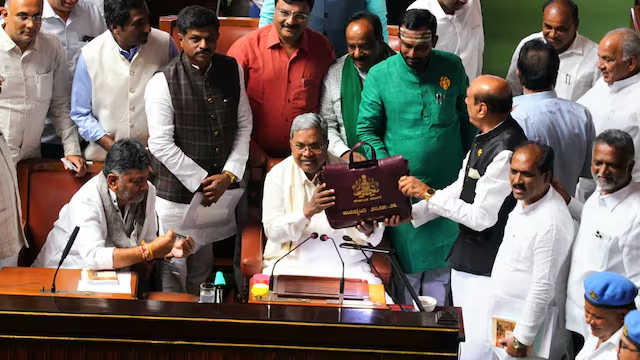
 Bengaluru, Karnataka – On March 7, 2025, Karnataka Chief Minister Siddaramaiah presented the state’s budget for the financial year 2025-26, unveiling an ambitious outlay of ₹4.09 lakh crore—the highest in the state’s history. This budget, tabled by the Congress-led government, emphasizes welfare schemes, infrastructure development, and fiscal discipline, marking a significant escalation from the previous year’s ₹3.65 lakh crore (revised estimate). Against the backdrop of a projected 7.4% state GDP growth—surpassing India’s 6.2% national growth rate—this analysis compares the 2025-26 budget with last year, evaluates the current Congress government’s approach against the previous BJP administration, and explores the long-term economic implications, while critically examining the establishment narrative.
Highlights of Karnataka Budget 2025-26
The 2025-26 budget allocates ₹4.09 lakh crore, with ₹3.11 lakh crore for revenue expenditure, ₹71,336 crore for capital expenditure, and ₹26,474 crore for loan repayment. Key highlights include:
- Infrastructure Boost: Bengaluru receives an increased annual grant of ₹7,000 crore (up from ₹3,000 crore), with ₹8,916 crore for city projects, including a ₹15,000 crore North-South tunnel from Hebbal to Silk Board and metro expansion to Kempegowda International Airport. Statewide, ₹4,848 crore is earmarked for 4,420 km of highway upgrades, and ₹1,000 crore for 39 weak bridges.
- Welfare Schemes: The five guarantee schemes, including Gruha Jyothi (₹10,100 crore) and Anna Bhagya (5 kg additional rice for 4.21 crore people), receive ₹51,034 crore. Health allocations include ₹320 crore to reduce maternal mortality and ₹873 crore for Kalyana Karnataka’s health development, with a ₹1,000 honorarium hike for ASHA workers.
- Agriculture and Rural Development: ₹200 crore initiates the Local Economy Accelerator Program (LEAP) outside Bengaluru, while ₹555 crore funds Phase 5 of the Cauvery water supply project.
- Education and Minorities: ₹1,292 crore upgrades 61 KREIS schools, ₹120 crore supports scholarships, and ₹350 crore (₹100 crore for Jain/Buddhist/Sikh, ₹250 crore for Christian communities) promotes minority development, including new women’s colleges on Waqf land.
- Fiscal Metrics: The fiscal deficit is ₹90,428 crore (2.95% of GSDP), within the 3% FRBM limit, with total liabilities projected at ₹7.64 lakh crore (24.91% of GSDP), nearing the 25% ceiling.
This Year vs. Last Year
Compared to the 2024-25 revised estimate of ₹3.65 lakh crore, the 2025-26 budget marks a 12% increase. Revenue expenditure rises 17% from ₹2.65 lakh crore to ₹3.11 lakh crore, reflecting heightened welfare spending, while capital expenditure jumps 47.3% from ₹48,400 crore to ₹71,336 crore, signaling a focus on infrastructure. Receipts grow 13.9% from ₹3.58 lakh crore to ₹4.08 lakh crore, but the revenue deficit widens from 0.54% of GSDP (₹19,262 crore) to 1% (₹27,354 crore), indicating reliance on borrowings.
Last year’s budget prioritized economic recovery post-COVID, with a 17.7% GSDP growth projection, whereas 2025-26 emphasizes urban development and social equity, aligning with a 7.4% growth rate in 2024-25. The gender budget rises 25% to ₹94,000 lakh, reflecting greater inclusivity, though critics argue this diverts funds from growth-oriented capital outlay.
This Government vs. Previous Government
The current Congress government (since May 2023) contrasts with the BJP-led administration (2019-2023) under Basavaraj Bommai. The BJP’s 2022-23 budget projected a ₹2.51 lakh crore expenditure with a 9.6% GSDP growth, focusing on post-pandemic stabilization and a revenue deficit projected to persist until 2025-26. Capital outlay was modest, with liabilities rising from 19.87% of GSDP in 2019-20 to 27.55% by 2025-26, breaching the 25% FRBM limit in 2021-22 due to COVID borrowings.
Congress, however, has escalated spending, with 2025-26’s ₹4.09 lakh crore outlay reflecting a welfare-centric approach, up 63% from 2022-23’s base. The BJP emphasized infrastructure like economic corridors, while Congress prioritizes urban mobility (e.g., Bengaluru tunnel) and rural schemes. Fiscal discipline under BJP aimed for a revenue surplus roadmap (per FMRC recommendations), but Congress’s higher deficit (2.95% vs. BJP’s 2.5% average) suggests short-term populism, with liabilities nearing the ceiling despite a lower growth projection (7.4% vs. 9.5%).
Comprehensive Analysis of the Economy
Karnataka’s economy, contributing 8.4% to India’s GDP, thrives on a tertiary sector (55% of GSDP) led by IT and services, with agriculture (4% growth in 2024-25) and manufacturing gaining traction. The 2025-26 budget’s 47.3% capital expenditure hike signals infrastructure-led growth, potentially boosting GDP by 0.5-1% long-term if executed efficiently. However, the revenue deficit’s rise to 1% of GSDP, against a 0.5% target, strains fiscal health, with 58% of revenue receipts locked in committed expenditures (salaries, pensions, interest).
The establishment narrative touts this as a balanced budget, but critics, including posts on X, label it “fiscal irresponsibility,” citing a ₹82,981 crore deficit and reliance on freebies. The 24.91% liability-to-GSDP ratio, close to the 25% limit, risks crowding out private investment if borrowing escalates. Agriculture’s 4% growth contrasts with last year’s -4.9%, suggesting policy impact, yet LEAP’s ₹200 crore allocation outside Bengaluru may insufficiently address rural underemployment.
Long-Term Implications
The budget’s long-run implications hinge on execution and fiscal management. Infrastructure investments could enhance Karnataka’s global competitiveness, with Bengaluru’s tunnel and metro projects reducing congestion and boosting trade, potentially adding ₹20,000 crore annually to economic output by 2030. However, the revenue deficit’s growth, if unchecked, may push liabilities beyond 25% by 2027, raising borrowing costs and deterring FDI, which hit $2,026.4 million in 2008-09 and remains critical.
Welfare schemes, while socially beneficial, risk fiscal unsustainability without revenue growth, projected at 13.9% but historically volatile (e.g., 12% shortfall in 2022-23). The gender budget’s 25% rise supports inclusivity, aligning with “empowerment for all,” but diverts funds from capital assets, potentially slowing industrial growth. Long-term prosperity requires expenditure rationalization, as recommended by the FMRC, and a shift toward revenue surplus, currently elusive with a deficit trajectory.
Critically, the narrative of “comprehensive development” masks risks of over-leverage. If global economic slowdowns (e.g., India’s projected 6.2% growth) impact Karnataka, the state’s debt servicing could exceed 15% of receipts by 2030, per CBO-like projections, threatening stability. Conversely, successful infrastructure delivery could position Karnataka as India’s economic leader, leveraging its 13.11% GSDP CAGR (2011-2018) for sustained growth.
Opinion
Karnataka Budget 2025-26, with its ₹4.09 lakh crore outlay, reflects a bold shift toward welfare and infrastructure under Congress, outpacing last year’s ₹3.65 lakh crore and the BJP’s ₹2.51 lakh crore baseline. While promising urban and social gains, the rising deficit and liabilities pose long-term risks, necessitating prudent fiscal strategies. As NZB News advocates “technology for everyone, empowerment for all,” Karnataka’s success depends on balancing immediate benefits with sustainable economic health.
Excerpt: Karnataka’s 2025-26 budget, at ₹4.09 lakh crore, boosts infrastructure and welfare, up 12% from ₹3.65 lakh crore last year. Compared to BJP’s ₹2.51 lakh crore, Congress prioritizes equity, but a 2.95% fiscal deficit and 24.91% liabilities signal long-term economic challenges.