


 Vinay Karanam
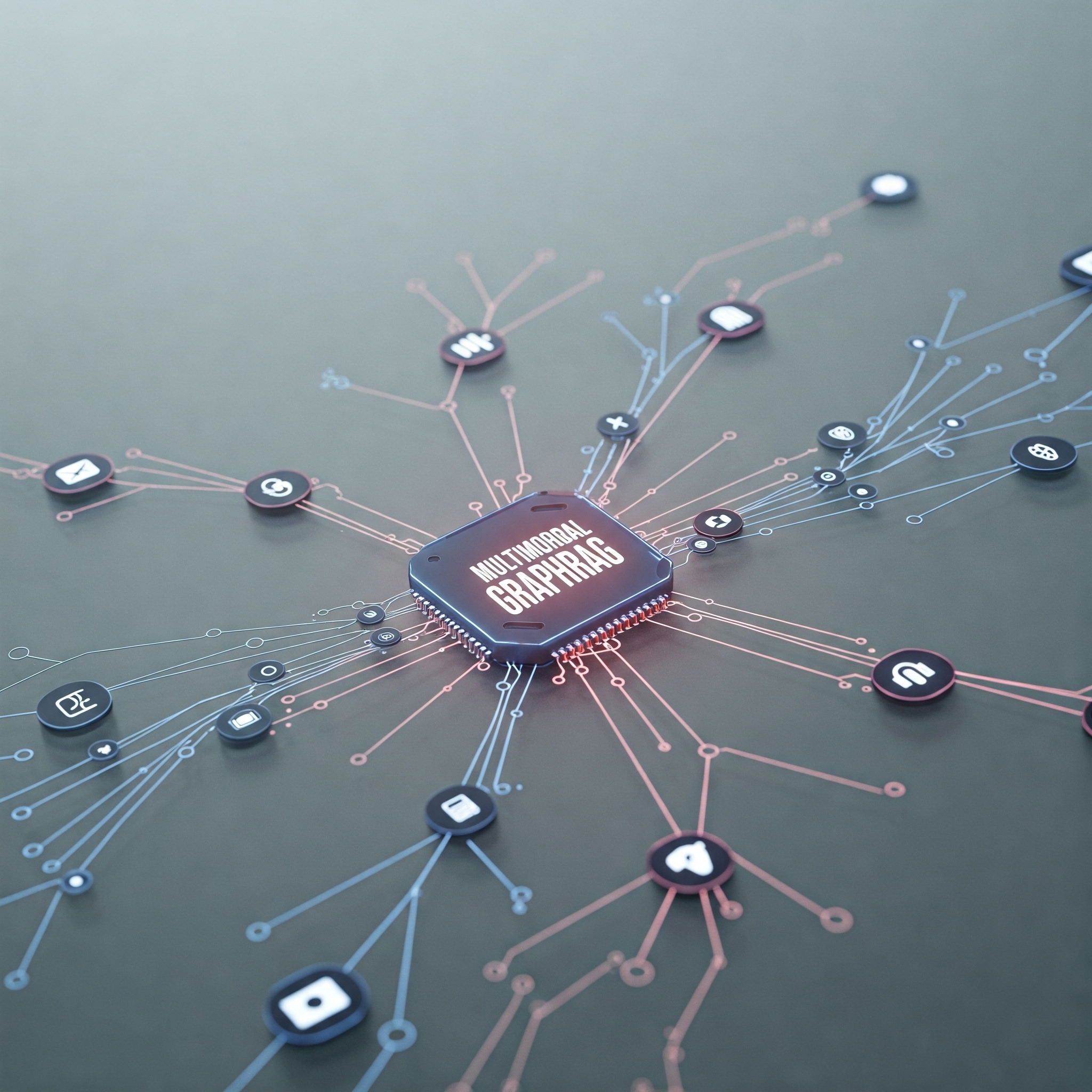
 Multimodal Graph Retrieval-Augmented Generation (mmGraphRAG) is rapidly emerging as a transformative approach in artificial intelligence, fusing the strengths of knowledge graphs, vision models, and large language models (LLMs). By uniting structured data, images, and text into a single, queryable framework, mmGraphRAG delivers richer, more accurate, and context-aware AI outputs. This article explores the architecture, techniques, real-world applications, challenges, and future directions of mmGraphRAG, illustrating how it is redefining the capabilities and trustworthiness of AI.
Understanding Multimodal GraphRAG
What is Retrieval-Augmented Generation (RAG)?
Retrieval-Augmented Generation (RAG) is a design pattern in AI where a language model is enhanced by retrieving relevant information from a large knowledge base before generating a response. Traditionally, RAG systems have focused on text: a user query is embedded into a vector, compared to a database of text embeddings, and the most relevant text chunks are injected into the language model’s prompt for generation.
The Multimodal Evolution
However, the world is not just text. Knowledge is stored in images, tables, charts, audio, and video. Multimodal RAG extends the RAG paradigm by enabling AI to retrieve and reason over multiple data types, not just text. The next evolution, mmGraphRAG, takes this further by using knowledge graphs as a backbone to connect and contextualise information across all modalities.
Core Architecture of Multimodal GraphRAG
1. Knowledge Graph Construction
- Entity and Relationship Extraction: AI models process raw data-text, images, tables, and more-to extract entities (such as people, locations, products) and the relationships between them.
- Graph Creation: These entities and relationships are structured into a knowledge graph. Nodes represent entities, and edges represent relationships, forming a dynamic, queryable map of knowledge.
- Multimodal Nodes: Each node can link to various data types: an entity might have associated text descriptions, images, structured records, or even video clips.
2. Multimodal Embedding and Fusion
- Unified Embedding Space: Models like CLIP or similar are used to embed text and images into a shared vector space, allowing the system to compare and retrieve relevant information regardless of modality.
- Hybrid Embeddings: For more complex scenarios, hybrid embedding solutions are used to encode tables, charts, or audio alongside text and images.
- Attention-Based Fusion: Multimodal graph attention networks assign dynamic weights to nodes and edges, integrating features across modalities and allowing the model to focus on the most relevant information for a given query.
3. Retrieval and Generation Pipeline
- Data Indexer: All multimodal data is indexed, with embeddings and graph connections stored in efficient databases.
- Retrieval Engine: When a query arrives, the system searches across modalities-text, images, structured data-using vector similarity and graph traversal to find the most relevant information.
- LLM Generation: Retrieved information is injected into the prompt for a large language model, which generates a coherent, context-rich response. The LLM can reference text, describe images, summarise tables, or explain relationships found in the knowledge graph.
How Multimodal GraphRAG Works in Practice
Example Workflow
- User Query: “Show me all recent protests against deforestation, with images and related news articles.”
- Entity Extraction: The system identifies key entities (protests, deforestation) and relationships (location, date, media coverage).
- Graph Traversal: The knowledge graph is traversed to find nodes representing relevant protests, linking to associated images and news articles.
- Multimodal Retrieval: Using unified embeddings, the system retrieves both text and images that are semantically aligned with the query.
- LLM Generation: The language model generates a response, referencing images, summarising articles, and explaining the connections-all grounded in the graph structure.
Handling Diverse Data Types
Multimodal GraphRAG can handle a wide variety of data:
- Text: News articles, reports, social media posts.
- Images: Photographs, satellite imagery, charts.
- Structured Data: Tables, spreadsheets, databases.
- Audio/Video: Transcripts, recordings, video clips (converted to embeddings or text summaries).
Technical Foundations
Embedding Modalities into a Shared Space
A cornerstone of mmGraphRAG is the ability to embed different data types into a common vector space. For example, using a model like CLIP, both images and text are converted into vectors that can be compared directly. This enables the retrieval engine to find the most relevant information for a query, regardless of whether it is text or image-based.
Graph Attention and Fusion
Attention mechanisms allow the system to weigh the importance of different nodes and edges in the knowledge graph, focusing on the most relevant connections for a given query. For instance, when answering a question about environmental protests, the model might assign higher attention to recent events, locations with high activity, or images with strong visual cues.
Reranking and Contextualisation
After initial retrieval, the system can rerank results based on relevance scores, using the knowledge graph to provide additional context. For example, if multiple images are retrieved, those linked to highly credible news sources or with strong semantic ties to the query are prioritised.
Advantages of Multimodal GraphRAG
Contextual Depth and Accuracy
By grounding responses in a structured knowledge graph, mmGraphRAG provides context-aware answers that go beyond surface-level correlations. This reduces hallucinations and ensures that generated responses are supported by explicit relationships in the data.
Multimodal Comprehension
The ability to retrieve and integrate information from text, images, and structured data enables richer, more informative answers. For example, a medical diagnosis system can link patient records, MRI scans, and clinical guidelines to provide a holistic view.
Scalability and Efficiency
Knowledge graphs and unified embeddings allow for efficient storage and retrieval. Rather than storing redundant data, the system keeps a single copy of each entity and links it to all relevant modalities. Updates, such as adding a new image or report, can be made incrementally without retraining the entire model.
Transparent and Trustworthy Outputs
Because responses are grounded in graph-based relationships, users can trace the reasoning behind each answer. This transparency builds trust, especially in high-stakes domains like healthcare, law, and finance.
Real-World Applications
Healthcare
Challenge: Diagnosing complex conditions often requires synthesising data from medical images, lab results, patient histories, and clinical guidelines.
Solution: mmGraphRAG links all relevant data in a knowledge graph. A doctor can query the system for similar cases, view associated MRI scans, and read guideline summaries-all within a single, context-rich response.
Supply Chain Management
Use Case: A retailer wants to monitor ethical sourcing by analysing supplier reports, satellite images of factories, and ESG scores.
Outcome: The system flags high-risk suppliers, links to audit documents, and provides visual evidence, enabling proactive decision-making and reducing compliance risks.
Environmental Monitoring
Application: Detecting illegal logging requires integrating satellite imagery, sensor data, and field reports.
Result: mmGraphRAG identifies deforestation hotspots, links to on-the-ground photos and government records, and generates alerts for rapid intervention.
Social Media and Enterprise Search
Scenario: An analyst queries a system for trending topics, relevant images, and structured data (such as poll results) on a breaking news story.
Benefit: The system retrieves and fuses information from multiple sources, providing a comprehensive, up-to-date overview.
Implementation Approaches
Unified Embedding Space
Embedding all modalities into a shared vector space allows the system to perform similarity searches across text, images, and more. For example, a query about “renewable energy projects” can retrieve both written reports and photos of solar farms.
Grounding Modalities
Some systems convert non-text modalities into text (for example, using vision-language models to generate image captions). This allows the language model to process all information as text, simplifying downstream generation.
Separate Datastores and Reranking
Alternatively, each modality can be stored in a dedicated database (e.g., a vector database for embeddings, blob storage for images). The system retrieves relevant data from each store and then reranks results using a multimodal language model, ensuring the most relevant and diverse information is presented.
Challenges and Solutions
Modality Imbalance
Text data can dominate retrieval and generation, overshadowing images or structured data. Balanced attention mechanisms and contrastive learning techniques are used to ensure all modalities contribute meaningfully.
Data Heterogeneity
Aligning data with different formats, resolutions, and timeframes is complex. Advanced fusion networks and temporal-spatial alignment techniques help unify disparate sources.
Scalability
Efficient indexing and graph traversal are essential for handling large, dynamic knowledge bases. Graph databases and optimised embedding models enable rapid updates and real-time retrieval.
Explainability
Ensuring users can understand and trust AI outputs is critical. Visualising graph pathways and providing source links for each answer helps build transparency and accountability.
Emerging Innovations
Neuromorphic Hardware
Specialised hardware designed for graph traversal and multimodal processing is being developed, promising faster and more energy-efficient real-time queries.
Generative Graph Expansion
Future systems may use LLMs to autonomously infer missing relationships in the knowledge graph, enriching context and improving retrieval without manual curation.
Ethical Considerations
Bias mitigation is vital, especially when linking data across modalities. Regular audits and fairness checks help prevent skewed or misleading outputs.
Summary
Multimodal GraphRAG is reshaping the landscape of AI by integrating the structured reasoning of knowledge graphs with the contextual power of vision and language models. By embedding and retrieving information across text, images, and structured data, mmGraphRAG delivers deeper insights, higher accuracy, and more transparent decision-making. As industries adopt this framework, they gain powerful tools to navigate complex, data-rich environments-from diagnosing diseases and monitoring supply chains to environmental protection and enterprise intelligence. While technical and ethical challenges remain, the ongoing evolution of multimodal graph-based AI promises a future where machines can reason as intuitively and reliably as humans, but with the speed and scale only AI can achieve.