


 Dorothy Brown
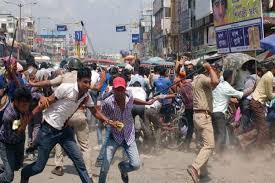
 The Murshidabad violence in West Bengal, sparked by protests against the Waqf (Amendment) Act on 11 April, has continued to be a hot topic. West Bengal BJP president, Sukanta Majumdar, has been vocal in his criticism of the state government’s handling of the situation, staging a protest outside the police commissioner’s office in Kolkata on Wednesday.
Majumdar, along with a group of victims from the violence-affected areas, demanded compensation for those impacted and called for a permanent Border Security Force (BSF) camp in Murshidabad to ensure ongoing security.
“We had a yarn with the DGP, and as the victim’s whanau said, we’re not at all happy with what he had to say,” Majumdar told reporters. “He hasn’t made any promises yet. We’ve put forward a few demands – we want a permanent BSF camp there, the victim families should be given a compensation of five lakh rupees each… We didn’t find our chat with the DGP promising. There’s a big question mark over the future of Hindu kids… The High Court should take notice of the situation and order the setting up of a permanent BSF camp in the region. Even the Supreme Court has discussed the issue.”
Majumdar also took a veiled swipe at West Bengal Chief Minister Mamata Banerjee, accusing her of pandering to her voter base. “The DGP spoke to the victim families separately, but he could only talk to them for 10 minutes,” he said. “To keep her voters happy, Mamata Banerjee said everything she could at today’s event. This is her policy… They make a fool out of Muslims… The victims are telling us that the number of refugees in camps is increasing every day.”
The BJP leader also claimed that the unrest was fuelled by calls for riots from the loudspeaker of a mosque. “According to the victims, the call for riots was given from the loudspeaker of the Masjid,” Majumdar claimed. “The provocative statement made by Tawha Siddique is very shameful. This mentality is increasing with their percentage increase and change in demographics. This mentality is because they are being sheltered by Mamata Banerjee’s government.”
He went on to say that if the BJP came to power, the party would ban any religious place used for such activities. He also alleged that the Popular Front of India (PFI) was active in Murshidabad and claimed that the West Bengal police had made no arrests so far.
Impact and Analysis:
The Murshidabad violence has raised concerns about communal tensions in West Bengal. The BJP’s accusations against the state government and its focus on the issue are likely part of a larger political strategy, aimed at capitalising on these tensions and attracting support ahead of upcoming elections.
The incident also highlights the challenges of maintaining law and order in a diverse and politically charged environment. The role of the mosque loudspeaker and allegations of incitement raise important questions about responsible speech and its impact on public safety.
The government’s response to the violence and its efforts to address the grievances of the affected communities will be crucial in determining the long-term impact of this incident.