

 Tracey Beatrice
 A Sudden Departure After Reappointment
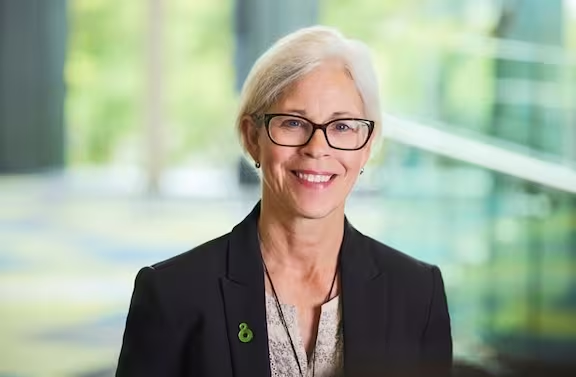
In a surprising development, Professor Dawn Freshwater, Vice-Chancellor of the University of Auckland, has announced her intention to step down from the role early next year, just six months after being reappointed for a new five-year term. The announcement came on 11 June 2025, with Freshwater set to remain in the position until early 2026 to allow for a smooth transition and a thorough international search for her successor.
Chancellor Cecilia Tarrant confirmed the extended notice period, emphasizing the university’s commitment to maintaining momentum while finding a new leader.
A Trailblazing Leadership Tenure
Professor Freshwater made history in March 2020 as the University of Auckland’s first female Vice-Chancellor. Her tenure coincided with the onset of the COVID-19 pandemic, a period that demanded swift and decisive leadership. Freshwater successfully guided the university through an unprecedented shift to online learning, ensuring continuity for both domestic and international students amid global disruptions.
Under her leadership, the university has maintained its prestigious global ranking within the top 100 universities worldwide, notably holding 65th place in the QS rankings. The institution has also seen growth in both domestic and international student numbers, with postgraduate enrolments increasing significantly.
Strategic Vision and Achievements
Freshwater championed the development and implementation of the Taumata Teitei Vision 2030 and the updated Strategic Plan 2025, which have driven a broad transformation agenda. Key achievements during her tenure include:
- Strengthening research excellence, with a growing number of academics recognized among the world’s top two percent of researchers.
- Expanding international research partnerships, including collaborations through Horizon Europe.
- Launching initiatives such as the Centre for Innovation and Entrepreneurship and the Newmarket Innovation Precinct.
- Opening the student-supported Hiwa Recreation Centre, enhancing campus life and student wellbeing.
Freshwater has also led the university’s response to emerging challenges, including the accelerated adoption of artificial intelligence technologies.
Challenges and Controversies
Despite these successes, Freshwater’s leadership has not been without criticism and internal challenges. Some staff and colleagues reportedly lost confidence in her leadership during a tumultuous period marked by:
- Proposed faculty mergers and course optimizations that met with resistance from academic staff and students.
- Staff strikes and negotiations with the Tertiary Education Union over pay and working conditions.
- Public scrutiny over university expenditures, including a controversial purchase and subsequent sale of a mansion intended as the Vice-Chancellor’s residence.
Her remuneration, reported at $766,000 in 2023/2024, placed her among the highest-paid public service and Crown Entity executives, which also attracted attention.
Reflections on Leadership and Legacy
In her statement, Professor Freshwater emphasized the importance of maintaining a comprehensive university offering diverse disciplines and research areas. She highlighted the critical role of universities in addressing complex global challenges and the need to balance technological advancement with a focus on people.
She also spoke about the importance of moral courage in university leadership, particularly in navigating misinformation and complex international issues affecting staff and students.
Next Steps for the University
The University of Auckland will commence an international search for a new Vice-Chancellor, aiming to find a leader capable of continuing the institution’s trajectory of excellence while addressing ongoing challenges in the tertiary education sector.
The university plans to formally farewell Professor Freshwater in the first half of 2026, marking the end of a significant chapter in its history.
Summary
Professor Dawn Freshwater, the University of Auckland’s first female Vice-Chancellor, has announced her resignation effective early 2026, six months after being reappointed. Her tenure was marked by navigating the university through the COVID-19 pandemic, sustaining global rankings, and driving strategic transformation. While her leadership saw notable achievements, it also faced internal dissent and public scrutiny. The university is preparing for an international search to appoint her successor, ensuring continued momentum and stability.