




 Dr. Rukumangada Acharya
 Article 53: “Kṛtātyaye’nuśayavān, dṛṣṭasmṛtibhyām, yathetamanevaṃ ca”—The Descent of the Soul and the Mystery of Residual Karma
Introduction: The Soul’s Return from Heaven
The Brahmasutras, with their terse aphorisms, continue to guide the seeker through the mysteries of existence, liberation, and the journey of the soul. Having explored the nature of Brahman’s immanence and the soul’s relationship to the Divine, we now turn to a profound question: What happens to the soul after it enjoys the fruits of its good deeds in the heavenly worlds? Does it return to earth empty-handed, or does it carry with it the seeds of past actions? The next sutra in our series addresses this very mystery:
कृतात्ययेऽनुशयवान्, दृष्टस्मृतिभ्याम्, यथेतमनेवं च ॥ ८ ॥
kṛtātyaye’nuśayavān, dṛṣṭasmṛtibhyām, yathetamanevaṃ ca || 8 ||
kṛtātyaye—On the exhaustion of (good) work; anuśayavān—possessed of residual Karma; dṛṣṭasmṛtibhyām—as is known from the Sruti and Smriti; yathā etam—as (it) went; anevam—differently; ca—and.
Translation:
“On the exhaustion of (good) work (the soul) with the residual Karma (descends to this earth), as is known from the Sruti and Smriti, along the path (it) went by (from here) and differently too.”
The Context: The Cycle of Karma and Rebirth
This sutra is located in Chapter III, Section I, Adhikarana II of the Brahmasutras. The topic at hand is the fate of souls who, through virtuous deeds, ascend to the heavenly realms and enjoy celestial pleasures. The scriptures describe a return to earth after the exhaustion of merit. But the mechanism of this return is debated: Does the soul come back with a clean slate, or does it retain some residue of past actions?
The answer, as this sutra declares, is that the soul returns with anuśaya—residual karma—that shapes its new birth. This teaching is not only a matter of metaphysical speculation but has profound implications for ethics, destiny, and the meaning of human life.
Scriptural Foundations: Sruti and Smriti in Harmony
The authority of this teaching rests on both Sruti (revealed scriptures) and Smriti (remembered tradition). The Chhāndogya Upanishad says:
“Having dwelt there till their work is consumed, they return again the way they went by.”
Similarly, the Smriti texts, such as the Bhagavad Gītā and the Manusmṛti, affirm that souls return to earth with the remnants of their karma, which determines the circumstances of their next birth.
This harmony between Sruti and Smriti is crucial. The Brahmasutras consistently seek to reconcile apparent contradictions in the scriptures, showing that the journey of the soul is governed by a just and orderly law—the law of karma.
The Mechanism of Descent: The Path of Return
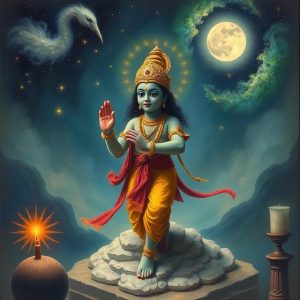
The sutra specifies that the soul returns “along the path it went by, and differently too.” The path of ascent to heaven is described in detail in the Upanishads—passing through realms of light, deities, and subtle worlds. The return journey, however, is marked by a reversal of this process, with the soul descending through various stages until it finds a new birth on earth.
Yet, there is a difference: The path of return is not identical to the path of ascent. The texts mention elements such as smoke, mist, and clouds in the descent, symbolizing the soul’s gradual re-entry into the material world. This difference is significant—it indicates that the soul’s return is shaped by the specific nature of its residual karma.
The Mystery of Residual Karma: Seeds of Destiny
What is anuśaya—residual karma? It is the sum total of actions, impressions, and tendencies that have not yet borne fruit. When a soul ascends to heaven through virtuous deeds, it enjoys the rewards of those specific actions. But not all karma is exhausted in one lifetime or even in one sojourn in heaven. The unspent karma remains as a subtle force, drawing the soul back to the earthly plane to continue its journey.
This teaching explains the diversity of human experience. Why are some born into privilege and others into hardship? Why do talents, inclinations, and circumstances vary so widely? The answer lies in the complex web of residual karma, which shapes each birth according to the soul’s past actions.
The Dvaita Perspective: Individuality and Divine Justice
In Dvaita Vedānta, the doctrine of karma is intimately linked to the soul’s eternal individuality and the justice of the Divine. Each soul is unique, with its own history, merits, and demerits. The Lord, as the inner controller, ensures that every soul reaps the fruits of its actions in a manner that is both just and merciful.
The return to earth is not a punishment, but an opportunity—a chance for the soul to learn, grow, and progress toward liberation. The diversity of births is a reflection of the soul’s journey through the cycles of karma, guided by the Lord’s wisdom and grace.
The Role of Conduct: Karma and Character
The sutras that follow elaborate on the relationship between karma and conduct. Some argue that good conduct alone determines birth, while others maintain that it is karma—action—that is the true cause. The Brahmasutras reconcile these views by showing that conduct and karma are intertwined: Good conduct leads to good karma, and both shape the destiny of the soul.
This teaching has practical implications. It affirms the importance of ethical living, self-discipline, and the cultivation of virtue. Every thought, word, and deed leaves an imprint on the soul, influencing its future journey.
Creative Exploration: The River of Life
Imagine the soul as a traveler on a great river. Each action is a ripple, a current, a wave that shapes the course of the journey. When the soul reaches the ocean of heaven, it enjoys the calm and beauty of celestial existence. But the river does not end there. The currents of residual karma draw the traveler back to new lands, new experiences, new challenges.
The journey is never random. Every twist and turn is shaped by the soul’s own choices, guided by the unseen hand of the Divine. The river flows on, carrying the soul ever closer to its true home.
The Problem of Suffering: Karma and Compassion
The doctrine of residual karma offers an explanation for the apparent injustices of life. Suffering is not arbitrary; it is the result of past actions, known or unknown. Yet, this teaching is not meant to foster fatalism or indifference. On the contrary, it calls for compassion, empathy, and the recognition that every soul is on a unique journey.
The wise see their own struggles reflected in the lives of others. They respond not with judgment, but with kindness, understanding that the web of karma binds all beings together in a shared destiny.
The Path to Liberation: Transcending Karma
While karma governs the cycle of birth and death, the ultimate goal is to transcend karma altogether. This is achieved through knowledge, devotion, and surrender to the Divine. The soul, recognizing its dependence on the Lord, seeks liberation—not by escaping the consequences of action, but by offering all actions to the Supreme.
In the Dvaita tradition, liberation is not the erasure of individuality, but its perfection in the eternal service of the Lord. The soul, freed from the bondage of karma, enjoys the bliss of divine presence, forever distinct yet forever united in love.
Scriptural Resonance: The Upanishads and the Gītā
The teaching of this sutra finds echoes in the great scriptures of India. The Chhāndogya Upanishad describes the journey of the soul, the exhaustion of merit, and the return to earth. The Bhagavad Gītā teaches that the soul carries with it the impressions of countless lifetimes, shaping its destiny in each new birth.
These texts affirm the law of karma as a universal principle, governing the cycles of creation, preservation, and dissolution. They also point to the possibility of liberation—a state beyond karma, where the soul rests in the infinite embrace of the Divine.
The Sādhaka’s Meditation: Embracing the Journey
For the spiritual aspirant, the doctrine of residual karma is both a challenge and an inspiration. It calls for vigilance, self-examination, and the cultivation of virtue. Every action matters; every choice shapes the future.
Yet, the journey is not one of fear or anxiety. The Lord is ever present, guiding, supporting, and uplifting the soul. The path is long, but the destination is certain. The soul, through countless births and experiences, is drawn inexorably toward the light.
The Sutra’s Legacy: Justice, Mercy, and the Mystery of Life
कृतात्ययेऽनुशयवान्, दृष्टस्मृतिभ्याम्, यथेतमनेवं च ॥ ८ ॥
kṛtātyaye’nuśayavān, dṛṣṭasmṛtibhyām, yathetamanevaṃ ca || 8 ||
This sutra stands as a testament to the justice and mercy of the Divine. No action is lost; no effort is wasted. The soul’s journey is shaped by its own deeds, yet always under the watchful eye of the Lord. The mystery of life, with its joys and sorrows, is a reflection of the soul’s own history—a tapestry woven from the threads of karma.
Comparative Perspectives: Dvaita, Advaita, and Viśiṣṭādvaita
Each school of Vedānta interprets the doctrine of karma and rebirth in its own way:
- Dvaita Vedānta affirms the eternal distinction of the soul, the reality of karma, and the justice of the Divine. The journey is real, the individuality of the soul is preserved, and liberation is eternal service.
- Advaita Vedānta sees karma as part of the illusion of individuality. Liberation is the realization of non-duality, the dissolution of the self in the Absolute.
- Viśiṣṭādvaita Vedānta teaches that the soul is a mode of the Divine, distinct yet inseparable. Karma governs the journey, but liberation is union with the Lord in His qualified form.
These perspectives enrich the tradition, offering multiple paths for the seeker to explore.
The Cycle of Samsara: Endless Return and Ultimate Release
The doctrine of residual karma explains the endless cycle of samsara—birth, death, and rebirth. The soul, bound by its own actions, moves from one existence to another, seeking fulfillment and release. The cycle is not a prison, but a school—a place for learning, growth, and transformation.
The ultimate goal is moksha—liberation from the cycle. This is achieved not by denying the world, but by transcending attachment, cultivating knowledge, and surrendering to the Divine. The soul, freed from karma, rests in the bliss of the Lord.
The Ethical Imperative: Living with Awareness
The teaching of this sutra is a call to ethical living. Every action, however small, leaves an imprint on the soul. The wise live with awareness, choosing actions that lead to virtue, wisdom, and compassion.
The doctrine of karma is not a burden, but a gift. It affirms the dignity of human life, the power of choice, and the possibility of transformation. The soul is not a victim of fate, but a co-creator of its own destiny.
The Journey Continues: Hope and Aspiration
The soul’s journey through the cycles of karma is long and complex, but it is never without hope. The Lord is ever present, offering guidance, support, and grace. The soul, through effort and devotion, can overcome the bonds of karma and attain the highest goal.
The journey is not solitary. The community of seekers, the wisdom of the scriptures, and the presence of the guru all support the soul on its path. Together, they form a tapestry of aspiration, woven from the threads of faith, hope, and love.
Conclusion: The Sutra as a Beacon for the Seeker
कृतात्ययेऽनुशयवान्, दृष्टस्मृतिभ्याम्, यथेतमनेवं च ॥ ८ ॥
kṛtātyaye’nuśayavān, dṛṣṭasmṛtibhyām, yathetamanevaṃ ca || 8 ||
“On the exhaustion of (good) work (the soul) with the residual Karma (descends to this earth), as is known from the Sruti and Smriti, along the path (it) went by (from here) and differently too.”
This sutra shines as a beacon for all seekers. It teaches that the journey of the soul is shaped by its own actions, guided by the law of karma, and sustained by the grace of the Divine. The cycles of birth and death are not endless; they are stages on the path to liberation.
May this sutra inspire us to live with awareness, to act with virtue, and to seek the highest goal—the eternal presence of the Lord. The journey is long, but the destination is certain. The soul, through effort, devotion, and grace, will find its way home.
Next in the Series:
We will continue our exploration of the Brahmasutras, delving into the subsequent aphorisms that unravel the mysteries of karma, conduct, and the soul’s ultimate destiny. Let the journey continue, guided by the wisdom of the sages and the light of the Eternal.