




 Swamy Gitananda
 A Daily Exploration of Dharma, Jnana, and Relevance to Modernity
By Swami Gitananda
Published on New Zealand Bharat (NZB) News, April 18, 2025
Om Shri Lakshmyai Namaha. Salutations to Lakshmi, the bestower of siddhi (perfection) and shanti (peace), as we advance through the Bhagavad Gita, the Moksha-Sagara (ocean of liberation) that transforms Kurukshetra into a dharmakshetra of eternal truth. Yesterday, Arjuna’s vishada-yoga (yoga of despondency) consumed his body and mind—limbs trembling, Gandiva slipping, manas reeling—as krup (pity) for kin overwhelmed his kshatriya shakti (strength). Today, in Shloka 31, his despair deepens, seeing ill omens (nimitta) and questioning victory’s worth over svajanam (kin), a jiva’s plea that primes the Gita for Krishna’s upadesha.
This series is a daily sadhana (spiritual practice), offering one shloka at a time—its direct meaning, a profound exploration of its tattva (essence), insights from sampradayas (spiritual traditions), and its resonance with modern fields like quantum science, leadership, and svasthya (wellbeing). Let us now immerse ourselves in Adhyaya 1, Shloka 31, where Arjuna’s vishada seeks reason, a prelude to the Gita’s eternal wisdom.
The Shloka
निमित्तानि च पश्यामि विपरीतानि केशव।
न च श्रेयोऽनुपश्यामि हत्वा स्वजनमाहवे॥
Nimittani cha pashyami vipareetani keshava,
Na cha shreyo’nupashyami hatva svajanamahave.
Direct Meaning
“[Arjuna said:] ‘I see omens that are adverse (nimittani cha pashyami vipareetani), O Keshava (keshava). Nor do I see any good (na cha shreyo’nupashyami) in slaying my own people (hatva svajanam) in this battle (ahave).”
In this verse, Arjuna addresses Krishna as Keshava and laments seeing ominous signs (vipareetani nimittani), declaring no shreyas (good) in killing svajanam (kin) in war, his vishada rationalizing his refusal to fight.
Explanation of the Shloka
This shloka marks Arjuna’s shift from raw krup (pity, Shloka 28) and physical collapse (Shlokas 29-30) to reasoned despair, as he interprets omens and rejects war’s merit. His manas seeks justification for vishada, projecting doom and moral futility onto Kurukshetra’s karmakshetra (field of action). Krishna, the silent Yogeshvara, listens as Partha’s buddhi (intellect) falters, poised to answer with jnana. Let us explore its layers with viveka (discernment) and bhakti (devotion).
- Nimittani Cha Pashyami: I See Omens
- Nimittani: “Omens,” signs or portents, often subtle cues in Vedic tradition signaling karmic outcomes. Arjuna’s pashyami (I see) reflects drishti clouded by vishada, reading doom in Kurukshetra’s tableau.
- Cha: “And,” links this to prior shlokas’ anguish, a new layer of despair—manas now seeking external validation for krup.
These nimittani are likely subjective—Arjuna’s trembling (vepathuh, Shloka 29) or Gandiva’s fall (Shloka 30)—interpreted as karmic warnings, a jiva’s fear projecting samsara’s chaos.
- Vipareetani: Adverse
- Vipareetani: “Adverse,” marks Arjuna’s omens as ashubha (inauspicious), foretelling calamity. Vipareeta (contrary) suggests a reversal of dharma’s promise—victory tainted by loss.
This perception reveals moha (delusion), buddhi skewed by kleshas (raga, attachment; dvesha, aversion), blinding Arjuna to svadharma (duty). Krishna will later counter: “Na tvam shochitum arhasi”—“You should not grieve” (Adhyaya 2).
- Vipareetani: “Adverse,” marks Arjuna’s omens as ashubha (inauspicious), foretelling calamity. Vipareeta (contrary) suggests a reversal of dharma’s promise—victory tainted by loss.
- Keshava: O Keshava
- Keshava: Krishna’s name, meaning “lord of kesha (senses)” or “slayer of Keshi” (a demon), evokes his Yogeshvara mastery and sakha (friend) intimacy. Arjuna’s address, after Krishna (Shloka 28), deepens trust amid vishada.
This invocation signals bhakti’s spark, a jiva’s plea to Ishvara, priming Krishna’s role as Guru to dispel moha.
- Keshava: Krishna’s name, meaning “lord of kesha (senses)” or “slayer of Keshi” (a demon), evokes his Yogeshvara mastery and sakha (friend) intimacy. Arjuna’s address, after Krishna (Shloka 28), deepens trust amid vishada.
- Na Cha Shreyo’nupashyami: Nor Do I See Any Good
- Na Cha: “Nor,” a firm negation, Arjuna’s manas rejecting war’s value.
- Shreyo’nupashyami: “I see any good,” shreyas (highest good, spiritual or moral benefit) absent in Arjuna’s drishti. Anupashyami (I do not perceive) underscores buddhi’s clouding, vishada eclipsing viveka.
This denial reflects samsara’s grip—Arjuna measures shreyas by worldly loss, not dharma, a misstep Krishna will correct with sankhya-yoga.
- Hatva Svajanam Ahave: Slaying My Own People in Battle
- Hatva Svajanam: “Slaying my own people,” echoes svajanam (Shloka 28), pitrin, acharyan, bandhun—kin now foes. Hatva (slaying) is visceral, Arjuna’s manas recoiling at bloodshed.
- Ahave: “In battle,” roots despair in Kurukshetra’s rana (war), a kshatriya’s svadharma now seen as adharma.
This phrase crystallizes vishada’s logic: killing svajanam negates shreyas, a klesha-driven conclusion Krishna will reframe as karmic duty.
- The Reasoning of Vishada
Arjuna’s nimittani and rejection of shreyas mark vishada-yoga’s intellectual phase—manas rationalizing krup with omens and ethics. Kurukshetra mirrors samsara’s moral maze, where dharma seems futile. The Gita’s question sharpens: Can jnana restore buddhi? Krishna, the Sarathi, prepares to answer with nishkama karma (selfless action). - The Chariot’s Silent Witness
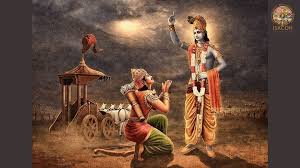
Krishna’s silence as Keshava is kripa (grace), allowing Arjuna’s vishada to exhaust itself. The rathottamam (finest chariot), centered between armies, symbolizes the jiva’s karmakshetra—manas adrift, awaiting Ishvara’s reins, a metaphor for Krishna’s yoga in Adhyaya 2.
This shloka, then, is Arjuna’s reasoned despair—a kshatriya’s vishada cloaked in omens and morality, crying for Krishna’s jnana. It invites us to ponder: Do we, like Arjuna, see doom in duty, and can we seek Keshava to clarify our drishti (vision)?
Spiritual Wisdom from Authoritative Voices
The Bhagavad Gita’s divya-tattva (divine essence) shines through the bhashyas of acharyas, each illuminating its eternal truth. Let us draw from their insights.
- Adi Shankaracharya (Advaita Vedanta)
Shankaracharya sees Arjuna’s nimittani as maya’s projection—vipareetani born of avidya (ignorance), veiling atman’s unity. Na shreyo reflects samsara’s grip. This shloka urges viveka—to see Brahman beyond omens, a truth Krishna will unveil in Adhyaya 13. - Ramanujacharya (Vishishtadvaita)
Ramanuja interprets Arjuna’s vishada as the jiva’s struggle, krup seeking prapatti (surrender). Addressing Keshava sparks bhakti. The shloka hints at Narayana’s kripa, guiding svajanam’s loss to dharma’s gain. - Madhvacharya (Dvaita)
Madhvacharya views Arjuna’s vipareetani as tamasic delusion, svajanam a karmic test. Na shreyo shows nishtha’s lapse. This shloka underscores daiva-shakti, Krishna as Keshava steadying the jiva for svadharma. - Swami Vivekananda (Neo-Vedanta)
Vivekananda reads this as duty’s doubt. “Arjuna sees omens, not truth,” he writes. Fear clouds shreyas. He urges us to awaken shakti in our karmakshetra, discerning dharma with Keshava’s light—a lesson the Gita unfolds.
These voices weave a jnana-sutra (thread of wisdom), guiding us toward moksha.
Relevance to Today’s Context
The Bhagavad Gita is a jivan-shastra (manual for life), its wisdom vibrant today. Let us explore how this shloka resonates with quantum science, leadership, and svasthya.
- Quantum Science and Cosmology
Arjuna’s nimittani vipareetani mirrors quantum perception—vishada skewing reality’s field. Na shreyo reflects collapsed intent. Keshava’s presence evokes ekatva (oneness), aligning chaos. This shloka suggests a dharmakshetra cosmos, where drishti shapes karma, a quest science pursues. - Leadership and Business
In the corporate Kurukshetra, Arjuna’s vipareetani reflects a leader’s pessimism—svajanam as stakeholders, shreyo as vision lost. Keshava’s kripa offers a path: lead with clarity, not doubt, fostering drishti to see duty beyond fear. - Svasthya (Wellbeing)
Arjuna’s vishada mirrors modern anxiety—nimittani as stress signals, na shreyo as hopelessness. Practices inspired by this shloka—pranayama and dhyana (meditation)—nurture shanti, realigning manas with Keshava’s calm to find shreyas.
Conclusion: The Omen of Doubt
This thirty-first shloka deepens Arjuna’s vishada-yoga, nimittani and na shreyo rationalizing his krup, the Gita’s heart poised for Krishna’s jnana. It mirrors samsara’s doubts, dharma obscured by moha. Each day, we unveil another shloka of this divya-gita, seeking satyam (truth) and sundaram (beauty).
Tomorrow, Arjuna will reject kingdom and joy, his vishada renouncing war. Let us approach with bhakti and vichar, chanting: “Krishnaya Vasudevaya”—to Krishna, the divine guide. May His kripa guide us onward.
Hari Om Tat Sat.