


 Swamy Gitananda
 A Daily Exploration of Dharma, Jnana, and Relevance to Modernity
By Swami Gitananda
Published on New Zealand Bharat (NZB) News, April 11, 2025
Om Shri Saraswatyai Namaha. Salutations to Saraswati, the goddess of vidya (wisdom), as we journey deeper into the Bhagavad Gita, the Yoga-Shastra that unveils the path from samsara (worldly illusion) to moksha (liberation). Yesterday, Arjuna spoke his first words, requesting Krishna, the Achyuta (infallible one), to position their chariot between the armies, a kshatriya’s command tinged with the stirrings of vishada (despondency). Today, he completes his thought across Shlokas 22-23, revealing his intent to survey the warriors arrayed for battle, a moment that intensifies his vishada-yoga (yoga of despondency) and paves the way for Krishna’s jnana-upadesha (teaching of knowledge).
This series is a daily sadhana (spiritual practice), offering one or more shlokas at a time—their direct meaning, a profound exploration of their tattva (essence), insights from sampradayas (spiritual traditions), and their resonance with modern fields like quantum science, leadership, and svasthya (wellbeing). Given their continuity, we combine Shlokas 22-23 here, immersing ourselves in Arjuna’s plea as Kurukshetra becomes the stage for the Gita’s eternal wisdom.
The Shlokas
यावदेतान्निरीक्षेऽहं योद्धुकामानवस्थितान्।
कैर्मया सह योद्धव्यमस्मिन् रणसमुद्यमे॥२२॥
Yavadetannirikshe’ham yoddhukamanavasthitan,
Kairmaya saha yoddhavyamasmin ranasamudyame. [22]
योत्स्यमानानवेक्षेऽहं य एतेऽत्र समागताः।
धार्तराष्ट्रस्य दुर्बुद्धेर्युद्धे प्रियचिकीर्षवः॥२३॥
Yotsyamananavekshe’ham ya ete’tra samagatah,
Dhartarashtrasya durbuddheryuddhe priyachikirshavah. [23]
Direct Meaning
Shloka 22: “So that I may behold these warriors (yavadetannirikshe’ham), eager to fight (yoddhukaman) and arrayed here (avasthitan), with whom I must contend (kairmaya saha yoddhavyam) in this onset of battle (asmin ranasamudyame).”
Shloka 23: “I wish to see those who are about to fight (yotsyamananavekshe’ham), who have gathered here (ya ete’tra samagatah), intent on pleasing (priyachikirshavah) the evil-minded son of Dhritarashtra (dhartarashtrasya durbuddheh) in this war (yuddhe).”
In these verses, Arjuna explains his request to Krishna, desiring to observe the warriors—both his foes and their allies—assembled for battle, specifically noting those supporting Duryodhana’s misguided cause, as his vishada begins to unfold.
Explanation of the Shlokas
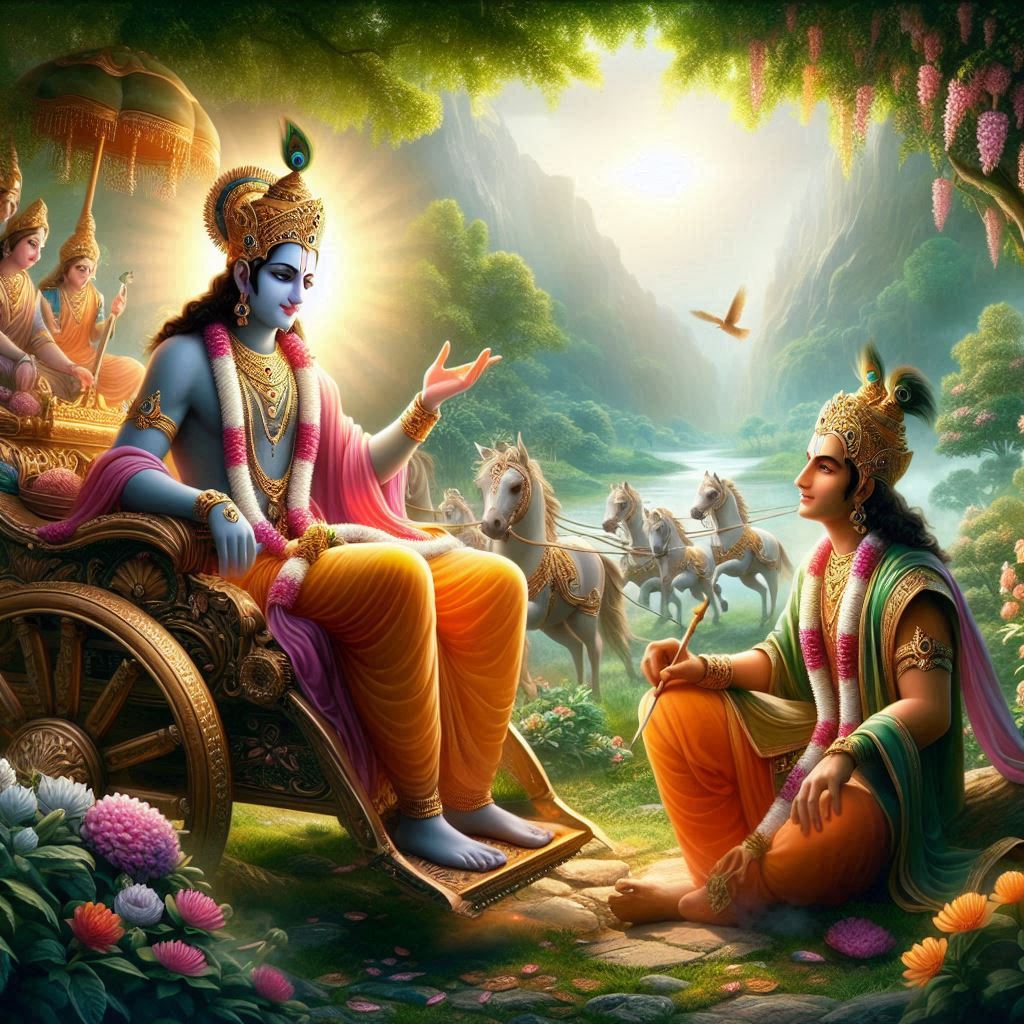
These shlokas form a single, continuous thought, following Arjuna’s command in Shloka 21. His intent—to survey the armies—reveals a kshatriya’s tactical mind, yet foreshadows the emotional turmoil that will define his vishada-yoga. Krishna, the silent Sarathi (charioteer), listens as Arjuna’s words weave dharma with moha (delusion), setting the Gita’s philosophical stage. Let us explore their layers with viveka (discernment) and bhakti (devotion).
Yavadetannirikshe’ham: So That I May Behold
Yavat: “So that,” links this to Shloka 21’s request, explaining Arjuna’s purpose.
Etan Nirikshe’ham: “I may behold these,” reflects Arjuna’s desire to see (niriksha) the warriors before him. As Dhananjaya, his drishti (vision) is strategic, assessing the vyudham (formation).
Yet, this act of seeing ignites vishada—the kleshas (afflictions) of raga (attachment) and dvesha (aversion) stir as he faces kin, a tension Krishna will resolve with jnana.
Yoddhukaman Avasthitan: Warriors Eager to Fight
Yoddhukaman: “Eager to fight,” describes the warriors’ rajas (passion), poised with shakti (power) for battle.
Avasthitan: “Arrayed,” echoes Shloka 20’s vyavasthitan—the Kauravas and their allies in disciplined ranks, a formidable sight.
Arjuna’s focus on their readiness contrasts with his own wavering buddhi (intellect), a kshatriya duty clashing with human sneha (affection).
Kairmaya Saha Yoddhavyam: With Whom I Must Contend
Kairmaya Saha: “With whom I must,” personalizes the conflict—Arjuna as maya (me) facing kaih (whom), his foes.
Yoddhavyam: “Must contend,” a kshatriya’s svadharma (duty) to fight, yet laden with doubt.
This phrase hints at his inner question—who are these enemies?—foreshadowing vishada as he identifies Bhishma, Drona, and kin, a prelude to Krishna’s nishkama karma (Adhyaya 2).
Asmin Ranasamudyame: In This Onset of Battle
Asmin Ranasamudyame: “In this onset of battle,” rana (war) and samudyame (endeavor) frame Kurukshetra as a karmakshetra (field of action). The war’s edge looms, intensifying Arjuna’s stakes.
This temporal marker roots his request in the moment, a kshatriya’s resolve teetering before moha.
Yotsyamanan Avekshe’ham: I Wish to See Those About to Fight
Yotsyamanan Avekshe’ham: “I wish to see those about to fight,” shifts from nirikshe (behold) to avekshe (observe closely), deepening Arjuna’s intent. Yotsyamanan (those about to fight) broadens his gaze to both sides.
His curiosity persists, a kshatriya assessing allies and foes, yet this scrutiny will fuel vishada as familial bonds surface.
Ya Ete’tra Samagatah: Who Have Gathered Here
Ya Ete’tra Samagatah: “Who have gathered here,” the warriors assembled in Kurukshetra—Pandavas, Kauravas, and their allies. Samagatah (gathered) emphasizes the collective, a microcosm of samsara’s forces.
Arjuna’s focus on ete (these) hints at recognition—faces he knows—stirring sankoca (hesitation) Krishna will later address.
Dhartarashtrasya Durbuddheh Yuddhe Priyachikirshavah: Supporting Duryodhana’s Evil Mind
Dhartarashtrasya Durbuddheh: “Of the evil-minded son of Dhritarashtra,” Arjuna names Duryodhana, durbuddhi (evil-minded), pinpointing adharma’s root—greed and pride.
Yuddhe Priyachikirshavah: “Intent on pleasing in this war,” those fighting for Duryodhana’s favor—Bhishma, Drona, Karna—bound by loyalty or oath.
Arjuna’s judgment reveals clarity amid vishada, yet his naming of kin as foes deepens his turmoil, a paradox Krishna will unravel with dharma’s lens.
The Deepening of Vishada
Arjuna’s intent—to see friends and foes—unwittingly opens his manas (mind) to vishada. His kshatriya duty to fight clashes with sneha (affection) for Bhishma and Drona, birthing the Gita’s first question: How can dharma justify this? Krishna, the silent Achyuta, prepares to answer.
This combined shloka, then, is Arjuna’s plea—a kshatriya’s gaze turning inward, vishada blooming under Krishna’s kripa (grace). It invites us to ask: Do we, like Arjuna, seek to see our battles, and can we face the truths they reveal?
Spiritual Wisdom from Authoritative Voices
The Bhagavad Gita’s divya-artha (divine meaning) shines through the bhashyas of acharyas, each illuminating its eternal truth. Let us draw from their insights.
Adi Shankaracharya (Advaita Vedanta)
Shankaracharya sees Arjuna’s desire to see as maya’s grip—attachment to forms clouding atman. Durbuddhi is avidya (ignorance) personified. This shloka urges viveka—to transcend the seen for Brahman, a truth Krishna will unveil in Adhyaya 11.
Ramanujacharya (Vishishtadvaita)
Ramanuja interprets Arjuna’s intent as a jiva’s struggle, seeking clarity before prapatti (surrender). Krishna, the Sarathi, guides this vishada to bhakti. The shloka hints at Narayana’s kripa, lifting Arjuna beyond moha.
Madhvacharya (Dvaita)
Madhvacharya views Arjuna’s gaze as Vishnu-bhakta’s duty facing asuric forces. Durbuddhi’s allies are tamasic, yet Arjuna’s nishtha wavers. This shloka underscores daiva support, with Krishna as Achyuta steadying the jiva.
Swami Vivekananda (Neo-Vedanta)
Vivekananda reads this as action’s prelude. “Arjuna sees foes, but Krishna sees souls,” he writes. Duty tests the heart. He urges us to awaken shakti in our karmakshetra, guided by dharma—a lesson the Gita unfolds.
These voices weave a jnana-sutra (thread of wisdom), guiding us toward moksha.
Relevance to Today’s Context
The Bhagavad Gita is a jivan-shastra (manual for life), its wisdom vibrant today. Let us explore how these shlokas resonate with quantum science, leadership, and svasthya.
Quantum Science and Cosmology
Arjuna’s nirikshe mirrors quantum observation—perception shaping reality—his intent a collapse of possibilities into vishada. Krishna’s presence evokes ekatva (oneness), harmonizing chaos. These shlokas suggest a dharmakshetra cosmos, where awareness aligns with truth, a quest science pursues.
Leadership and Business
In the corporate Kurukshetra, Arjuna’s survey reflects a leader assessing allies and rivals—yoddhukaman as ambition, durbuddhi as opposition. Krishna’s nishkama karma offers a path: lead with clarity, not attachment, fostering drishti (vision) amid conflict.
Svasthya (Wellbeing)
Arjuna’s vishada mirrors modern indecision—chitta-vikshepa from divided loyalties—while Krishna’s silence suggests samatva. Practices inspired by these shlokas—pranayama and dhyana (meditation)—nurture shanti, grounding the manas before choices.
Conclusion: The Gaze of Conflict
These twenty-second and twenty-third shlokas deepen Arjuna’s vishada-yoga, his intent to see igniting doubt under Krishna’s Achyuta gaze. They mark the Gita’s heart, where dharma meets moha. Each day, we unveil another shloka of this divya-gita, seeking satyam (truth) and sundaram (beauty).
Tomorrow, Sanjaya will narrate Krishna’s response, fulfilling Arjuna’s plea. Let us approach with bhakti and vichar, chanting: “Yatra yogeshvarah Krishno” (Gita 18.78)—where Krishna is, victory follows. May His kripa guide us onward.
Hari Om Tat Sat.