




 Swamy Gitananda
 A Daily Exploration of Dharma, Jnana, and Relevance to Modernity
By Swami Gitananda
Published on New Zealand Bharat (NZB) News, April 29, 2025
Om Shri Narayana Namaha. Salutations to Narayana, the refuge of all jivas and bestower of moksha (liberation), as we delve deeper into the Bhagavad Gita, the Divya-Upadesha (divine teaching) that transforms Kurukshetra into a dharmakshetra of eternal truth. Yesterday, Arjuna invoked shastra’s (scriptural) warning that those who destroy kula-dharma (family duties) dwell in naraka (hell), his vishada-yoga (yoga of despondency) rooted in viveka (discernment) yet clouded by moha (delusion), fearing eternal papa (sin). Today, in Shloka 45, his vishada reaches its emotional and moral zenith, as he cries out that slaying svajanam (kin) for rajya (kingdom) is a grave papa, overwhelmed by karuna (compassion) and guilt, cementing his refusal to fight, priming the Gita for Krishna’s jnana-upadesha.
This series is a daily sadhana (spiritual practice), offering one shloka at a time—its direct meaning, a profound exploration of its tattva (essence), insights from sampradayas (spiritual traditions), a yogic and philosophical analysis, and its resonance with modern fields like quantum science, leadership, psychology, and svasthya (wellbeing). Let us immerse ourselves in Adhyaya 1, Shloka 45, where Arjuna’s heart breaks under papa’s weight, a heartrending prelude to Krishna’s eternal jnana.
The Shloka
अहो बत महत्पापं कर्तुं व्यवसिता वयम्।
यद्राज्यसुखलोभेन हन्तुं स्वजनमुद्यताः॥
Aho bata mahatpapam kartum vyavasita vayam,
Yadrajyasukhalobhena hantum svajanamudyatah.
Direct Meaning
“[Arjuna said:] ‘Alas (aho bata), we are resolved (vyavasita vayam) to commit a great sin (mahatpapam kartum), because (yad), driven by greed for the pleasures of kingdom (rajyasukhalobhena), we are prepared (udyatah) to slay our own kin (hantum svajanam).’”
In this verse, Arjuna laments with aho bata (alas), decrying the mahatpapam (great sin) of slaying svajanam (kin) for rajya’s (kingdom’s) sukha (pleasures), driven by lobha (greed), his vishada overwhelmed by guilt and karuna, resolute in refusing to fight.
Detailed Explanation of the Shloka
This shloka is the emotional and moral climax of Arjuna’s vishada-yoga, synthesizing Shlokas 28-44’s fears—kula-kshetra (lineage destruction), adharma’s rise, varna-sankara (caste mixing), pitarah’s (ancestors’) fall, and naraka’s (hell) doom—into a visceral cry of despair. He condemns the mahatpapam of slaying svajanam for rajya, attributing it to lobha (greed), framing Kurukshetra as a manas-kshetra (field of mind) where svadharma (personal duty) is buried under karuna and moha. Krishna, the silent Madhusudana, listens as Partha’s buddhi (intellect) drowns in guilt, poised to guide him to jnana. Let us explore its layers with viveka (discernment), bhakti (devotion), and vichara (inquiry).
- Aho Bata: Alas
- Aho: “Alas,” an exclamation of sorrow, marks vishada’s emotional peak, Arjuna’s manas (mind) breaking under krup (pity).
- Bata: “Indeed,” intensifies aho, a cry of regret and despair, unique in Adhyaya 1, signaling vishada’s culmination.
This opening sets the tone—Arjuna’s heart lays bare, karuna and guilt overwhelming svadharma, a tamasic surrender Krishna will address.
- Mahatpapam Kartum: To Commit a Great Sin
- Mahatpapam: “Great sin,” mahat (great) + papam (sin), echoes papa (Shlokas 35-36, 39, 44), but mahat amplifies its gravity, a karmic and ethical stain binding jiva to samsara.
- Kartum: “To commit,” infinitive, underscores papa’s deliberateness, Arjuna’s buddhi recoiling at karmic intent.
This phrase frames svajanam’s slaughter as adharma’s pinnacle, vishada’s moral dread peaking, a klesha Krishna will unravel.
- Vyavasita Vayam: We Are Resolved
- Vyavasita: “Resolved,” vi-ava-sita (determined), implies a collective decision, yet Arjuna’s tone is ironic—he condemns this resolve as adharma.
- Vayam: “We,” unites the Pandavas, as in vayam (Shloka 37), Arjuna speaking for his brothers, bound by sneha (affection) and guilt.
This clause reveals buddhi’s conflict—svadharma’s call to fight clashes with karuna’s refusal, a tamasic paralysis Krishna will counter.
- Yadrajyasukhalobhena: Because, Driven by Greed for the Pleasures of Kingdom
- Yad: “Because,” links papa to its cause—lobha (greed).
- Rajyasukhalobhena: “By greed for the pleasures of kingdom,” rajya (kingdom) + sukha (pleasures) + lobhena (by greed), echoes lobhopahatachetasah (Shloka 38), but shifts lobha from the Kauravas to the Pandavas, Arjuna implicating himself.
This phrase diagnoses vishada’s root—lobha as a klesha, blinding buddhi to dharma, a self-accusation Krishna will reframe with nishkama karma.
- Hantum Svajanam Udyatah: Prepared to Slay Our Own Kin
- Hantum: “To slay,” repeats hantum (Shlokas 35, 37), vishada recoiling at violence against svajanam.
- Svajanam: “Our own kin,” echoes Shlokas 31-34, 37, svajanam as acharyah (teachers), pitarah (fathers), putrah (sons), vivid in Arjuna’s drishti (vision).
- Udyatah: “Prepared,” ud-yat (ready, intent), suggests imminent action, yet Arjuna’s despair rejects it, a karmic refusal.
This clause seals vishada’s moral crux—svajanam’s slaughter for rajya is mahatpapam, karuna overriding svadharma.
- The Emotional and Dharmic Climax
Arjuna’s aho bata and mahatpapam mark vishada’s emotional zenith, svajanam’s slaughter a karmic abyss driven by lobha. Kurukshetra mirrors samsara’s ethical maze, svadharma veiled by krup and moha. The Gita’s question persists: Can jnana redeem papa’s weight? Krishna, the Sarathi, waits to answer with sankhya-yoga, guiding Partha from tamas to sattva. - Krishna’s Silent Kripa
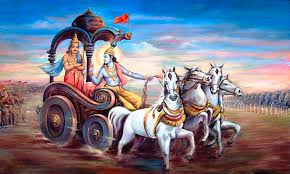
Krishna’s silence, unaddressed here, is kripa (grace), a divine pause allowing Arjuna’s manas to exhaust its kleshas—raga (attachment to svajanam), dvesha (aversion to papa), abhinivesha (fear of karmic stain). The rathottamam (finest chariot), centered between armies, symbolizes the jiva’s karmakshetra—buddhi collapsing, awaiting Ishvara’s reins, a prelude to Krishna’s upadesha.
This shloka, then, is Arjuna’s heart-wrenching cry—a kshatriya’s vishada condemning mahatpapam, overwhelmed by karuna and guilt, crying for Krishna’s jnana. It invites us to reflect: Do we, like Arjuna, recoil from duty under guilt’s weight, and can we seek Madhusudana to guide our drishti (vision)?
Spiritual Wisdom from Authoritative Voices
The Bhagavad Gita’s divya-artha (divine meaning) shines through the bhashyas of acharyas, each illuminating its eternal truth. Let us draw from their insights, weaving a jnana-mala (garland of wisdom).
- Adi Shankaracharya (Advaita Vedanta)
Shankaracharya sees Arjuna’s mahatpapam as maya’s veil—svajanam binding atman to samsara’s forms. Rajyasukhalobhena reflects avidya’s grip, mistaking deha (body) for atman. He writes, “Arjuna’s vishada is moha, not viveka,” urging discernment of Brahman beyond papa. This shloka foreshadows Adhyaya 13: “Kshetrajnam chapi mam viddhi”—“Know me as the knower of the field,” freeing karma from dosha. - Ramanujacharya (Vishishtadvaita)
Ramanuja interprets Arjuna’s aho bata as the jiva’s tenderness, mahatpapam a cry for prapatti (surrender). Krishna’s silent kripa sparks bhakti, guiding vishada to dharma. He notes, “Krishna’s silence nurtures shishya’s heart,” aligning with Adhyaya 12: “Bhaktya mam abhijanati”—“Through devotion, one knows me.” Svajanam’s loss is a bhakta’s test, resolved by Narayana’s grace. - Madhvacharya (Dvaita)
Madhvacharya views Arjuna’s rajyasukhalobhena as tamasic delusion, svajanam’s slaughter a karmic lapse. Vyavasita prioritizes sneha over Vishnu’s sankalpa. He emphasizes daiva-shakti, Krishna steadying Partha for svadharma, echoing Adhyaya 18: “Mam ekam sharanam vraja”—“Take refuge in me,” transcending papa’s weight. - Swami Vivekananda (Neo-Vedanta)
Vivekananda reads Shloka 45 as humanity’s moral cry. “Arjuna’s aho bata is the heart’s revolt against adharma,” he writes. Viveka shines, but krup paralyzes dharma. He urges awakening atma-shakti in the karmakshetra, balancing karuna with duty, aligned with Adhyaya 2: “Yoga-sthah kuru karmani”—“Established in yoga, perform actions.”
Yogic and Philosophical Analysis
Shloka 45 is a yogic and philosophical crescendo, Arjuna’s vishada engaging Vedanta’s inquiry: Does papa’s weight negate svadharma’s call? Let us explore this through yogic, Vedantic, and Ayurvedic lenses.
- Yogic Perspective: Vishada as Klesha
In Patanjali’s Yoga Sutras (2.3), kleshas—raga (attachment), dvesha (aversion), abhinivesha (fear)—drive samsara. Arjuna’s mahatpapam reflects raga for svajanam, dvesha for papa, and abhinivesha for karmic doom. Aho bata shows viveka’s cry, but tamasic inaction hinders chitta-shuddhi (mental purification). Krishna’s dhyana-yoga (Adhyaya 6) will guide manas to sattva, aligning viveka with karma. - Vedantic Inquiry: Papa vs. Atman
The Brihadaranyaka Upanishad (4.4.5) states, “Atmanam eva priyam”—“The self alone is dear,” suggesting svajanam’s love is atman’s reflection. Arjuna’s rajyasukhalobhena clings to preyas (worldly gain), missing shreyas (spiritual good). Krishna’s sankhya will affirm: “Na jayate mriyate va”—“The soul is neither born nor dies” (Adhyaya 2.20), freeing jiva from papa’s chains. - Ayurvedic Insight: Vishada as Tamas
Ayurveda sees vishada as vata-pitta imbalance, with tamas dulling ojas (vitality). Aho bata’s despair evokes tamas’ grip, mahatpapam disrupting kapha’s stability. Practices like pranayama (nadi shodhana), asana (shavasana), and sattvic ahara (pure diet) restore chitta’s balance, aligning with Krishna’s silent kripa.
Relevance to Today’s Context
The Bhagavad Gita is a jivan-shastra (manual for life), vibrant in 2025. Let us explore how Shloka 45 resonates with quantum science, leadership, and svasthya.
- Quantum Science and Cosmology
Arjuna’s mahatpapam mirrors quantum ethics—svajanam as entangled systems, papa as karmic entropy. Krishna’s kripa evokes ekatva (oneness), harmonizing chaos. This shloka suggests a dharmakshetra cosmos, where buddhi shapes karma, resonant with quantum consciousness theories. - Leadership and Business
In the corporate Kurukshetra, Arjuna’s rajyasukhalobhena reflects profit-driven ethics—svajanam as stakeholders, mahatpapam as moral cost. Krishna’s guidance inspires dharma-driven leadership, fostering drishti to balance gain with integrity, aligned with 2025’s ESG frameworks. - Svasthya (Wellbeing)
Arjuna’s vishada mirrors modern guilt—chitta-vikshepa from ethical conflicts—while aho bata evokes emotional overwhelm. Practices like pranayama and dhyana nurture shanti, freeing manas from papa’s weight, guided by Krishna’s calm.
Conclusion: The Cry of Aho Bata
This forty-fifth shloka crowns Arjuna’s vishada-yoga, mahatpapam’s weight halting svadharma, the Gita’s heart open for Krishna’s jnana. It mirrors samsara’s ethical binds, dharma veiled by moha. Each day, we unveil another shloka of this divya-gita, seeking satyam (truth) and sundaram (beauty).
Tomorrow, Arjuna will declare his refusal to fight, surrendering his gandiva (bow). Let us approach with bhakti and vichar, chanting: “Krishnam vande jagadgurum”—to Krishna, the world’s Guru. May His kripa guide us onward.
Hari Om Tat Sat.